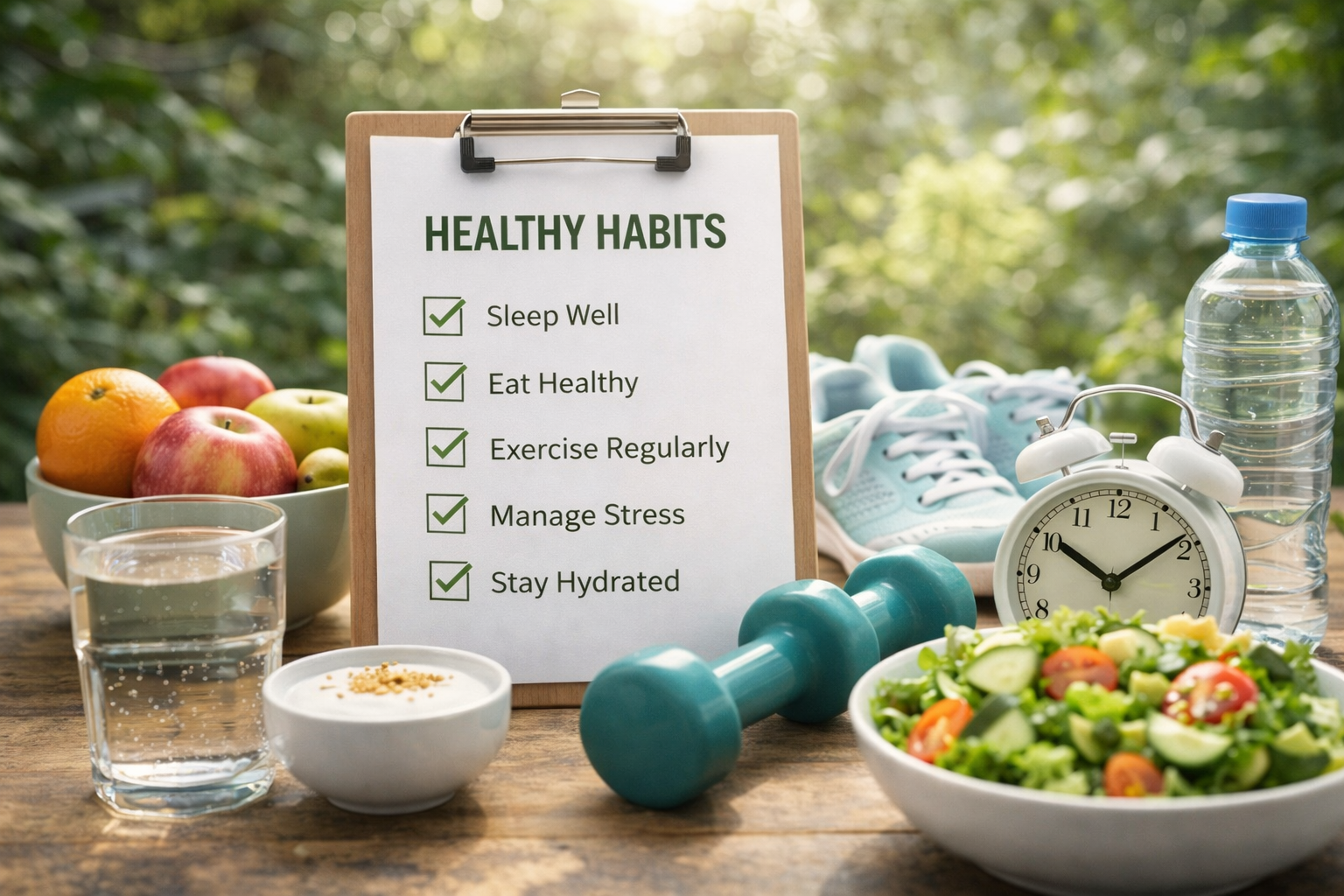
The Easiest Way to Start A healthier daily habit often sounds like the kind of health habit that should be easy. In practice, though, it competes with convenience, old routines, and the tiny choices we make on autopilot throughout the day. When a habit is tied to a stable cue and supported by the environment around you, it stops feeling like another item on a wellness to-do list. It becomes something you simply do, and that matters more than intensity in the long run.
Why This Matters
One reason a healthier daily habit matters is that it touches daily energy, recovery, and overall resilience. Small routines often look trivial in isolation, yet they influence the rhythm of the rest of the day. A better first hour can improve the next three. A safer kitchen habit can protect the meal that follows. A change that lowers irritation at home can make recovery easier at night. It also helps to remember that health habits work in clusters. a healthier daily habit rarely acts alone. It usually interacts with other factors such as timing, cues, friction, and recovery. That is why people often notice side benefits once they become more consistent: more stable routines, less decision fatigue, better consistency, and a healthier baseline. The goal is not to become obsessive. The goal is to create a baseline that supports you even when life feels messy. That baseline is exactly what daily habits are good at building.
Why It Often Feels Harder Than It Should
If this habit has felt harder than expected, that does not mean you are doing something wrong. It usually means the routine is missing one of three things: a reliable cue, a low-friction first step, or a clear finish line. Without those anchors, the brain keeps postponing the behavior because the start feels vague. Many people also run into a common trap: they try to perform the full ideal version from day one. That creates a gap between intention and reality. A routine that asks too much will be skipped on busy days, and skipped days are what break momentum. Another issue is hidden competition. The habit you want has to compete with convenience, distraction, and your old defaults. That is why behavior change often improves only after you redesign the setting around the action, not just the action itself.
Common Mistakes That Keep the Habit Unstable
Some of the most common mistakes are starting too big, being inconsistent on weekends, expecting instant results, and ignoring your environment. None of these mistakes are character flaws. They are design problems. When the routine is poorly designed, even motivated people drift back to the easiest available option. A better question is not, ‘Why am I so inconsistent?’ but ‘What is making the desired behavior unnecessarily difficult?’ Sometimes the answer is timing. Sometimes it is clutter, lack of preparation, or an unrealistic standard. Often it is all three. Once you view the problem that way, the solution becomes more practical. You stop chasing intensity and start improving repeatability.
Getting the Timing Right
Timing matters more than people think. The best moment for a healthier daily habit is usually the moment with the least resistance, not the moment that looks most impressive on paper. In other words, choose the slot you can protect consistently. For many people, the ideal time is the one already attached to an existing cue: after brushing your teeth, right after your first glass of water, once you shut your laptop, or during the first ten minutes after getting home. Stable timing lowers negotiation fatigue. If the routine belongs to a specific health goal, it also helps to match timing to function. Some habits are better earlier in the day for rhythm and energy. Others work better after meals, after long sitting, or during a transition point when you already need a reset.
How to Start Without Overcomplicating It
So what does a realistic start look like? It begins with a deliberately small version. For the next week, think in terms of a minimum dose rather than an ideal routine. make the first step so small that you do not need willpower to begin. Write the behavior in a form that is impossible to misunderstand. Instead of saying, ‘I will do better,’ say, ‘After X, I will do Y for Z minutes.’ That sentence turns intention into action architecture. The smaller version should feel almost modest. That is a good sign. Habits grow more reliably from successful repetition than from dramatic effort.
A Practical Checklist You Can Use This Week
A simple routine checklist can look like this:
Pick one cue. Tie a healthier daily habit to a moment that already happens every day.
Prepare the environment in advance so the start feels obvious, not effortful.
Decide the minimum version before the cue arrives so there is no bargaining in the moment.
Keep the action short enough that you can finish it even on a crowded day.
Record completion right away with a note, a checkbox, or a simple tally.
Review the pattern at the end of the week and adjust only one barrier at a time.
Make the Environment Work for You
Environment design is where many routines either become easy or quietly collapse. Look around the place where the behavior is supposed to happen. Is the necessary item visible? Is there enough space? Is there something nearby that nudges you away from the habit? A routine improves fastest when the setting stops working against it. That may mean adjusting timing, cues, friction, and recovery. It may also mean removing one obstacle rather than adding more tools. The most effective changes are often boring: placing the needed item in sight, cleaning the surface where the habit happens, labeling dates, setting out supplies, or creating a tiny preparation ritual. In behavior terms, success comes from reducing activation energy. In ordinary language, success comes from making the healthy choice feel less annoying to begin.
What a Realistic Routine Looks Like in Daily Life
Imagine a normal weekday. You wake up a little rushed, or you come home mentally drained, but the routine still works because it is pre-decided. The cue appears. The tool is already there. The first step is small. Completion takes a few minutes, not half your evening. That is the kind of routine worth building. For example, you might use a three-part sequence: cue, action, close. The cue could be the end of breakfast, the moment you enter the kitchen, or the first break after study time. The action is the minimum version of a healthier daily habit. The close is one visible sign of completion such as washing the tool, logging the action, or resetting the area for tomorrow. When repeated across a week, this simple loop does something important: it teaches your brain that the behavior is normal, finite, and not something to dread.
How to Track Progress Without Becoming Obsessive
To measure progress, keep it embarrassingly simple. Track consistency first, results second. Did you do the routine four days this week instead of one? Did the friction feel lower? Did the related problem show up less often or feel easier to manage? That is usually more useful than chasing perfection. The relevant data may include track consistency and how easy the habit feels after the first week. You do not need a complicated spreadsheet unless you enjoy using one. A note on your phone or a paper calendar is enough if it helps you see the pattern clearly. What you are looking for is not a dramatic overnight transformation. You are looking for signs that the routine is becoming automatic and that the downstream problem is shrinking.
When a Habit Is Not Enough on Its Own
It is also worth keeping a boundary between self-management and professional care. A daily routine can support health, but it should not replace appropriate treatment when symptoms suggest something more serious. As a general rule, if a symptom is persistent, severe, or interfering with daily life, get personalized advice. That does not mean every discomfort is an emergency. It means you should not force a lifestyle solution onto a problem that may need evaluation, testing, or individualized guidance. In many cases, the best plan is both-and: a smarter routine plus professional advice when needed.
Final Thoughts
In the end, a healthier daily habit works best when it is treated less like a challenge and more like a system. Make it visible. Make it small. Make it repeatable. Then let consistency do what intensity cannot. You do not need to win the whole month today. You only need to make tomorrow easier than yesterday. Once the behavior fits naturally into your real schedule, the habit stops feeling fragile. That is the real goal: not a perfect wellness identity, but a routine that quietly protects daily energy, recovery, and overall resilience and keeps working even when life is busy.”
Hi, I’m the creator and editor behind ZestyHabit. I research everyday safety, first aid, and practical wellness topics using official guidance and reliable public sources, then turn that information into clear, realistic steps for daily life.
My goal is to help readers make safer, better-informed choices at home and beyond.