
A lot of people get told to “just breathe” when they’re stressed, which is honestly not always helpful.
If you’re already tense, annoyed, overstimulated, or two seconds away from snapping at someone who does not technically deserve it, that advice can land a little badly. Not because breathing is useless, but because it often gets presented like a magic button. Breathe for a minute, and somehow you’re supposed to feel centered, graceful, and emotionally mature.
Real life is rarely that tidy.
Still, breathing can help lower tension in a very ordinary, practical way. Not by turning you into a different person, and not by fixing every stressful situation, but by giving your body a small signal that things can ease up a bit. Sometimes that small shift is enough to keep a rough moment from getting worse.
And that matters.
The tricky part is timing. A lot of people only remember breathing exercises when they are already at full stress volume. By then, it can still help, but it may feel harder to access. In many cases, breathing works better when you use it a little earlier, or more regularly, or in those low-key moments when tension starts creeping in before it turns into a whole internal event.
That’s where this gets more useful. Not “breathe when your life is falling apart,” but “notice when your body is starting to tighten and give it something simple to do.”
Why breathing can affect tension at all
Tension is not just mental. It shows up in the body fast.
You clench your jaw. Your shoulders lift. Your chest gets tight. Your breathing gets shallow without you noticing. Sometimes you start holding your breath during work, while driving, while reading emails, while dealing with a difficult conversation, while trying to get through a crowded grocery store without losing patience.
People do this constantly.
And once breathing gets short and tight, the whole body can start feeling more wound up. You may feel restless, edgy, or weirdly tired and activated at the same time. That’s part of why changing your breathing pattern can help. It gives your body a slightly different signal than the one it was stuck in.
Not dramatic. Just different.
That said, breathing is not a cure-all. If you are dealing with chronic anxiety, panic, trauma, or intense emotional distress, breathing exercises may help in some moments and feel frustrating in others. That doesn’t mean you’re doing them wrong. It just means the body is not a machine.
For everyday tension, though, simple breathing can be surprisingly useful when the approach is realistic.
What “lowering tension” actually looks like
This is worth saying clearly, because people often expect too much from breathing.
Lowering tension does not always mean you feel instantly calm.
Sometimes it means:
- your shoulders drop a little
- your chest feels less tight
- you stop rushing your words
- you feel a bit less buzzy and reactive
- your thoughts slow down enough to focus
- you pause instead of spiraling or snapping
- bedtime feels a little less wired
That’s already meaningful.
A lot of the benefit from breathing is subtle. It’s not always a dramatic before-and-after moment. More often, it takes the edge off. It lowers the temperature a little. It helps you feel less trapped inside the stress response you were sliding into.
That kind of change can be easy to overlook, but it’s often the part that makes the rest of the day go better.
Timing matters more than people think
Most people treat breathing like an emergency tool only.
That’s understandable. Tension becomes obvious when it’s high. You notice it when your heart is up, your head feels crowded, or you’re on the verge of crying in a parking lot for reasons that were probably building for three days.
But if you only use breathing then, it can feel harder than expected.
A more workable approach is to use breathing at three different times:
- before tension spikes
- during stressful moments
- after tension-heavy moments to come down
That gives it more range. It stops being this one desperate thing you attempt when you’re already overwhelmed and turns into a small skill you can use throughout the day.
H2: The best times to use breathing to lower tension
There is no single perfect time, but some moments are especially useful.
H3: Before something you know tends to stress you out
This is probably the most underused timing.
If you already know certain things wind you up, it helps to breathe before them instead of waiting until your body is fully activated.
For example:
- before opening your laptop to a packed inbox
- before a meeting where you’ll have to speak
- before driving in heavy traffic
- before a difficult phone call
- before walking into a crowded event
- before picking your kid up when you’re already overstimulated
- before a workout class that makes you nervous
Even thirty to sixty seconds can help here. Not because it erases stress, but because it gives your body a softer start.
There’s a real difference between entering something while unconsciously holding your breath and entering it after a few steadier breaths.
H3: In the middle of everyday buildup
Tension often rises quietly.
You may not notice it right away because it does not always arrive as a dramatic emotion. Sometimes it looks like:
- scrolling while feeling strangely agitated
- answering emails faster and faster
- snapping at small inconveniences
- feeling your neck and jaw get tight
- bouncing your leg without realizing it
- reading the same paragraph three times and absorbing none of it
That’s a good time to stop for a minute and breathe.
Not in a ceremonial way. You don’t need a meditation app and a perfect chair. Just pause and take a few slower breaths before the tension stacks higher.
This is often where breathing is most useful, honestly. Not at full collapse. At the point where you can still feel yourself tightening.
H3: After a stressful interaction
People often forget this window.
Something tense happens, then you move right into the next thing without giving your body any chance to come down. You finish the meeting, send the message, handle the awkward conversation, deal with the parenting moment, survive the commute, and then just keep going while your nervous system is still acting like the event is still happening.
A minute of breathing after the fact can help interrupt that carryover.
This matters more than people think because tension lingers. If you never come down after one stressful moment, it tends to bleed into the next part of the day.
H3: At bedtime when your body is tired but not settling
This is another common time.
You’re physically tired, but your body still feels “on.” Thoughts are looping. Your chest feels a bit tight. You’re not necessarily in full panic mode, but you do not feel relaxed either. That is often a good time for slower breathing.
Not as a performance. Not to force sleep. Just to make the transition into rest a little less jagged.
Sometimes bedtime tension has been building since the afternoon, and breathing gives it somewhere to go besides more scrolling or more thinking.
H2: The simplest breathing approaches that work in real life
You do not need a whole catalog of techniques.
In fact, having too many options can make people do nothing. It’s usually better to know one or two simple approaches and use them often enough that they feel familiar.
H3: 1. Slow, easy breathing without counting much
This is the most accessible place to start.
Just breathe in a little more slowly than usual, then breathe out a little more slowly than that. The exhale can be slightly longer if that feels natural. Nothing forced. Nothing dramatic.
This works well when:
- you’re at work
- you’re in public
- you’re already irritated
- counting feels annoying
- you want something low-friction
Sometimes the best breathing exercise is the one that does not feel like an exercise at all.
H3: 2. A simple counted breath
If you like a little structure, try something like:
- inhale for 4
- exhale for 6
Or:
- inhale for 3
- exhale for 4 or 5
The exact numbers matter less than comfort. If the count makes you strain, it stops being calming and starts feeling like homework.
That is not the goal.
A slightly longer exhale often feels helpful for tension because it encourages a slower pace without asking too much.
H3: 3. A “physically softer” breath
For some people, the most useful cue is not counting at all. It is relaxing the body around the breath.
Try:
- unclenching your jaw
- dropping your shoulders
- loosening your hands
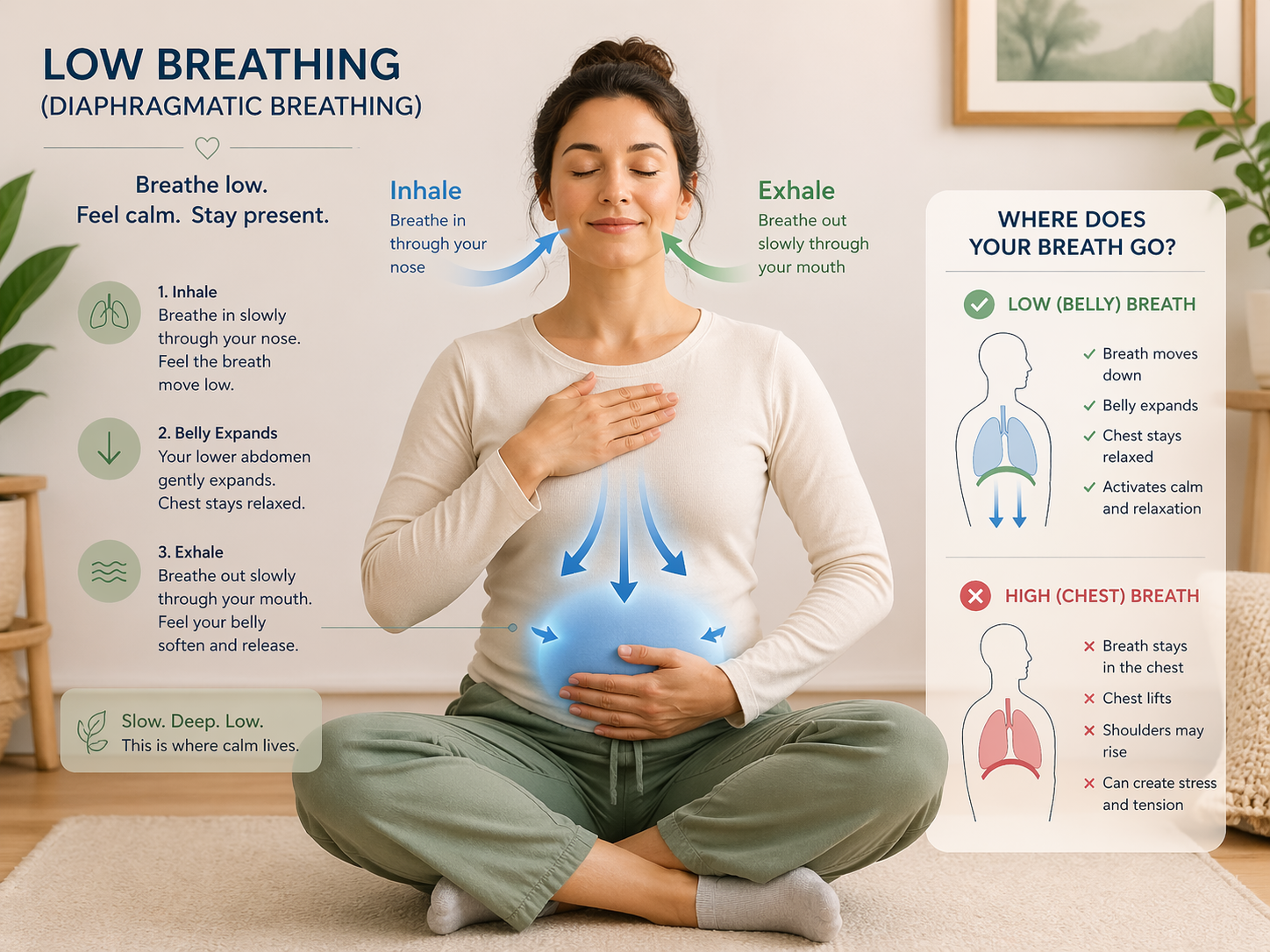
- letting the belly soften a bit instead of gripping
- breathing quietly through the nose if comfortable
This approach can be especially helpful if you tend to hold tension in obvious places. Sometimes the breath improves because the body stops bracing so hard around it.
H2: How long should you do it?
Usually shorter than people think.
You do not need a 20-minute practice in the middle of a stressful Tuesday. For everyday tension, 30 seconds to 2 minutes can be enough to make a difference. If you want longer, great. But shorter is often more sustainable.
People sometimes avoid breathing exercises because they picture some long, formal routine they do not have time for. That picture gets in the way.
A minute counts.
Three slow breaths count.
Breathing while waiting for the microwave, sitting in your parked car, standing in the bathroom, or walking slowly down a hallway all count.
The small version is still real.
H2: Practical ways to remember to use breathing
This is where good intentions usually need help.
Most people do not forget breathing exists. They forget to use it when it would actually help. So it helps to connect it to specific moments instead of hoping you will remember on your own.
H3: Pair it with routine parts of the day
Breathing fits well into moments that already have a built-in pause.
For example:
- before opening email
- before joining a call
- after locking your car
- while waiting for coffee
- before eating lunch
- after using the bathroom
- when you get into bed
That kind of pairing is useful because you do not have to invent a new routine from scratch. You are just attaching breathing to a moment that already exists.
H3: Use body tension as the cue
This is one of the most practical cues because your body often notices stress before your mind labels it.
If you catch yourself:
- clenching your jaw
- pressing your tongue to the roof of your mouth
- lifting your shoulders
- holding your breath
- rushing for no clear reason
- feeling chest tightness
use that as the signal.
Not “I have failed and need to calm down.”
Just “Oh, there it is. Let me take a slower breath.”
That tone matters. Gentle noticing works better than self-criticism.
H3: Put it in transition moments
Transitions are sneaky stress zones.
Going from work to home. From one meeting to another. From errands to dinner. From being around people to finally being alone. A lot of tension builds in those handoff moments because the body never fully resets.
A short breathing pause during transitions can help keep stress from piling up all day.
It doesn’t need to be visible or formal. You can do it while washing your hands, walking to the next room, or sitting at a red light.
H2: Common mistakes that make breathing feel less helpful
There are a few reasons people try breathing once or twice, hate it, and decide it is not for them.
H3: Trying it only when you are already overwhelmed
This is the biggest one.
If you only use breathing when you are at your absolute limit, it may not feel like enough. That does not mean it is useless. It just means you are asking a very small tool to enter a very loud moment.
It helps more when it becomes something you use earlier and more often.
H3: Breathing too forcefully
A lot of people think calming breaths have to be deep, huge, and dramatic.
Not necessarily.
Sometimes overly deep breathing can make people feel more uncomfortable, especially if they are already anxious or lightheaded. Gentle, steady breathing tends to work better than forcing giant breaths that feel unnatural.
H3: Expecting instant peace
This sets people up badly.
Breathing may help you feel a little less tense, a little more grounded, a little less reactive. That’s a solid result. If you expect to feel completely serene in sixty seconds, you may miss the more realistic benefit that is actually happening.
H3: Treating it like a test
There is no gold star for “best breathing.”
If you lose count, get distracted, feel silly, or only do it for twenty seconds, that does not mean it failed. People often bring performance energy into relaxation practices, which is kind of ironic when you think about it.
The point is to soften, not to impress yourself.
H2: A few very real-life examples
Sometimes examples make this easier than instructions.
H3: At work
You open your inbox and immediately feel your chest tighten because three new problems showed up before 9 a.m.
Instead of diving straight in while already braced, sit back for thirty seconds. Unclench your jaw. Inhale slowly. Exhale a little longer. Then start.
You are still going to answer the emails. You just do it from a slightly less wound-up place.
H3: In the car
Traffic is slow, someone cuts you off, and your whole body reacts before your brain does.
Rather than feeding the tension, take a slower breath at the next red light. Drop your shoulders from around your ears. Loosen your grip on the wheel a little. Again, this does not make traffic pleasant. It just stops your body from acting like it is under attack for twenty straight minutes.
H3: Before bed
You are tired, but your mind is replaying the day and your body still feels busy.
Instead of trying to force sleep, lie still and breathe a bit slower for a minute or two. Let the exhale stretch slightly. Keep the room dim. Nothing fancy.
Sometimes that small shift is enough to stop the bedtime spiral from gathering momentum.
H2: A very easy way to start this week
If you want to actually use breathing more, keep the first step small.
Try this for a week:
- pick one stressful time of day
- attach one minute of slower breathing to it
- do not aim for perfect calm
- just notice whether your body feels even slightly less tight afterward
That’s enough.
You could choose:
- before work starts
- after lunch
- during the commute home
- right before bed
The best time is the one you can repeat without making it a whole production.
H2: Let it be ordinary
That is probably the biggest thing to remember.
Breathing works best for everyday tension when it is allowed to be ordinary. Not spiritual unless you want it to be. Not optimized. Not something you perform beautifully while sitting in perfect posture with a peaceful expression.
Just a simple way to interrupt the body when it starts winding itself too tight.
A few slower breaths before a hard moment. A small reset after a tense one. A quieter exhale before bed. That is often enough to make the day feel a little less sharp around the edges.
And honestly, that kind of help counts.
Leave a Reply