
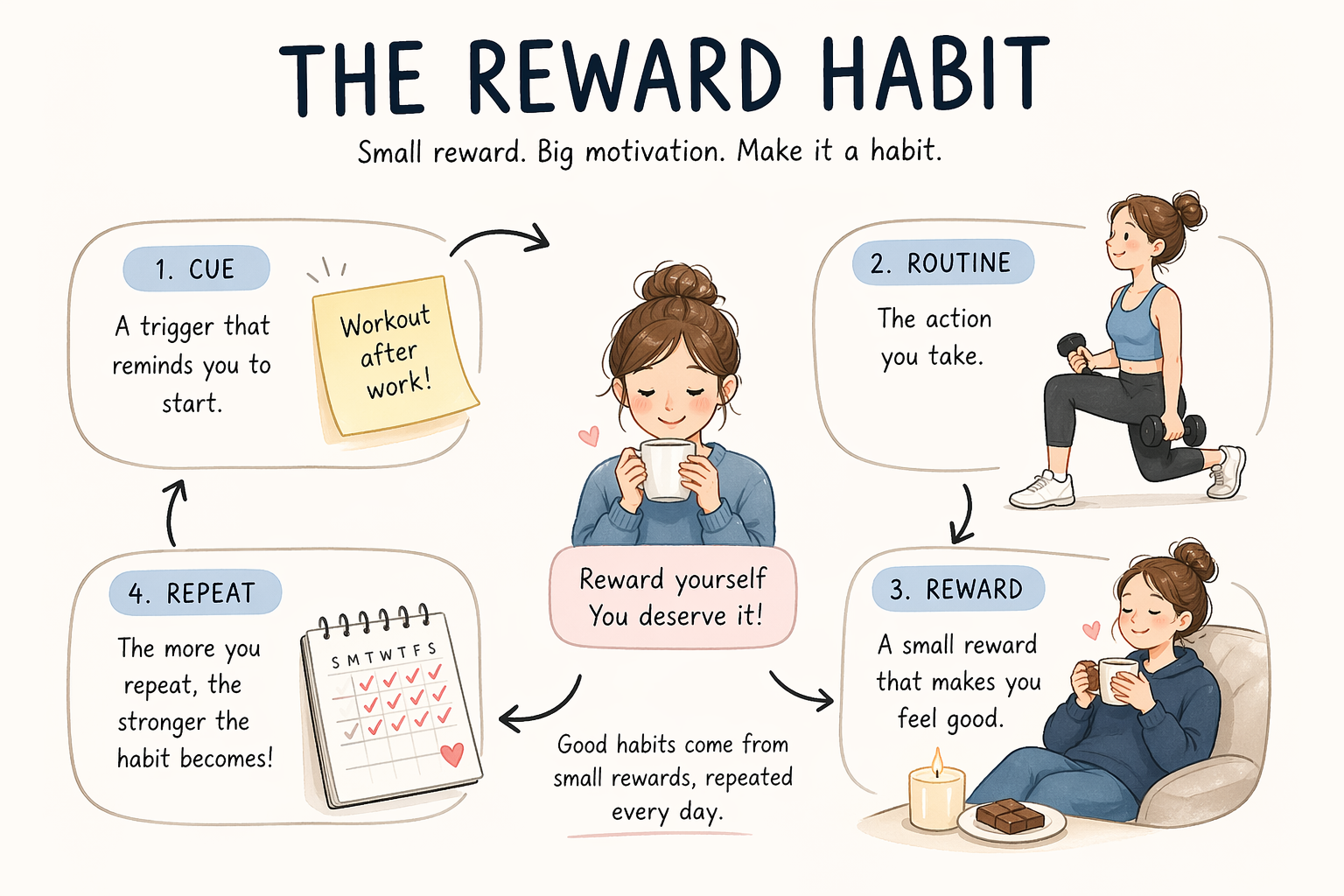

Trying to build a reward habit but it never sticks? Here’s why that happens, and how to set up small, realistic rewards that support your habits instead of quietly wrecking them.
The strange problem with rewarding yourself
On paper, reward habits sound simple.
You do something good for yourself. You give yourself a small reward. Your brain starts to connect effort with pleasure. The habit gets easier over time. Everybody wins.
And yet, in real life, it often goes sideways.
You tell yourself you’ll go for a walk every evening, then enjoy a dessert afterward. A week later, the dessert is still happening, but the walk is suddenly optional. Or you promise yourself that if you finish your work, you can scroll your phone for twenty minutes, and somehow the scrolling starts before the work does. Or you set up a “treat” for sticking to a budget, only to realize the reward is basically spending money you were trying not to spend.
A lot of people struggle with this, and not because they are lazy or bad at self-discipline. Reward habits are tricky because they sit right at the intersection of psychology, emotion, routine, and timing. That is a messier place than most habit advice admits.
The good news is that the problem usually is not you. It is the design.
Reward habits fail when the reward is stronger than the habit
This is probably the most common issue.
A reward is supposed to reinforce the habit. But if the reward is far more appealing than the habit itself, your attention shifts. You stop thinking, “I’m becoming someone who reads every night,” and start thinking, “When do I get my fancy coffee?”
That sounds small, but it changes the whole structure.
Instead of the habit being the main event, it becomes the annoying step before the prize. That is not always sustainable. It works for a little while, especially when motivation is fresh, but eventually the brain starts looking for shortcuts.
This is why people sometimes end up “earning” a reward without quite doing the thing they meant to do. The system gets fuzzy. “Well, I didn’t do the full workout, but I did think about it.” “I didn’t deep clean the apartment, but I did pick up a sock.” “Close enough.”
The reward was too attractive, and the habit was too easy to negotiate.
What helps instead
Keep the reward pleasant, but not overpowering.
A good reward says, “Nice job, keep going.” A bad reward says, “Forget the habit, let’s get to the fun part.”
That might mean:
- listening to your favorite podcast only during walks
- making a good cup of tea after tidying the kitchen
- putting a sticker on a tracker
- taking ten guilt-free minutes to rest after finishing a task block
These are not dramatic rewards, and that is kind of the point. They support the routine instead of hijacking it.
Sometimes the reward comes too late
Humans are not great at caring deeply about delayed rewards.
That is why “exercise now so you can be healthier in ten years” is true, but not always useful at 7:10 p.m. when your couch is warm and your day was annoying.
A lot of habit plans fail because the reward exists only in theory or in the distant future. Better sleep. Lower stress. A cleaner home. More savings. Stronger focus. These are real benefits, but they arrive slowly. They are easy to believe in when you are making a plan and much harder to feel in the moment when you have to act.
Your brain likes immediacy. It wants some sign that the effort mattered now, not next season.
What helps instead
Pair long-term habits with short-term signals.
If the habit itself does not feel rewarding yet, build in a small immediate payoff. Not a giant one. Just enough to make the loop feel complete.
For example:
For exercise
Put on a playlist you genuinely like, or take a warm shower right after.
For budgeting
Move money into savings and then update a tracker where you can see the number rise.
For reading
Read in a chair with a blanket and decent lighting instead of treating the whole thing like moral homework.
For meal prep
Play music, use containers you like, and give yourself permission to stop before it turns into a three-hour kitchen event.
The immediate reward does not need to be impressive. It just needs to be real.
Many reward systems are built on fantasy versions of daily life
This one gets overlooked.
People design reward habits when they are calm, optimistic, and slightly overestimating who they will be on a random Tuesday.
So they create a perfect little system. After every workout, they will blend a beautiful smoothie. After every productive morning, they will journal in sunlight with a candle burning quietly nearby. After every week of responsible behavior, they will enjoy a meaningful, healthy, balanced treat that somehow costs nothing, takes no effort, and never spirals.
Then regular life shows up.
You get home late. The kitchen is messy. Your mood is off. You are tired enough to resent the smoothie blender. Suddenly the reward system feels like one more task to manage.
When a reward adds friction, it stops feeling like a reward.
What helps instead
Choose rewards that still work on low-energy days.
This is an underrated standard. A reward habit should survive not just your best day, but your most ordinary one.
Ask yourself:
- Can I do this when I’m tired?
- Can I do this without buying something?
- Can I do this even if the day was a little chaotic?
- Does this require setup, cleanup, or extra decision-making?
If the answer is no, simplify it.
A workable reward is often boring from the outside. That is fine. Boring systems are usually the ones that keep functioning.
The reward accidentally cancels the habit
This is where things get a little ironic.
Sometimes the reward directly undermines the habit you are trying to build.
You exercise, then reward yourself with something that makes you feel sluggish. You save money, then celebrate by impulse shopping. You finally get to bed on time, then treat yourself by watching “just one episode” that ends at 1:20 a.m. You focus for an hour, then “take a break” by opening an app that eats the rest of your afternoon.
This does not mean rewards have to be ultra-pure or joyless. It just means the reward should not punch a hole in the routine you are trying to protect.
What helps instead
Pick rewards that are neutral or supportive.
A useful question is: After this reward, do I feel more stable, or more scattered?
That question alone filters out a lot.
Supportive rewards might include:
- a relaxed shower after a workout
- ten minutes outside after finishing a difficult task
- watching one episode after doing your evening reset, not before
- making your favorite iced drink after completing admin work
- ordering takeout after a week of planned meals, if it fits your budget and does not trigger guilt
The best rewards do not create a second problem.
You may be using rewards for emotional rescue, not reinforcement
This is a tender one, because it is very human.
Sometimes what looks like a reward system is actually an emotional survival system. You are not saying, “I’d like to reinforce this habit.” You are saying, “I need something to get me through the day.”
Those are not the same thing.
If you are exhausted, lonely, stressed, angry, or numb, rewards can turn into quick relief tools. Food, shopping, scrolling, drinking, staying up late, skipping routines entirely and declaring you “deserve a break.” The language of reward can hide the fact that you are trying to comfort yourself.
There is nothing shameful about wanting comfort. Most people do this in some form. But comfort habits and reward habits should not be confused, because they work differently.
A reward habit strengthens behavior. An emotional escape habit dulls the moment. Sometimes it also creates regret afterward, which makes the original stress worse.
What helps instead
Get a little more honest about what you need.
Before using a reward, pause and ask:
Am I celebrating effort, or trying to soothe myself?
Sometimes the answer is both. That is okay. But if the main need is comfort, then give yourself comfort directly instead of dressing it up as a productivity system.
That might look like:
- texting a friend
- taking a short nap
- getting outside for ten minutes
- eating a proper meal
- stopping work earlier
- admitting you are fried and scaling the habit down for the day
Oddly enough, reward systems work better when they are not carrying your whole emotional life.
The habit is too vague, so the reward becomes confusing
You cannot reinforce a behavior if you never clearly defined it.
A lot of habit plans sound nice but are too fuzzy to support a reward loop. Things like:
- eat better
- be productive
- work out more
- spend less
- clean up regularly
Those are directions, not actions.
If the behavior is vague, you never quite know when you have “earned” the reward. That leads to inconsistency, bargaining, or the feeling that you are failing some invisible test.
What helps instead
Make the habit specific enough that a tired version of you can still recognize it.
For example:
- “Eat better” becomes “include a vegetable at lunch three times this week.”
- “Work out more” becomes “do a 15-minute walk after dinner on weekdays.”
- “Be productive” becomes “work on the report for 25 minutes before checking messages.”
- “Clean up regularly” becomes “reset the kitchen counters before bed.”
Now the reward has a clear job. It follows a visible action.
This sounds basic, but it matters. Clear habits create clean reward loops.
Small rewards usually work better than big ones
Big rewards feel exciting when you are planning them. They also tend to make the whole thing weird.
If the reward is too large, you start performing for it. You may even save up pressure around the habit, which makes it heavier than it needs to be. Miss a day, and suddenly the whole system feels broken. Or you start treating normal maintenance as something that deserves grand compensation.
That can backfire fast.
Daily habits tend to respond better to small, repeatable rewards than dramatic ones. Think more “pleasant cue” and less “major ceremony.”
What helps instead
Use layered rewards.
This is a simple way to keep things balanced:
Daily reward
Something tiny and immediate, like good music, tea, checking off a tracker, or ten peaceful minutes alone.
Weekly reward
Something a little more noticeable, like takeout night, a slow morning, a movie, a bookstore visit, or extra hobby time.
Milestone reward
Something more special after a meaningful stretch, like new workout clothes after two consistent months, or a day trip after finishing a large personal goal.
This keeps the system from feeling flat without making every little task feel like it needs fireworks.
The reward is external, but the habit needs internal satisfaction too
External rewards can help a habit begin. They are often useful in the awkward early stage when a new routine still feels unnatural.
But over time, habits last longer when you start noticing the built-in payoff.
The walk clears your head. The tidy room makes the evening quieter. The earlier bedtime makes the morning less hostile. The saved money gives you a strange, deeply adult kind of peace. The workout helps your mood. The reading habit makes your attention span feel less shredded.
At some point, those internal effects matter more than the sticker, snack, or small treat.
What helps instead
Do not rush past the real benefit.
After you complete the habit, take a second to notice what changed.
Not in a dramatic “I am transformed” way. Just in a plain way.
- My shoulders do feel less tight.
- I’m less stressed now than I was twenty minutes ago.
- The kitchen looks better, and that helps.
- I’m glad tomorrow morning won’t start with this mess.
- I do sleep better when I stop scrolling earlier.
This matters because the brain learns from experience, not just intention. When you actually register the payoff, the habit starts standing on its own feet.
A better way to design a reward habit
If your reward systems keep collapsing, you probably do not need more discipline. You need a lighter structure.
Here is a more practical formula:
1. Choose one clear behavior
Not five. One.
Something visible and small enough to repeat.
2. Add an immediate reward that does not compete with it
Keep it simple, low-friction, and easy to repeat.
3. Make sure the reward does not undo the habit
This rule saves a lot of trouble.
4. Keep the system realistic for tired days
If it only works in your ideal life, it does not work yet.
5. Notice the internal payoff
This is what helps the habit last after the novelty wears off.
For example, instead of saying, “I’m going to become healthier and reward myself properly,” you could say:
“I’m going to walk for 15 minutes after dinner four nights a week. During the walk, I’ll listen to the show I like. When I get back, I can shower and relax without feeling behind.”
That is concrete. It fits regular life. The reward supports the routine. It is not flashy, but it has a much better chance of surviving contact with reality.
When a reward habit is actually working
It usually feels less exciting than people expect.
A working reward habit does not necessarily give you a dramatic burst of motivation every day. It is quieter than that. It reduces resistance. It makes the action easier to start. It removes some of the childish inner bargaining. It helps the routine feel complete instead of punishing.
And maybe most importantly, it does not require you to keep reinventing the system every week.
That is often the real sign. Not intensity. Stability.
If you have been struggling to “reward yourself properly,” try lowering the stakes. Make the habit smaller. Make the reward simpler. Make the loop clearer. Most people do better with gentle consistency than with elaborate self-management.
That may not sound glamorous, but in daily life, it is usually what holds.

Hi, I’m the creator and editor behind ZestyHabit. I research everyday safety, first aid, and practical wellness topics using official guidance and reliable public sources, then turn that information into clear, realistic steps for daily life.
My goal is to help readers make safer, better-informed choices at home and beyond.


