Why Strong Cleaners Are Not Always Better for Children’s Toys
Minjin Park
·
Using harsh cleaners on children’s toys may feel extra safe, but it can leave residue, damage materials, and create unnecessary exposure. Here’s how to clean toys in a gentler, more practical way.
Children’s toys have a rough life.
They get dragged across floors, dropped under car seats, chewed on, sneezed near, taken outside, brought back inside, and somehow end up in the grocery cart even though you were sure you left them at home.
So it makes sense that many parents and caregivers want to clean them well.
Really well.
When a toy looks sticky or has been through a playdate, daycare bag, or mysterious couch-cushion adventure, reaching for a strong cleaner can feel reassuring. Bleach spray. Heavy disinfectant. Powerful bathroom-style cleaner. Something that smells like it “worked.”
Kids touch toys constantly. Babies and toddlers put them in their mouths. Even older children rub their eyes, eat snacks mid-play, and carry toys into beds and blankets. If a harsh cleaner leaves residue behind, that residue may end up on little hands, skin, or mouths.
Cleaning toys matters. No question.
But the goal is not to make every toy smell like a hospital hallway. The goal is to remove dirt, reduce germs when needed, and keep the toy safe for the child who is actually going to play with it.
The Problem With the “Stronger Means Cleaner” Habit
A strong cleaner gives instant emotional satisfaction.
You spray it, wipe it, smell that sharp chemical scent, and think, “Okay, that’s clean now.”
The trouble is that scent does not equal safety. A product can smell powerful and still be a poor choice for a toddler’s teething ring, plastic blocks, bath toys, or soft dolls.
Harsh cleaners can leave behind chemical residue if they are not rinsed properly. They can also damage toy surfaces, especially if used repeatedly. Paint may fade. Plastic may become cloudy or sticky. Rubber can break down. Wooden toys may absorb moisture or cleaner and become rough.
And then there is the obvious but often overlooked issue: children do not use toys like adults use household objects.
Adults do not usually put the TV remote in their mouth. Toddlers might.
Adults do not lick the edge of a plastic dinosaur. Some kids absolutely will, with full confidence and no explanation.
They spend long periods in a child’s hands. They get pressed against cheeks, carried in backpacks, stuffed into beds, shared between siblings, and occasionally used as spoons in pretend soup that becomes a little too real.
For babies and toddlers, mouthing is normal. It is how they explore texture, shape, and comfort. This means anything left on a toy’s surface has a better chance of getting into the mouth.
That does not mean every toy has to be sterilized after every use. Most homes do not work that way, and trying to keep toys perfectly germ-free can become exhausting fast.
It does mean cleaning choices should be more thoughtful than “whatever kills the most things.”
For everyday toy messes, mild soap and water often do a lot more than people give them credit for.
Residue Is the Part People Forget
Many strong disinfectants and cleaning sprays are designed for hard household surfaces. Counters. Sinks. Doorknobs. Bathroom fixtures. Floors.
Those surfaces are usually not meant to be mouthed.
With toys, residue matters. If you use a strong cleaner and do not rinse the toy thoroughly, some of that product can remain on the surface. A child may later touch it, chew it, or rub their face after playing.
This is especially important with:
teething toys
pacifier clips
bath toys
toy dishes and pretend food
plastic blocks
rattles
soft books
stuffed animals
toys used by babies under 3
Even disinfecting wipes can be tricky. They are convenient, and they can be useful in some situations, but many require the surface to stay wet for a certain amount of time to disinfect properly. Some surfaces should also be rinsed afterward if they may contact food or mouths.
That fine print is easy to miss when you are cleaning in a rush with a child asking for applesauce and one sock missing.
Strong Cleaners Can Damage Toys Over Time
Some toys are tougher than others, but many are not made to handle repeated harsh cleaning.
Plastic toys may lose their shine or become brittle. Printed designs can rub off. Stickers peel. Wooden toys can swell, crack, or feel rough if they absorb too much liquid. Electronic toys can stop working if moisture gets into seams or buttons.
Soft toys bring their own problems. Spraying a stuffed animal with a strong cleaner may make it smell “clean,” but the liquid can settle into the fabric or stuffing. If it does not dry fully, it can create a musty smell later.
Bath toys are another sneaky category. They already live around moisture. If harsh cleaners get trapped inside squeeze toys, rinsing them out completely can be hard. A toy that squirts water may also squirt out old cleaner residue if it was not washed carefully.
Not ideal.
Before using any cleaner, it helps to think about what the toy is made of and how a child uses it. A plastic ride-on toy kept outside is not the same as a teething ring. A wooden puzzle is not the same as a washable silicone stacking cup.
Clean and Disinfect Are Not the Same Thing
This is a useful distinction.
Cleaning removes dirt, sticky residue, food, dust, and many germs from a surface. Soap and water are the classic cleaning tools because soap helps lift grime so it can be rinsed away.
Disinfecting uses chemicals or heat to kill certain germs on a surface.
Both can be helpful, but they are not needed in the same way every time.
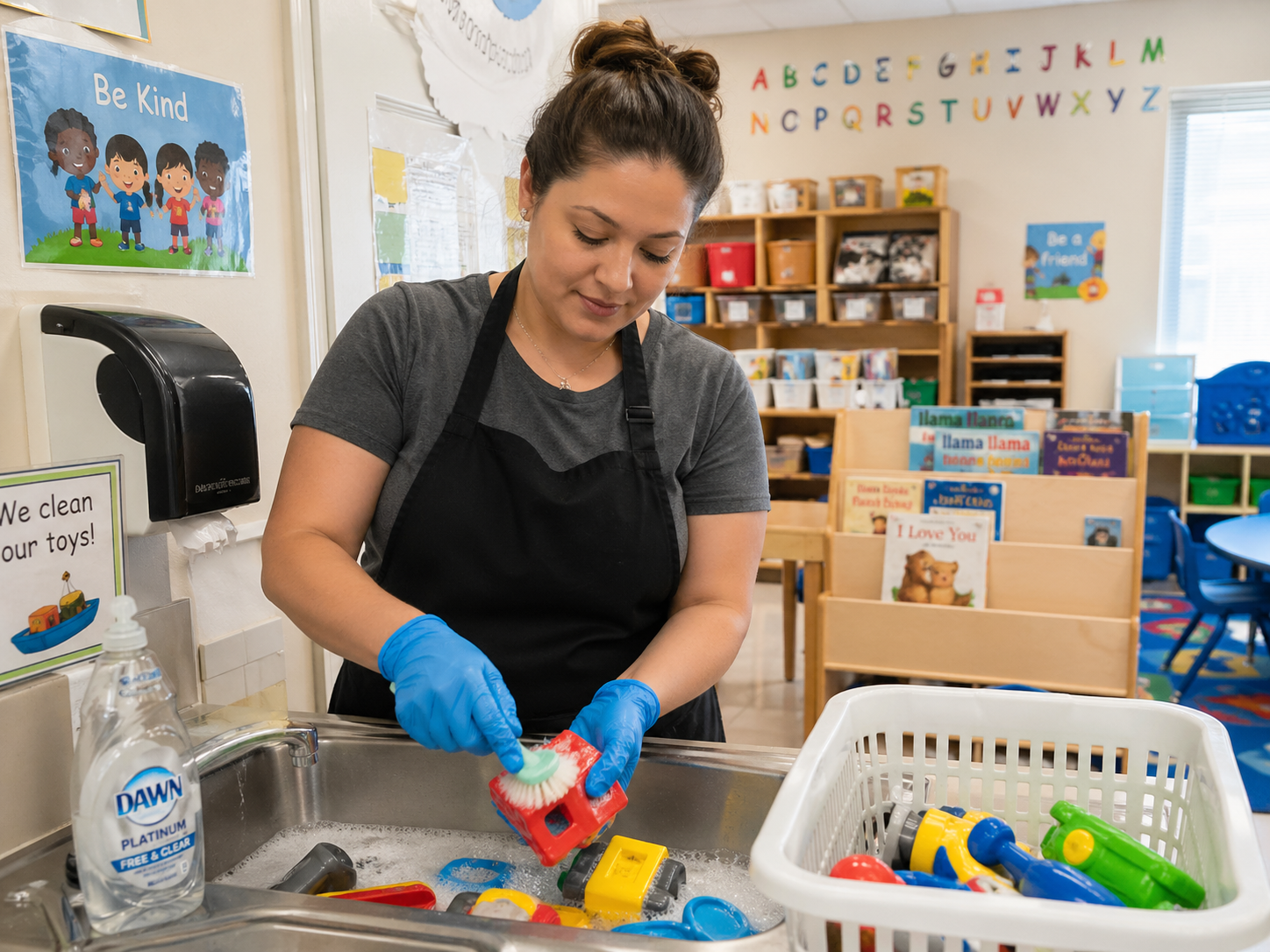
If a toy has a bit of dust, food smudge, or general floor contact, cleaning is usually the first step. A quick wash with mild dish soap and warm water may be enough.
Disinfecting makes more sense after illness, after exposure to bodily fluids, during certain daycare situations, or when toys have been shared among many children. Even then, the product should be appropriate for children’s items, used according to the label, and rinsed when needed.
A common mistake is disinfecting a dirty toy without cleaning it first. Dirt and grime can make disinfectants less effective. So if a toy is visibly dirty, wash it first.
That feels less dramatic than spraying it with the strongest thing under the sink, but it is often the better routine.
Mild Soap and Water Deserve More Credit
For many washable toys, mild soap and warm water are enough for regular cleaning.
Think plastic blocks, silicone toys, rubber animals without holes, toy cars, stacking cups, and washable play food. If the toy does not have batteries, fabric parts, or paper stickers, it may be able to handle a simple sink wash.
Use a clean sponge or cloth, scrub the surfaces, rinse well, and let the toy air-dry completely.
That last step is important. A toy put away while damp can develop odor or mildew, especially if it goes into a closed bin.
For small plastic toys that are dishwasher-safe, the dishwasher may be an option. But “plastic” does not automatically mean dishwasher-safe. Heat can warp some toys, damage paint, or loosen parts. Check the toy’s care instructions when possible.
And for toys that go in the mouth, rinse like you mean it. Soap residue is not something you want lingering on a teething toy.
When Disinfecting Is Actually Helpful
There are times when a deeper clean is reasonable.
If a child has been sick, shared toys may need more than a regular wipe-down. The same goes for toys exposed to vomit, diarrhea, blood, or heavy drool during illness. Daycare toys and playroom toys used by multiple children may also need a more structured cleaning routine.
In those cases, use a disinfectant that is suitable for the material and safe when used as directed. Follow the label for contact time, ventilation, rinsing, and drying. Contact time simply means the surface has to stay wet long enough for the disinfectant to do its job. Wiping it off immediately may not give it time to work.
This is where people often overuse products but underuse instructions.
If the label says to rinse surfaces that may contact mouths or food, rinse them. If it says to use in a well-ventilated area, open a window or run a fan. If the toy cannot be rinsed, think carefully before using that product on it.
Disinfecting should feel like a targeted step, not a daily fog of chemicals over the toy basket.
Be Careful With Bleach Around Toys
Bleach can be useful in some cleaning situations, but it needs respect.
It must be diluted properly, used with good ventilation, and never mixed with other cleaners. Mixing bleach with ammonia, vinegar, or certain other products can create dangerous fumes.
For children’s toys, bleach should not be used casually. If you do use a diluted bleach solution for appropriate hard, non-porous toys, rinse thoroughly afterward if the toy may go in a child’s mouth, and let it dry completely.
Do not use bleach on plush toys, porous wood, delicate painted items, or toys with electronics.
Also, more bleach is not better. Stronger mixtures increase the chance of irritating fumes, residue, discoloration, and material damage.
It is easy to think, “I’ll just add a little extra to be safe.” With bleach, that is not the direction you want to go.
Electronic Toys Need a Different Approach
Electronic toys are where cleaning gets annoying.
You cannot exactly dunk a singing alphabet toy in the sink and hope for the best. Well, you can, but the toy may never forgive you.
For battery-operated toys, remove batteries if possible before cleaning. Wipe the surface with a slightly damp cloth and mild soap. Avoid soaking buttons, speaker holes, battery compartments, and seams. Then wipe again with a clean damp cloth to remove soap residue.
Dry the toy carefully before putting batteries back in.
If disinfecting is needed, use a product that is safe for electronics or follow the toy manufacturer’s guidance. Spraying liquid directly onto the toy is usually a bad idea. Spray the cloth instead, and keep moisture controlled.
Electronic toys often have crevices where grime collects. A cotton swab lightly dampened with soapy water can help with edges and grooves. Just do not let liquid drip inside.
Stuffed Animals and Fabric Toys Hold Onto Everything
Soft toys are comfort objects, which means they get hugged, slept with, carried around, and occasionally dragged through questionable places.
They also hold onto dust, drool, food crumbs, and smells.
Check the tag first. Many stuffed animals are machine-washable, though some need a gentle cycle or laundry bag. Use a mild detergent, avoid heavy fragrance if the child is sensitive, and dry thoroughly. Damp stuffing can smell unpleasant fast.
For non-washable plush toys, spot cleaning may be the safer route. Use a damp cloth with a tiny amount of mild soap, then wipe with clean water and let the toy dry fully in an airy spot.
Avoid soaking plush toys with strong sprays. The outside may dry, while the inside stays damp longer than you realize.
If a stuffed animal has batteries, lights, sound boxes, delicate eyes, or glued-on parts, treat it more carefully. Sometimes surface cleaning is the best you can do.
Wooden Toys Need Gentle Cleaning
Wooden toys are lovely, but they do not like being soaked.
Wood can absorb water and cleaning products. Too much moisture may cause swelling, cracking, rough patches, or warping. Strong cleaners can also strip finishes or leave odors behind.
For most wooden toys, wipe with a lightly damp cloth and mild soap. Then wipe again with clean water and dry right away. Let the toy air out completely before storing it.
Do not leave wooden toys sitting in a sink. Do not run them through the dishwasher. Do not spray them heavily and walk away.
A small amount of care keeps them in better shape for years.
A Simple Toy Cleaning Routine That Feels Realistic
A perfect cleaning schedule sounds nice until real life enters the room with crumbs in its hair.
So keep it practical.
For everyday toys, clean visibly dirty items when you see them. If a toy is sticky, dusty, or has been in a mouth, give it a wash or wipe.
For frequently used baby toys, have a small rotation. Clean a few at a time instead of trying to clean the entire toy bin in one heroic afternoon.
After playdates or illness, gather shared toys and do a more careful clean. Hard washable toys can usually be cleaned with soap and water first, then disinfected if needed.
For stuffed animals, wash the favorites regularly enough that they do not reach the “this has a smell” stage. Every family knows that stage.
Keep a separate bin or basket for toys that need cleaning. That way, dirty toys do not go right back into the main pile.
And once toys are washed, let them dry completely before storing. Closed bins plus damp toys are not a great combination.
The Bottom Line
Using strong cleaners on children’s toys may feel like extra protection, but it can create problems when done too often or without proper rinsing.
Harsh products can leave residue, irritate skin or mouths, damage toy materials, and make simple cleaning more complicated than it needs to be. For many everyday messes, mild soap, warm water, good rinsing, and thorough drying are enough.
Disinfect when there is a real reason, like illness or heavy shared use. Follow product labels carefully. Choose cleaning methods based on the toy’s material and how your child uses it.
Children’s toys do not need to smell like chemicals to be clean. They need to be washed thoughtfully, dried well, and safe enough to go right back into the hands of the small person who will probably drop them on the floor again in five minutes.
Hi, I’m the creator and editor behind ZestyHabit. I research everyday safety, first aid, and practical wellness topics using official guidance and reliable public sources, then turn that information into clear, realistic steps for daily life.
My goal is to help readers make safer, better-informed choices at home and beyond.