Staying Steady After 60: Fall Prevention and Strength Habits That Fit Real Life
Minjin Park
·
Falls are not just “part of getting older.” Learn practical ways to build strength, improve balance, make your home safer, and stay confident after 60.
Getting older changes the way the body responds to everyday things.
A rug corner that never bothered you before suddenly catches your foot. Standing up too quickly makes the room tilt for a second. A dark hallway feels more annoying than it used to. Even carrying laundry downstairs can become a small calculation: “Do I have one hand free for the railing?”
That does not mean life after 60 has to shrink. It just means the body appreciates a little more preparation.
Falls are common in older adults, but they are not something to shrug off as inevitable. The CDC recommends that adults 65 and older include aerobic activity, muscle-strengthening activity, and balance training each week, because all three support safer movement and independence.
The reassuring part is that fall prevention does not require a gym personality, expensive equipment, or a total lifestyle makeover. For most people, it starts with small habits: stronger legs, better balance, safer floors, clearer vision, and not rushing through movements that deserve a second.
It may start with weaker leg muscles. Add poor lighting, a loose bath mat, stiff ankles, a medication that causes dizziness, and a dog toy in the hallway. Suddenly, the fall looks less like “bad luck” and more like several little risks meeting at the wrong time.
Age can affect balance, vision, reaction speed, bone strength, and muscle mass. Some people also deal with arthritis, neuropathy, low blood pressure when standing, inner ear problems, or recovery from surgery. None of these automatically mean a person will fall, but they can make everyday movement less forgiving.
This is why prevention works best when it is practical. Not dramatic. Practical.
You do not need to live in fear of every step. You just want to remove the obvious hazards and build enough strength that your body has more room to recover when something unexpected happens.
Strength Is a Safety Tool, Not Just a Fitness Goal
When people hear “strength training,” they may picture heavy weights, loud gyms, and people taking mirror selfies. That image keeps a lot of older adults away from something that could genuinely help them.
Strength after 60 is simpler than that.
It is being able to stand up from a chair without rocking three times first. It is stepping onto a curb without feeling wobbly. It is carrying groceries from the car and still having energy left to close the door. It is getting off the floor if you kneel to reach something under the bed.
Muscle-strengthening activities involving major muscle groups are recommended at least two days a week for older adults. That can include resistance bands, light dumbbells, bodyweight exercises, water exercise, or supervised machines at a community center.
The point is not to chase soreness. In fact, soreness is not proof of success. A better sign is that normal tasks begin to feel a little less demanding.
The chair stand is a good place to start
A chair stand is exactly what it sounds like: sit in a sturdy chair, stand up, then sit down again with control.
That movement trains the thighs, hips, and core in a way that directly carries over to daily life. Use a chair that does not roll. Keep your feet flat. Push through your heels. If you need your hands at first, use them. Over time, you may be able to use them less.
Start with a small number, maybe 5 repetitions. Rest. Do another set if it feels safe. This is not a competition with your past self from 1987. It is practice for today’s body.
If standing causes pain, dizziness, or unusual shortness of breath, that is a sign to stop and ask a healthcare professional what is safe for you.
Balance Needs Practice, Too
Balance is not something we only “have” or “lose.” It can often be trained.
The National Institute on Aging notes that balance problems may come from many causes, including medications, inner ear issues, blood pressure changes, and certain health conditions. It also explains that specific exercises may help, depending on the cause.
In daily life, balance gets tested in sneaky ways. Turning around in a small bathroom. Reaching for a mug on a high shelf. Walking across wet grass. Looking over your shoulder while backing out of the driveway.
A little balance practice makes those moments less surprising.
Try supported balance before unsupported balance
Balance training should not begin with standing on one foot in the middle of the room, hoping for the best. That is how a “healthy habit” turns into a very annoying afternoon.
Start near a counter, wall, or heavy table.
You might practice standing with feet close together while lightly touching the counter. Then try shifting weight from one foot to the other. Later, you can practice a gentle heel-to-toe stance, still with support nearby.
Tai chi is also often used for balance and fall prevention. Some people love it because it feels calmer than regular exercise. Others prefer a class because the routine is easier to follow with an instructor. Either way, the slow, controlled movement can be useful.
The key is safety. Balance training should challenge you a little, not scare you.
Walking Helps, But It Is Not the Whole Plan
Walking is wonderful. It supports heart health, mood, circulation, and general mobility. It also gives the legs regular practice doing what they are meant to do.
But walking alone may not be enough for fall prevention.
A person can walk every day and still struggle with getting out of a low chair or catching themselves after a stumble. That is why strength and balance work matter alongside walking.
For many older adults, a realistic weekly rhythm might look like this: walks most days, strength exercises twice a week, and a few minutes of balance practice several times a week. The CDC’s older adult activity guidance includes aerobic, muscle-strengthening, and balance activities as part of a well-rounded routine.
This does not need to be perfectly arranged. Life is not a fitness calendar printed in a magazine.
Maybe Monday is chair stands and wall push-ups. Tuesday is a walk. Wednesday is balance practice while the coffee brews. Thursday is resistance bands. Friday is another walk. Small pieces add up when they repeat.
The Home Is Where Many Falls Can Be Prevented
A home can be familiar and risky at the same time.
You know every corner of your kitchen, but that does not help much if the floor is slippery. You may have walked past the same hallway rug for ten years, but one curled edge can still catch a toe.
CDC fall-prevention materials include practical home safety steps, such as checking floors, stairs, lighting, bathrooms, and frequently used pathways.
The most useful home changes are often boring, which is why they work.
Remove loose throw rugs or secure them properly. Keep walkways clear. Put night lights in the bathroom path. Add grab bars near the toilet and shower. Use non-slip mats. Keep frequently used items within easy reach so no one has to climb onto a chair to get the slow cooker from the top shelf.
And please, let the step stool be sturdy if you use one. Not a dining chair. Not a wobbly little decorative stool that was never meant to hold a person. We have all improvised in the kitchen, but after 60, improvising with height becomes less cute.
Stairs deserve extra attention
Stairs are one of those places where confidence can be helpful, but overconfidence is not.
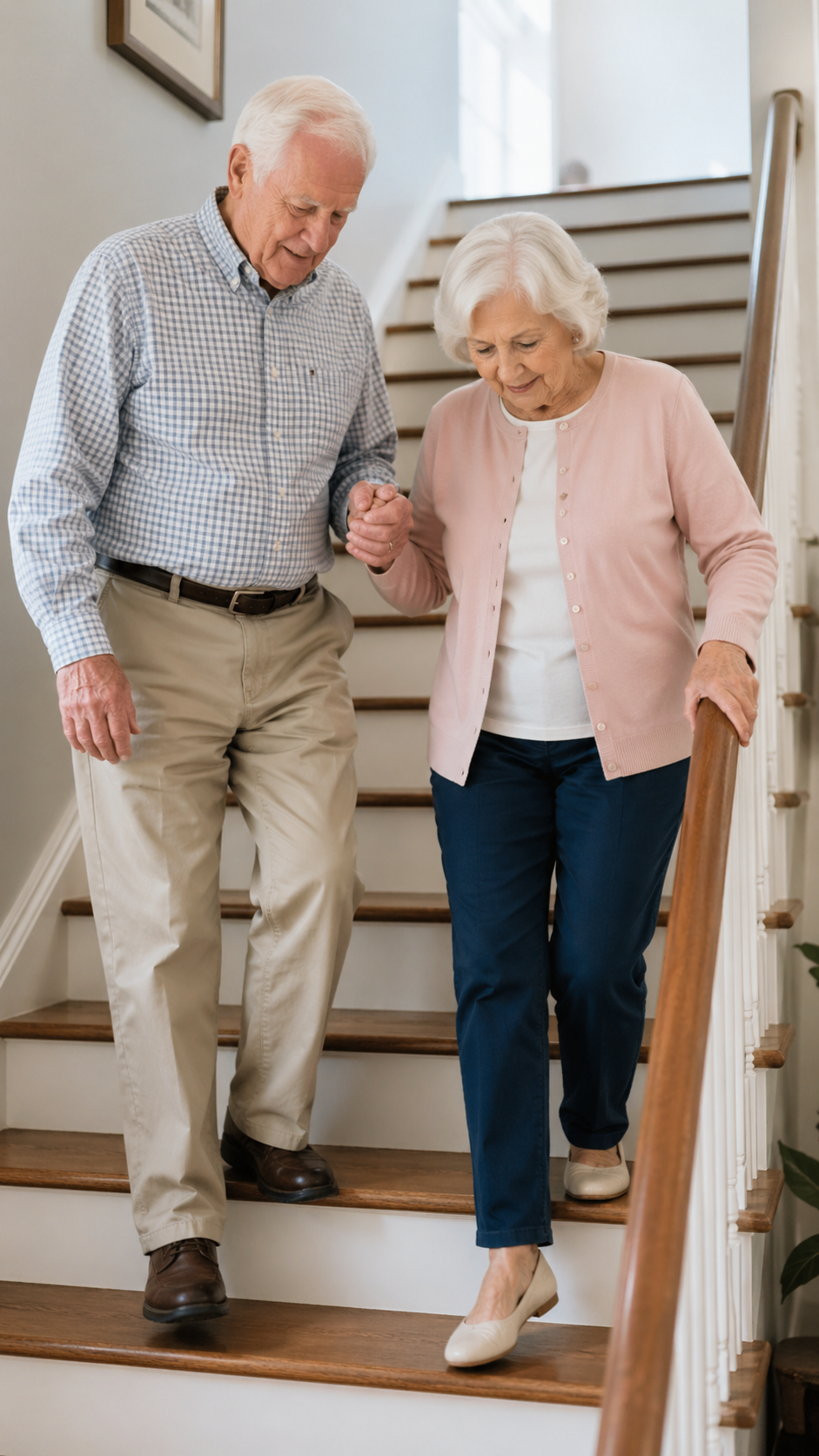
Good lighting matters. So do railings on both sides if possible. Avoid carrying large loads that block your view. If you are taking laundry downstairs, use a smaller basket or make two trips. It may feel inefficient, but it is still faster than recovering from a fall.
Shoes matter here too. Slippers that slide around may feel cozy, but they can be terrible on stairs. Look for footwear with a secure back, good fit, and non-slip sole.
Vision, Hearing, and Feet Are Part of Balance
Balance is not only in the legs.
Your eyes help you judge distance and obstacles. Your inner ears help with spatial orientation. Your feet send information to the brain about the ground. When one of these systems is not working well, the body has to guess more.
That is why regular vision checks are not just about reading small print. Updated glasses can make steps, curbs, and floor changes easier to see.
Foot health matters too. Painful bunions, numbness, poorly fitting shoes, or long toenails can change the way someone walks. A small walking change may lead to instability elsewhere. It is all connected in a slightly inconvenient but very real way.
If you have diabetes, numbness, foot pain, or frequent stumbling, it is worth bringing up directly with a clinician. Do not wait for them to ask. A simple sentence works: “I’ve noticed my feet feel less steady lately.”
Medications Can Increase Fall Risk
Some falls are linked to dizziness, sleepiness, confusion, or blood pressure changes from medications. This can include certain sleep aids, anxiety medications, blood pressure drugs, pain medications, and combinations of several prescriptions.
That does not mean you should stop anything on your own. It means medication review is part of fall prevention.
Bring a full medication list to appointments, including over-the-counter sleep aids, allergy pills, supplements, and anything taken “only sometimes.” Those occasional pills still count if they make you drowsy at night and you get up to use the bathroom.
A pharmacist can also be helpful. They look at medication interactions all day long. Ask, “Do any of these increase my risk of dizziness or falling?” That question is simple and very much worth asking.
Getting Up Safely Matters
Many falls happen during transitions: getting out of bed, standing from a chair, stepping out of the shower, turning quickly, or rushing to answer the phone.
Standing up more slowly can feel like such tiny advice that people ignore it. But it matters, especially if you ever feel lightheaded when you rise.
Try this: sit at the edge of the bed for a few seconds before standing. Move your ankles a little. Stand, pause, then start walking. It adds maybe ten seconds. Ten seconds is a decent trade for not meeting the floor unexpectedly.
The same goes for bathroom trips at night. Keep a light within reach. Wear stable slippers. Do not rush in the dark. The phone can wait. The doorbell can wait. Your balance gets priority.
Protein, Vitamin D, and Bone Health
Muscle is built through use, but it also needs enough nutrition.
Many older adults do not eat enough protein, sometimes because appetite changes, cooking feels tiring, dental issues make chewing harder, or meals become less structured after retirement. Protein does not have to mean a huge steak. It can be eggs, Greek yogurt, fish, chicken, tofu, beans, cottage cheese, lentils, or protein-rich soups.
Bone health matters too because falls are more dangerous when bones are fragile. Calcium, vitamin D, weight-bearing activity, and osteoporosis screening may all come into the picture depending on your age, sex, health history, and fracture risk.
This is a good topic for a regular checkup. Ask whether you need a bone density test, whether your vitamin D level should be checked, and whether your diet is giving you enough calcium and protein.
Food cannot prevent every fall, of course. But strong muscles and bones make the body more resilient.
Fear of Falling Can Quietly Shrink Life
After a fall, many people become cautious. That is understandable. A fall can shake your confidence even if you are not badly injured.
The tricky part is that fear can lead to less movement. Less movement leads to weaker muscles and poorer balance. Then the risk of falling may actually increase.
This cycle is frustrating, and it can happen quietly. Someone stops walking outside. Then they stop going to the store alone. Then they avoid stairs. Before long, the world feels smaller.
The answer is not to “just be brave.” That phrase helps almost no one.
A better approach is supported confidence. Physical therapy, a fall-prevention class, a walking buddy, a cane fitted properly, or a supervised exercise program can help someone move again without feeling reckless.
The CDC’s fall-prevention resources include exercise, home modification, and clinical approaches, which reflects an important point: fall prevention usually works best when several risks are addressed together.
When to Ask for Professional Help
It is wise to ask for help if you have fallen more than once, feel unsteady, avoid activities because of balance, feel dizzy, have numb feet, or struggle to rise from a chair.
A doctor can check for medical causes. A physical therapist can evaluate strength, balance, walking pattern, and safe exercises. An occupational therapist can help with home setup and daily routines.
This is not “making a big deal out of aging.” It is maintenance.
People service their cars before a long road trip. They replace worn tires. They fix loose steps on the porch. The body deserves at least that much attention.
A Simple Weekly Routine That Feels Doable
A fall-prevention routine does not have to take over the day.
Here is a simple version many people can adapt:
Take a short walk most days, even if it is just around the block or through a store.
Do chair stands twice a week.
Practice supported balance near a counter for a few minutes several times a week.
Add light resistance work for arms, back, hips, and legs.
Stretch gently after movement, especially calves, hips, and ankles.
Check one home safety item each week: bathroom mat, hallway light, stair clutter, shoe fit, extension cords, rug edges.
That last part is underrated. You do not have to fix the whole house in one afternoon. Start with the place where you walk half-asleep. For many people, that is the bed-to-bathroom route.
Keep It Respectful, Not Overprotective
For adult children or caregivers, fall prevention can be a delicate topic.
Nobody likes being treated like a fragile object. Saying “Don’t do that, you’ll fall” every five minutes can make a person feel scolded rather than supported.
A better tone is collaborative: “Would it help if we added a night light here?” or “Can we move this rug so it doesn’t catch your foot?” or “I found a balance class at the community center. Want to try it together?”
Independence matters. Safety matters too. The goal is not to wrap someone in bubble wrap. The goal is to make daily life easier to move through.
The Real Goal Is Confidence
Fall prevention is not only about avoiding injury. It is about keeping ordinary life available.
Walking to the mailbox. Playing with grandchildren. Gardening. Shopping. Traveling. Getting in and out of the car without a production. Moving through your own home without constantly scanning for danger.
After 60, strength and balance are less about looking fit and more about staying connected to the life you want to keep living.
Start small. Stand from the chair a few times. Clear the hallway. Turn on the light. Ask about your medications. Schedule the eye exam. Put on shoes that actually stay on your feet.
None of those steps is dramatic. That is why they are easy to dismiss. But repeated over weeks and months, they become the quiet structure that helps a person stay steady.
A safer, stronger body is not built in one heroic effort. It is built in regular, ordinary moments—the kind that fit between breakfast, errands, phone calls, and the rest of real life.
Hi, I’m the creator and editor behind ZestyHabit. I research everyday safety, first aid, and practical wellness topics using official guidance and reliable public sources, then turn that information into clear, realistic steps for daily life.
My goal is to help readers make safer, better-informed choices at home and beyond.



[…] like a perfectly polished lifestyle influencer who lights a candle before every nighttime routine. Real life gets messy. People get […]
[…] easiest routines are built around your real life, not an imaginary version of you who always has perfect […]
[…] people do not walk away from a gas stove because they are careless. They walk away because real life […]
[…] in real life, frostbite can happen during much more ordinary winter […]