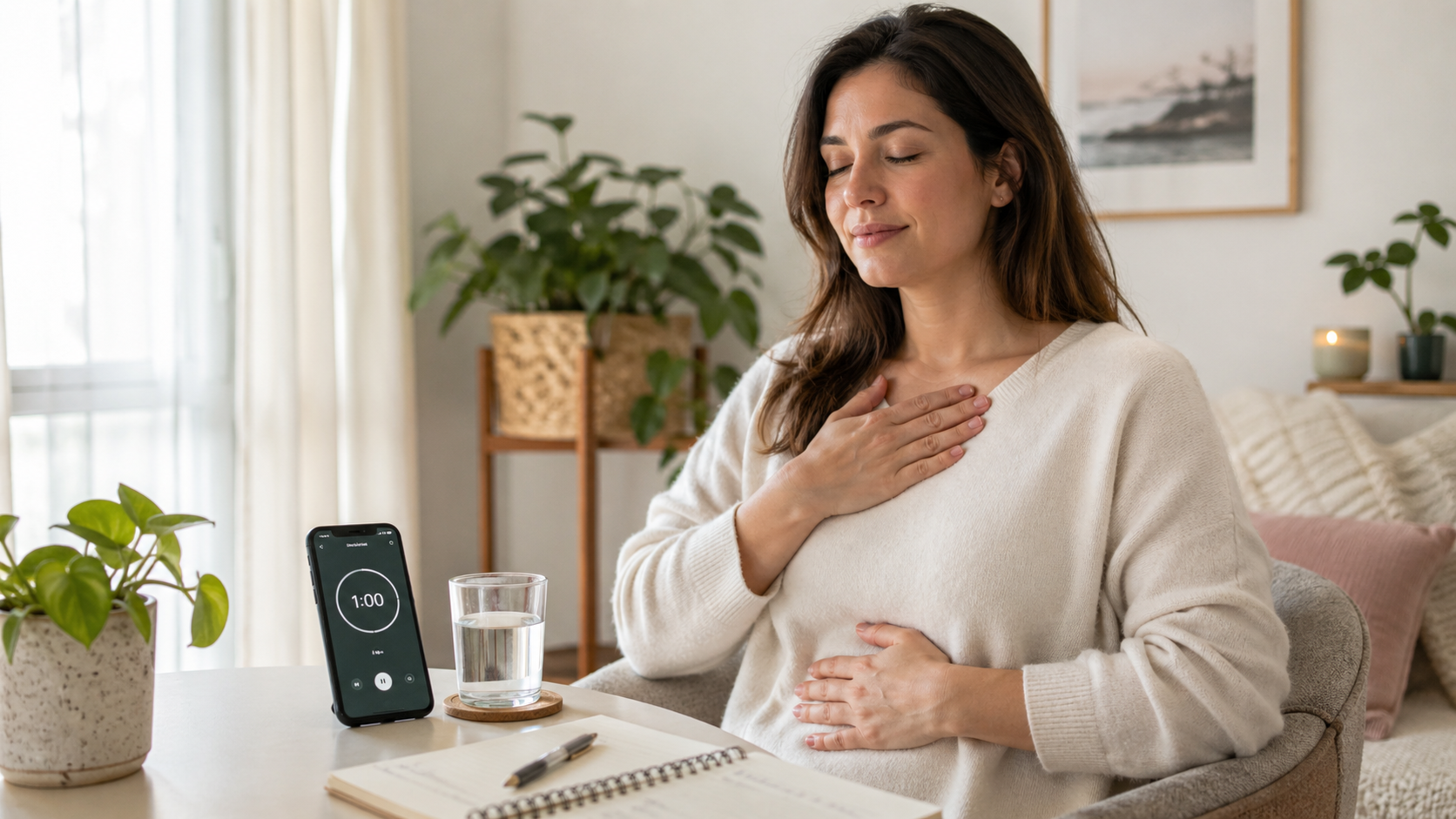

A lot of people like the idea of meditation right up until they try to do it.
That is usually where the trouble starts. Not because breathing is hard, obviously, but because the whole thing can feel strangely loaded. You sit down intending to “be calm,” and within ten seconds you are thinking about laundry, unanswered texts, whether you forgot to thaw something for dinner, and how annoying it is that your nose suddenly feels louder than usual. It can make a very simple habit feel weirdly inaccessible.
That is why a one-minute breathing meditation makes sense.
Not because one minute is magical. Mostly because it is small enough to begin without turning into a project. You do not need a cushion, a playlist, a life reset, or a beautifully organized morning. You just need a minute and a fairly normal willingness to pause without doing anything else.
That may not sound impressive, but it is often the version that people actually keep doing.
A short breathing routine works well for real life because real life is messy. Some days you feel fine. Some days your brain is full of static. Some days you are standing in the kitchen waiting for the microwave and realizing you have been mentally sprinting since 8 a.m. A one-minute pause can fit into those kinds of days without demanding too much from you.
And honestly, that is what makes it useful.
This is not about becoming the kind of person who floats serenely through life because they breathed deeply before noon. It is more grounded than that. A one-minute breathing meditation is just a small way to interrupt mental noise, notice your body again, and create a tiny pocket of steadiness in a day that may not offer many of those on its own.
Why one minute is a good place to start
Longer does not always mean better when you are building a habit.
A lot of routines fail because the starting version is too ambitious. Five minutes sounds reasonable. Ten sounds healthy. Twenty sounds admirable. But if the habit still feels unfamiliar or slightly uncomfortable, those numbers can be enough to make people avoid it altogether. They put it off until they have “real time,” which often means it never quite happens.
One minute is different.
One minute slips past your internal resistance more easily. It is short enough that you can do it before your brain has time to argue. You do not have to create a whole peaceful environment around it. You can do it sitting at your desk, standing by a window, parked in your car before going inside, or on the side of your bed with one sock still on. None of that disqualifies it.
There is also something reassuring about the limit. If your thoughts feel restless or the silence feels awkward, you are not stuck there forever. You are just staying for a minute. That makes the habit feel less dramatic, which is often exactly what people need.
And once one minute feels normal, you can always stay longer. But oddly enough, many people do not need to force that part. The routine grows more naturally once the pressure is gone.
What a 1-minute breathing meditation actually is
This helps to clear up, because people often overcomplicate it.
A one-minute breathing meditation is not a performance. You are not trying to empty your mind. You are not trying to feel instantly peaceful. You are not even trying to breathe in some special advanced way unless that genuinely helps you.
At its core, it is very simple: for one minute, you stop and pay attention to your breathing.
That is it.
You might notice the air coming in through your nose. You might feel your chest rise a little or your belly move. You might silently count your breaths. You might exhale a bit slower than usual. All of those can work.
The key part is the noticing.
It is really more of an attention habit than a perfection habit. You notice the breath. Your mind wanders. You notice that too. Then you come back. That loop is not failure. That loop is the whole practice.
People sometimes assume meditation is only “working” if they feel deeply calm the whole time. Usually that just leads to frustration. A more realistic goal is much smaller: can you spend one minute returning your attention to the breath without making it into a personal evaluation?
That tends to go much better.
Why this routine often helps on busy days
A one-minute breathing pause is useful for the exact kind of day when people think they do not have time for it.
When the mind gets crowded, it tends to stay crowded. Thoughts stack on top of each other. Your shoulders inch upward. You move from one task to the next without much transition. It is not always a dramatic stress response. Often it is just a low, constant hum of being mentally “on.”
That is where a short breathing routine can help.
Not because it solves every problem, but because it creates a small break in the stream. A reset point. Something that reminds your body and brain that not every moment has to be filled with input, reaction, or planning.
For example, if you do one minute of breathing before opening your laptop, the day may feel slightly less like it has already started without your permission. If you do it in the car before going into work, it can soften the jump between places. If you do it after an annoying email, it may keep that irritation from spreading all over the next hour.
These effects are subtle. That is worth saying. This is not an instant personality transplant. It is more like turning the volume down one notch.
Sometimes that is enough to matter.
The most common reason people stop: they think they are doing it wrong
This is incredibly common.
They sit down, try to focus on their breathing, and immediately notice a hundred thoughts. Then they assume they are bad at meditation. Or they get self-conscious. Or they feel bored. Or they become hyper-aware of their breathing in a way that feels unnatural. Then the whole thing gets labeled as “not for me.”
But most of that is just the normal beginning part.
A wandering mind is not proof that the practice is failing. It is proof that you have a mind. That is all. Breathing meditation is not about never getting distracted. It is about noticing distraction a little sooner and returning without much drama.
It also helps to know that one minute can feel surprisingly long when you first start. That does not mean you are broken. It means you are unused to being still without a task attached.
Once people realize that awkwardness is allowed, the habit usually becomes easier.
The easiest way to begin: attach it to something you already do
This makes a huge difference.
The easiest habits are often the ones that do not depend on memory alone. If you try to start a breathing meditation routine by vaguely hoping you will remember it at some peaceful moment, there is a good chance it will drift around in your head as a nice idea and stay there.
It helps much more to connect it to a moment that already exists.
For example:
- before checking your phone in the morning
- after brushing your teeth
- before starting the car
- after sitting down at your desk
- before lunch
- after shutting your laptop at the end of work
- while waiting for the shower to warm up
- before getting into bed
The best anchor is not the one that sounds the healthiest. It is the one that matches your real life.
If you are never going to become a sunrise-meditation person, there is no need to force that image. Maybe your best time is midday in a parked car. Maybe it is at night in the dark living room for sixty quiet seconds before bed. Maybe it is in the bathroom at work with the fan running and no one bothering you. That still counts.
A habit that fits your real schedule is stronger than a prettier habit that never starts.
A very simple 1-minute breathing meditation you can use
You do not need a long script, but it helps to have a concrete version in mind. Here is an easy one.
Step 1: Get still enough
Sit, stand, or lie down. You do not need a perfect posture. Just something steady and reasonably comfortable.
Step 2: Set a one-minute timer
This removes the urge to peek at the clock and wonder how much time has passed.
Step 3: Notice one breath
Just one. Feel the inhale. Feel the exhale.
Step 4: Keep your attention on the next breath
You can silently think “in” and “out,” or count each breath up to five and then start over.
Step 5: When your mind wanders, come back
Without scolding yourself. Without starting over emotionally. Just return.
That is the whole routine.
You do not need special music. You do not need a deep spiritual mood. You do not need to look calm. Sometimes you will feel centered afterward. Sometimes you will just feel slightly less scrambled. Both are fine.
If “just breathe” feels too vague, try one of these versions
Some people do better with a little more structure. That is completely normal.
The counted-breath version
Inhale naturally, exhale naturally, and count each full breath cycle from one to five. Then start over. This works well if your brain likes having a small task.
The longer-exhale version
Breathe in gently, then let the exhale run a bit longer than the inhale. Nothing forced. This can feel grounding when you are tense or overstimulated.
The hand-on-chest or hand-on-belly version
Place one hand lightly on your chest or stomach and feel the movement of your breath. This helps if you have trouble focusing without a physical cue.
The phrase version
Silently repeat something simple with each breath, like “breathing in” and “breathing out,” or “here” and “now.” A small phrase can steady the mind without making the moment feel stiff.
You do not need to rotate through all of these like a meditation buffet. Just pick the one that feels least annoying and stick with it for a bit.
What to expect in the first week
A lot of people quietly hope that once they start, the practice will immediately feel natural and rewarding.
Sometimes it does. More often, it feels a little uneven at first.
One day you may finish the minute and think, Okay, that was nice. Another day you may feel distracted the entire time. On a stressful day, you might spend the whole minute thinking about the thing that is stressing you out. That still counts as doing the routine.
The first week is mostly about familiarity.
You are teaching your day to make space for a pause. You are also teaching yourself that the routine does not need a perfect mood to happen. That part matters more than how “good” the minute feels.
Some people notice their breathing meditation starts to feel more natural once they stop expecting immediate depth from it. It is a small daily action, not a dramatic event.
And small daily actions often get stronger in quiet ways.
Common mistakes that make the routine harder than it needs to be
These show up a lot.
Waiting for ideal conditions
People think they need silence, privacy, a clean room, or a better mindset. Usually they just need one minute and a timer.
Forcing the breath
A meditation breath does not need to sound impressive. If you make it too big or too deliberate, the whole thing can feel tense.
Turning it into a self-test
The second it becomes “Am I calm yet?” the routine gets heavier. You do not need to grade the minute.
Starting with too much
If you aim for ten minutes every day right away, there is a good chance you will talk yourself out of it. A minute is enough to build the doorway.
Treating missed days like a collapse
If you forget once or skip a couple days, nothing dramatic happened. You just restart. Quietly. That is how many good routines survive.
How to make the habit feel more real in daily life
A habit becomes real when it stops being theoretical.
One easy way to do that is to decide where it belongs. Not just “I meditate now,” but “I do one minute of breathing when I sit in the car before going into the grocery store,” or “I do it after I turn off my work notifications.”
That level of specificity helps a lot.
Another useful trick is to keep the setup visible. Put a sticky note on your desk. Rename an alarm “1 minute.” Leave your timer app in an easy spot. Use something plain and a little boring if needed. Habits do not need branding. They need reminders.
It can also help to notice the situations where one minute would be genuinely useful. Before a difficult call. After a tense conversation. When you feel yourself doom-scrolling. Before eating lunch at your desk. Before walking into the house after a long day. Those moments are not perfect, but they are real.
That is usually where routines get roots.
A simple routine checklist you can actually use
If you want a basic version to start with, this is enough.
Before the minute
- Do I know when I am doing it?
- Is my timer ready?
- Can I pause without multitasking?
During the minute
- Can I notice the inhale and exhale without trying too hard?
- If my mind wanders, can I just come back?
- Can I keep this gentle instead of turning it into work?
After the minute
- Do I need another breath, or am I good?
- Can I move into the next part of my day a little less rushed?
That is a workable checklist. Nothing fancy. Just enough structure to make the habit easier to repeat.
When one minute is especially worth doing
There are certain moments where this routine earns its keep.
It helps before tasks you are resisting. Before you reply too quickly to something irritating. Before you walk into a crowded place. Before bed when your thoughts are looping. During that odd afternoon slump where you are not exactly panicking, just mentally scattered.
It can also be surprisingly useful during ordinary transitions. That is one of its strengths.
Transitions are where a lot of people lose themselves a little. Home to work. Work to errands. Phone to sleep. Task to task. A short breathing pause can make those handoffs feel less jarring.
And because it only takes a minute, you do not need to save it for “serious” moments. You can use it the way people use a sip of water or a stretch. As a small act of recalibration.
The best version is the one you do without making it a whole thing
That is probably the most honest way to put it.
A one-minute breathing meditation routine works best when it stays simple enough to live in your real day. Not your ideal day. Not your future organized day. Your current, slightly cluttered, sometimes distracted, normal day.
Maybe it happens in the driver’s seat before work. Maybe it happens at the kitchen counter while the kettle heats. Maybe it happens sitting on the edge of the bed with tired shoulders and a busy mind. That is perfectly fine.
The goal is not to become impressive at breathing.
It is just to give yourself one small, steady moment to pause, notice, and come back to yourself a little. On most days, that is already more helpful than it sounds.
Leave a Reply