
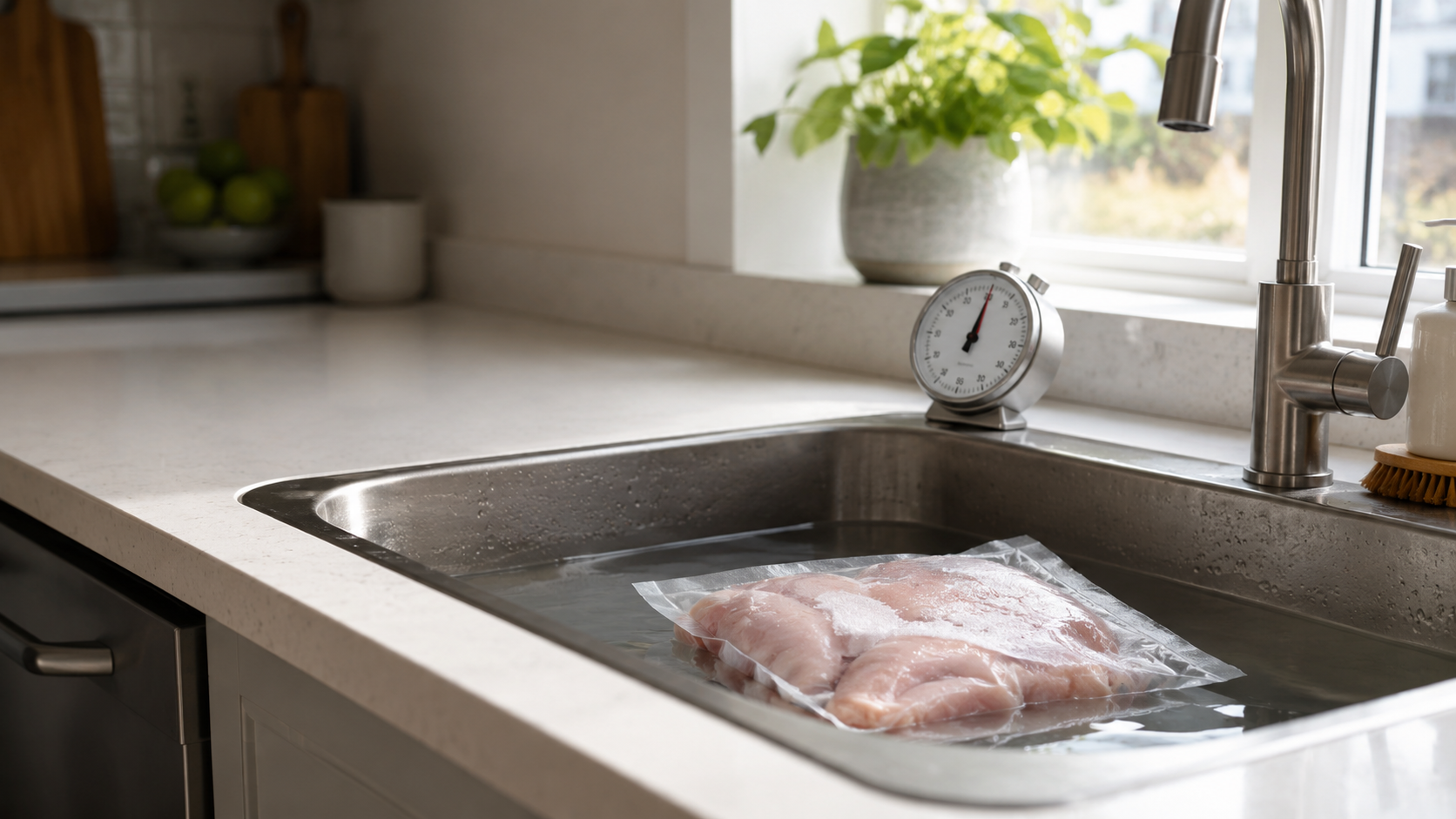

Leaving frozen food in the sink to thaw may feel convenient, but it can create food safety risks and messy kitchen habits. Here’s why it happens, what can go wrong, and safer ways to defrost everyday ingredients.
The Kitchen Habit That Feels Harmless Until You Think About It
Most of us have done it.
You pull chicken, ground beef, fish, or a bag of frozen shrimp out of the freezer, place it in the sink, and tell yourself you’ll cook it “soon.” Then life happens. A phone call runs long. Laundry needs moving. Someone asks where the tape is. Suddenly, the food has been sitting there for two or three hours, half-frozen in the middle and warm around the edges.
It feels normal because the sink seems like a practical place for thawing. It keeps drips off the counter. It is easy to rinse things nearby. It looks temporary.
But the sink is not a safe holding zone for frozen food, especially when thawing takes longer than expected. The outside of the food can warm up while the inside is still icy, and that middle stage is where problems begin.
The issue is not that every piece of food left in the sink will make someone sick. Plenty of people have done it for years and felt fine. The problem is that the habit gives bacteria the exact conditions they like: moisture, time, and a temperature that is no longer cold enough to slow them down.
And because food can look and smell normal even when bacteria have multiplied, it is not something you can judge with a quick sniff.
Why Sink Thawing Feels So Convenient
Before blaming the habit, it helps to understand why people do it.
Freezer planning is not always tidy. You may decide on dinner at 5 p.m. and realize the chicken is still frozen solid. Or you bought a big family pack of meat and forgot to portion it before freezing. Now it is one icy block, and the refrigerator method feels painfully slow.
The sink also feels “contained.” If meat leaks, at least it leaks into a place that can be washed. If fish smells a little strong, it is not sitting right beside the fruit bowl. In a busy kitchen, the sink becomes the place where unresolved food tasks wait.
The problem is that thawing is not just about making food soft enough to cook. It is about keeping the food at a safe temperature while it thaws.
That part is easy to overlook when you are just trying to get dinner moving.
The Temperature Problem: Cold Inside, Too Warm Outside
Frozen food does not thaw evenly.
A thick chicken breast, a roast, or a stack of frozen burger patties may still be hard in the center while the outer layer has already warmed up. If that food sits at room temperature, the surface can spend too much time in the range where bacteria grow quickly.
This is why leaving food in the sink for hours is risky. The middle may still look frozen, which tricks you into thinking the whole thing is still safe and cold. But bacteria grow on the surface first, not deep inside the ice-cold center.
That is especially important for foods like:
- Raw chicken
- Ground beef or turkey
- Pork
- Fish and seafood
- Cooked leftovers
- Frozen casseroles
- Foods with dairy, eggs, or cooked rice
Ground meat is particularly tricky because bacteria can be mixed throughout during processing. Seafood can also be delicate because it thaws quickly and spoils faster than people expect.
A frozen loaf of bread sitting out is one thing. Raw chicken sitting in the sink all afternoon is a very different situation.
“But I’m Going to Cook It Anyway”
This is one of the most common arguments, and I understand it. Cooking does kill many bacteria when food reaches the right internal temperature.
But there are two problems.
First, not all cooking is as thorough as people imagine. A pan-seared chicken breast can brown beautifully on the outside while staying undercooked near the thickest part. A meat thermometer is the only reliable way to know.
Second, some bacteria can produce toxins that may not be destroyed by normal cooking. That is why food safety is not only about cooking at the end. It is also about how the food is handled before it reaches the pan.
This does not mean you need to be scared of your kitchen. It just means thawing should not become a long, casual room-temperature waiting period.
The Sink Itself Is Not as Clean as It Looks
Even a clean-looking sink can hold bacteria.
Think about what goes through it: raw vegetable dirt, dishwater, food scraps, cutting boards, sponges, hands, coffee grounds, maybe the occasional pet bowl. The sink is a hardworking place, not a sterile one.
When frozen meat or seafood sits in the sink, two things can happen. The food can pick up bacteria from the sink surface, and the food’s juices can contaminate the sink area.
Raw meat juices do not always stay neatly inside the package. Plastic can leak. Condensation can spread. A bag can have tiny punctures you did not notice. That liquid may touch the drain area, faucet handle, sponge, dish rack, or nearby utensils.
And then someone rinses an apple. Or sets down a clean plate. Or grabs the sponge to wipe the counter.
That is how cross-contamination sneaks into an ordinary kitchen. It is usually not dramatic. It is small, invisible, and easy to miss.
The “I’ll Just Rinse It” Problem
A lot of people rinse thawed meat or seafood because it feels cleaner. But rinsing raw meat can splash bacteria around the sink and nearby surfaces. The splashes may be tiny. You may not see them.
If you have ever rinsed chicken and noticed water bouncing off the surface, that is the issue. Those droplets can land on the counter, faucet, dish soap bottle, drying rack, or your shirt.
For most raw meat and poultry, cooking properly is what makes it safe, not rinsing. If the surface is wet, pat it dry with paper towels and throw them away immediately. Then wash your hands and clean the area.
Seafood is a little different sometimes, depending on the product and recipe, but even then, the key is controlled handling. Do not turn the sink into a splash zone.
How Long Is Too Long?
As a general food safety habit, perishable foods should not sit at room temperature for more than two hours. If the room is very warm, that window is shorter.
But with thawing, I would be even more cautious because the food may not be evenly cold. A big frozen item sitting in the sink can look “fine” while the outside is warming.
If you placed meat in the sink and forgot about it for several hours, especially raw poultry, seafood, or ground meat, it is safer not to gamble. I know throwing food away feels awful. Food is expensive. Nobody likes wasting a whole package of chicken because the afternoon got away from them.
Still, food poisoning is worse than wasted groceries. That is the unfun truth.
The Best Everyday Thawing Method: Refrigerator Thawing
The safest and least dramatic method is thawing in the refrigerator.
Yes, it requires planning. No, it is not exciting. But it works because the food stays cold the entire time. The outside does not warm up while the inside catches up.
Place frozen food on a plate, tray, or shallow container to catch drips. Put it on the lowest shelf so raw juices cannot leak onto ready-to-eat foods. If you have ever opened the fridge to find chicken liquid near the lettuce, you only need that lesson once.
Small items may thaw overnight. Larger cuts can take a day or longer. A whole turkey, of course, is its own project and needs several days.
For real life, the easiest habit is this: move tomorrow’s protein from the freezer to the fridge right after dinner tonight. You are already in the kitchen, the freezer is right there, and future-you gets a small gift.
When You Forgot: Use Cold Water Thawing
Cold water thawing is useful when you forgot to plan ahead.
The food should be sealed in a leakproof bag. Not kind of sealed. Actually sealed. You do not want water getting into the food, and you do not want raw juices leaking into the sink or bowl.
Submerge the package in cold tap water. Change the water about every 30 minutes so it stays cold. A bowl is often better than placing food directly in the sink, especially if your sink is full of dishes or not freshly cleaned.
This method is faster than refrigerator thawing but still keeps the food out of the risky room-temperature zone. Once the food is thawed, cook it right away.
Do not use warm or hot water. It may seem clever when you are hungry, but it can warm the outside of the food too quickly while the inside remains frozen. That puts you right back in the danger zone problem.
Microwave Thawing Works, But Cook Immediately
The microwave is another option, especially for smaller portions.
Use the defrost setting if your microwave has one. Rotate or separate pieces as they soften. The downside is that microwaves thaw unevenly. Some parts may begin to cook while others remain icy.
That is why microwave-thawed food should be cooked immediately. Do not defrost chicken in the microwave, leave it on the counter, and then wander off to answer emails. The warmed edges are already in a more vulnerable state.
Microwave thawing is not my favorite for texture, especially with fish or thin meat, but it is helpful in a pinch. For soups, stews, cooked grains, and some leftovers, it can be perfectly practical.
Cooking From Frozen Is Sometimes Fine
Depending on the food, you may not need to thaw at all.
Frozen vegetables can go straight into a pan, soup, or sheet tray. Frozen dumplings, meatballs, burger patties, and fish fillets often have cooking instructions from frozen. Some chicken products are designed that way too, though raw frozen chicken still needs careful cooking to the correct internal temperature.
Cooking from frozen usually takes longer. The outside may brown before the inside is done, so lower heat and patience help. A meat thermometer is useful here, not just for safety but for avoiding dry, overcooked food.
For busy nights, this can be a good strategy: choose foods that are meant to cook from frozen instead of trying to speed-thaw something unsafe.
The Packaging Problem: Big Frozen Blocks
A lot of bad thawing habits start at the grocery store.
You buy a large pack of meat because it is cheaper. You put the whole thing in the freezer. Later, you only need half, but it has frozen into a solid brick. Now you are stuck thawing more than you need.
The fix happens before freezing.
When you bring food home, portion it into meal-sized amounts. Flatten ground meat in freezer bags so it thaws faster. Separate chicken breasts or fish fillets with parchment or wrap them individually. Label bags with the date and type of food.
This sounds like the kind of advice people give when they have unusually organized freezers. But it does not have to be fancy. Even five extra minutes after grocery shopping can save you from the sink-thawing trap later.
Flat packages thaw faster, stack better, and make weeknight cooking less annoying. That alone is worth it.
What About Frozen Food Left in the Sink Overnight?
This is where people really hope for a loophole.
If raw meat, poultry, seafood, cooked leftovers, or other perishable food has been left in the sink overnight, it should be thrown away. Even if it still feels cool in the middle. Even if it smells normal. Even if the package was unopened.
Overnight is simply too long at room temperature.
The hard part is that the food may not look spoiled. Foodborne bacteria do not always create a bad smell, slimy texture, or obvious warning sign. Your senses are not reliable enough here.
It feels wasteful, but it is the safer choice.
How to Clean Up After Sink Thawing
If you did thaw food in the sink, clean the area properly afterward.
First, remove any packaging and throw it away. Wash your hands. Then clean the sink, faucet handles, and any nearby surfaces that may have been touched by raw juices or splashes.
Use hot, soapy water first to remove residue. Then sanitize according to the cleaner’s label instructions. Let the surface sit wet for the recommended contact time if your sanitizer requires it. People often spray and wipe immediately, but many products need a little time to work.
Wash or replace sponges and dishcloths often. A sponge that wiped raw chicken juice and then sits damp by the sink is not doing anyone favors. I like using paper towels for raw meat cleanup because they can go straight into the trash.
A Simple Thawing Routine That Actually Fits Daily Life
A safe routine does not need to be complicated.
After grocery shopping, portion meat before freezing. The night before cooking, move what you need into the fridge. If you forget, use cold water in a sealed bag and cook the food right away. If you are truly out of time, cook from frozen when the food allows it.
That is the whole rhythm.
You can even keep a small tray in the fridge for thawing. It catches drips and makes the habit feel automatic. No searching for a plate. No balancing a leaking package over the lettuce. Just freezer to tray to fridge.
For families, roommates, or anyone who shares a kitchen, it helps to make the rule clear: no raw meat sitting loose in the sink for hours. Not because anyone is being dramatic. Because it keeps the kitchen safer for everyone.
A Few Foods That Need Extra Care
Some foods deserve special mention.
Raw chicken should always be handled carefully because it is commonly linked with bacteria like Salmonella and Campylobacter. Ground meat needs attention because bacteria can be mixed throughout. Seafood thaws quickly and can spoil faster than thicker cuts of meat.
Cooked rice and pasta may not seem risky, but leftovers can also become unsafe if left at room temperature too long. The same goes for soups, stews, casseroles, and foods with eggs or dairy.
Frozen fruit is usually less risky than raw meat, but it still should not sit around indefinitely in a dirty sink. If you are using it for smoothies, keep it frozen or thaw it in the fridge.
Different foods have different risk levels, but the basic habit stays the same: thaw cold, keep clean, cook promptly.
The Real Issue Is Not Laziness
People thaw food in the sink because they are busy, tired, hungry, or trying to make dinner happen with what they have. That is normal. Kitchen habits are rarely perfect.
The goal is not to feel guilty every time you forget to move chicken to the fridge. The goal is to have a backup plan that does not rely on room-temperature thawing.
Cold water thawing is there for rushed evenings. Microwave defrosting is there for smaller items. Cooking from frozen works for certain foods. Portioning before freezing makes everything easier later.
Once those options become familiar, the sink stops being the default waiting room for frozen food.
A Safer Kitchen Starts With Small Changes
Leaving food in the sink to thaw for a long time may seem like a harmless shortcut, but it can create the perfect setup for bacteria and cross-contamination. The outside of the food warms first, the sink may not be as clean as it looks, and smell is not a reliable safety test.
A better habit is simple: thaw in the refrigerator when you can, use cold water when you forgot, and cook immediately after faster thawing methods.
Dinner does not need to become a food safety lecture. It just needs a few practical routines that protect the people eating it. And honestly, once you get used to thawing food the safer way, it becomes one less thing to worry about in the middle of a busy day.

Hi, I’m the creator and editor behind ZestyHabit. I research everyday safety, first aid, and practical wellness topics using official guidance and reliable public sources, then turn that information into clear, realistic steps for daily life.
My goal is to help readers make safer, better-informed choices at home and beyond.


