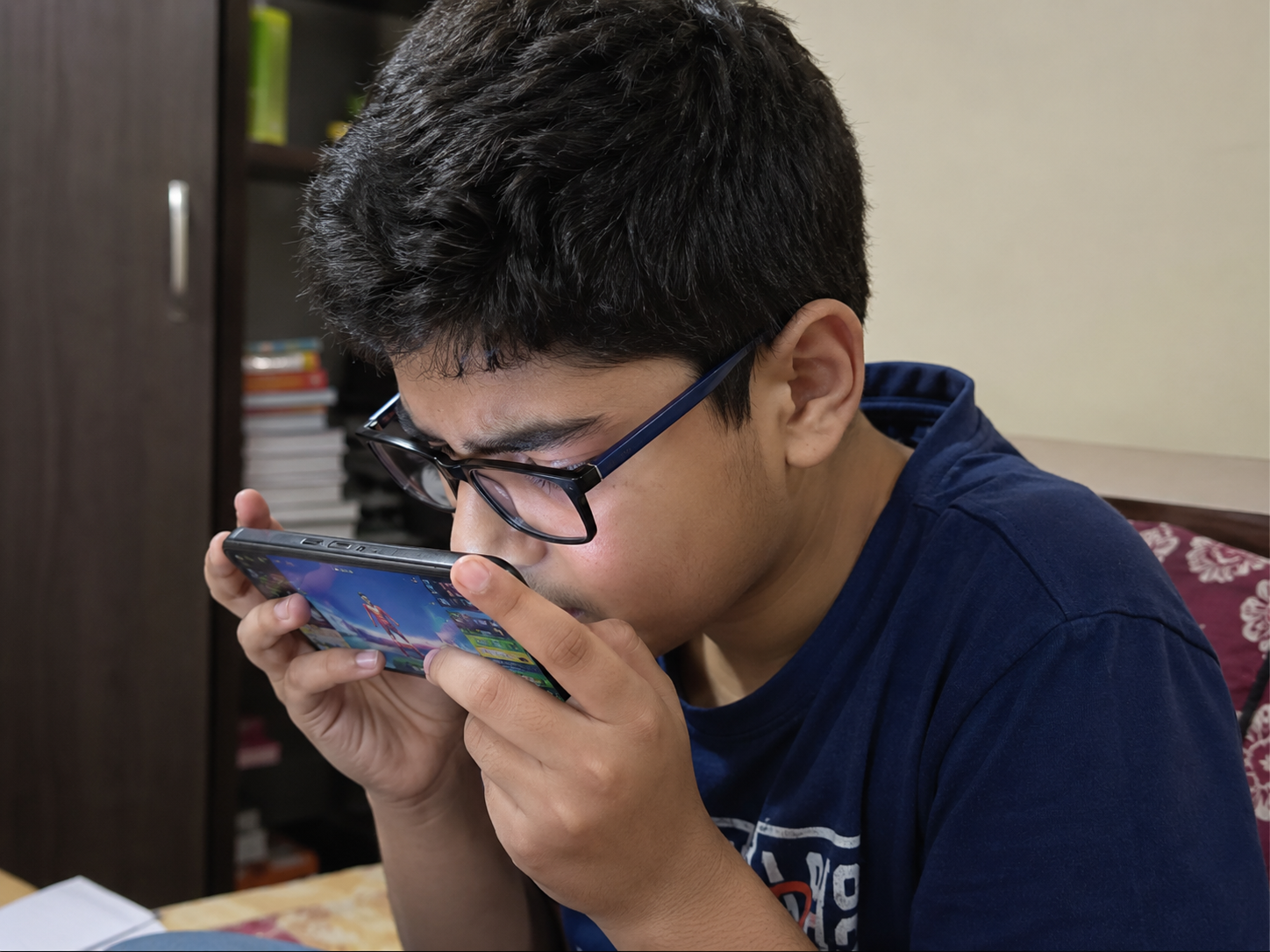
Holding Your Phone Too Close to Your Face: A Small Habit That Can Wear You Down
Minjin Park
·
Keeping your smartphone close to your face for long periods may strain your eyes, neck, sleep, and focus. Here’s how to use your phone more comfortably without overhauling your life.
Most of us do not start out with the phone two inches from our nose.
It happens slowly.
You sit on the couch, phone at a normal distance. Then you get tired. Your elbow sinks into a pillow. The screen drifts closer. Maybe you are reading comments, checking a recipe, watching a short video, or doing that very specific modern activity where you open your phone for one thing and somehow end up watching a stranger reorganize a pantry.
Ten minutes later, your chin is tucked, your shoulders are rounded, and your phone is basically having a private meeting with your face.
It feels harmless because it is so ordinary. No one thinks, “I am now creating a poor visual and posture environment for my body.” We just think, “One more minute.”
But when that habit repeats every day, especially at night or during long scrolling sessions, it can start to bother your eyes, neck, sleep, and even your ability to settle your mind.
Not in a dramatic, instant-ruin kind of way. More like a slow leak.
Why Holding Your Phone Too Close Can Strain Your Eyes
Your eyes are not lazy. They work hard all day.
When you look at something close up, your eyes have to focus inward and maintain that focus. A phone held very close makes that job more demanding. If you are reading tiny text, watching fast-moving videos, or switching between apps, your eyes are doing even more little adjustments.
That is one reason your eyes may feel tired after a long phone session.
You might notice:
dry or gritty eyes
blurry vision after looking away
headaches around the forehead or temples
a heavy feeling behind the eyes
trouble focusing on faraway objects for a moment
The funny thing is, many people blame the phone brightness first. Brightness matters, of course. A screen blasting your eyes in a dark room is not exactly a spa treatment. But distance matters too.
A screen held too close can make your eyes work harder than they need to.
The Blink Problem
There is also the blinking issue.
When people stare at screens, they often blink less. Not because anyone decides to stop blinking. It just happens. You get absorbed in the screen, and your eyes stay open longer between blinks.
Blinking spreads tears across the surface of the eyes. When you blink less, your eyes can dry out faster. Add a phone held close to your face, a dark room, a ceiling fan, or dry indoor air, and suddenly your eyes feel scratchy.
This is why a person can spend the whole day feeling fine, then lie in bed with their phone for 40 minutes and wonder why their eyes feel weird.
The habit looks small. The body still notices.
Your Neck Pays Attention Too
Phones are sneaky because they are light.
A laptop feels like something you sit down to use. A TV stays across the room. A phone follows you everywhere, including awkward places: bed, the bathroom, the kitchen counter, the car while parked, the couch, the hallway, the edge of the bed when you were supposedly “getting ready.”
When the phone is close to your face, your head often moves forward. Your chin drops. Your upper back rounds. Your shoulders come along for the ride.
That position may not hurt after three minutes. After thirty minutes, it can.
After months of doing it every day, your neck and shoulders may start complaining in a language that sounds like stiffness, tension, or a dull headache that creeps up from the base of the skull.
I think almost everyone has had that moment where they finally put the phone down and realize they have been shaped like a shrimp for the past hour.
On your back, you may hold the phone above your face until your arms get tired. On your side, one shoulder gets crushed while the other hand holds the phone too close. On your stomach, your neck bends backward like it is trying to solve a problem it did not ask for.
And because bedtime scrolling feels relaxing, people often stay in those positions longer than they realize.
The problem is not that you checked one message in bed. The problem is the nightly routine of locking your body into a cramped shape while your mind keeps asking for “just one more video.”
Close Screens Can Make Scrolling Feel More Intense
There is something different about a phone held very close.
The screen fills more of your visual field. The content feels more immediate. Your attention narrows. A short video becomes a tiny world. A comment section becomes a room you accidentally walked into and now cannot leave.
This is part of why close-up phone use can feel so absorbing.
When the screen is right in front of your face, it is harder to stay aware of the rest of the room. You are less likely to notice the time, your posture, your breathing, or the fact that your tea has gone cold.
Again.
This does not mean the phone is evil. It just means the physical setup affects how you use it. Distance creates a little breathing room. Literally and mentally.
Holding the phone farther away can make it easier to pause, look around, and remember that the screen is not the whole evening.
The Nighttime Problem: Eyes, Sleep, and a Brain That Won’t Clock Out
A lot of close-phone habits happen at night.
You are tired. The room is dark. The phone is bright. You bring it closer because your body is comfortable, your arms are folded in, and the screen feels easier to see.
That combination can be rough.
The brightness can feel harsher in a dark room. Small text may make you squint. Fast content can keep your brain alert. And because the phone is close, the experience feels even more direct.
You may have planned to check the weather. Then you read a message, open a video, check one notification, look up a random symptom, see a news headline, and now your brain is wide awake holding seven unrelated thoughts.
Not exactly restful.
The “I’m Resting” Trap
This is the tricky part: phone use can feel like rest while not actually giving your body much rest.
Your body is still. Your mind is stimulated. Your eyes are focused. Your neck is bent. Your thumb is moving. Emotionally, you may be relaxed, amused, annoyed, curious, or mildly stressed, depending on what appears on the screen.
So you may be lying down, but your nervous system is not necessarily winding down.
This is why some people feel more tired after “relaxing” with their phone. The rest was not fake, exactly. It just was not the kind of rest their body needed.
How Close Is Too Close?
You do not need to measure with a ruler every time you use your phone.
A simple guide: if your phone is so close that your eyes feel pulled inward, your face is scrunched, or your neck is curled down, it is probably too close.
Many eye care professionals suggest keeping screens at a comfortable distance and taking regular breaks from near work. For a smartphone, a practical everyday habit is to hold it around forearm’s length when you can. Not stiffly. Not like you are presenting a museum artifact. Just far enough that your eyes and neck are not doing extra work.
If you cannot read the text at that distance, increase the font size instead of bringing the phone closer.
That one change helps more than people expect.
Make the Text Bigger
This is the least glamorous phone tip, but it is genuinely useful.
Increase text size. Turn on display zoom if needed. Use reader mode when reading articles. Make captions easier to read. Adjust brightness so the screen matches the room.
People sometimes resist larger text because it feels like admitting something about their eyesight. But tiny text is not a personality test. It is just tiny text.
Make the screen comfortable. Your eyes do not need to suffer for aesthetics.
The 20-Second Break That Actually Helps
A lot of screen advice sounds unrealistic. “Simply stop using your phone so much.” Great. Very helpful. Right up there with “just be less stressed.”
A more realistic habit is taking tiny breaks.
Every so often, look away from your phone and focus on something farther away. Across the room, out a window, down the hallway. Let your eyes shift out of close-up mode.
You can also blink deliberately a few times. It sounds silly until your dry eyes thank you.
This does not have to become a formal routine with alarms and charts. Just attach it to moments that already happen:
When a video ends, look up.
When a page loads, look across the room.
When you switch apps, relax your shoulders.
When you notice your phone creeping closer, move it back.
Small resets are easier to keep than big rules.
Watch Your Hands and Elbows
The phone does not move close to your face by itself. Usually, your arms get tired and your body starts folding inward.
A better setup can help.
Rest your elbows on a pillow if you are sitting, but keep the phone farther from your face. Sit with your back supported. If you are reading for a while, consider using a stand or placing the phone on a table. For videos, casting to a TV or using a tablet at a better distance can be easier on your body.
This is not about becoming perfectly ergonomic every time you check a text. That would be exhausting.
It is about noticing when “quick phone use” has quietly become a long session.
If you are going to be on your phone for 30 minutes, your body deserves a better position than curled over like you dropped a contact lens.
The Face-Skin Side of the Habit
There is another small issue people forget: phones are touched constantly.
Hands, pockets, counters, bags, car cup holders, gym equipment, kitchen surfaces. Then the phone comes close to your face. Sometimes it touches your cheek. Sometimes you hold it near your mouth while talking. Sometimes you scroll while eating, which is a whole little hygiene adventure.
This does not mean you need to sanitize your phone every hour. But wiping it regularly is sensible, especially if you use it while eating, commuting, working out, or after being in public places.
Also, holding the phone very close can make you touch your face more. You rub your eye, rest your chin, scratch your cheek, adjust your hair, scroll, repeat.
For people prone to breakouts or eye irritation, this may be one of those hidden habits worth cleaning up.
Children and Teens Need Extra Attention
Kids and teens often hold screens very close without noticing.
They may watch videos with the phone near their face, play games with intense focus, or read while curled up in bed. They also may not complain about eye strain clearly. Instead, they might rub their eyes, avoid reading, get headaches, or become cranky after long screen time.
For children, the goal does not need to be a strict household battle over every minute. But distance, breaks, outdoor time, and lighting matter.
A simple rule like “keep the screen away from your nose” is easier for kids to understand than a lecture about visual strain.
It also helps when adults model it. Children notice when we say, “Don’t hold it so close,” while our own phone is practically touching our eyelashes.
Painful but true.
A More Comfortable Phone Routine
Here is a phone routine that fits normal life:
Hold the phone farther away than feels automatic.
Raise the phone slightly instead of dropping your head all the way down.
Make the text larger so you do not squint.
Take little look-away breaks.
Avoid long scrolling sessions in total darkness.
Use a pillow, stand, or table if you know you will be reading or watching for a while.
Keep the phone clean.
Put it down when your eyes, neck, or head start sending signals.
None of this requires quitting your phone. It is more like changing the way you hold a coffee mug that keeps burning your hand. Same object, better handling.
When to Pay More Attention
Occasional tired eyes after screen use are common, but some symptoms should not be ignored.
If you often have headaches, blurry vision, eye pain, double vision, strong light sensitivity, or neck pain that does not improve, it is worth checking in with an eye doctor or healthcare professional.
Sometimes the issue is not just phone distance. You may need updated glasses, treatment for dry eyes, better lighting, or help with posture-related pain.
The phone may be part of the story, not the whole story.
A Small Habit Worth Adjusting
Holding your smartphone close to your face for a long time is easy to dismiss because everyone does it. It does not look dangerous. It does not feel like a major lifestyle choice. It is just a phone, just a few minutes, just a little scroll before bed.
But small habits have a way of adding up.
Your eyes work harder. Your neck bends more. Your sleep routine gets pushed around. Your mind stays hooked when it was probably asking for quiet.
The fix does not have to be dramatic. Hold the phone a bit farther away. Make the text bigger. Look up more often. Stop letting the screen creep toward your face like it owns the room.
That is enough to start. A little more space between your face and your phone can give your body a surprising amount of relief.
Hi, I’m the creator and editor behind ZestyHabit. I research everyday safety, first aid, and practical wellness topics using official guidance and reliable public sources, then turn that information into clear, realistic steps for daily life.
My goal is to help readers make safer, better-informed choices at home and beyond.