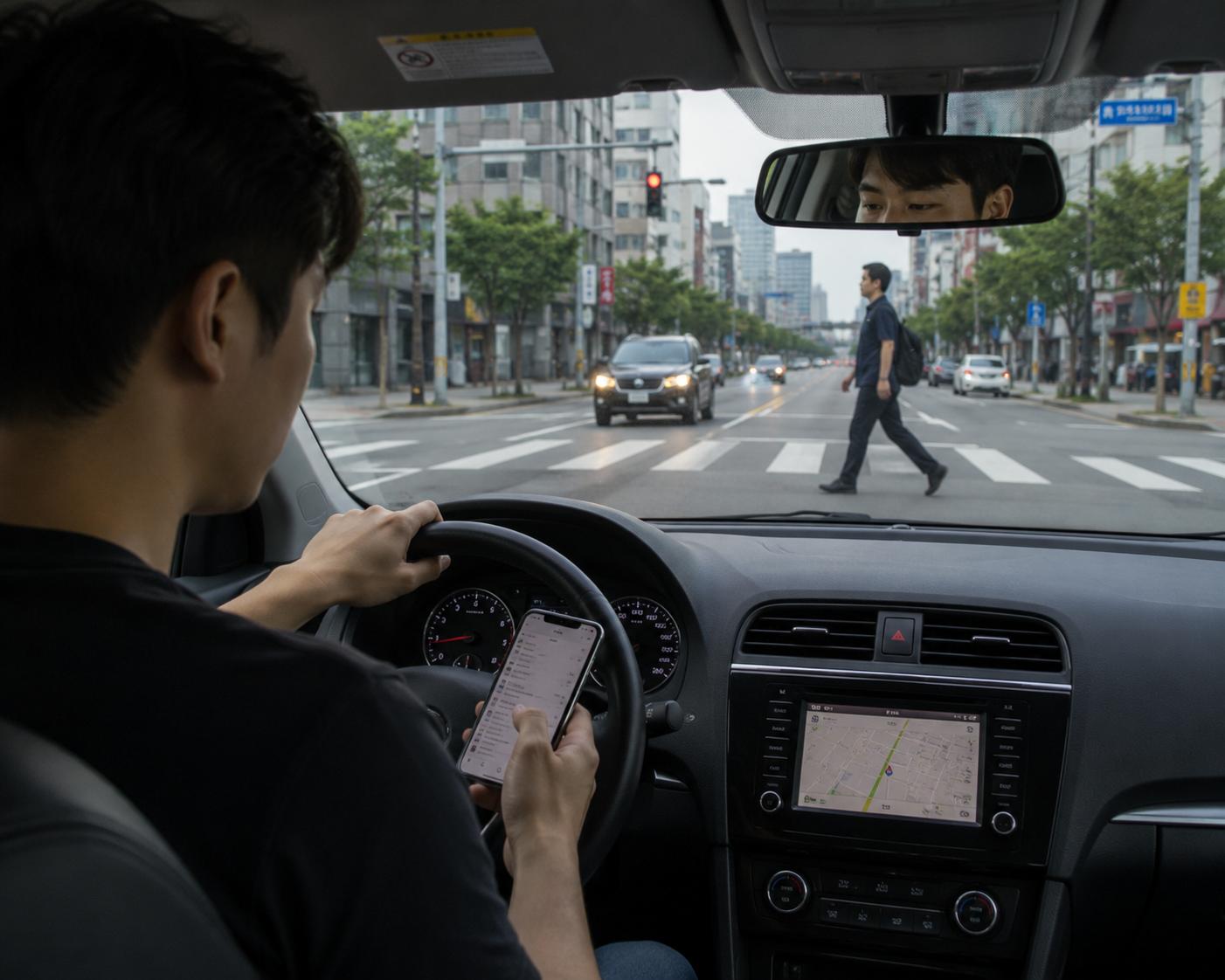
The Real Problem With “Just Checking” Your Phone While Driving
Minjin Park
·
Glancing at your phone while driving may feel harmless, but even a few seconds of distraction can change everything. Here’s why the habit is riskier than it seems and how to break it in daily life.
Most people do not pick up their phone behind the wheel because they think they are reckless.
It usually starts smaller than that.
A quick look at a text while stopped at a red light. A tap to skip a song. A glance at the map because the next turn is confusing. Maybe the phone buzzes in the cup holder, and before you even think about it, your eyes drop.
Just for a second.
That is the phrase people often use: “I only looked for a second.” And honestly, that is what makes this habit so easy to excuse. It does not feel like dangerous driving. It feels like multitasking. It feels normal, almost boring. Everyone has notifications. Everyone has directions. Everyone has someone waiting for a reply.
But driving is one of those activities where a few seconds can be much longer than they sound.
When you look at your phone, the actual glance may be short. But the distraction is not only the moment your eyes leave the road.
There is the moment before, when your attention shifts because you heard the notification.
There is the moment you look down.
There is the moment your brain reads the message, understands it, and reacts.
Then there is the moment you look back up and re-enter the driving situation.
That whole process takes more mental space than we like to admit.
Even if your hands stay on the wheel, your attention is split. And driving does not pause politely while your brain checks a message. Cars keep moving. Pedestrians step off curbs. Traffic lights change. The car ahead brakes. Someone drifts into your lane.
It is not that phones are magically dangerous by themselves. It is that they pull your mind away from a task that needs constant, boring, ordinary attention.
And ordinary attention is what keeps most drives safe.
“I’m Good at Multitasking” Does Not Help Much Here
A lot of people trust themselves with phone use because they know their own roads.
They think, “I’ve driven this route a hundred times.” Or, “I’m only checking at a red light.” Or, “I can see the road from the corner of my eye.”
That confidence is part of the problem.
Driving familiar roads can make us less alert because we stop treating them as active situations. The commute to work, the school pickup route, the grocery store loop — these drives become background noise. So checking a phone feels less risky than it would on a steep mountain road or in heavy rain.
A cyclist appears where there usually is not one. A delivery truck blocks part of the lane. A child runs toward a dropped ball. Someone stops suddenly because they are also distracted.
You do not need a dramatic situation for a phone glance to matter. You only need bad timing.
And bad timing is not something anyone can predict.
The Red Light Trap
Red lights are where many drivers let their guard down.
The car is stopped, so the phone feels safer. You answer one text. You check the map. You look at a notification and think you will be done before the light turns green.
Then the light changes.
Now there is pressure. The car behind you may honk. You rush to put the phone down. You move forward while your mind is still half inside the message you just read.
That little mental delay matters.
It can also create a new habit: every stop becomes a phone break. Red light, phone. Drive-thru line, phone. Traffic jam, phone. Railroad crossing, phone.
Soon the phone becomes part of driving, not something separate from it.
The tricky thing is that using a phone at a red light may feel controlled, but it keeps the habit alive. It trains your brain to check whenever there is a small opening. And once the phone is already in your hand, it is easier to keep touching it after the car moves again.
Maps Are Useful, But They Can Still Distract You
Navigation apps are probably one of the biggest gray areas.
Most people are not “texting” when they use maps. They are trying to get somewhere. That feels practical and necessary.
Still, looking closely at a map while driving can be just as distracting as reading a text. The screen has small details. Lane guidance, traffic colors, estimated arrival time, alternate routes, tiny street names. If the app suddenly reroutes you, it is tempting to tap around and figure out why.
That is a lot to process at 35, 55, or 70 miles per hour.
A better approach is to set the route before you start moving. Turn on voice directions. Place the phone where you can hear it and, if needed, see it without holding it. If the route gets confusing, pull over or wait until you are parked.
Missing a turn is annoying. Missing something on the road is worse.
I say that as someone who has absolutely taken the wrong exit before and felt personally betrayed by the map. But a wrong turn can be fixed. A crash is not so easy.
Music, Podcasts, and “Just One Tap”
Changing music feels harmless because it is not a conversation. You are not typing a paragraph. You are only skipping a song.
But the same problem shows up: your eyes leave the road, your hand leaves its normal position, and your brain starts choosing.
Which playlist? Which episode? Why is the app not loading? Did the Bluetooth disconnect? Why is the volume weird?
One tap becomes three. Three becomes scrolling.
This is especially common on short drives. People think, “I’m only going ten minutes, I’ll just pick something quickly.” But short drives often happen in neighborhoods, parking lots, school zones, and busy local streets. Those places have more unpredictable movement than open highways.
The simplest fix is boring but effective: choose before you drive. Start the playlist, queue the podcast, adjust the volume, and leave it alone.
If the song is bad, let it be bad for two minutes. That is character building, in the smallest and most irritating sense.
The Phone Does Not Have To Be in Your Hand To Be a Problem
Hands-free features help, but they do not make distraction disappear.
Voice assistants, car displays, Bluetooth calls, and message dictation can reduce some physical distraction. You may not be looking down or holding the phone. That is better than typing.
But your mind can still leave the road.
A stressful call can take over your attention. A complicated voice command can make you repeat yourself three times. Dictating a text can turn into editing, correcting, and getting annoyed because the phone heard “meeting” as “meat thing.”
Not exactly calm driving.
Hands-free tools are most useful when they reduce the need to touch the phone, not when they become another task to manage. A quick voice direction is one thing. A long emotional conversation during heavy traffic is something else.
The question is not only, “Are my hands on the wheel?”
It is also, “Is my mind still driving?”
Why We Check Even When We Know Better
Most drivers already know phone use is risky. The habit continues because phones are designed to feel urgent.
A buzz creates curiosity. A message preview creates a tiny open loop. A work email makes you feel responsible. A family text makes you wonder if something happened. A group chat can feel silly but still hard to ignore.
And sometimes, checking the phone is less about the message and more about discomfort.
You are bored at a long light.
You feel awkward sitting in silence.
You are anxious about being late.
You want to know whether someone replied.
The phone offers a little hit of control. That is why “just don’t do it” sounds simple but does not always work in real life.
It helps to make the habit harder before the urge shows up.
Put the Phone Somewhere Annoying
A phone sitting in your lap or cup holder is basically asking to be checked.
Put it somewhere you cannot easily reach while driving. In a bag. In the glove compartment. In the back seat. Even zipped into a jacket pocket.
This sounds extreme until you try it and realize how much calmer driving feels when the phone is not physically available.
If you need navigation, mount the phone and keep it on the map only. No loose phone sliding around. No screen lighting up near your hand. No “I’ll just check while stopped.”
You can also turn on Do Not Disturb While Driving or a similar focus mode. Many phones can send an automatic reply, so people know you are not ignoring them. That alone can reduce the pressure to respond.
The goal is not to become a perfect person with saintly self-control. The goal is to remove the temptation from arm’s reach.
Make a Pre-Drive Routine
A small routine helps because most phone checking happens when we start driving unprepared.
Before you shift into drive, take thirty seconds.
Check the route.
Start the music or podcast.
Send the “leaving now” text if needed.
Put the phone away or set driving mode.
Adjust the temperature.
Take a sip of water.
Then drive.
It may feel unnecessary at first, especially for quick errands. But quick errands are exactly when people leave things half-set and then fiddle with them on the road.
A pre-drive routine is like tying your shoes before walking. Not exciting. Very useful.
What To Do When Something Feels Urgent
Sometimes a message really might matter.
Maybe you are waiting for a doctor’s call. Maybe your child’s school might contact you. Maybe you are coordinating a pickup and the timing keeps changing.
That still does not mean reading while moving is safe.
Pull into a parking lot. Stop at a gas station. Use a legal parking space. If you are on the highway, wait for a rest area or safe exit. It feels inconvenient, but it usually takes less time than people imagine.
If you regularly need to be reachable while driving, set expectations. Tell family or coworkers, “I’m driving, I’ll call when I park.” Use automatic replies. Share your ETA through a map app before leaving.
Most messages can wait ten minutes. The ones that cannot wait deserve your full attention while parked, not half your attention while driving.
Passengers Can Help, But They Need Clear Instructions
If someone else is in the car, let them manage the phone.
Ask them to read the message, change the playlist, check the route, or answer the call. This is not laziness. It is smart delegation.
But be specific. A passenger reading every notification out loud can become its own distraction. You do not need a live performance of the group chat while merging onto the freeway.
A simple “Can you check if that’s from Mom?” or “Can you tell me the next turn?” is enough.
For parents, this also models something important. Kids notice phone habits in the car. They notice when adults say safety matters but still glance down at every red light. That is uncomfortable, but true.
The Parking Lot Counts Too
Many people relax in parking lots because speeds are lower.
But parking lots are full of unpredictable movement. People back out without seeing you. Kids walk between cars. Shopping carts roll. Drivers look for spaces instead of watching crosswalks.
Phones are especially tempting there because the environment feels slow. But slow does not mean simple.
If you need to check your phone, park first. Fully park. Not creeping forward. Not halfway through backing out. Not rolling slowly near the entrance while looking down.
Park, check, then move.
It is a small distinction, but it matters.
Breaking the Habit Without Being Dramatic About It
You do not have to make a huge personal declaration.
You can start with one rule: no phone in hand while the car is moving.
Then make it easier:
Keep a phone mount in the car.
Use voice directions.
Turn on driving focus mode.
Put the phone in the back seat when you do not need navigation.
Choose music before leaving.
Pull over for anything that truly needs attention.
If you slip once, do not turn it into “Well, I already failed.” Just reset at the next stop. Habits change through repeated small decisions, not one perfect day.
The less you check your phone while driving, the less normal it feels to check it. That is the good news. Your brain can learn a calmer pattern.
Final Thought
Looking at your phone while driving rarely feels like a big decision. That is exactly why it becomes dangerous. It sneaks into the ordinary parts of the day — the red light, the familiar road, the short drive, the quick errand.
But the road deserves your full attention, even when the drive feels routine.
Put the phone out of reach. Set things up before you go. Let messages wait until you are parked. Not because you are trying to be perfect, but because you are giving yourself a better chance to notice what matters in front of you.
Hi, I’m the creator and editor behind ZestyHabit. I research everyday safety, first aid, and practical wellness topics using official guidance and reliable public sources, then turn that information into clear, realistic steps for daily life.
My goal is to help readers make safer, better-informed choices at home and beyond.