
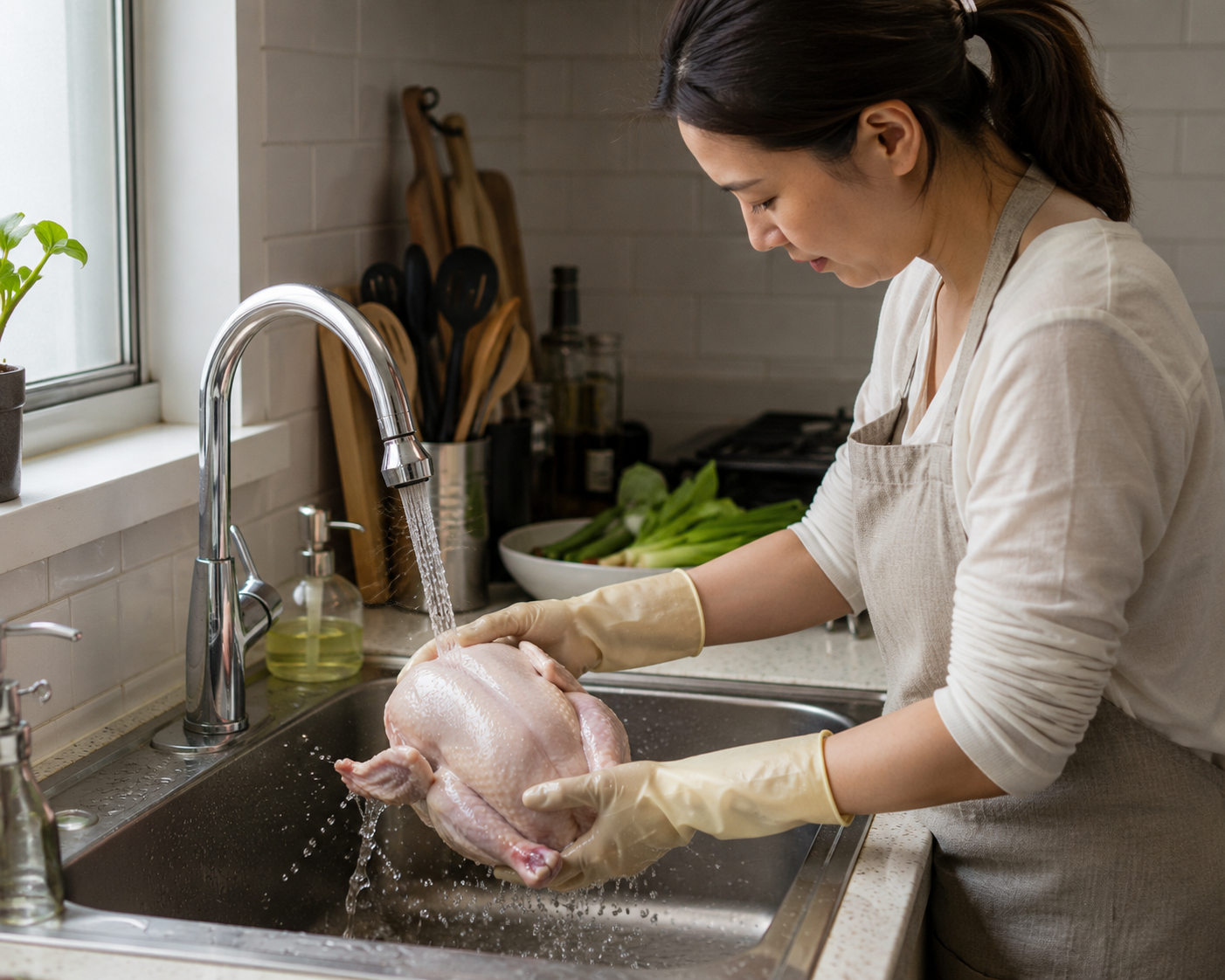

Washing raw chicken may feel like a clean habit, but it can splash bacteria onto your sink, counters, utensils, and nearby food. Here’s what to do instead.
There are some kitchen habits that feel almost automatic because we saw them growing up. Rinsing rice. Washing vegetables. Wiping the counter before cooking. And, in many homes, washing raw chicken before it goes into the pan.
At first glance, it makes sense. Chicken can feel slippery when it comes out of the package. Sometimes there is extra liquid in the tray. Maybe there is a faint smell that makes you want to “freshen it up” before seasoning. So you put it under the faucet, give it a quick rinse, and feel like you’ve made it cleaner.
The problem is that raw chicken does not become safer because it touched running water. In fact, washing it can do the opposite.
Food safety experts, including the USDA and CDC, advise against washing raw chicken because the water can splash germs from the chicken onto your sink, faucet, countertops, utensils, towels, and even nearby food. Cooking chicken properly kills harmful bacteria; rinsing it in the sink does not.
The Habit Usually Comes From a Good Place
Most people who wash chicken are not being careless. They are trying to be careful.
Maybe your family always rinsed chicken before making soup. Maybe a recipe from years ago mentioned washing meat. Maybe the raw juices in the package just look unappetizing. Honestly, I understand the instinct. There is something about opening a pack of raw chicken that makes you want to “deal with it” before it touches anything else.
But food safety is not always intuitive.
The thing that feels cleaner can sometimes create more mess than you can see.
With chicken, the main concern is not dirt you can rinse away. It is bacteria that may be present on the raw poultry, such as Salmonella or Campylobacter. These germs are not reliably removed by a quick rinse. And once water hits the chicken, tiny droplets can carry bacteria beyond the chicken itself.
That is where the trouble starts.
What Actually Happens When Water Hits Raw Chicken
Picture the sink while you are rinsing chicken.
The water hits the surface of the meat. It bounces off. Some of it goes down the drain, sure. But some of it lands on the sink walls, the faucet handle, the edge of the counter, the dish rack, the sponge, the soap bottle, or the cutting board sitting nearby.
You may not see it happen. It is not always a dramatic splash.
Sometimes it is just a fine mist. Tiny droplets. The kind you would never notice unless the light hit them at just the right angle.
That invisible splash can spread bacteria from raw chicken to places that were clean a few seconds earlier. The USDA has specifically warned that washing or rinsing raw meat and poultry can increase cross-contamination risk in the kitchen.
This matters because those surfaces may later touch food that will not be cooked.
A salad bowl. A tomato. A slice of bread. A child’s cup. Your phone, because of course the recipe is open on your phone and somehow it always ends up on the counter.
That is how a simple rinse can turn into a kitchen-wide contamination problem.
“But I Clean the Sink Afterward”
A lot of people say this, and it is a fair point. Many home cooks do clean their sink after handling raw meat.
The issue is that contamination does not always stay neatly inside the sink. USDA research found that even among people who cleaned the sink after washing chicken, germs could still remain. The CDC notes that in one USDA study, 1 in 7 people who cleaned their sink after washing chicken still had germs in the sink.
That does not mean your kitchen is doomed every time you cook chicken. It just means rinsing creates extra risk without giving you a real safety benefit.
And that is the part I find most convincing: washing chicken adds work, creates cleanup, and still does not solve the main problem.
Cooking does.
Cooking Is What Makes Chicken Safe
Raw chicken is not made safe by water. It is made safe by heat.
The practical target is simple: cook chicken until it reaches an internal temperature of 165°F. That is the temperature commonly recommended in U.S. food safety guidance for poultry. A meat thermometer is the easiest way to know, especially with thick chicken breasts, thighs, whole birds, or stuffed preparations.
Without a thermometer, it is easy to guess wrong.
Chicken can look browned outside while still being undercooked near the bone. Or it can look pale and still be fully cooked if it was poached or simmered. Color helps a little, but it is not as reliable as temperature.
A small digital thermometer is one of those boring kitchen tools that earns its drawer space. You do not need a fancy one. Just something that tells you whether the thickest part of the chicken has reached 165°F.
What To Do Instead of Washing Chicken
The better routine is much simpler than people expect.
Open the package carefully. Keep the chicken contained. Move it straight to the cutting board, pan, baking dish, or bowl you are using for seasoning.
If the chicken is very wet, pat it dry with paper towels. Then throw the towels away immediately.
That is it.
Patting dry is useful for cooking, too. Chicken browns better when the surface is not dripping wet. So if your goal is crispier skin, better searing, or less watery marinade, paper towels are more helpful than rinsing.
The USDA says that if there is something on raw poultry you want to remove, you can pat the area with a damp paper towel and then wash your hands right away.
That small change keeps the mess contained instead of spraying it around the sink.
Make a “Raw Chicken Zone”
This sounds more official than it needs to be. I just mean: give raw chicken a small, controlled area and do not let it wander.
Before you open the package, clear the counter. Move the fruit bowl. Move the clean plates. Move the dish towel you actually like and do not want anywhere near raw poultry.
Set out only what you need:
A cutting board.
A knife.
A plate or pan.
Seasoning.
Paper towels.
Trash bag or bin nearby.
Once your hands touch raw chicken, try not to touch ten other things. This is the part where many kitchens get messy. You grab the pepper grinder, open a drawer, adjust the faucet, answer a text, move a bowl, touch the fridge handle.
Then later you wonder, “Wait, did I touch that before or after the chicken?”
I have absolutely done this. Most people have.
A little setup before you start saves you from that awkward mental replay.
Wash Your Hands, Not the Chicken
This is the habit worth keeping.
After touching raw chicken, wash your hands with soap and water for at least 20 seconds. The USDA and CDC both emphasize handwashing as a key step when handling raw poultry.
And yes, 20 seconds can feel longer than expected when you are standing at the sink with chicken seasoning on your wrist.
Use warm or cold running water, lather with soap, scrub between fingers, under nails if needed, and around the backs of your hands. Then dry with a clean towel or paper towel.
The drying part matters more than people think because damp hands can move germs around more easily. Also, using the same kitchen towel all day after touching raw food is… not ideal. Paper towels are handy during raw meat prep, even if you normally prefer reusable cloths.
Be Careful With Cutting Boards and Utensils
A common mistake is using the same board or knife for raw chicken and then vegetables.
Sometimes it happens because dinner is moving fast. You cut chicken, push it aside, then chop onions or lettuce on the same board. If those onions are going into a hot pan with the chicken, that may be less concerning. But if the vegetables are for a salad or garnish, that is a problem.
A simple rule helps: raw chicken gets its own board and utensils until everything is washed.
Some people like using a color-coded board for meat. You do not have to, but it can help. I like any system that works when you are tired and hungry, because that is when kitchen safety tends to get sloppy.
Wash cutting boards, knives, and plates that touched raw chicken with hot, soapy water. If your dishwasher runs hot and the item is dishwasher-safe, that is often the easiest route.
For countertops and sinks, clean first, then sanitize if raw chicken juices touched the surface. Cleaning removes grease and food bits. Sanitizing reduces germs. They are related, but not the same.
What About Lemon Juice, Vinegar, or Salt Water?
Some people do not exactly “wash” chicken under running water. They soak it in vinegar, lemon juice, salt water, or a mix of seasonings and acid.
This can be part of a flavor tradition, and food habits are personal. But from a food safety standpoint, vinegar or lemon juice is not a reliable way to kill harmful bacteria on raw chicken. The USDA notes that rinsing or brining meat and poultry in salt water, vinegar, or lemon juice does not destroy bacteria.
That does not mean you can never marinate chicken.
Marinating is fine when done safely. Keep it in the refrigerator, not on the counter. Use a covered container or sealed bag. Do not reuse marinade that touched raw chicken unless you boil it properly first. And avoid splashing the liquid around when you drain it.
The goal is flavor, not sterilization.
What If the Chicken Smells Weird?
This is where rinsing can become a cover-up habit.
Raw chicken can have a mild smell when you open the package, especially vacuum-sealed chicken. Sometimes the smell fades after a minute. But if the odor is sour, rotten, sulfur-like, or unusually strong, rinsing is not the answer.
Bad chicken does not become good chicken because it was washed.
Check the date, texture, and smell. If it feels unusually slimy even after patting dry, looks discolored, or smells clearly off, it is safer to throw it away. I know that feels painful when groceries are expensive. Still, food poisoning is worse than losing a package of chicken.
When in doubt, do not try to rescue questionable poultry with water, vinegar, or extra seasoning.
The Sink Is Not as Clean as It Looks
The kitchen sink has a reputation for being a cleaning place, so we forget that it can also be a dirty place.
Raw chicken juice in the sink can touch the drain area, the basin, the faucet, the sponge, and anything sitting nearby. Then the sponge gets used on a plate. The faucet gets touched after handwashing. The sink gets used to rinse berries.
This is why washing chicken can be sneaky. The chicken itself goes into the pan and gets cooked, but the bacteria may have already moved elsewhere.
If raw chicken juices do end up in the sink, clean it with hot, soapy water. Then use an appropriate kitchen sanitizer according to the product directions. Let it sit for the recommended contact time instead of spraying and immediately wiping it away.
That last part is easy to skip. I skip-read labels too. But sanitizers usually need a little time to work.
A Realistic Chicken Prep Routine
Here is a routine that feels doable on a normal weeknight, not just in a food safety brochure.
Clear a small area near the stove or prep space.
Put the trash nearby.
Open the chicken package carefully, keeping the juices from dripping across the counter.
Pat the chicken dry with paper towels if needed.
Season it on a plate, tray, or board used only for raw meat.
Move it to the pan, oven dish, grill, or air fryer basket.
Wash your hands well.
Wash or set aside any tools that touched the raw chicken.
Cook the chicken to 165°F.
Clean the counter, sink area, and any spots that may have been touched during prep.
That is not glamorous. It is just practical.
And after a few times, it becomes easier than washing the chicken because there is less splashing and less cleanup.
Why This Habit Is Hard To Change
Food habits are sticky because they are tied to family, comfort, and the feeling of doing things “properly.”
If your parent or grandparent washed chicken, stopping may feel oddly wrong at first. Almost lazy. Like you skipped a step.
But kitchen knowledge changes. Food processing changes. Public health advice gets clearer. A habit can be traditional and still not be the safest option.
There is no need to judge yourself or anyone else for having done it. Most people who rinse chicken are trying to protect their family. The better information is simply this: the safest move is to keep raw chicken contained, avoid splashing, wash your hands and tools, and cook it thoroughly.
That is the part that matters.
Final Thought
Washing chicken feels clean because water usually means cleaning. But raw poultry is one of those exceptions where the sink can make things messier, not safer.
Skip the rinse. Pat it dry if you need to. Keep raw chicken away from ready-to-eat foods. Wash your hands like you mean it. Cook the chicken all the way through.
It is a small kitchen habit to change, but it removes a risk that was never helping much in the first place.

Hi, I’m the creator and editor behind ZestyHabit. I research everyday safety, first aid, and practical wellness topics using official guidance and reliable public sources, then turn that information into clear, realistic steps for daily life.
My goal is to help readers make safer, better-informed choices at home and beyond.


[…] or upper sleeve. It keeps droplets away from your hands and makes it less likely that you will spread germs to shared […]