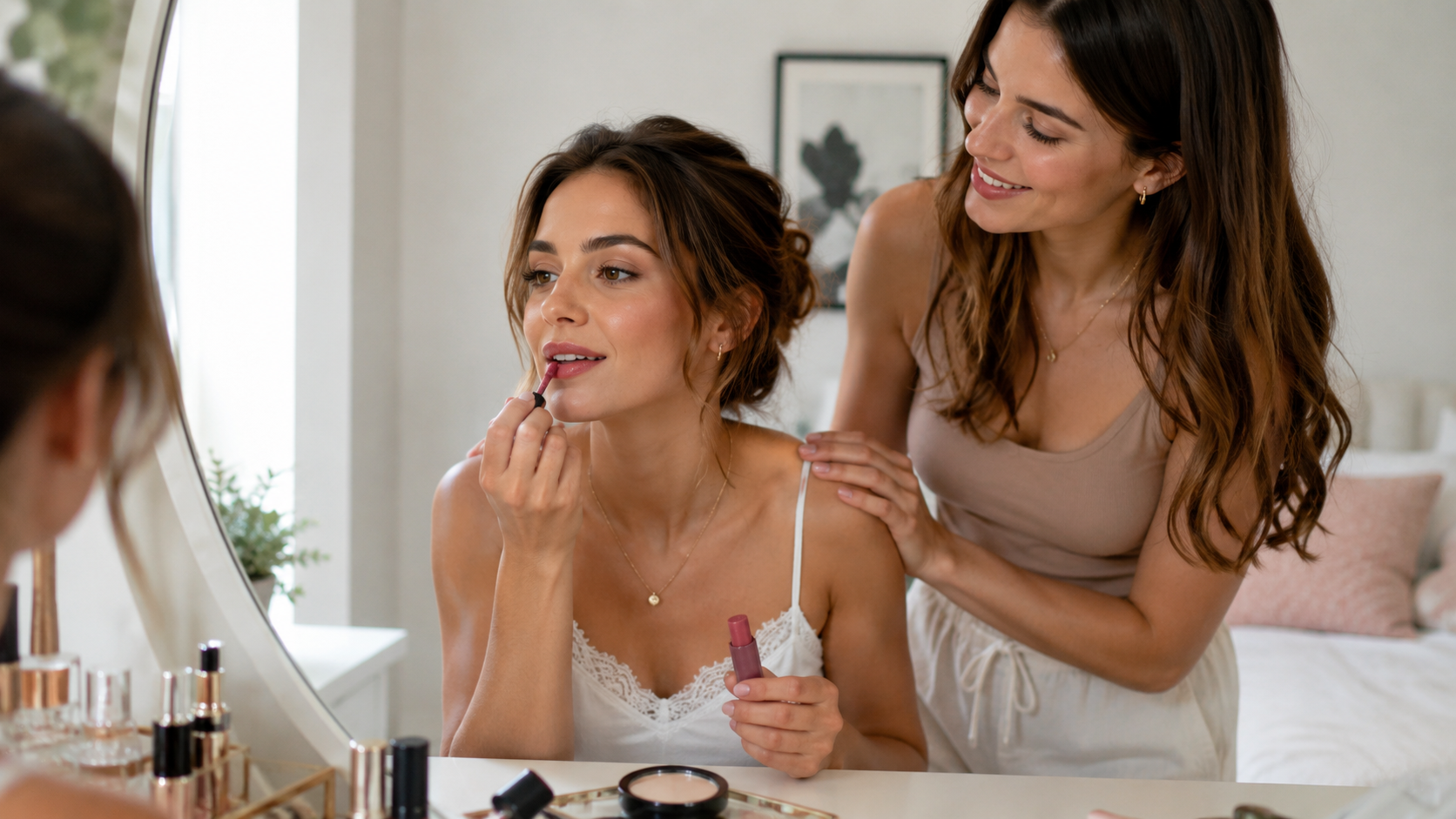
Sharing lip balm, lipstick, or gloss may seem harmless, but it can spread germs more easily than people realize. Here’s why it’s better to keep lip products personal, plus simple ways to handle awkward sharing moments.

It Feels Harmless Until You Think About Where It Goes
Sharing a lip balm with a friend can feel like nothing.
You are out at brunch, someone says their lips are dry, and you happen to have a balm in your bag. Or you are getting ready before a night out, and one person’s lipstick shade looks perfect on everyone. A quick swipe, a laugh, maybe a mirror passed around. It feels friendly, casual, even a little nostalgic.
Most of us have done it at least once.
The problem is that lip products touch one of the easiest places for germs to move in and out of the body: the mouth area. Lips are delicate. The skin around them can crack. Saliva, tiny skin flakes, oils, and bacteria can transfer onto the product, then sit there until the next person uses it.
That does not mean every shared lip balm is a disaster waiting to happen. Life is not that dramatic. But it does mean the habit is riskier than it looks, especially when it happens often or when someone has a cold sore, a cold, cracked lips, or an infection they have not noticed yet.
And honestly, lip balm is one of those things that feels too small to make a big deal about. That is exactly why people keep sharing it.
Why Lips Are So Easy to Irritate

Lips do not have the same tough protective layer as the skin on your arms or legs. They dry out faster, split more easily, and are constantly exposed to food, drinks, weather, saliva, and touching.
Think about a winter day. Your lips feel tight, you lick them without thinking, then they get drier. Maybe there is a tiny crack at the corner of your mouth. You might not even see it, but it is there.
Now imagine using a shared lip balm over that area.
A small crack gives germs a better chance to settle in. Even when lips look normal, the mouth carries plenty of bacteria and viruses. That is not meant to sound scary; everyone’s mouth has microbes. The issue is transfer. A lip product can become a little bridge between one person’s mouth area and another’s.
Lip gloss, balm, lipstick, lip liner, tinted oil, and even those cute squeeze-tube lip treatments can all pick up residue if they touch the lips directly. Products with applicator wands can be especially tricky because the wand goes from mouth to tube and back again. Whatever it picks up can end up inside the product.
Not exactly the glamorous part of beauty routines.
Cold Sores Are the Big One People Forget About
The most common concern with sharing lip products is cold sores.
Cold sores are usually caused by herpes simplex virus type 1. They often appear as small blisters around the lips, but the timing is frustrating. A person may be contagious before a sore is fully visible. Sometimes they feel a tingle, itch, or slight burn before anything shows up. Sometimes they do not connect that feeling with a cold sore at all.
That is where sharing gets messy.
Someone might say, “I don’t have anything right now,” and mean it honestly. But if they are at the early stage of an outbreak, a shared lip balm or lipstick can still be a bad idea.
This is also why borrowing “just once” is not always as harmless as it sounds. The risk is not about whether your friend is clean. It is not about judging anyone. Cold sores are common, and many people carry the virus. It is simply one of those things that does not pair well with shared lip products.
A good personal rule is simple: if a product touches your lips, it stays yours.
Colds, Flu, and Other Everyday Germs Can Tag Along Too
Cold sores get most of the attention, but they are not the only concern.
When someone is sick, even mildly sick, their mouth area can carry germs from coughing, sneezing, nose wiping, drinking, or touching their face. A person might not be visibly ill either. Maybe they are at the “I think allergies are acting up” stage. Maybe they had a sore throat yesterday. Maybe they are getting sick tomorrow.
Lip products are not the main way every illness spreads, of course. Shared air, hands, cups, and surfaces matter too. But a lip balm passed around during cold season is not doing anyone a favor.
This is especially true with products that feel moist or creamy. A dry pencil lip liner is still not ideal to share, but a sticky gloss wand or soft balm can hold onto residue more easily. If you have ever opened an old lip gloss and noticed the smell changed, you already know lip products are not magical germ-proof objects.
They live in bags, cars, coat pockets, bathroom counters, and sometimes the bottom of a backpack next to crumbs from who knows when. They deserve a little suspicion.
Sharing Can Trigger Breakouts Around the Mouth
Not every reaction is an infection. Sometimes sharing lip products simply irritates your skin.
Someone else’s lip balm might contain fragrance, flavoring, lanolin, menthol, cinnamon oil, plumping ingredients, dyes, or preservatives your skin does not like. You may not know until your lips start burning or the skin around your mouth gets bumpy the next day.
This can be especially annoying for people who already have sensitive skin, eczema, acne-prone skin, or perioral dermatitis. A product that works fine for your friend may be completely wrong for you.
Even if the formula is not irritating on its own, the product may carry oils, bacteria, or old residue that can contribute to clogged pores around the lip line. Those tiny bumps near the mouth are irritating in a very specific way. They are small, stubborn, and always seem to appear right before you need to look put together.
Sharing lipstick for a quick photo may not seem worth it after that.
“But It’s My Best Friend” Does Not Change the Biology
This is the part that makes people feel awkward.
Sharing lip products often happens between close friends, siblings, partners, or roommates. People may think, “We share drinks anyway,” or “We’re always together, so what’s the difference?”
Closeness does not remove the risk. It only makes the habit feel more normal.
You can love someone, trust them, and still not want their lip balm. Those ideas can exist in the same room. Hygiene boundaries do not have to be cold or dramatic. They are just practical.
The same way you probably would not share a toothbrush, you can choose not to share lip products. Lip balm is not quite as intense as a toothbrush, obviously, but the logic is similar: it touches saliva, skin, and the mouth area. That is enough reason to keep it personal.
A decent friend will understand. They might tease you for three seconds, but they will understand.
Lip Gloss Wands Are Especially Sneaky
Some products are easier to share safely than others. A lipstick bullet can technically be wiped or sprayed and the top layer removed, though that is still more effort than most people make in real life.
Lip gloss wands are a different story.
The wand touches the lips, then goes back into the tube. Over time, anything on the wand can mix with the product inside. You cannot clean the inside of a lip gloss tube. You cannot scrape off the “used” layer. Once it has been shared directly, it is shared all the way through.
The same issue applies to liquid lipstick, lip oils with doe-foot applicators, and some tinted treatments.
This is why makeup artists use disposable applicators. They do not swipe one wand across five people and call it charming. They use clean tools for each person because the product needs to stay sanitary.
At home, most of us are not setting up a professional makeup station before going out. Fair enough. But that also means direct sharing is better avoided.
Lip Balm Pots Are Not Innocent Either
Potted lip balms look cute. They also invite fingers.
If someone dips a finger into a balm pot after touching their phone, keys, steering wheel, or snack wrapper, that balm is now hosting more than moisture. Add another person dipping into the same pot, and the situation gets even less appealing.
Phones alone are enough reason to pause. Most people touch their phones constantly, including while eating, commuting, shopping, and using public bathrooms. Then those same fingers go into a lip pot. I do not say this to ruin your favorite balm, but once you notice the chain of contact, it is hard to unsee.
For personal use, a lip pot can be fine if your hands are clean. For sharing, it is not the best choice.
If you like potted products, keep them personal and try to use clean hands or a small spatula. That sounds fussy until you get a cracked lip corner that refuses to heal for a week.
The Awkward Part: Saying No Without Making It Weird
The hardest part is not understanding the risk. It is handling the moment.
A friend asks, “Can I use your lip balm?” and suddenly you feel like the villain in a very tiny social drama.
You do not need a speech. You do not need to explain viruses over dinner. A casual line works best.
Try something like:
“I’m weird about sharing lip stuff, sorry.”
Or:
“I don’t share lip products, but I have an extra unopened one.”
Or even:
“I’m trying not to share anything that touches my mouth.”
That is enough.
Most people respond better when you keep it light. You are not accusing them of being dirty. You are just setting a small boundary. A little humor helps too: “My lip balm has trust issues” is ridiculous, but it gets the job done.
If you are the person asking, try not to take it personally. Someone saying no to sharing lip balm is not a friendship test. It is just hygiene.
What To Do Instead
The easiest solution is to carry a spare.
A small, unopened lip balm in your bag can save the day without turning your own product into a community item. Drugstore balms are cheap enough that keeping an extra one around is realistic for many people. If your friend always forgets theirs, giving them a spare may be kinder than sharing yours every week.
For makeup nights, disposable lip applicators are useful. They are not only for professionals. If friends are trying on shades, use clean applicators and avoid double-dipping. Put a little product onto a clean surface or palette, then apply from there.
For lipstick bullets, you can use a clean brush or disposable applicator instead of applying straight from the tube. If you are testing products in a store, do not apply testers directly to your lips. Use your hand, a disposable tool, or skip it. Store testers have lived many lives.
For lip balm in a pot, do not pass it around. If someone really needs some, you can scoop a tiny amount with a clean cotton swab or disposable spatula. That may sound overly careful, but it is still less awkward than sharing germs.
When You Should Definitely Not Share
Some situations are clear no’s.
Do not share lip products if either person has a visible cold sore, a healing sore, tingling around the lips, cracked corners of the mouth, bleeding lips, or any rash around the mouth.
Do not share if someone has recently been sick, has a sore throat, or has been coughing. Same goes for events where everyone is eating, drinking, and touching the same surfaces all night. That lip gloss does not need to join the party.
It is also smart to avoid sharing during winter, travel, school events, festivals, sleepovers, and group trips. Basically, any situation where people are tired, dehydrated, and passing things around without thinking.
And if a lip product smells off, changes texture, separates strangely, or has been sitting around for a questionable amount of time, retire it. There is no award for finishing every tube.
Replace Old Lip Products More Often Than You Think
A lot of people keep lip products forever. There is always one old lipstick in the bottom of a bag, one balm in the car, one gloss from a holiday set three years ago.
Lip products do expire. They may not suddenly become dangerous on a specific date, but over time the formula can break down, smell different, dry out, or become more likely to irritate your skin.
Mascara gets the most attention for expiration, but lip products deserve a little cleaning-out too. If a gloss smells sour, a lipstick smells waxy in a strange way, or a balm feels gritty when it used to be smooth, toss it.
Heat matters as well. A lip balm that melts in a hot car, solidifies, melts again, and rolls around under the seat is not living its best life.
A practical habit: check your lip products every few months. Keep the ones you actually use. Throw out the suspicious ones. Your bag will feel lighter, and your lips will probably be happier.
What About Sharing With a Partner?
This question comes up because partners often kiss, share drinks, and live closely together. So is sharing lip balm still a concern?
It can be lower-stakes in some cases because you already share close contact. But it is not automatically risk-free. If one person has a cold sore outbreak, mouth irritation, a cold, or an infection, sharing lip products can still spread or worsen the issue.
There is also the product itself. A shared balm can collect residue and move it back and forth. Even between partners, separate lip balms are cleaner and simpler.
This does not need to become a big household rule posted on the fridge. Just keep your own balm on your side of the sink or in your own bag. Small boundaries are easier when they are built into the routine.
Kids, Teens, and Shared Lip Products
Teenagers and younger kids may share lip glosses, flavored balms, and trendy lip oils without thinking twice. It feels social. It is part of getting ready together, trying a friend’s new product, or copying a shade they saw online.
This is a good place for a gentle explanation rather than panic.
Saying “never share because it’s disgusting” may only make it dramatic. A calmer approach works better: lip products touch the mouth, and mouth germs can spread. Everyone should have their own. If friends want to try colors, use clean applicators.
For parents, it helps to give kids their own inexpensive lip balm and replace it when needed. For teens, disposable applicators or small sample containers can make sharing makeup looks possible without direct sharing.
The goal is not to make people afraid of makeup. It is to teach the difference between fun and unnecessary risk.
A Cleaner Lip Routine That Still Feels Normal
You do not have to become obsessive about your lip products. You just need a few habits that make sense.
Keep your main lip balm personal. Avoid applying lip products over broken skin if you can. Wash your hands before using potted products. Do not use a gloss wand on someone else. Replace products that smell strange or look old. Carry a backup if people often ask to borrow yours.
Also, try not to lick dry lips all day. It feels helpful for about four seconds, then usually makes the dryness worse. A simple balm, enough water, and a little patience often work better.
If your lips are constantly cracked, peeling, burning, or irritated, it may not be just dryness. Fragrance, flavoring, toothpaste, weather, allergies, or skin conditions can all play a role. In that case, switching to a plain, fragrance-free balm and avoiding shared products is a good starting point. If it does not improve, getting medical advice is worth it.
The Bottom Line on Sharing Lip Products
Sharing lip balm or lipstick seems like a tiny kindness, and sometimes it comes from a sweet place. Someone needs help, you have the thing, and passing it over feels natural.
But lip products touch the mouth. They can pick up saliva, skin cells, bacteria, viruses, and irritants. Cold sores, colds, breakouts, and lip irritation are all good reasons to keep them personal.
The fix is not complicated. Carry your own. Keep a spare if you like being helpful. Use clean applicators when trying makeup with friends. Say no casually when someone asks to borrow yours.
It is a small boundary, but a useful one. Your lip balm can still be generous in spirit without becoming a group project.
Leave a Reply