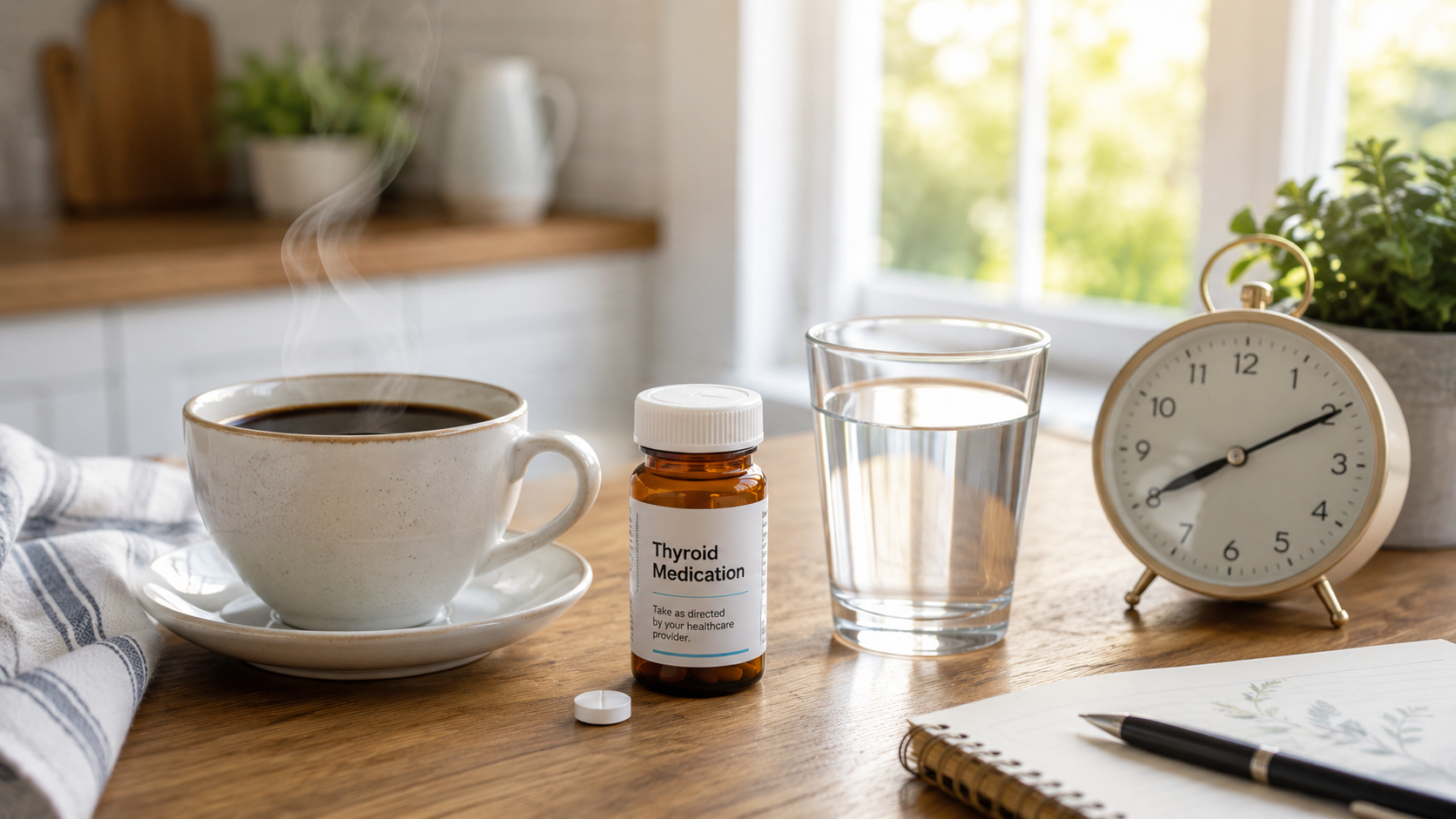
Morning Coffee and Thyroid Medication: Why a Few Minutes Can Matter More Than You Think
Minjin Park
·
If you take thyroid medication in the morning, coffee timing can affect how well your body absorbs it. Here’s why that small gap before your first cup matters, and how to make the habit easier.
For a lot of people, morning coffee is not really a beverage.
It is a ritual.
You wake up, shuffle into the kitchen, press a button, scoop grounds into a machine, or stand there half-awake waiting for the kettle. The smell hits first. Then the first sip makes the room feel slightly less hostile.
So when someone says, “You should wait before drinking coffee after taking your thyroid medication,” it can feel oddly personal.
Wait? Before coffee?
That tiny instruction can feel much bigger in real life than it sounds in a doctor’s office. Especially if you already wake up tired, cold, foggy, or rushed. Especially if taking thyroid medicine is just one more thing on a morning checklist that already includes alarms, pets, kids, work messages, breakfast, and trying to find your keys.
But with thyroid medication, especially levothyroxine, timing really can matter.
Not because coffee is “bad.” Not because one rushed morning ruins everything. But because thyroid medicine is one of those medications where absorption is picky. It wants a fairly quiet stomach, water, and a little time before food, coffee, supplements, or other medications start joining the party.
That small window between your pill and your coffee can affect how consistently your body receives the medication.
And consistency is the part people often underestimate.
Why Thyroid Medication Is So Sensitive to Timing
Levothyroxine is commonly prescribed for hypothyroidism, a condition where the body does not make enough thyroid hormone. The medication helps replace what the thyroid is not producing enough of.
The tricky part is that it has to be absorbed through the digestive system first.
That sounds simple, but your stomach is not an empty hallway. It is more like a busy kitchen. Food, coffee, calcium, iron, antacids, fiber, milk, and some other medicines can all change how well levothyroxine is absorbed.
That is why many instructions say to take levothyroxine in the morning on an empty stomach with water, then wait before eating or drinking anything else. Mayo Clinic lists the usual guidance as taking the tablet or capsule at least 30 to 60 minutes before breakfast. It also notes that calcium, iron, antacids, and several other medicines may need to be separated by at least four hours.
That may sound fussy, but it is not random fussiness.
If your body absorbs less medication one day and more the next, your thyroid levels may become harder to keep steady. And when thyroid levels are off, people may feel it in very ordinary but frustrating ways: fatigue, brain fog, feeling cold, mood changes, constipation, or changes in weight and energy.
Not everyone feels changes immediately. Some people do not notice anything obvious for weeks. That is part of why the habit can quietly matter.
So What Does Coffee Have to Do With It?
Coffee is often the first thing people reach for after swallowing their thyroid pill.
The problem is that coffee has been reported to reduce absorption of levothyroxine tablets when taken too close together. The American Thyroid Association notes that patients are usually instructed to take levothyroxine on an empty stomach 30 to 60 minutes before food to avoid erratic absorption.
Coffee is one of the everyday things that can interfere with that clean absorption window.
The annoying part is that black coffee may seem like it should not count. It is not breakfast. It is not a calcium supplement. It is not a full meal. It feels like a harmless liquid, and for many medications, black coffee does not matter much.
But thyroid medicine is not always that forgiving.
For many people taking standard levothyroxine tablets, the safer routine is: pill first, water only, coffee later.
Some sources recommend waiting a full hour before coffee, especially if your thyroid levels have been hard to stabilize or your clinician specifically told you to be strict. Drugs.com, summarizing common guidance, notes that most foods are generally eaten 30 to 60 minutes after levothyroxine, while coffee and cow’s milk have also been reported to decrease absorption.
A few minutes may not feel like much. But when you repeat the same habit every morning for months, it can add up.
The Real Issue Is Not One Cup. It Is the Pattern.
Let’s be realistic.
Plenty of people have had coffee too soon after thyroid medication at least once. Maybe you forgot. Maybe you were traveling. Maybe you had a 7 a.m. meeting and needed caffeine before forming full sentences.
One imperfect morning is not usually the big concern.
If you take your medication at 7:00 and drink coffee at 7:05 every morning, your body may consistently absorb less than expected. Your blood tests may reflect that. Your doctor may adjust your dose based on those numbers, not realizing the routine is part of the picture unless you mention it.
That does not mean you should change your dose on your own. Please do not do that. Thyroid medication dosing should be handled with your clinician.
But it does mean your coffee habit is worth being honest about.
If your doctor asks, “Are you taking it on an empty stomach?” and you say yes because you are not eating breakfast, but you are drinking coffee five minutes later, that detail matters.
Not in a shameful way. Just in a practical one.
Your morning routine is part of the medication routine.
Why “30 Minutes” and “60 Minutes” Both Get Mentioned
This is where people get confused.
Some instructions say wait 30 minutes. Some say 30 to 60 minutes. Some people online swear their doctor told them one full hour. Someone else says they drink coffee after 20 minutes and their labs are fine.
No wonder it feels messy.
In general, many standard patient instructions give a range of 30 to 60 minutes before breakfast. The American Thyroid Association has also discussed that patients are commonly told to wait 30 to 60 minutes before food intake to avoid erratic absorption.
But the “best” timing can depend on the person.
Someone whose thyroid levels are stable may be fine with a consistent 30-minute wait if their clinician agrees. Someone who has fluctuating TSH levels, is pregnant, has a history of thyroid cancer, takes several other medications, or is especially sensitive to small thyroid changes may be told to wait longer or follow a stricter routine.
The key word is consistent.
A consistent 45-minute wait may be better than randomly waiting 5 minutes one day, 90 minutes the next, and taking it with breakfast on weekends.
Your body and your lab results are both easier to interpret when your routine is predictable.
The Creamer Question
Now we have to talk about the real morning coffee situation.
Because when people say “coffee,” they often mean coffee with milk, half-and-half, creamer, protein drink, collagen powder, sugar, or something else mixed in.
That matters.
Milk contains calcium, and calcium is one of the classic things that can interfere with levothyroxine absorption. Calcium supplements are usually separated by several hours from thyroid medication. Mayo Clinic notes that medicines or products containing calcium or iron should be taken at least four hours before or after levothyroxine.
A splash of milk is not the same as swallowing a calcium tablet, of course. But if your morning coffee is basically a small latte, it is no longer just coffee. It is coffee plus dairy. If it is a protein coffee, it may contain minerals or added ingredients that complicate the picture even more.
This is why “I only had coffee” can mean different things.
Black coffee. Coffee with milk. Coffee with a full scoop of protein powder. Coffee with a meal replacement shake. Coffee with collagen and creamer.
Those are not the same morning routine.
For thyroid medication, plain water is the cleanest partner.
Boring? Yes. But reliable.
What About Liquid Thyroid Medication?
There is an interesting exception worth knowing, but not assuming.
Some research suggests that coffee may not affect certain liquid levothyroxine formulations in the same way it affects standard tablets. The Endocrine Society reported on research suggesting that coffee did not hinder absorption of a liquid form of levothyroxine, even when taken close together.
That does not mean everyone can ignore timing.
It depends on the exact medication form you take: tablet, capsule, soft gel, liquid, brand, generic, and your own medical situation. Product instructions and your prescriber’s advice still come first.
But if you truly cannot manage the morning waiting window, it may be worth asking your clinician whether a different formulation or bedtime dosing could make sense for you.
Do not switch forms or timing casually. Thyroid medication is often adjusted based on lab results, and changes should be tracked properly.
The Bedtime Option Some People Forget
Morning is common, but it is not the only possible time for everyone.
Some people take levothyroxine at bedtime instead, usually several hours after the last meal. This can be useful for people who cannot function without immediate coffee or who have chaotic mornings.
The catch is that bedtime dosing also needs consistency.
If you snack at night, take supplements, drink milk, or use antacids before bed, the same absorption problem can show up in a different outfit.
A bedtime routine might look simple for one person and impossible for another. Someone who eats dinner at 6 and goes to bed at 10 may find it easy. Someone who grazes until midnight probably will not.
The best routine is not the one that sounds perfect on paper. It is the one you can actually do most days and discuss clearly with your healthcare provider.
A Morning Routine That Feels Less Annoying
The waiting period becomes easier when you stop treating it as empty time.
One simple approach is to put your medication and a glass of water beside your bed. When your first alarm goes off, take the pill with water. Then doze, stretch, check the weather, shower, get dressed, feed the cat, or stare at the ceiling like a person slowly returning to Earth.
By the time coffee happens, some of the waiting is already done.
Another option is to create a “water first, coffee later” rule. Medication with water. Bathroom. Shower. Clothes. Then coffee. The routine itself becomes the timer.
Some people set a phone alarm labeled “coffee okay.” It sounds dramatic until you realize how many mornings run on autopilot.
You can also prepare coffee during the waiting window but not drink it yet. The smell is still there. The cup is waiting. It feels less like punishment and more like a short delay.
A tiny habit shift can make the whole thing less irritating.
When to Bring It Up With Your Doctor
It is worth mentioning your coffee timing if your thyroid labs have been unstable, your symptoms do not match your dose, or your medication keeps being adjusted without a clear reason.
You do not need to confess like you committed a crime.
Just say something plain:
“I usually drink coffee about 10 minutes after taking my thyroid medication. Could that affect my labs?”
That is useful information.
Also mention supplements, especially calcium, iron, magnesium, multivitamins, fiber supplements, antacids, and acid reflux medicines. These are easy to forget because they may not feel like “real medication,” but they can affect absorption.
Your clinician may not need you to overhaul your life. They may simply ask you to separate timing, repeat labs after a consistent routine, or adjust the plan based on your situation.
The point is not perfection. It is clarity.
Do Not Let the Rule Make You Anxious
There is a fine line between being careful and becoming tense about every sip.
The goal is not to panic if you accidentally drank coffee too soon. It happens. Get back to your usual routine the next day unless your clinician told you otherwise.
What matters most is the pattern you repeat.
A steady routine helps your medication work more predictably and helps your doctor interpret your bloodwork more accurately. That is the practical reason behind the waiting window.
Not fear. Not guilt. Just consistency.
A Small Delay That Can Make the Day More Stable
Morning coffee is one of those small comforts that can make daily life feel manageable. Nobody wants to turn it into a medical obstacle course.
But if you take thyroid medication, especially levothyroxine tablets, it is worth giving the medicine a quiet head start with water before coffee enters the scene.
For many people, that means waiting 30 to 60 minutes before breakfast or coffee, and keeping calcium, iron, and certain other products several hours away. Your exact routine should match your prescription instructions and your clinician’s advice.
A few minutes may seem small, but repeated every day, they can matter.
Take the pill. Drink the water. Let your body absorb what it needs.
Then enjoy the coffee properly, without wondering if it got in the way.
Hi, I’m the creator and editor behind ZestyHabit. I research everyday safety, first aid, and practical wellness topics using official guidance and reliable public sources, then turn that information into clear, realistic steps for daily life.
My goal is to help readers make safer, better-informed choices at home and beyond.