
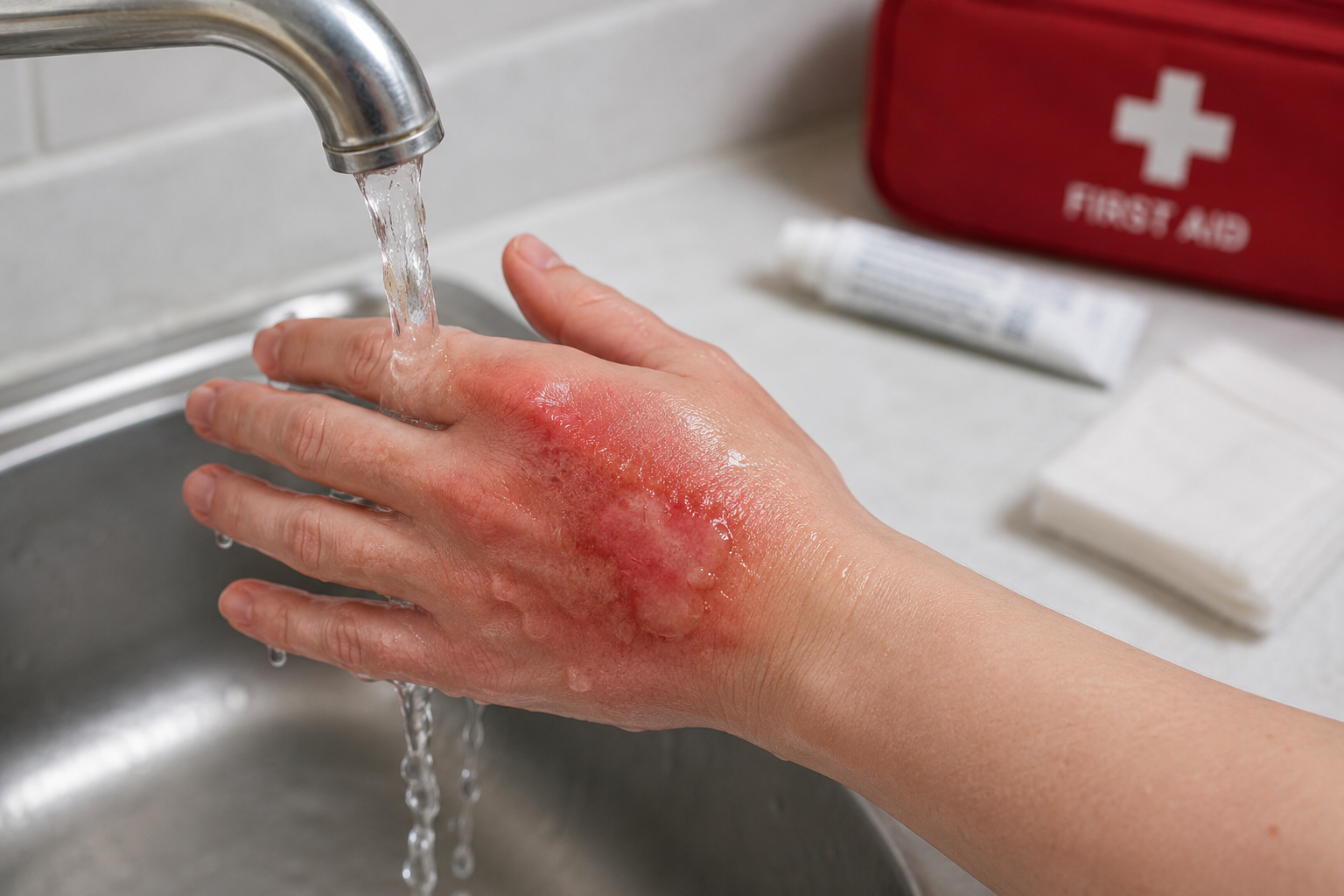

A burn can happen in seconds, but the first few minutes matter. Here’s what to do right away, what not to put on a burn, and when a burn needs medical care.
The First Few Minutes Matter More Than People Think

Burns have a way of making everyone in the room suddenly confident.
Someone says to put butter on it. Someone else says ice. Another person starts looking for toothpaste, which is somehow still a thing people suggest. Meanwhile, the burned person is standing there in pain, holding their hand like it has personally betrayed them.
The good news is that burn first aid does not need to be complicated.
The most useful first step for many minor household burns is simple: cool the burn under cool running water. Not ice water. Not a frozen bag of peas pressed against the skin. Cool water.
Mayo Clinic recommends holding a minor burn under cool, not cold, running water for about 10 minutes, then covering it with a clean bandage. The American Red Cross also advises cooling burns with cool, clean running water and warns not to use ice, ice water, or freezing compresses.
That first step can reduce heat in the tissue, ease pain, and help prevent the injury from getting worse. It is not magic, but it is the kind of boring practical thing that actually helps.
Get Away From the Heat Source First
Before treating the burn, stop the burning.
That may mean moving your hand away from the pan, turning off the stove, removing yourself from steam, stepping away from a hot appliance, or getting out of the sun. If clothing is on fire, the classic “stop, drop, and roll” advice still matters.
For a chemical burn, the first priority is getting away from the chemical and following emergency guidance for that substance. For an electrical burn, the situation can be dangerous even if the skin injury looks small, because electricity can affect the heart and deeper tissues. The Red Cross notes that electrical burns can affect heart rhythm and breathing, so they deserve serious attention.
With ordinary kitchen burns, people often skip this step because they are embarrassed. They keep cooking. They finish pouring the pasta. They wipe the counter. They say, “It’s fine, it’s fine,” while their finger is still throbbing.
Pause. Move away from the heat. Then cool the burn.
The pasta can wait.
Cool the Burn, But Do Not Freeze It
Cool running water is your friend.
Ice is not.
Ice sounds helpful because it feels like the fastest way to stop the burning sensation. The problem is that ice can damage already injured skin and reduce blood flow to the area. Mayo Clinic specifically says not to use cold water to cool a burn, and the Red Cross warns against ice, ice water, or freezing compresses.
Use cool tap water instead. Let it run gently over the burned area. If running water is not available, a clean cool wet cloth can help until you can get proper cooling.
For a small burn on a hand or arm, this is usually easy. For a burn on the torso, face, or a larger area, be more careful. Cooling a large burn too aggressively can chill the person too much, especially children, older adults, or someone already in shock. Major burns need emergency care.
The goal is to cool the burn, not freeze the person.
Take Off Tight Items Before Swelling Starts
Burned skin can swell.
That swelling can turn rings, bracelets, watches, belts, tight sleeves, or shoes into a problem. Something that feels loose now may become painfully tight later.
If you can remove jewelry or tight clothing near the burned area without pulling at damaged skin, do it early. Mayo Clinic advises removing jewelry, belts, and other tight items, especially from the burned area and neck, before swelling occurs.
The key phrase is “without pulling at damaged skin.”
If fabric is stuck to the burn, do not rip it off. That can tear the skin and make the injury worse. Cut around the stuck material if needed and get medical help.
This is one of those moments when calm, slow hands help. People get frantic around burns. They start tugging at things. Take a breath and be gentle.
Cover the Burn After Cooling
Once the burn has been cooled, cover it loosely.
A clean, dry, nonstick dressing is ideal. A sterile gauze pad works if you have one. In a pinch, a clean cloth is better than leaving it exposed to dirt, friction, or curious fingers.
Do not wrap it tightly. Burned skin needs protection, but swelling may happen, and a tight bandage can create more pain.
Mayo Clinic recommends covering a burn with a clean bandage after cooling, and the Red Cross suggests a sterile dressing, clean dressing, or plastic wrap if necessary while waiting for care.
Plastic wrap may sound strange, but it is sometimes used because it does not stick to the burn. Still, for everyday minor burns, most people will reach for clean gauze or a nonstick pad.
Try not to keep touching the burn to “check it.” Everyone does this. It is understandable. But touching adds irritation and germs.
Do Not Put Butter, Toothpaste, or Random Kitchen Fixes on It
Burns bring out folklore.
Butter. Oil. Egg whites. Toothpaste. Flour. Soy sauce. Honey from the pantry. A mystery ointment that expired during a previous presidential administration.
Please do not.
Greasy substances can trap heat and make cleaning harder. Toothpaste can irritate skin. Powders can contaminate the wound. Random home remedies can delay actual first aid.
After cooling and covering, mild burns may later be soothed with appropriate products, but the first response should not be a kitchen experiment. Mayo Clinic notes that after a burn has cooled and started healing, lotion with aloe vera or cocoa butter may soothe dryness, but that is not the same as smearing random products on a fresh burn.
If the skin is open, blistered, large, dirty, or in a sensitive area, be more cautious. A pharmacist, doctor, urgent care clinic, or nurse line can help you decide what is safe to apply.
Your burn should not become a science fair project.
Leave Blisters Alone
Blisters are annoying. They look dramatic. They catch on clothing. They make people want to poke them.
Try not to.
A blister is part of the skin’s protective response. Popping it can increase the risk of infection and expose tender tissue underneath. If a blister breaks on its own, keep the area clean, cover it with a nonstick dressing, and watch for signs of infection.
Small blisters from minor burns can often be managed at home if the person is otherwise well and the burn is in a low-risk spot. But large blisters, blisters on the hands, face, feet, genitals, or over a joint, or blisters in young children or older adults may need medical advice.
Also, do not assume “no blister” means “not serious.” Deep burns can sometimes be less painful because nerves are damaged. A burn that looks white, leathery, waxy, charred, or numb should be treated as serious.
Pain is information, but it is not the whole story.
When a Burn Needs Medical Care
Some burns should not be handled casually at home.
Get urgent medical care or call emergency services if the burn is large, deep, caused by electricity or chemicals, involves the face, eyes, hands, feet, genitals, or a major joint, or if there is trouble breathing after smoke or fumes. Mayo Clinic lists difficulty breathing from smoke or fumes as a burn-related emergency concern, and notes that minor burns may still need emergency care when they affect sensitive areas such as the eyes, mouth, hands, or genitals.
Also seek care if the person is an infant, an older adult, immunocompromised, or has diabetes or poor circulation. These situations can make healing more complicated.
A burn should also be checked if pain is severe, redness spreads, swelling worsens, pus appears, fever develops, red streaks show up, or the wound smells bad. Those can be signs of infection.
And if you are unsure? That counts. Burns can be hard to judge, especially in the first hour.
Special Case: Scalds From Hot Liquid
Hot water, soup, coffee, tea, and oil are common causes of household burns.
Scalds can spread quickly over the skin, especially if liquid soaks clothing. If clothing is wet with hot liquid and not stuck to the skin, remove it carefully and cool the area under running water. If the clothing is stuck, do not pull it away.
Be extra careful with children. Their skin is thinner, and a burn can be more serious than it looks at first. A splash of hot coffee that an adult might treat as a painful inconvenience can be a much bigger problem for a toddler.
Hot oil burns can also be tricky. Oil holds heat and can cling to skin. Cool the burn with running water and get medical advice if the area is blistered, large, or very painful.
The first move is still the same: cool the burn and protect it.
Special Case: Chemical Burns
Chemical burns are not just “regular burns with a different cause.”
The chemical may keep damaging skin until it is removed or diluted. If a dry chemical is involved, you may need to brush off dry powder first before rinsing, depending on the substance. If a chemical gets in the eye, that is urgent.
Because chemicals vary, the safest move is to follow the product label if available and contact emergency services or Poison Control for guidance. In the U.S., Poison Control is available at 1-800-222-1222.
Remove contaminated clothing or jewelry if it can be done safely. Rinse affected skin with running water unless the chemical’s instructions say otherwise. Do not try to neutralize an acid or base at home with another chemical. That can create heat or worsen injury.
This is not the time for chemistry confidence.
Special Case: Electrical Burns
Electrical burns can look small on the surface and still be serious underneath.
The first priority is safety. Do not touch someone who is still in contact with electricity. Turn off the power source if you can do so safely. Call emergency services for serious electrical injuries, loss of consciousness, chest pain, confusion, trouble breathing, or burns from high-voltage sources.
Even if the skin mark seems minor, electricity can affect heart rhythm, muscles, and deeper tissue. The Red Cross warns that electrical injury can affect the heart and breathing.
This is one of those cases where “it looks okay” may not be enough.
What About Sunburn?
Sunburn is technically a burn, but it behaves a little differently from touching a hot pan.
Get out of the sun. Cool the skin with a cool shower or damp cloths. Drink water. Use gentle moisturizer or aloe after cooling. Do not pop blisters. Avoid more sun exposure while healing.
Severe sunburn with blistering over a large area, fever, chills, dizziness, confusion, dehydration, or intense pain should be treated seriously.
And yes, the best sunburn treatment is preventing it in the first place, but nobody wants to hear that after they already look like a boiled lobster. Still, future you would appreciate sunscreen, shade, and clothing coverage.
Pain Relief Can Help, But Use Common Sense
Minor burns can hurt a lot. A tiny burn on a fingertip can make you suddenly aware of how often you use that finger for everything.
Over-the-counter pain relievers such as acetaminophen or ibuprofen may help some people, as long as they are safe for that person to take. Avoid ibuprofen if you have been told not to use NSAIDs, have certain stomach or kidney issues, take specific blood thinners, or have other medical reasons to avoid it.
Do not give aspirin to children or teenagers unless a clinician specifically says to.
Pain that keeps worsening, feels out of proportion, or comes with spreading redness, swelling, numbness, or a deep-looking wound should not be brushed off.
Burn pain can be normal. Severe or changing pain deserves attention.
Watch the Burn Over the Next Few Days
First aid does not end after the water and bandage.
Over the next few days, keep the burn clean and protected. Change the dressing as needed. Avoid picking at peeling skin. Keep the area out of the sun while it heals; new skin can discolor more easily.
Watch for infection signs: increasing redness, warmth, swelling, pus, fever, red streaks, or worsening pain. If any of those appear, get medical advice.
If the burn is over a joint, such as a finger, wrist, elbow, knee, or ankle, stiffness can become an issue. Do not force movement through severe pain, but do pay attention if swelling or tightness makes normal movement difficult.
Burns on hands can interfere with everyday life more than people expect. Cooking, typing, showering, driving, opening jars — suddenly all of it is a reminder that skin is not just decoration.
A Simple Burn First Aid Checklist
For a typical small household burn, the basic steps are:
Get away from the heat.
Cool the burn under cool running water for about 10 minutes.
Remove rings, watches, or tight items nearby if they are not stuck.
Do not use ice, butter, toothpaste, or random remedies.
Cover the burn loosely with a clean dressing.
Leave blisters alone.
Get medical help if the burn is large, deep, in a sensitive area, infected, or caused by electricity or chemicals.
That is the core.
Not fancy. Not dramatic. Just useful.
The Calm Thing to Remember
When someone gets burned, the room can become noisy fast.
People offer advice. The pain makes it hard to think. The skin turns red. A blister may appear. Suddenly everyone is searching cabinets for something to put on it.
But the first move is usually simpler than the panic makes it feel.
Cool water. Remove tight items. Cover loosely. Avoid ice and weird home remedies. Know when to get help.
A burn may happen in a second, but the way you respond in the next few minutes can make healing smoother and safer. Keep it simple, be gentle with the skin, and do not be embarrassed to ask for medical advice when the burn seems bigger, deeper, or stranger than an ordinary kitchen accident.

Hi, I’m the creator and editor behind ZestyHabit. I research everyday safety, first aid, and practical wellness topics using official guidance and reliable public sources, then turn that information into clear, realistic steps for daily life.
My goal is to help readers make safer, better-informed choices at home and beyond.


