
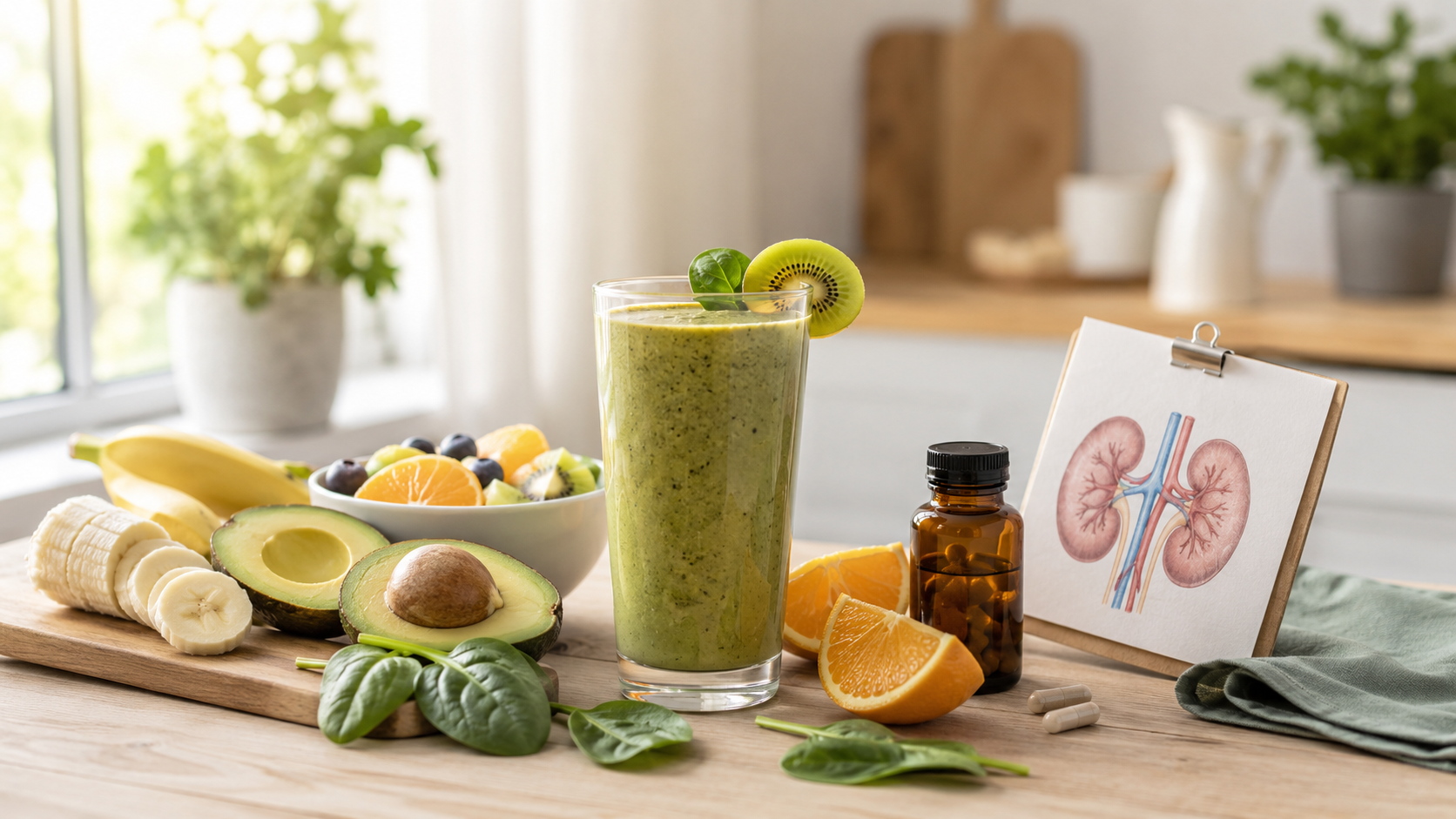
Fruit smoothies can look like the healthiest choice in the room, but if kidney health is a concern, high-potassium ingredients can add up quickly. Here’s why portion size, ingredients, and medical guidance matter.
The Smoothie That Looks Too Healthy to Question
A fruit smoothie has a very convincing personality.

It looks fresh. It looks colorful. It often comes in a clear cup, which somehow makes it feel even more virtuous. Banana, orange, spinach, avocado, coconut water, maybe a scoop of protein powder. You look at it and think, “Well, at least I’m doing something good for myself.”
And for many people, that may be true.
Fruit and vegetables are not the enemy. Potassium is not “bad.” Your body needs potassium for normal muscle and nerve function, and most healthy adults do not need to fear a banana.
But kidney health changes the conversation.
When your kidneys are not filtering well, potassium can build up in the blood. That is one reason people with chronic kidney disease may be told to watch potassium intake, depending on their blood work, kidney function, medications, and overall treatment plan. The National Kidney Foundation notes that people living with kidney disease are at risk of potassium levels being either too high or too low, so the goal is not random restriction but staying in the right range.
That is where smoothies can become tricky.
Not because they are “junk food in disguise.” Not because fruit is secretly terrible. The problem is simpler: smoothies can pack a lot of high-potassium foods into one drink, and it is easy to drink them faster than you would ever eat the same ingredients whole.
Why Potassium Matters More When Kidneys Are Struggling
Potassium is a mineral found in many foods, especially fruits, vegetables, beans, dairy, potatoes, and some drinks. In the right amount, it is essential.
The kidneys help keep potassium levels balanced by removing extra potassium from the blood. When kidney function drops, that balancing act can become harder. The American Kidney Fund explains that when kidneys are not working well, potassium may become too high or too low, and some people with kidney disease may be advised by their doctor or dietitian to lower potassium in their eating plan.
High potassium in the blood is called hyperkalemia. It can be serious because potassium affects the way muscles work, including the heart. The frustrating part is that high potassium does not always announce itself in a dramatic way at first. Some people may feel weakness, nausea, or an irregular heartbeat, but others may not notice clear symptoms until levels are concerning.
That is why diet advice for kidney disease is often based on lab results, not just how someone feels.
You may feel fine after a giant smoothie. That does not always mean your potassium level loved it.
The Sneaky Thing About Smoothies
A smoothie can turn several servings into one casual drink.
Think about eating these foods separately: one banana, half an avocado, a big handful of spinach, a cup of orange juice, and maybe some yogurt. That would feel like a lot of food.
Blend it, add ice, pour it into a cup, and suddenly it becomes breakfast on the go.
This is the main reason smoothies deserve special attention for kidney-conscious eating. They concentrate ingredients. They remove some of the natural “pause” that comes with chewing. They make large portions feel smaller.
The National Kidney Foundation makes a useful point: even a large amount of a lower-potassium food can become high in potassium when the portion gets big enough. That idea matters a lot with smoothies, because smoothie portions can quietly grow from “small snack” to “fruit bowl in liquid form.”
A small strawberry smoothie is one thing.
A 24-ounce smoothie with banana, mango, orange juice, spinach, avocado, and coconut water is another creature entirely.
It may still look healthy. But healthy-looking is not the same as kidney-friendly.
The Usual High-Potassium Smoothie Suspects
Some smoothie ingredients show up again and again because they make the texture creamy, sweet, or “green.”
Bananas are probably the classic one. They are convenient, cheap, and great for making a smoothie taste smooth instead of icy and sad.
Avocado gives that rich, creamy texture people love.
Spinach is often tossed in because it disappears easily. You can add a handful and still feel like you are drinking fruit.
Orange juice makes smoothies bright and sweet.
Coconut water has a health halo and is often marketed as a hydration upgrade.
Dried fruits, dates, and some protein powders can also add potassium, depending on the product.
None of these foods are automatically forbidden for every person with kidney concerns. That is important. Kidney diets are not one-size-fits-all. Some people need to limit potassium. Some do not. Some may even have low potassium and need a different plan.
But if you have been told your potassium is high, your kidney function is reduced, or you are following a kidney-friendly eating plan, these ingredients are worth discussing with your care team.
The issue is not one innocent strawberry. It is the total load in the cup.
“But It’s Natural” Is Not the Same as “Safe for Me”
This is where people get understandably frustrated.
A smoothie does not feel like a risky choice. It feels responsible. It feels like the opposite of fast food. And it can be annoying, even unfair, to hear that a drink full of fruit and greens may need limits.
But kidney nutrition often works differently from general wellness advice.
For the average person, “eat more fruits and vegetables” is usually solid advice. For someone with kidney disease, the question becomes more specific: which fruits, how much, how often, and what do your labs show?
The NIDDK explains that people with chronic kidney disease may need to choose foods and drinks carefully, including watching nutrients such as sodium, potassium, and phosphorus, to help prevent or delay some health problems related to CKD.
That does not make fruits and vegetables bad. It makes context matter.
A food can be nutritious and still be the wrong portion or frequency for a certain medical situation. That is not a contradiction. It is just real life being inconvenient again.
Smoothies Can Hide Portion Size
Whole fruit gives you clues.
You see the banana peel. You notice the orange sections. You feel the fullness from chewing. Your stomach has time to catch up.
A smoothie hides the evidence.
Two bananas vanish into the blender. A large handful of greens shrinks into nothing. A cup of juice becomes “just the liquid base.” A few dates become “natural sweetness.” Then it all fits into one travel cup.
This is why a smoothie can accidentally become a potassium-heavy meal, even when each ingredient feels reasonable on its own.
It is similar to making soup. A pot of soup may contain a mountain of vegetables, but once everything softens, it looks smaller. With smoothies, the blender does the shrinking for you.
For someone without kidney issues, that may be no big deal. For someone watching potassium, it can matter.
A practical habit is to build smoothies with measured portions instead of handfuls and guesses. Not forever, not obsessively, but at least long enough to understand what is really going into the cup.
Because “a little spinach” means very different things depending on whose hand is involved.
Kidney-Friendly Does Not Always Mean No Fruit
Some people hear “watch potassium” and assume they have to give up fruit completely.
That is usually not the goal.
Many kidney-conscious eating plans still include fruit, but the choices and portions may be adjusted. Lower-potassium fruits are often used more often, while high-potassium options may be limited or portioned carefully.
Common lower-potassium smoothie-friendly options may include berries, apples, grapes, peaches, pineapple, or watermelon, depending on the person’s plan and portion size. The exact list can vary, and canned or processed versions may have added sugar or other ingredients, so labels still matter.
A berry-based smoothie with a measured portion of fruit and a kidney-appropriate liquid may fit better than a banana-orange-avocado blend.
But again, this is where individual guidance matters. A person on dialysis may receive different advice than someone with early-stage CKD. A person with normal potassium labs may not need the same restrictions as someone whose potassium keeps running high.
Kidney nutrition is personal in a way that Instagram smoothie recipes are not.
Watch the Liquid Base
People usually focus on the fruit, but the liquid matters too.
Orange juice can add potassium. Coconut water can be especially potassium-heavy. Milk and yogurt may add potassium and phosphorus. Some plant-based milks are fortified with minerals, while others are not. Some protein shakes contain added potassium or phosphorus additives.
Even “low sodium” products can sometimes contain potassium-based salt substitutes. The Indian Health Service’s kidney education materials note that foods labeled low sodium may contain salt substitutes that are high in potassium.
That little label detail can be easy to miss.
For smoothies, water, ice, or a kidney-appropriate milk alternative may be better choices for some people. But do not guess based only on the front of the carton. The nutrition label and ingredient list matter.
Look for potassium when it is listed. Check for phosphorus additives if your care team has told you to watch phosphorus. And bring your usual products to a dietitian appointment if you have one. A photo of the label can be surprisingly useful.
Protein Powders Can Complicate Things
A lot of people add protein powder to smoothies because they want the drink to be more filling.
That can make sense in general. But for kidney concerns, protein powders deserve caution.
Some powders contain potassium, phosphorus, sodium, or added ingredients that may not fit your plan. The serving size can also be larger than people realize. One scoop, two scoops, a “heaping scoop” because the scoop got buried and nobody has patience in the morning — it adds up.
Protein needs vary widely in kidney disease. Some people are told to limit protein. Others, especially people on dialysis, may need more. This is not something to freestyle from a fitness label.
If kidney health is a concern, ask your clinician or renal dietitian before making protein smoothies a daily habit. Not because protein powder is evil, but because your kidney stage, labs, and treatment plan matter.
A smoothie should not accidentally become a supplement cocktail.
When You Should Be Extra Careful
Some situations make high-potassium smoothies more concerning.
If you have chronic kidney disease and have been told your potassium is high, be careful.
If you are on dialysis, follow the diet plan given by your renal team.
If you take medications that can raise potassium, such as some blood pressure medications, ask your clinician what that means for your diet.
If you have diabetes and kidney disease, smoothie choices can affect both potassium and blood sugar.
If you have been told to limit fluids, smoothies count as fluid too. The American Kidney Fund notes that people who need to limit fluids may need to cut back on drinks and also watch high-water foods such as many fruits and vegetables.
That last point catches people off guard. A smoothie is not just food. It is also liquid.
For someone on a fluid restriction, a large smoothie may take up a lot of the day’s allowance before lunch even happens.
A More Kidney-Conscious Smoothie Habit
A safer smoothie habit starts with making the drink smaller and simpler.
Use one main fruit instead of five. Choose lower-potassium fruits if your care team has recommended that. Measure the portion. Pick a liquid base that fits your plan. Skip coconut water unless your clinician says it is fine. Be cautious with bananas, oranges, avocado, dried fruit, and large amounts of greens.
You can also make the smoothie less concentrated by keeping it small and pairing it with something else your diet allows, rather than turning it into a giant all-in-one meal.
Texture does not have to depend on banana. Frozen berries, crushed ice, chilled applesauce in a small portion, or a kidney-appropriate yogurt alternative may help, depending on your plan.
Flavor can come from cinnamon, vanilla, lemon zest, or a small amount of allowed fruit rather than loading the blender with several sweet ingredients.
No, it may not taste like the giant tropical smoothie from a café. But it also will not be pretending that three servings of high-potassium fruit are “just a drink.”
The Café Smoothie Problem
Store-bought smoothies are especially hard to judge.
The menu may say “green mango glow” or “tropical wellness blend,” which tells you almost nothing useful. You may not know how much banana, juice, coconut water, avocado, or powdered mix is inside. The cup may be huge. The drink may taste light but contain more fruit than you would normally eat in one sitting.
If kidney health is a concern, café smoothies are not impossible, but they do require questions.
Ask what liquid base is used. Ask whether banana is included. Ask whether they can make a smaller size. Ask if they can leave out coconut water or spinach. Some places will customize. Some will not.
And if the answer is vague, it is okay to choose something else.
You are not being difficult. You are trying to avoid a nutrition surprise.
Talk to a Renal Dietitian If You Can
Kidney nutrition advice can feel confusing because people receive different instructions.
One person may be told to avoid bananas. Another may be allowed a small portion. Someone else may not need potassium restriction at all. That can make online advice feel contradictory.
The reason is usually that the advice depends on blood potassium levels, kidney function, medications, dialysis status, and the rest of the diet.
A renal dietitian can help translate your labs into actual meals. Not vague rules. Actual food. What to put in a smoothie. What to avoid. How often. What portion. What to do when you miss your usual breakfast and need something quick.
That kind of guidance is much more useful than simply labeling foods as good or bad.
The National Kidney Foundation emphasizes that potassium needs can vary in CKD and that people should work with their healthcare team to understand their target range.
That is the boring answer, but it is the honest one.
A Healthy Habit Still Needs the Right Context
Smoothies can be a good habit for many people. They can help someone eat more fruit, get breakfast when mornings are rushed, or choose something fresher than a pastry grabbed in a hurry.
But if kidney health is on your mind, the smoothie deserves a closer look.
High-potassium ingredients can stack up quickly. Big portions can turn a reasonable food into too much. A drink that looks light can carry a lot of minerals your kidneys may struggle to balance.
You do not have to fear every piece of fruit. You do not have to throw away your blender. Just stop assuming that “healthy” automatically means “right for my kidneys.”
A smaller, simpler smoothie made with the right ingredients may still fit your life.
The best version is not the prettiest one on the menu. It is the one your body, your lab results, and your care team can live with.

Hi, I’m the creator and editor behind ZestyHabit. I research everyday safety, first aid, and practical wellness topics using official guidance and reliable public sources, then turn that information into clear, realistic steps for daily life.
My goal is to help readers make safer, better-informed choices at home and beyond.


