
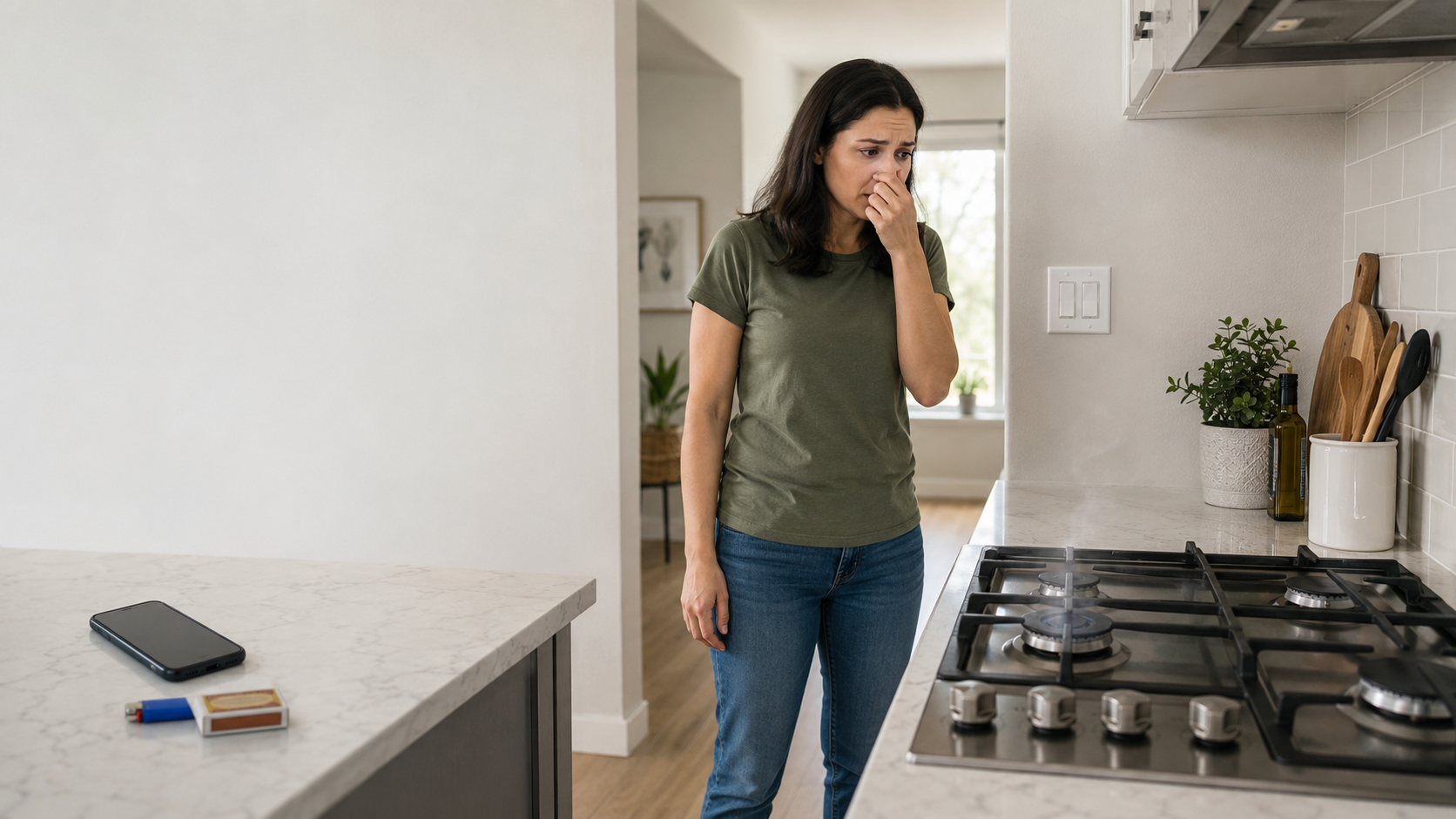

Smell gas or a rotten egg odor at home? Learn what not to do, why small actions can create risk, and the simple steps that help keep your household safer.
When a Strange Gas Smell Stops You in Your Tracks
There are certain smells in a home that instantly get your attention. Burnt toast, smoke from the oven, a musty basement, spoiled food in the fridge.
And then there is that sharp, sulfur-like smell many people describe as rotten eggs.
If you ever smell gas inside your home, apartment, garage, basement, or near a gas appliance, the most important thing is not to investigate like a detective. It is to avoid doing anything that could create a spark, flame, or added risk.
Natural gas itself is odorless, but utility companies add a strong odorant, often described as rotten eggs or sulfur, to help people notice a possible leak. Several utilities and safety agencies advise the same basic response: stop what you are doing, leave the area, and call for help from a safe location.
This article is not meant to scare you. Most of us use gas stoves, furnaces, fireplaces, dryers, water heaters, and outdoor grills without thinking much about them. But when something smells wrong, a few ordinary habits can become risky.
So let’s walk through what you should not do if you smell gas, why those actions matter, and how to build a simple household plan before you ever need it.
Why Gas Smell Should Never Be Ignored
A faint smell near the stove after a burner knob was bumped may have a simple explanation. A strong smell in the kitchen, basement, garage, or near an appliance is different. Either way, gas odor deserves attention.
Natural gas and propane can ignite when enough gas collects in an enclosed area and meets an ignition source. That ignition source does not have to be dramatic. It may be a flame, a cigarette, a light switch, an appliance motor, a phone, a garage door opener, or another small spark-producing action.
That is why many official safety instructions focus less on “find the leak” and more on “leave first.” NFPA guidance says not to operate lights, appliances, telephones, or cell phones if gas is suspected because flames or sparks can trigger fire or explosion.
In everyday life, the hard part is that our instincts are often backwards. We want to turn on a light, check behind the stove, open every window, call someone from inside, or start troubleshooting. Those actions feel helpful, but they can be the wrong first move.
The First Thing to Remember: Do Not Stay Inside to Figure It Out
If you smell gas indoors, do not stand there trying to decide whether it is serious enough.
Leave the building or area first. Then call 911 or your gas utility from outside or from another safe location. The Pennsylvania Public Utility Commission, National Grid, NW Natural, and other utilities give similar advice: leave immediately and call from a safe place.
This can feel inconvenient, especially if the smell seems mild. But leaving does two important things. It gets people and pets away from the possible source, and it prevents you from accidentally creating a spark while trying to investigate.
Once you are outside, do not go back in to grab your bag, laptop, phone charger, wallet, or keys if doing so puts you back in the suspected area. Wait for trained help to assess the situation.
Do Not Turn Lights On or Off
This is one of the most common mistakes.
You walk into the kitchen at night, smell something strange, and your first instinct is to flip the light switch. Or maybe you are leaving and decide to turn lights off on the way out.
Do not do either.
Turning a light switch on or off can create a tiny electrical spark. Under normal conditions, that is not something you would notice or worry about. But if gas has built up in the air, even a small spark can matter.
Many gas-safety instructions specifically warn against operating light switches when a gas leak is suspected.
If the room is dark, leave it dark. Use the safest visible path out. Do not turn on lamps, ceiling lights, bathroom fans, range hoods, or garage lights.
Do Not Use Your Phone Inside the House
Another instinctive mistake is calling for help while standing in the kitchen or hallway.
It feels responsible. You smell gas, so you grab your phone and dial. But safety guidance commonly advises not to use a phone inside the building where gas may be present. That includes a cell phone and a landline.
The better habit is simple: leave first, then call.
Once you are outside and away from the suspected leak area, call 911 or your gas utility’s emergency number. If you do not have your phone with you, go to a neighbor, nearby business, or safe outdoor location and ask to call.
Also, do not text, email, or message the utility instead of calling emergency services. Some utility guidance specifically says not to send an email during a gas emergency.
Do Not Light Matches, Candles, or Lighters
This one sounds obvious, but it still happens in small everyday ways.
Someone smells gas and lights a candle to “check the smell.” Someone uses a lighter near a pilot light. Someone keeps cooking because the burner still works. Someone smokes near a doorway while waiting outside.
If you smell gas, avoid all flames. That includes matches, candles, lighters, cigarettes, gas burners, fireplaces, and outdoor grills nearby.
Do not try to relight a pilot light if the gas smell is strong, spreading, or unexplained. If you are unsure, leave and call for help from a safe location. A minor pilot light issue can be handled later, but only after the area has been checked and it is safe to do so.
Do Not Turn Appliances On or Off
It may seem helpful to shut things down. But if you smell gas, avoid operating electrical appliances or devices in the affected area.
That includes:
- Stove controls
- Range hood fans
- Exhaust fans
- Microwaves
- Washers and dryers
- Furnaces or thermostats
- Space heaters
- Air conditioners
- Vacuums
- Garage door openers
- Doorbells
- Flashlights that are not rated for hazardous environments
The reason is the same: many devices can create sparks, heat, or electrical activity.
Some people think turning on a fan will “blow the gas away.” Do not do that. A fan motor is an electrical device, and using it may create more risk than benefit.
Do Not Start Your Car or Open the Garage Door Automatically
Garages are a common place to overlook gas-safety habits. Many homes have gas water heaters, furnaces, dryers, or utility lines near or inside the garage.
If you smell gas in or near a garage, do not start a vehicle. Do not use an automatic garage door opener. Do not start lawn equipment, motorcycles, generators, or power tools.
Some local and utility guidance specifically warns against starting or shutting off vehicles or equipment that could cause sparks near a suspected gas leak.
If the garage door is already open and you can safely walk out, leave. If it is closed, use a regular door if available. Do not stand around trying to move cars or “make space” for responders.
Do Not Search for the Leak Yourself
It is tempting to follow your nose. You may want to check behind the stove, inspect the basement, sniff around the water heater, or look for a loose connection.
Do not do that.
Gas leaks are not a household mystery to solve while standing inside the building. The safest basic action is to leave and let trained professionals handle it. Peoples Gas guidance, for example, says not to attempt to find the source and to leave the area immediately.
This is especially important if you hear a hissing sound, notice a strong smell, feel symptoms like dizziness or nausea, or see signs outdoors such as blowing dirt, bubbling water, or dead vegetation near a gas line area.
You do not need to prove there is a leak before taking it seriously. Smelling gas is enough reason to act carefully.
Do Not Assume Someone Else Has Called
In apartment buildings, duplexes, townhomes, and close neighborhoods, it is easy to think, “Someone else probably reported it.”
Do not assume that.
If you smell gas outside or in a shared hallway, leave the area and report it from a safe location. National Grid’s gas emergency guidance specifically says not to assume someone else has called.
In shared buildings, it is also reasonable to warn others nearby as you leave, as long as doing so does not delay your exit or put you in danger. Knock, speak clearly, and move out. Do not use the doorbell or electrical intercom if gas is suspected.
Do Not Re-Enter Until You Are Told It Is Safe
Once you are outside, stay outside.
This is harder than it sounds. People remember pets, medicine, wallets, work laptops, groceries on the counter, or a pot on the stove. But if there is a possible gas leak, returning inside before the area is cleared can put you at risk.
Many utility instructions say not to re-enter the building until emergency responders or the gas company say it is safe.
It may feel awkward standing outside, especially if the smell turns out to have a simple cause. That is okay. Gas calls are exactly the kind of situation where being cautious is normal.
Do Not Open Windows If It Delays Leaving
You may have heard that you should open windows if you smell gas. This is one area where everyday advice can get confusing.
Some older household advice focused on ventilation. But many utility instructions now emphasize leaving immediately and not doing extra tasks inside. Peoples Gas specifically says not to open windows if you smell natural gas because it could make the area more unsafe.
The practical takeaway is this: do not stay inside to ventilate the home. Do not walk around opening windows, turning on fans, or trying to “air it out.” Leave first. Let trained responders decide what needs to be opened, shut off, or checked.
Common Everyday Situations Where People Make Mistakes
The stove knob got bumped
This happens in real homes. A child, pet, pan handle, or hip brushes a burner knob, and gas begins to flow without a flame.
If you notice the smell immediately and can clearly see a stove knob is on, some utility guidance says to check that range and oven controls are off.
But use judgment. If the smell is strong, you are unsure how long gas has been flowing, or you feel uncomfortable, leave first and call from outside. Do not turn on lights, fans, or appliances to help you check.
The basement smells strange
Basements often contain furnaces, water heaters, gas dryers, and utility lines. If you smell rotten eggs in a basement, do not go down to investigate. Do not flip the basement light switch. Do not run the furnace fan.
Leave the building and report it.
You smell gas outside
Gas smells can also occur outdoors near meters, underground lines, construction areas, or damaged pipes. Warning signs may include a rotten egg smell, hissing, blowing dust, bubbles in standing water, or dead plants in a small area.
Move away from the area. Do not start vehicles, operate equipment, smoke, or use flames nearby. Call from a safe distance.
The smell comes and goes
A gas smell that comes and goes still deserves attention. Do not dismiss it just because it is not constant. Air movement, appliance cycling, and small leaks can make odors seem intermittent.
If you suspect gas, treat it seriously.
Simple Prevention Habits for Gas Appliances
Prevention is mostly about maintenance and awareness, not worry.
Keep the area around gas appliances clear. Avoid storing cardboard, paper, paint, gasoline, cleaners, or other flammable items near furnaces, water heaters, dryers, or gas fireplaces.
Make sure stove knobs are fully off after cooking. If you have young children or pets, consider knob covers or removing knobs when the stove is not in use, depending on your appliance design.
Have gas appliances installed and serviced by qualified professionals. If a burner flame changes color, an appliance starts acting oddly, or you smell gas repeatedly, do not ignore it.
Know where your gas meter is, but do not rely on yourself to manage emergency shutoffs unless your utility has specifically instructed you how and when to do so. Some local guidance warns not to attempt to operate natural gas valves during a suspected leak.
Install gas or propane alarms where appropriate. NFPA has discussed residential fuel gas alarms as an added detection layer, especially because odor may not always be noticed quickly by every person in every situation.
Make a Small Household Plan
You do not need a dramatic emergency binder for this. A simple plan is enough.
Make sure everyone in the home knows what gas smells like: rotten eggs, sulfur, or a strong unpleasant odor.
Choose a meeting spot outside, away from the home.
Save your gas utility’s emergency number in your phone, but remember not to call from inside if gas is suspected.
Teach children not to touch stove knobs.
Remind family members not to flip switches, use phones indoors, or search for the leak.
If you live in an apartment, know the safest exits from your unit and building.
These small steps are useful because emergencies are not the best time to explain basic rules.
A Calm, Easy Rule to Remember
If you smell gas, keep it simple:
Do not switch. Do not spark. Do not search. Leave and call from outside.
That phrase covers most of the common mistakes.
Do not turn lights on or off.
Do not use phones inside.
Do not light flames.
Do not operate appliances.
Do not start vehicles nearby.
Do not investigate the source yourself.
Do not go back in until the area has been cleared.
Final Thoughts: A Few Seconds of Caution Can Prevent Bigger Problems
Gas appliances are part of normal home life for millions of households. Cooking dinner on a gas stove or heating water with a gas water heater does not need to feel scary.
But a gas smell is one of those signals worth respecting right away.
The safest response is not complicated. Avoid anything that could create a spark or flame, leave the area, and call 911 or your gas utility from a safe location. Let trained people check the source, handle the equipment, and tell you when it is okay to return.
Most household safety habits are small. This one is especially simple: when gas smells wrong, do less inside the house, not more. Leave first, call from outside, and let caution do its job.

Hi, I’m the creator and editor behind ZestyHabit. I research everyday safety, first aid, and practical wellness topics using official guidance and reliable public sources, then turn that information into clear, realistic steps for daily life.
My goal is to help readers make safer, better-informed choices at home and beyond.


