Shoulder Press Precautions: How to Avoid Neck and Shoulder Strain
Minjin Park
·
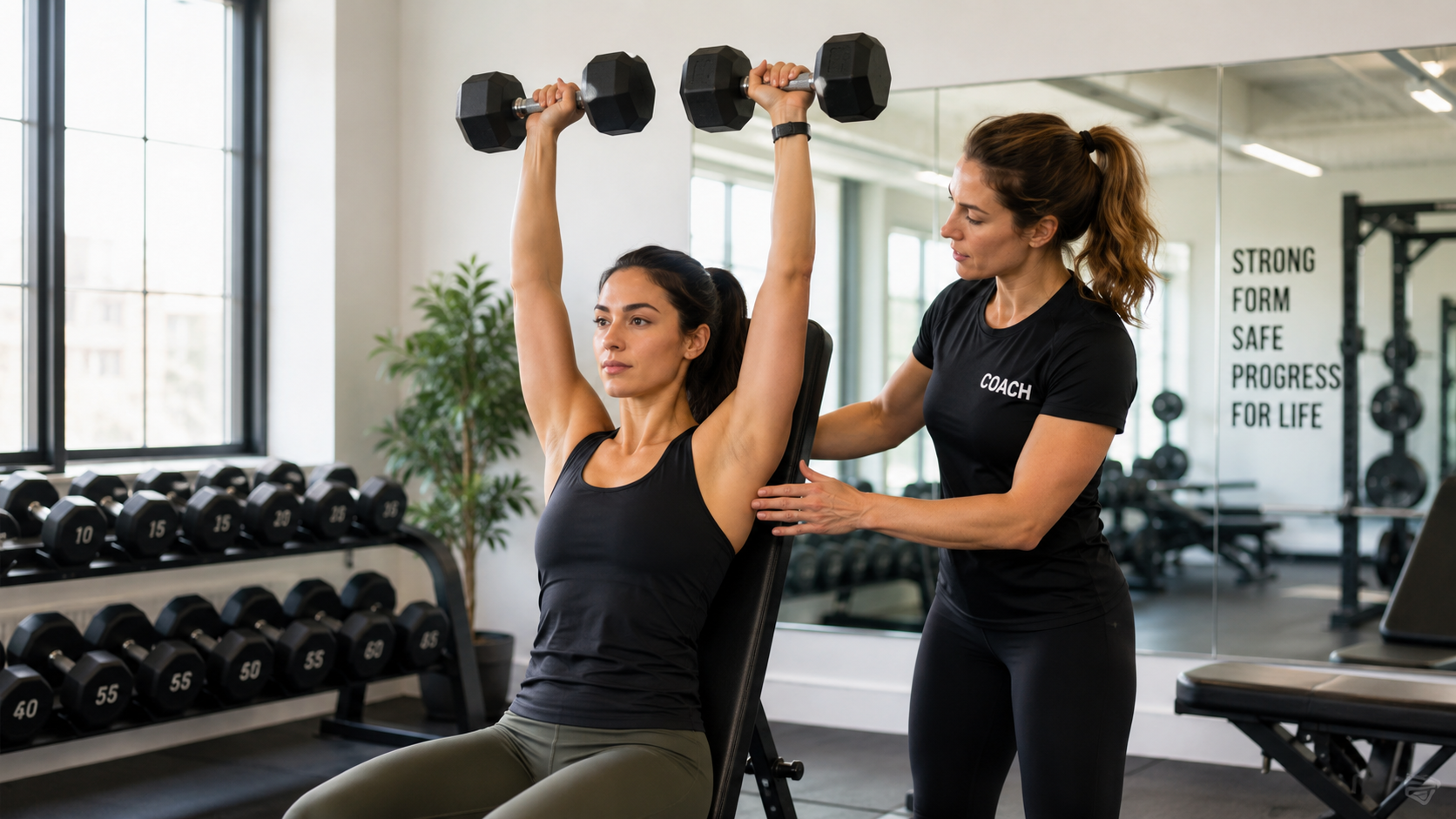
The shoulder press is one of the most classic upper-body exercises. It looks straightforward: hold a weight near your shoulders, press it overhead, lower it back down, and repeat. It can be done with dumbbells, a barbell, kettlebells, resistance bands, or even machines.
When performed well, the shoulder press can build strong shoulders, triceps, upper chest, and core stability. It can also help improve your ability to reach, lift, and carry things in daily life.
But the shoulder press is also an exercise where small mistakes matter.
Because the weight moves overhead, your shoulders, neck, upper back, ribs, spine, and core all have to work together. If your neck is tense, your shoulders shrug, your lower back arches, or the weight drifts too far forward or backward, the movement can quickly feel uncomfortable.
Many people blame the exercise itself when their neck or shoulders hurt. Sometimes the issue is not the shoulder press, but the way it is being performed. Good form makes the movement feel controlled and strong. Poor form can turn it into a neck-tightening, shoulder-pinching struggle.
The goal is not to make you afraid of pressing overhead. It is to help you press with better control, protect your joints, and avoid the common habits that create strain.
The shoulder is a very mobile joint. That mobility is useful, but it also means the shoulder depends heavily on good control from surrounding muscles. Your shoulder blades, rotator cuff, upper back, core, and even your hips all play a role in a safe overhead press.
When one area is not doing its job, another area may compensate.
For example, if your core is not braced, your lower back may arch to help the weight go overhead. If your upper back is stiff, your shoulders may shrug or your neck may tense. If the weight is too heavy, you may lean back, flare your ribs, or press unevenly.
Common causes of neck and shoulder strain during shoulder presses include:
Using too much weight
Shrugging the shoulders toward the ears
Pressing with poor wrist or elbow alignment
Arching the lower back
Holding the neck in a tense position
Pressing the weight too far forward
Lowering too quickly
Training through pain or pinching
Skipping warm-up sets
The shoulder press can be a great exercise, but it rewards clean technique more than ego lifting.
Start with a Weight You Can Control
A heavy shoulder press can look impressive, but overhead lifting leaves very little room for sloppy form. If the weight is too heavy, your body will usually find a way to get it up. Unfortunately, that “way” may involve leaning back, shrugging, twisting, or forcing the shoulders into an uncomfortable position.
A good shoulder press weight should feel challenging, but manageable. You should be able to press it without holding your breath randomly, losing your posture, or changing your body position on every rep.
If the first rep already feels messy, the weight is too heavy for that set.
It is better to use lighter weights and press with control than to use heavier weights while your neck and shoulders take the stress. Strength built with poor form often comes with irritation later.
A helpful test: pause briefly at the top of the press. If you cannot hold the weight overhead with control for one second, reduce the weight.
Warm Up Your Shoulders Before Pressing
Overhead pressing asks a lot from the shoulders. Going straight into heavy sets without preparation can make the movement feel stiff and awkward.
A simple warm-up can make a big difference. Start with general movement to raise your body temperature, such as walking, cycling, or light rowing. Then prepare the shoulders, upper back, and core.
Good warm-up options include:
Arm circles
Wall slides
Band pull-aparts
Scapular push-ups
Light external rotations
Shoulder taps
Very light dumbbell presses
Empty bar presses
The goal is not to exhaust yourself before the workout. It is to help your joints and muscles move smoothly before you add load.
For shoulder presses, warm-up sets are especially useful. Start with a lighter version of the same movement, then gradually increase weight. This helps your body rehearse the press before the effort becomes more demanding.
Keep Your Neck Neutral
Neck position is one of the most overlooked parts of the shoulder press.
Some people jut their chin forward as they press. Others look up at the weight, tilt their head back, or squeeze their neck muscles without realizing it. These habits can create neck tightness during or after the workout.
Try to keep your neck long and neutral. Look straight ahead if standing or seated upright. Your chin can stay gently tucked, but not forced down. Think of making the back of your neck tall.
A useful cue is: “press the weight, not your head.”
Your head may move slightly out of the way during some barbell pressing variations, but it should not crane forward or backward dramatically. With dumbbells, it is usually easier to keep the head still and neutral.
If you finish shoulder presses with neck soreness, check whether you are shrugging, clenching your jaw, or pushing your head forward during reps.
Avoid Shrugging at the Wrong Time
Your upper traps are involved in overhead movement, but many people overuse them during shoulder presses. They start every rep by pulling their shoulders toward their ears, turning the exercise into a tense shrug instead of a controlled press.
This can make the neck feel tight and may reduce shoulder comfort.
Before pressing, set your shoulders in a stable position. They do not need to be pulled down aggressively, but they should not be jammed up toward your ears. As you press overhead, allow natural shoulder blade movement, but avoid excessive shrugging or neck tension.
Think “shoulders strong, neck relaxed.”
At the top of the press, your arms should be overhead with control. You should not feel like your shoulders are squeezing your ears. If you do, lower the weight and focus on smoother movement.
Brace Your Core Before Each Rep
The shoulder press is not only an arm and shoulder exercise. It is also a core exercise.
When you press weight overhead, your body has to resist arching, twisting, or leaning. If your core is relaxed, your lower back may take over. This is especially common during standing shoulder presses.
Before each set, gently brace your midsection. Imagine preparing for someone to lightly bump into you. Your ribs should stay controlled, not flared upward. Your glutes can engage lightly if you are standing.
This bracing gives your shoulders a stronger base to press from.
If you notice your lower back arching as the weight goes up, reduce the weight or try a seated version with back support. You can also try half-kneeling presses, which force you to use more core control and less lower-back arch.
Keep Your Ribs Down
Rib flare is one of the sneakiest shoulder press mistakes.
As the weight gets heavy, many people lift their chest and flare their ribs to help the arms reach overhead. This may make the rep happen, but it often shifts stress into the lower back and changes the shoulder position.
Instead, keep your ribs stacked over your pelvis. You do not need to round your back or collapse your chest. Just avoid turning the press into a backbend.
A simple cue is: “zip up the ribs.”
At the top of the press, your body should look tall and strong, not arched backward. If keeping the ribs down makes it impossible to press the weight overhead, the weight may be too heavy or your overhead mobility may need work.
Watch Your Elbow Position
Elbow position affects both shoulder comfort and pressing strength.
If your elbows flare straight out to the sides, your shoulders may feel strained. If your elbows are too far forward or too tucked, the press may feel awkward depending on the equipment you use.
For dumbbell shoulder presses, a slightly angled position usually works well. Instead of forcing your elbows directly out to the sides, let them sit slightly forward from the body. This is often called the scapular plane, and it tends to feel more natural for many shoulders.
Your forearms should stay mostly vertical as you press. If the dumbbells drift too far forward or backward, your wrists and shoulders may compensate.
At the bottom of the movement, lower only as far as you can control comfortably. You do not have to force the dumbbells below shoulder level if it causes pinching.
During shoulder presses, your wrists should stay stacked over your elbows as much as possible. If your wrists bend backward under the weight, you may feel pressure in the wrists and lose pressing stability.
Hold the weight firmly, but do not squeeze so hard that your forearms and neck tense up. The dumbbell or bar should sit securely in your hand.
With dumbbells, keep your knuckles facing upward and wrists neutral. With a barbell, keep the bar resting in a strong position over the base of the palm, not floating in the fingers.
A bent wrist often makes the whole press feel less stable. A stacked wrist helps transfer force more cleanly.
Do Not Press Behind the Neck Without Good Reason
Behind-the-neck pressing is a variation sometimes used by experienced lifters, but it is not necessary for most people. It requires good shoulder mobility, upper-back mobility, and control. For many beginners, it can place the shoulders and neck in an uncomfortable position.
If your goal is general strength, posture, or fitness, a standard front shoulder press is usually a better choice. Dumbbell presses, machine presses, landmine presses, and neutral-grip presses can all train the shoulders effectively with less awkward positioning.
Do not assume a behind-the-neck press is better because it looks advanced. Advanced does not always mean safer or more useful.
Control the Lowering Phase
Many people focus on pressing the weight up, then let it drop quickly back down. This can irritate the shoulders because the lowering phase requires control too.
Lower the weight smoothly. The descent should not be a free fall. Keep your core braced, neck relaxed, and elbows tracking well.
A controlled lowering phase helps your muscles work through the full movement. It also gives your shoulders time to stay organized instead of catching the weight suddenly at the bottom.
If you cannot lower the weight with control, it is probably too heavy.
Choose the Right Variation for Your Body
Not everyone needs to do the same shoulder press.
Some people feel great with dumbbells. Others prefer a machine because it offers more stability. Some people find a neutral grip more comfortable because the palms face each other. Others like landmine presses because the angle is not fully overhead.
The best variation is the one that lets you press with good control and no sharp pain. Do not force a barbell overhead press if dumbbells feel better. Do not force dumbbells if a machine helps you learn the movement safely.
Be Careful with Range of Motion
A deeper range of motion is not always better if it causes pain or loss of control.
Some people can lower dumbbells until they are near shoulder height with no issue. Others feel pinching if they go too low. Shoulder anatomy, mobility, and training history all affect comfort.
Lower to a range where you can stay stable and pain-free. Over time, mobility and strength may improve. But forcing depth before your shoulder is ready can backfire.
At the top, avoid aggressively locking out with shrugged shoulders and flared ribs. Finish the press with arms overhead, but keep the body organized.
Avoid Turning It Into a Push Press by Accident
A push press uses the legs to help drive the weight overhead. It is a valid exercise when done intentionally. But many people accidentally turn strict shoulder presses into push presses when the weight is too heavy.
They bend the knees, bounce, lean back, and use momentum to get the weight up. This may let them lift more, but it changes the exercise and can make the shoulders harder to control.
If you are doing a strict shoulder press, keep your legs still. Press with your shoulders and arms while your core stabilizes.
If you want to do push presses, learn them separately and use proper technique. Do not let sloppy momentum sneak into a set that was supposed to be controlled.
Stop If You Feel Pinching
Shoulder pinching is not something to ignore.
A mild muscle burn is normal. Effort in the shoulders and triceps is expected. But sharp pinching, catching, numbness, tingling, or pain deep in the shoulder is a sign to stop and adjust.
Try reducing the weight, changing grip, shortening the range of motion, or switching to a different press variation. If the discomfort continues, avoid pressing overhead until you can get guidance.
Training through shoulder pain often makes the problem harder to fix later. It is better to adjust early than to lose weeks of progress.
Strengthen the Upper Back Too
Healthy pressing is not only about the front of the shoulders. Your upper back helps control the shoulder blades and supports better posture.
If you do a lot of pressing but very little pulling, your shoulders may start to feel tight or unbalanced.
Balance your shoulder press routine with pulling exercises such as rows, lat pulldowns, face pulls, rear delt flyes, and band pull-aparts. These movements help strengthen the muscles that support shoulder position.
A balanced upper body usually feels better than one built only on pushing exercises.
Do Not Train Shoulders Hard Every Day
The shoulders are involved in many exercises, not just shoulder presses. Bench presses, push-ups, rows, pull-ups, planks, and even some lower-body exercises can place demand on the shoulder area.
If you train shoulders intensely too often, fatigue can build up. When the stabilizing muscles are tired, your form may break down more easily.
Give your shoulders time to recover. For many people, direct shoulder pressing two to three times per week is enough, depending on total training volume and intensity.
If your shoulders feel constantly irritated, stiff, or weak, your program may need more recovery or better exercise balance.
A Simple Shoulder Press Checklist
Before your next set, run through this quick checklist:
Weight feels challenging but controllable
Feet planted firmly
Core braced
Ribs down
Neck neutral
Shoulders not shrugged into ears
Wrists stacked
Elbows slightly forward, not forced wide
Weight travels smoothly overhead
Lowering phase controlled
You do not need perfect form in a robotic way. But these points help keep the press safer and more effective.
Final Thoughts
The shoulder press can be a powerful exercise for building upper-body strength, but it needs respect. Because the weight moves overhead, poor technique can quickly lead to neck tightness, shoulder irritation, or lower-back strain.
Use a weight you can control. Keep your neck relaxed. Brace your core. Avoid excessive shrugging. Keep your ribs down. Press smoothly and lower with control.
Most importantly, do not chase heavier weights at the expense of good movement. A clean, controlled shoulder press will do more for your strength than a heavy, messy rep that leaves your neck and shoulders angry.
When you press well, your shoulders feel strong, stable, and capable. That is the kind of progress worth building.
Hi, I’m the creator and editor behind ZestyHabit. I research everyday safety, first aid, and practical wellness topics using official guidance and reliable public sources, then turn that information into clear, realistic steps for daily life.
My goal is to help readers make safer, better-informed choices at home and beyond.