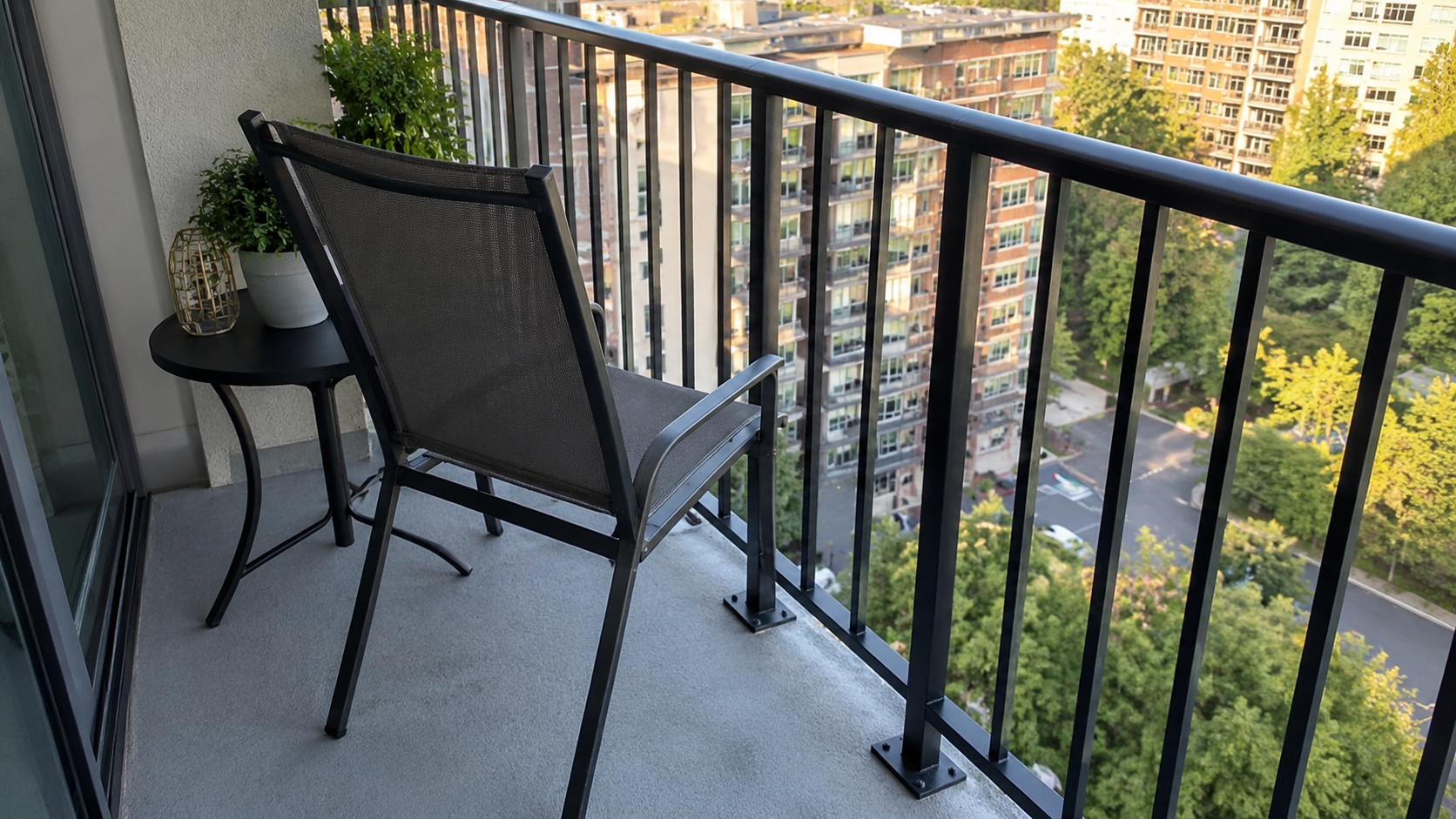
Why You Shouldn’t Keep Chairs Near Balcony Railings
Minjin Park
·
A chair near a balcony railing may seem harmless, but it can create fall risks for children, pets, guests, and even adults. Learn simple balcony safety habits that make outdoor spaces safer and more comfortable.
A balcony can be one of the nicest parts of a home.
It gives you a little fresh air, a place for morning coffee, a spot for plants, or a quiet corner to sit after a long day. In apartments, condos, and townhomes, even a small balcony can feel like a private outdoor room.
So it is natural to place a chair outside.
Maybe it is a folding chair for coffee. Maybe it is a small patio chair beside a plant shelf. Maybe you pull a dining chair outside for a moment and leave it there because it seems convenient.
But there is one balcony habit that deserves more attention: placing chairs too close to the railing.
At first glance, it may not look dangerous. The chair is not broken. The railing is there. Nobody is doing anything reckless. But a chair near a railing can become a climbing step, a tripping point, a tipping hazard, or an easy way for someone to lean too far over the edge.
This matters especially in homes with children, pets, elderly family members, frequent guests, or small balconies where every item is close to the edge.
Balcony safety is not about making your outdoor space feel scary or unusable. It is about arranging it so the safest choice is also the easiest one.
Why Chairs Near Railings Are a Problem
A balcony railing is designed to act as a barrier. A chair placed near it can reduce the protection that barrier provides.
The chair adds height. It changes balance. It invites climbing or leaning. It also makes the balcony feel more crowded, which increases the chance of bumping, slipping, or losing footing.
A chair can become a step
This is the biggest issue in homes with children.
To an adult, a chair is seating. To a child, it can be a ladder, a lookout point, a stage, or a way to reach something interesting. If a chair is close to the railing, a child may climb onto it and suddenly be much higher than the railing was meant to protect.
Children do not always understand height, danger, or how quickly balance can shift. They may stand on the seat, lean over the railing, reach for a bird, wave at someone below, or try to see a passing car.
Even a few seconds can matter.
Adults can misjudge balance too
This is not only a child safety issue.
Adults can also lose balance near balcony railings, especially when moving chairs, watering plants, reaching for hanging laundry, cleaning windows, or leaning to look outside.
A chair near the edge may shift, wobble, or catch someone’s foot. A person may sit down too quickly and tip the chair back. Someone may stand on it “just for a second” to adjust a plant or string light.
Most balcony incidents are not planned. They happen during ordinary moments.
Small balconies leave less room for error
On a wide patio, a chair may be far from the edge. On a narrow apartment balcony, the chair may be only a few inches from the railing.
When space is tight, furniture placement matters more. A chair that feels fine while sitting still may become awkward when someone turns around, carries a drink, opens the balcony door, or moves around another person.
Why This Matters in Everyday Life
Balcony risks often feel unlikely until you picture real household routines.
A toddler follows a parent outside while laundry is drying. A cat jumps onto a chair to look over the railing. A guest leans back in a lightweight chair while chatting. Someone stands on a chair to hang string lights. A child climbs onto a chair to watch people below. A strong gust of wind shifts a folding chair near the edge. An older adult steps backward and catches the chair leg.
None of these situations sound extreme. That is the point.
The safest balcony setup is one that does not depend on everyone making perfect choices every time.
Children and Balcony Chairs: The Biggest Concern
Children are naturally curious. Balconies can be fascinating because there is movement, sound, and activity below. Cars pass. Dogs bark. People walk by. Birds land nearby. The railing becomes a window into the world.
A chair near the railing gives a child exactly what they need to climb higher.
Kids climb faster than adults expect
Many parents and caregivers know this feeling: you turn away for a moment, and the child has already climbed onto something.
A balcony chair does not need to be tall to be risky. Even a low chair can raise a child enough to lean over the railing or put their center of gravity in the wrong place.
Lightweight chairs are especially concerning because they can tip, slide, or wobble.
“They know not to climb” is not enough
Teaching children balcony rules is important, but rules alone are not a safety system.
Children forget. They test limits. They copy adults. They act quickly when excited. A child who usually listens indoors may behave differently when something interesting is happening outside.
The safer approach is to combine teaching with environment design: keep climbable furniture away from the railing.
Visitors’ children may not know your home rules
Even if your own child understands the balcony, a visiting child may not. Family gatherings, playdates, babysitting, and holiday visits can change the risk level.
A balcony that seems safe for adults may need a quick reset before children arrive.
Pets Can Use Chairs as Launch Points
Pets are another reason to keep chairs away from balcony railings.
Cats love height. Small dogs may jump onto chairs to see outside. Birds, rabbits, and other pets may explore more than expected if allowed onto a balcony.
A chair near the railing can become a perch or launch point.
Cats are agile, but not risk-free
People often assume cats are too coordinated to fall. But cats can be startled, slip on a narrow rail, chase a bird, or misjudge a jump. A chair makes it easier for them to reach the railing in the first place.
If you have a cat, balcony safety may require more than moving chairs. Screens, enclosures, or supervised access may be needed depending on your setup.
Small dogs may jump without thinking
A dog may jump onto a chair because it hears another dog below. It may place its paws on the railing, bark, lean, or bounce with excitement.
Even if the dog cannot fit through the railing, the climbing and leaning can still be risky.
Chair Type Matters
Not all chairs create the same level of risk, but any climbable furniture near a railing deserves caution.
Folding chairs
Folding chairs are convenient but can be unstable on balcony floors. They may shift when someone sits down, collapse if not fully locked, or move in wind.
If a folding chair is placed close to a railing, the risk increases.
Lightweight plastic chairs
Plastic chairs are easy to move, which is part of the problem. A child can drag one closer to the railing. Wind may shift it. It may also tip more easily than heavier furniture.
Tall bar chairs
Bar-height chairs and stools are especially concerning because they already raise the person higher. On a balcony, they can reduce the effective height of the railing and encourage leaning.
These are best kept well away from the edge, and in many small balcony setups, they may not be a good choice at all.
Rocking or reclining chairs
Chairs that rock, tilt, or recline need plenty of clearance. Near a railing, they can change a person’s center of gravity quickly.
A balcony is usually not the best place for a chair that encourages leaning back unless there is ample space and a stable layout.
Outdoor storage benches
Storage benches may seem safer because they are heavier, but they can still be climbed. If placed under or near a railing, they may create the same step-up problem as a chair.
Common Mistakes People Make on Balconies
Balcony furniture mistakes often come from trying to save space.
Mistake 1: Pushing chairs against the railing to make more room
This is probably the most common layout choice. People push chairs outward so the center of the balcony feels open.
Unfortunately, that places climbable furniture exactly where it should not be.
A better option is to place seating against the wall side of the balcony, facing outward, with the chair backs away from the railing.
Mistake 2: Leaving temporary chairs outside
Sometimes the risky chair was not part of the balcony design. Someone brought it out for a phone call, a smoke break, a plant project, or a quick cup of coffee. Then it stayed there.
Temporary furniture can become a permanent hazard if no one moves it back.
Mistake 3: Using chairs as step stools
Standing on a chair near a balcony railing is not worth the risk. It may feel practical when hanging lights, cleaning glass, or reaching a plant hook, but chairs are not ladders.
Use proper tools and avoid doing tasks that require you to lean near the edge.
Mistake 4: Crowding the balcony
Too much furniture makes movement awkward. When people have to squeeze around chairs, plant stands, laundry racks, and storage bins, they are more likely to trip or bump into the railing.
A small balcony should have fewer items, not smaller margins.
Mistake 5: Trusting the railing too much
A railing is important, but it is not meant to handle every unsafe setup. Leaning hard against it, climbing near it, or placing furniture that defeats its height can create risk.
The railing works best when the area around it stays clear.
Warning Signs Your Balcony Setup Needs a Safety Reset
Walk onto your balcony and look at it with fresh eyes. You may need to rearrange it if:
A chair is close enough for a child to climb and lean over the railing. Furniture touches or nearly touches the railing. A chair can easily slide toward the edge. Someone has to squeeze between furniture and the railing. A stool, bench, plant stand, or storage box sits under the railing. Children or pets can access the balcony without close supervision. A chair wobbles on uneven flooring. The balcony door opens into furniture. Guests tend to lean back toward the railing. You use a chair to reach plants, laundry, lights, or windows.
These are not signs that you have done something terrible. They are simply clues that the layout can be improved.
Safer Ways to Arrange Balcony Furniture
The safest balcony is one where seating is comfortable but not climbable near the edge.
Keep chairs away from the railing
Place chairs closer to the building wall instead of the railing. If possible, position them so the person sitting faces the view, but the chair itself is not pushed against the edge.
Leave enough space that the chair cannot tip or slide into the railing.
Avoid tall seating
Low, stable chairs are usually safer than tall stools or bar chairs. Avoid seating that raises people above a comfortable, protected height.
Choose heavier, stable furniture
Outdoor furniture should be sturdy enough not to tip easily. It should sit flat on the balcony floor and not wobble.
Still, heavy furniture should not be placed close to the railing if children can climb it.
Use fewer pieces
A small balcony does not need a full outdoor dining set. One or two safe chairs may be better than several crowded pieces.
If the balcony feels hard to move around in, remove something.
Secure lightweight items
Wind can move cushions, small stools, folding chairs, plant stands, and drying racks. Store lightweight furniture indoors or secure it properly when not in use.
A chair blown against a railing can also damage property or create a tripping hazard.
Balcony Safety With Children
If children live in or visit the home, balcony safety needs special attention.
Make the balcony an adult-supervised space
Young children should not have unsupervised balcony access. Keep doors locked when the balcony is not in use. Consider door alarms or child-resistant locks if appropriate for your home.
Remove climbable objects
Chairs, stools, benches, coolers, storage boxes, plant stands, buckets, and toy bins can all become climbing aids.
If a child can move it or climb it, keep it away from the railing.
Avoid storing toys on the balcony
Toys invite children outside and encourage play. A balcony is not the best playroom, especially if space is limited.
Teach simple rules
Rules should be clear:
No climbing on balcony furniture. No leaning over the railing. No standing on chairs. Ask an adult before going outside.
But remember, rules work best when the environment supports them.
Balcony Safety With Pets
Pets need their own safety plan.
Supervise balcony time
Do not assume a pet will behave the same way every time. Sounds, birds, other animals, or people below can trigger sudden movement.
Keep chairs and perches away from railings
Cats and small dogs may use chairs as lookout spots. Move furniture so pets cannot easily reach the railing.
Check railing gaps
Some railings have gaps that small pets may squeeze through. Others have horizontal bars that can encourage climbing.
If you are unsure whether your balcony is safe for your pet, do not allow unsupervised access.
Avoid food and bird feeders near the edge
Food smells and bird activity can attract pets toward the railing. Keep these away from risky areas.
Don’t Forget Plant Stands and Storage Boxes
This article focuses on chairs, but chairs are not the only climbable items.
Plant stands, shelves, storage boxes, coolers, buckets, crates, and small tables can create the same problem.
A beautiful balcony garden can become risky if plant shelves are placed along the railing where children can climb them or where pots can fall.
Keep planters stable
Heavy pots should be stable and not balanced on narrow ledges. Hanging planters should be properly secured. Avoid placing pots where they can be knocked over by wind, pets, or people moving chairs.
Avoid ladder-like shelving near railings
Tiered plant stands look nice, but they can resemble stairs to a child. Place them against the wall side of the balcony or keep them indoors if children visit often.
Weather Makes Balcony Furniture Less Predictable
Balconies are exposed to wind, rain, temperature changes, and sometimes snow or ice. These conditions can make furniture behave differently.
Wind can move chairs
Light chairs can slide, tip, or bang against railings. A chair that was safely placed yesterday may shift after a windy night.
Rain can make surfaces slippery
Wet balcony floors can make it easier to slip while moving around furniture. Chair legs may also slide more easily on wet tile, concrete, or composite flooring.
Sun can weaken materials
Plastic furniture can become brittle over time. Fabric straps can stretch. Metal parts can rust. Wood can crack.
Inspect balcony furniture occasionally, especially before warm-weather use.
A Simple Balcony Safety Checklist
Use this quick check every so often, especially before kids, pets, or guests use the balcony.
Chairs are away from the railing. No stools, boxes, benches, or plant stands are under the railing. Furniture is stable and not wobbly. The balcony is not overcrowded. The door can open and close safely. Children cannot access the balcony unsupervised. Pets cannot climb from furniture to the railing. Lightweight items are secured or stored indoors during wind. Planters are stable and not balanced near the edge. No one uses chairs as step stools.
This checklist takes less than a minute, but it can make the balcony much safer.
What to Do If Your Balcony Is Very Small
Small balconies are harder because there is limited room to separate furniture from the railing.
In that case, choose furniture carefully. A compact bench against the building wall may be safer than chairs that must sit near the railing. Foldable furniture can be stored indoors when not in use. Wall-mounted shelves should be placed away from the edge and not create climbing opportunities.
If the balcony is too narrow to keep seating safely away from the railing, it may be better to use it for standing, plants, or fresh air rather than regular seating.
Comfort should not come at the cost of basic safety.
For Renters: What You Can Still Control
Renters may not be able to change railing height, balcony design, or door hardware without permission. But furniture placement is usually within your control.
You can:
Move chairs away from the railing. Use fewer balcony items. Store folding chairs indoors. Keep children and pets supervised. Report loose or damaged railings. Avoid hanging heavy objects from railings. Ask management about approved safety options if needed.
If a railing feels loose, wobbly, rusted, or damaged, report it promptly. Do not treat railing problems as cosmetic.
Final Thoughts: A Safer Balcony Starts With Simple Placement
A chair near a balcony railing may seem harmless, but it can change how safe the balcony really is. It can become a step for children, a perch for pets, a tipping point for adults, or an obstacle in a small outdoor space.
The fix is simple: keep climbable furniture away from the railing.
Arrange chairs closer to the wall side of the balcony. Avoid tall stools. Remove unnecessary furniture. Keep plant stands, storage boxes, and benches away from the edge. Supervise children and pets. Check the setup after wind, rain, or rearranging.
A balcony should feel relaxing, not risky. With a little thoughtful furniture placement, you can still enjoy fresh air, coffee, plants, and quiet evenings while keeping the space safer for everyone who uses it.
Hi, I’m the creator and editor behind ZestyHabit. I research everyday safety, first aid, and practical wellness topics using official guidance and reliable public sources, then turn that information into clear, realistic steps for daily life.
My goal is to help readers make safer, better-informed choices at home and beyond.