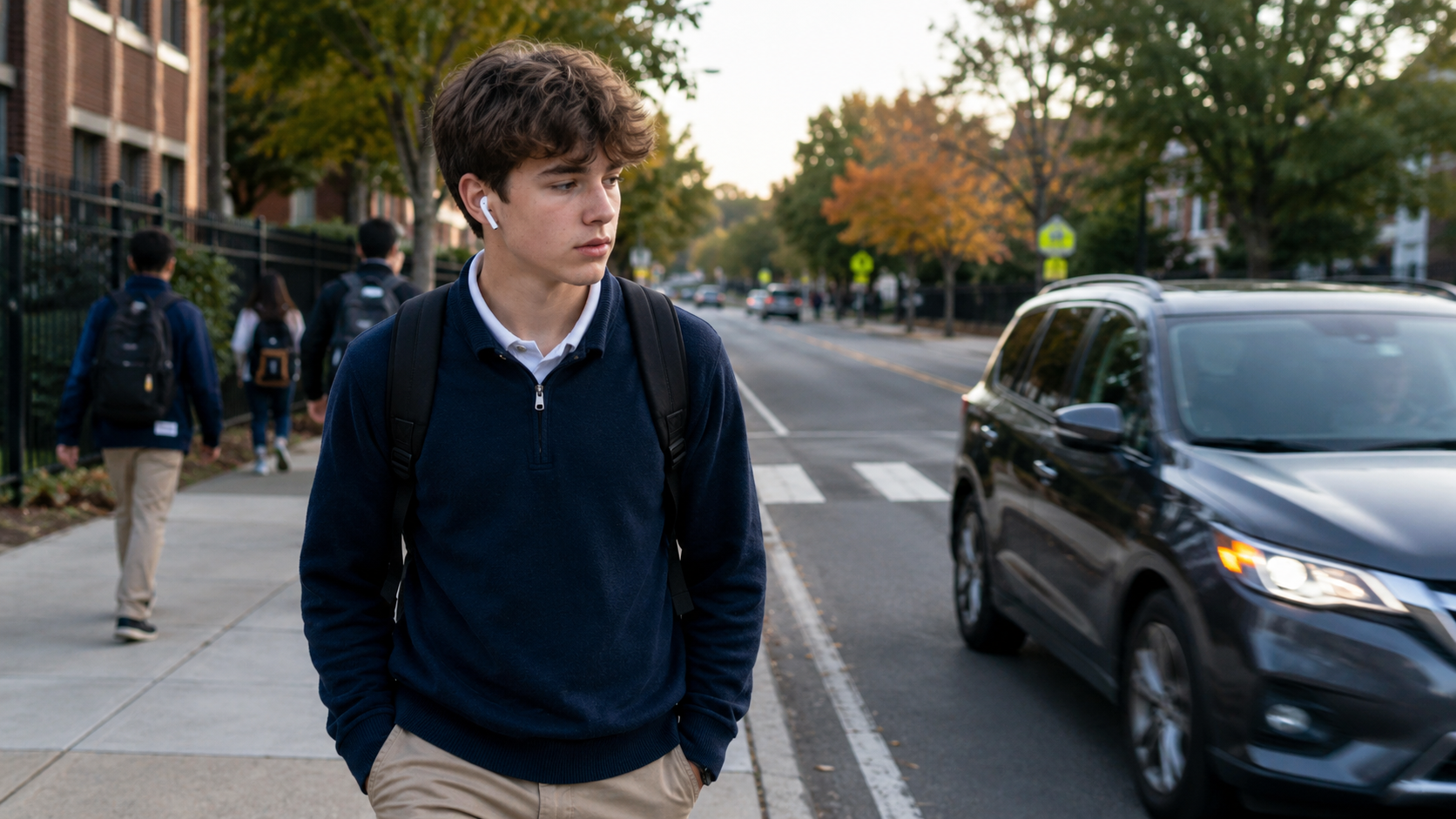
Earbuds can make the walk to school more enjoyable, but they can also reduce awareness around traffic, bicycles, strangers, and unexpected hazards. Learn simple ways students can listen more safely.

Why This Everyday Habit Deserves a Second Look
For many students, earbuds are part of the morning routine. They put on a backpack, grab a phone, start a playlist or podcast, and head out the door. Music can make the walk to school feel more fun. It can help teens wake up, feel calm, or enjoy a few minutes of privacy before a busy day.
There is nothing wrong with enjoying music. Earbuds are not “bad” by themselves.
The issue is that walking to and from school is not the same as sitting in a bedroom or riding in the back seat of a car. A school commute often includes crosswalks, driveways, buses, parking lots, bikes, scooters, construction zones, dogs, other students, and cars turning in places where drivers may be distracted.
When earbuds block too much sound, students may miss small warning cues that help them stay aware. A car backing out of a driveway, a cyclist calling “on your left,” a bus braking, a friend shouting a warning, or an approaching emergency vehicle may be harder to notice.
This matters because safety on the way to school is often about quick awareness. Most close calls do not come with a dramatic warning. They happen in ordinary moments: crossing a street, stepping around a parked car, walking through a busy school parking lot, or looking down at a phone while the world keeps moving.
The goal is not to ban earbuds completely. The goal is to help students use them in a smarter, safer way.
How Earbuds Can Reduce Situational Awareness
Sound Helps You Understand What Is Happening Around You
When people talk about safety, they often focus on what you can see. Look both ways. Watch for cars. Pay attention to traffic lights. These are important habits.
But hearing is also a big part of awareness.
You may hear a car before you see it. You may hear tires on wet pavement, a horn, a bicycle bell, footsteps behind you, a dog barking, or someone calling your name. These sounds help your brain build a picture of what is happening nearby.
Earbuds can shrink that picture. If the volume is loud, or if noise cancellation is turned on, the student may feel like they are in a private bubble. That can be pleasant, but it can also make it easier to miss changes in the environment.
Noise Cancellation Can Be Too Effective Outdoors
Noise-canceling earbuds are great on airplanes, in libraries, or in noisy indoor spaces. On a school commute, they can be a problem because they are designed to reduce outside sound.
A student using strong noise cancellation may not hear a vehicle approaching from behind, a bus pulling up, or another pedestrian trying to get their attention.
Transparency mode or ambient mode can help, but students still need to keep the volume low enough that outside sounds remain noticeable.
Why School Commutes Have Extra Risks
Mornings Are Busy and Rushed
School mornings can be hectic. Drivers are commuting to work. Parents are dropping off children. Buses are making stops. Students are crossing streets at the same time. Everyone is on a schedule.
That mix creates a lot of movement in a short period.
A student wearing earbuds may not notice a car turning into a driveway, a parent rushing through a drop-off lane, or a cyclist coming up from behind. Even if the student has the right of way, awareness still matters.
School Zones Can Be Crowded and Confusing
Near schools, there may be crosswalks, buses, cones, crossing guards, parked cars, and kids moving in different directions. Drivers may be focused on finding a drop-off spot or watching their own child get out safely.
This does not mean every driver is careless. It means the environment is busy.
Earbuds can make it harder for students to notice instructions from crossing guards, announcements from school staff, or warnings from other students.
Afternoons Can Be Just as Distracting
After school, students may be tired, excited, hungry, or focused on messages from friends. Some walk in groups. Others walk alone. Phones come out quickly.
This is another time when earbuds can reduce awareness. A student may be thinking about homework, sports practice, or social plans while also listening to music and walking near traffic.
The more distractions stack up, the easier it becomes to miss something important.
Common Mistakes Students Make With Earbuds
Mistake 1: Wearing Both Earbuds at Full Volume
The most obvious risk is using both earbuds with loud audio. This blocks much of the outside world.
Students may still think they are paying attention because they can see what is ahead. But hazards do not only come from the front. Cars, bikes, scooters, runners, and other students may approach from the side or behind.
A safer habit is to keep the volume low or use only one earbud in higher-risk areas.
Mistake 2: Using Noise Cancellation Near Roads
Noise cancellation can make a walk feel calm, but it is not ideal near traffic, train crossings, parking lots, or school drop-off zones.
Students may not realize how much sound they are missing until someone startles them. That startled reaction is a clue that the earbuds are blocking too much.
Mistake 3: Looking Down at the Phone While Listening
Earbuds and phones often go together. A student changes songs, checks a message, watches a video, or scrolls while walking.
This creates a double distraction: reduced hearing and reduced vision. Near roads or parking lots, that combination can be risky.
A simple rule helps: stop walking before changing music or replying to a message.
Mistake 4: Assuming Familiar Routes Are Always Safe
Many students walk the same route every day. Familiarity can create a false sense of security.
But the route is not exactly the same every day. A construction truck may block a sidewalk. A dog may be loose. A new driver may be backing out of a driveway. A traffic signal may be out. Rain, fog, snow, or darkness may change visibility.
Even on a familiar route, students need to stay alert.
Mistake 5: Ignoring Crossing Guards or School Staff
Crossing guards and school staff often use verbal instructions along with hand signals. If a student cannot hear them, they may step forward too early or miss a warning.
Earbuds should come out, or the volume should be lowered, before entering busy school areas and crosswalks.
Warning Signs That Earbuds Are Blocking Too Much
People Keep Startling You
If friends, cyclists, or pedestrians seem to “come out of nowhere,” the earbuds may be too loud or too isolating.
Being surprised once in a while is normal. But if it happens often, it is a sign that outside awareness is too low.
You Cannot Hear Cars Behind You
A student should be able to hear nearby traffic, especially on streets without sidewalks. If the music covers the sound of cars passing, the volume is too high for walking near roads.
You Miss Someone Calling Your Name
If a parent, friend, teacher, crossing guard, or bus driver calls out and the student does not hear, that is another warning sign.
You Feel Disconnected From Your Surroundings
Some students like earbuds because they create a private space. But if the private space feels so strong that the outside world fades away, that is not ideal for walking near traffic.
A safer listening setup should still allow the student to notice what is happening around them.
Practical Ways Students Can Use Earbuds More Safely
Keep the Volume Low
A simple rule is that students should still be able to hear traffic, voices, and environmental sounds around them. If the music has to be loud to feel enjoyable, it may be better to save it for the bus, home, or another safer setting.
Low volume does not eliminate all risk, but it keeps the student more connected to the environment.
Use One Earbud in Busy Areas
Using one earbud instead of two can help students hear more of what is happening around them. This is especially helpful near crosswalks, school zones, parking lots, bus stops, and streets without sidewalks.
It is not a perfect solution, but it is often better than blocking both ears.
Turn Off Noise Cancellation Outdoors
For walking to school, ambient mode or transparency mode is usually better than full noise cancellation. Even then, students should keep the volume low.
A good habit is to turn off noise cancellation before leaving the house or before getting off the bus.
Pause Audio at Crossings
Students can make crosswalks a “pause point.” Before crossing a street, pause the music, look up, listen, and check all directions.
This habit is simple and easy to remember. It also helps students avoid crossing while distracted by a favorite song, podcast, or video.
Put the Phone Away While Walking
Changing songs can wait. Messages can wait. Videos should not be watched while walking near roads.
If a student needs to use the phone, they should stop in a safe place away from traffic, finish the task, then continue walking.
Tips for Parents Without Turning It Into a Fight
Talk About Awareness, Not Control
Teens may tune out if the conversation sounds like a lecture. Instead of saying, “Earbuds are dangerous, stop using them,” try focusing on awareness.
For example: “I know music makes the walk better. I just want you to be able to hear cars, bikes, and people around you.”
This keeps the conversation practical rather than dramatic.
Practice the Route Together
For younger students, walk the route together and point out places where earbuds should be removed or lowered. These might include crosswalks, alleys, driveways, bus stops, railroad crossings, or busy intersections.
For older students, ask them to identify the risky spots themselves. This helps them build judgment instead of simply following rules.
Agree on Simple Earbud Rules
Family rules work best when they are clear and realistic. Examples might include:
Use only one earbud while walking.
No noise cancellation near roads.
Pause audio before crossing streets.
No videos while walking.
Take earbuds out in school parking lots.
These rules are easy to understand and easier to follow than a vague warning like “be careful.”
Tips for Schools and Communities
Include Earbud Awareness in Walking Safety Lessons
Schools often teach students to look both ways, use crosswalks, and follow crossing guards. Earbud awareness can fit naturally into those lessons.
A short reminder may be enough: “When you are near traffic, make sure you can hear what is around you.”
Use Signs in Busy Areas
Simple signs near school entrances, crosswalks, or bus zones can remind students to remove earbuds or lower volume. The message does not need to be harsh.
Something like “Heads up, earbuds down near traffic” is friendly and clear.
Encourage Adults to Model the Habit
Students notice what adults do. If parents, teachers, and older siblings walk through parking lots while looking down at phones and wearing earbuds, younger students may copy that behavior.
Modeling awareness can be more powerful than repeating warnings.
A Practical Example: The Walk Past the Drop-Off Lane
Imagine a middle school student walking to class with both earbuds in. The music is loud because the drop-off lane is noisy. A parent in an SUV is backing out of a tight space. Another student calls out, “Watch out,” but the student with earbuds does not hear it right away.
Nothing terrible has to happen for this to be a useful example. Maybe the student stops just in time. Maybe the driver brakes. Maybe everyone moves on.
But it shows how small delays in awareness can matter.
If the student had lowered the volume, used one earbud, or paused the music near the drop-off lane, they might have noticed the situation sooner.
What About Students Who Use Earbuds for Anxiety or Focus?
Some students use music or earbuds to feel calm, especially if the school commute is noisy or stressful. That is understandable.
The goal should not be to shame students who rely on audio for comfort. Instead, the goal is to find a safer balance.
They might use one earbud, choose lower-volume calming music, turn on transparency mode, or pause audio only at crossings and busy areas. For students with sensory sensitivities, families may need a more personalized plan that still keeps outdoor awareness in mind.
Safety habits work best when they respect real life.
Weather and Visibility Make Earbud Safety Even More Important
Earbuds can be riskier when conditions are already difficult. Rain, fog, snow, early morning darkness, and glare from the sun can all reduce visibility.
When drivers have a harder time seeing students, students need to be even more aware. On these days, it is smart to lower the volume more than usual or skip earbuds near traffic altogether.
Wet roads also change sound. Cars may slide, splash, or brake differently. Hearing those cues can help students react sooner.
Conclusion: Earbuds Are Fine, but Awareness Comes First
Wearing earbuds on the way to school may seem like a small habit, but it can affect how well students notice traffic, bikes, school buses, crossing guards, other pedestrians, and unexpected hazards.
The point is not to make students afraid of listening to music. It is to help them stay connected to the world around them while they walk, bike, or wait near roads.
The safest habits are simple: keep the volume low, avoid noise cancellation near traffic, use one earbud in busy areas, pause audio before crossing streets, and put the phone away while walking.
A school commute does not have to be silent. But it should leave enough room for real-world sounds. Music can be part of the morning, as long as awareness stays in the lead.
Leave a Reply