
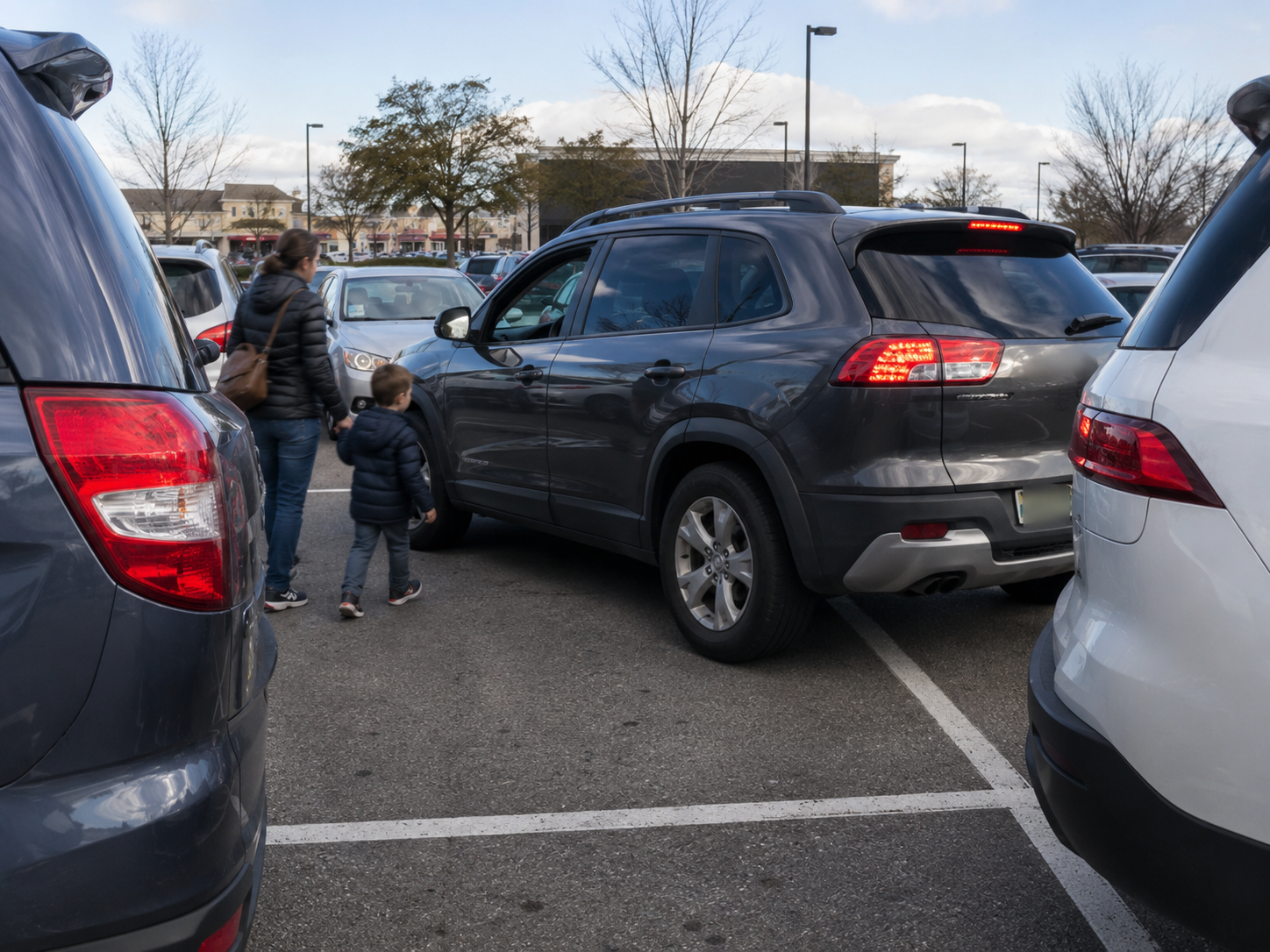

Backing out in a parking lot can feel routine, but the riskiest moment often happens before you fully see what is behind you. Learn simple habits to reverse more safely.
Why Parking Lot Reversing Deserves More Attention
Parking lots feel slow and ordinary. Most of us pull into a grocery store, office lot, school pickup area, gym, pharmacy, or apartment garage without thinking much about danger. Compared with highway driving, everything seems calmer.
But parking lots are full of movement.
Cars are backing out. Pedestrians are walking between vehicles. Shopping carts roll across lanes. Children may step out from behind SUVs. Delivery drivers, cyclists, and distracted shoppers all share the same tight space.
That is why backing out of a parking space can be one of the trickiest everyday driving moments.
The most dangerous moment is often the first few seconds after you start reversing, especially when your rear view is blocked by parked vehicles on both sides. You may technically be moving slowly, but your visibility is limited. Other people may not realize you are backing up. You may not yet have a clear view of the lane behind you.
The good news is that safer reversing does not require special driving skills. It comes down to pausing, looking carefully, moving slowly, and not trusting one tool alone.
The Most Dangerous Moment: When the Rear of Your Car Enters the Driving Lane
The riskiest part of backing out is usually not when you are fully in the aisle. It is the moment your vehicle begins to leave the parking space and the back end starts entering the traffic lane.
At that point, you may still be partly hidden between two parked cars. Your backup camera may show what is directly behind you, but it may not clearly show a fast-moving car coming from the side. Your mirrors may still be blocked by nearby vehicles. Pedestrians may be walking behind you from an angle.
This is the “half-visible” moment.
You are moving, but you cannot see everything yet.
Other drivers can see part of your car, but they may not know how far you plan to back out. Pedestrians may assume you are parked. A child may not understand that reverse lights mean the vehicle is about to move.
That short gap between “still parked” and “fully visible” is where many close calls happen.
Why Backing Out Is Harder Than It Looks
Backing out of a parking space asks your brain to do several things at once.
You need to watch behind the car, check both sides, steer in reverse, avoid nearby vehicles, watch for pedestrians, judge distance, and respond to moving traffic. All of that happens in a tight space, often while you are thinking about groceries, appointments, kids, weather, or your phone.
Even careful drivers can miss something.
Your View Is Often Blocked
If you are parked between two tall vehicles, such as SUVs, trucks, or vans, your view into the aisle may be very limited.
You may need to reverse slowly before you can see cross traffic. But the moment you reverse, part of your car is already entering the lane.
This is why rushing is risky. You need time to reveal your car slowly and gather information.
People Move Differently in Parking Lots
On regular roads, traffic usually follows predictable lanes and signals. In parking lots, people move in less predictable ways.
A pedestrian may cut between cars. A driver may pull through an empty space. Someone may stop suddenly for a shopping cart. A child may run ahead of a parent. Another car may reverse at the same time as you.
Because movement is unpredictable, you need a slower, more patient approach.
Reverse Steering Feels Less Natural
Many drivers are less comfortable steering in reverse than driving forward. Small steering inputs can feel confusing. The back of the car swings differently than the front.
When drivers feel rushed, they may turn too sharply, look only at the camera, or forget to check one side.
That is why backing out should never be treated as a casual, automatic motion.
Common Situations That Increase the Risk
Not every parking lot is equally difficult. Certain situations deserve extra caution.
Backing Out Between Large Vehicles
Large parked vehicles can create blind spots on both sides. If you are in a compact car between two SUVs, you may not see approaching traffic until your rear bumper is already in the aisle.
In this situation, reverse inch by inch. Look left and right repeatedly. Do not assume the aisle is clear just because your camera view looks empty.
Backing Out Near Store Entrances
Store entrances are busy. People may be carrying bags, pushing carts, walking with children, or looking at receipts and phones.
Drivers may also be distracted while looking for open spaces.
If you are parked near the entrance of a grocery store, school, medical office, or shopping center, expect more pedestrian movement.
Backing Out During Bad Weather
Rain, snow, fog, and glare can make reversing harder. Water droplets on the backup camera lens can blur the image. Wet pavement can reflect headlights. Snow piles can block your view. Fogged windows can reduce side visibility.
Before reversing, clear your windows and check that your mirrors and camera are usable.
Backing Out at Night
At night, you may rely more heavily on reverse lights, brake lights, and backup cameras. But pedestrians in dark clothing can be hard to see. Some parking lots have uneven lighting, especially near the edges.
Move slowly and take extra time to scan.
Backing Out When You Are in a Hurry
Hurrying is one of the biggest risk factors.
Maybe you are late for work, trying to leave before traffic gets worse, or rushing because someone is waiting for your spot. But backing up is not the moment to save a few seconds.
A slow reverse is not rude. It is responsible.
Why Backup Cameras Help, But Do Not Solve Everything
Backup cameras are useful. They can show the area directly behind your vehicle and help you avoid objects, pedestrians, and low obstacles that may be difficult to see through the rear window.
But a camera is not a complete picture of the world around your car.
Cameras Have Limits
A backup camera may not show everything coming from the sides. The lens can be dirty, wet, foggy, or covered with snow. Bright sunlight or darkness can affect the image. The screen may also make objects appear closer or farther than they really are.
Some cameras have wide-angle views, which are helpful but can distort distance.
Use the camera as one tool, not the only tool.
Mirrors Still Matter
Side mirrors help you see movement coming from the left and right. Rearview mirrors help you understand what is behind your vehicle. Your own eyes help you notice things cameras and mirrors may miss.
Before backing out, check all of them.
A good habit is: camera, mirrors, over-the-shoulder glance, then slow movement.
Rear Cross-Traffic Alerts Are Helpful, Not Perfect
Many newer vehicles have rear cross-traffic alert systems. These can warn you when a vehicle is approaching from the side while you reverse.
They are helpful, especially in crowded parking lots. But sensors can have limits. They may not detect every pedestrian, bicycle, cart, or fast-moving object.
Do not let alerts replace careful looking.
Common Mistakes Drivers Make When Reversing
Most parking lot mistakes are small habits that become risky in the wrong moment.
Mistake 1: Reversing Immediately After Starting the Car
Some drivers start the car, shift into reverse, and move right away. This leaves little time to notice someone walking behind the vehicle.
Before shifting into reverse, pause and look around. Check the area behind and beside the car before the vehicle moves.
Mistake 2: Looking Only at the Screen
A backup camera can become so convenient that drivers stare at the screen and forget the rest of the environment.
The screen may show what is behind you, but not everything around you. Look out the windows, check mirrors, and use the camera together with those checks.
Mistake 3: Backing Out Too Fast
Parking lots are not places for quick movements. Even a few miles per hour can feel fast when pedestrians are nearby and visibility is limited.
Creep slowly. Give yourself time to stop if something appears.
Mistake 4: Assuming Pedestrians Will Move
Drivers sometimes think, “They see me backing up. They will stop.”
That is not always true.
Pedestrians may be distracted, wearing headphones, managing children, carrying bags, or simply not looking your way. Children and older adults may also move more slowly or unpredictably.
Assume people may not notice you.
Mistake 5: Trusting Reverse Lights Alone
Reverse lights are helpful, but they are not a guarantee that others will react. In bright daylight, they may be hard to notice. In busy lots, people may ignore them.
Use your lights, but do not depend on them to clear the area for you.
Warning Signs You Should Pause Before Backing Out
Sometimes the safest move is to stop before you even start reversing.
You Cannot See Past the Cars Next to You
If your view is blocked, back out very slowly or wait until the area feels calmer. A blocked view is a clear sign to be patient.
A Pedestrian Is Nearby
If someone is walking behind or near your vehicle, wait. Even if you think they have enough space, it is better to let them pass first.
Another Vehicle Is Also Backing Up
Two cars backing out at the same time can create confusion. Stop and wait if another driver begins reversing near you.
A Child Is Nearby
Children can be difficult to see and may move suddenly. If children are nearby, take extra time. Make sure they are clearly away from the vehicle before moving.
Your Camera or Mirrors Are Dirty
If your camera lens is blurry or your mirrors are covered with water, dust, ice, or snow, clean them before relying on them.
A Simple Safer Routine for Backing Out
Safe reversing is easier when you follow the same routine every time.
Step 1: Look Around Before Getting In
As you approach your vehicle, glance around it. Look for children, carts, low objects, pets, bikes, or anything behind the car.
This is especially useful because some objects may not be visible once you are seated.
Step 2: Settle Before Shifting Into Reverse
Put on your seat belt, adjust mirrors if needed, put away your phone, and make sure passengers are settled.
Do not start reversing while distracted.
Step 3: Check Behind and to Both Sides
Use your mirrors, camera, and direct glances. Look left, right, and behind.
Pay attention to movement, not just objects. A person or car may enter your path after your first check.
Step 4: Reverse Slowly
Ease out gently. Do not press the accelerator unless necessary. In many cars, simply releasing the brake allows enough movement.
The slower you move, the more time you have to react.
Step 5: Pause When Your Rear Bumper Reaches the Aisle
This is the key moment. As your vehicle starts to become visible to cross traffic, pause briefly if needed.
Check both directions again. This gives approaching drivers and pedestrians a chance to notice you, and it gives you a clearer view.
Step 6: Continue Only When Clear
Once you can see the aisle and it is clear, keep backing slowly while turning. Continue checking both sides until you are fully out of the space.
Step 7: Shift to Drive Only After Stopping
Do not rush the shift from reverse to drive while the car is still moving. Stop, shift, check your path, and then move forward.
Safer Parking Choices Can Reduce Reversing Risk
You can make backing out easier before you even leave the car.
Choose a Pull-Through Space When Available
If two spaces line up and it is allowed, pulling through lets you leave by driving forward. This can reduce the need to back out later.
Make sure you follow posted signs and parking lot rules.
Back Into the Space When Practical
Backing into a space can feel slower at first, but it allows you to drive forward when leaving. This may be safer in some lots because you can assess the space before backing in, rather than backing out later into moving traffic.
Only do this where it is legal, practical, and safe.
Park Away from the Busiest Area
A spot farther from the entrance may have fewer pedestrians and less cross traffic. The extra walk can be worth it, especially in crowded lots.
Avoid Tight Spots When Possible
If a space is narrow or surrounded by large vehicles, choose another spot if you can. More room means better visibility and easier maneuvering.
Special Tips for Parents and Families
Parking lots are especially challenging with children.
Before backing out, make sure children are inside the vehicle and buckled, or safely supervised away from moving cars. Do not rely on a child to “stand over there” while you move the vehicle unless another responsible adult is watching them.
Teach children that parked cars can move at any time. Remind them not to run behind vehicles, chase balls, or walk between cars without an adult.
When driving through family-heavy areas such as schools, parks, daycares, and grocery stores, expect children to be present even if you do not see them right away.
Special Tips for Older Drivers
Older drivers may benefit from a little extra time and setup before reversing.
Make sure mirrors are adjusted well, windows are clean, and the seat position allows comfortable turning and looking around. If neck stiffness makes it hard to check over the shoulder, mirrors and camera use become even more important, but they should still be combined with slow movement and repeated checks.
There is no shame in taking more time. A slow, careful reverse is a good driving habit at any age.
What to Do If Someone Walks Behind You
If a pedestrian appears behind your vehicle, stop immediately and wait.
Do not wave them through while continuing to roll backward. Do not try to “beat them” by reversing quickly. Let them pass completely, then check again before moving.
The same applies to shopping carts, bicycles, and other vehicles. Stop first. Decide second.
Final Thoughts: The First Few Seconds Matter Most
Backing out of a parking space may feel like a small part of driving, but it deserves your full attention.
The most dangerous moment is often when your vehicle first begins entering the parking lane, before you can fully see cross traffic and before others clearly understand what you are doing.
A safer routine is simple: look before you move, use mirrors and cameras together, reverse slowly, pause when visibility is limited, and never assume pedestrians or other drivers see you.
Parking lot safety is not about being nervous. It is about being patient.
Those few extra seconds can make leaving a parking space calmer, smoother, and safer for everyone around you.

Hi, I’m the creator and editor behind ZestyHabit. I research everyday safety, first aid, and practical wellness topics using official guidance and reliable public sources, then turn that information into clear, realistic steps for daily life.
My goal is to help readers make safer, better-informed choices at home and beyond.


