
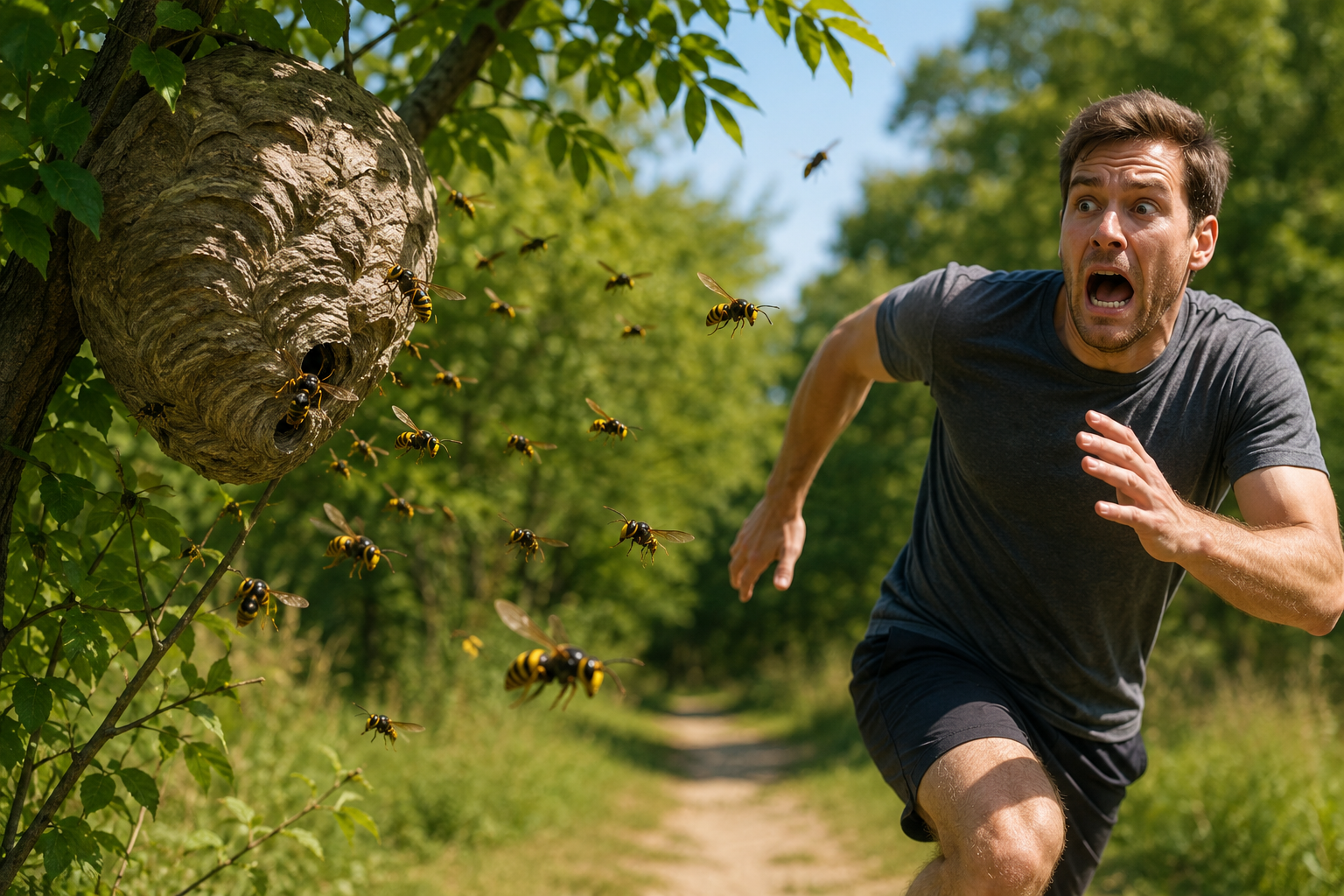

Learn why sudden movement, noise, and vibration near a bee or wasp nest can trigger defensive behavior—and what to do instead.
A child spots a nest under the deck and runs away screaming. A homeowner starts the lawn mower without noticing a hole in the ground. Someone throws a stick at a paper nest just to see whether it is active.
These situations share one problem: sudden movement and disturbance close to a nest can make social bees or wasps respond as though their colony is under attack.
The important detail is that insects are not usually offended by the human voice in the way a person might be. Simply talking loudly at a distance is unlikely to be the main issue. The greater concern is what often comes with shouting—running feet, waving arms, vibrations, thrown objects, or accidental contact with the nest.
That distinction matters because the safest response changes with the situation. If one bee is calmly flying nearby, swatting and sprinting may make the encounter worse. If several insects are already attacking, however, getting to an enclosed shelter quickly is the priority.
Why Insects Defend the Area Around a Nest
A social insect colony may contain a queen, developing young, food stores, and hundreds or thousands of workers.
Honey bees, bumblebees, yellowjackets, paper wasps, and hornets can all defend a colony, although their behavior varies. Many solitary bees and wasps are much less likely to sting because they do not have a large shared colony to protect.
Social wasps are especially capable of defending a nest as a group. Unlike a honey bee, many wasps can sting repeatedly. Penn State Extension notes that social wasps may aggressively defend nests when they feel threatened.
Guard Insects Watch the Entrance
Active nests often have workers moving in and out of one opening. Some colony members remain near the entrance and respond to possible threats.
A person does not need to hit the nest directly. Stepping over a ground entrance, shaking the branch supporting a nest, or standing in the insects’ flight path may be enough to change their behavior.
This is why underground yellowjacket nests can cause such sudden problems. The lawn may look empty until a mower, child, or dog passes directly over the entrance.
Vibration Can Feel Like a Physical Threat
Running produces repeated impacts through soil, decks, roofs, and tree limbs. Power equipment creates even stronger vibration.
Outdoor pest-management guidance warns that movement or noise near a nest—including a lawn mower, a running child, or someone stepping over an underground nest—can provoke wasps and yellowjackets.
The sound itself is only part of the picture. A mower also shakes the ground and vegetation. Footsteps may vibrate a wall cavity. Shouting at close range may come with stamping, arm movements, and forceful breathing.
To the colony, this combination can resemble an animal trying to damage the nest.
Sudden Movement Draws Attention
A person who discovers a nest may instinctively jump backward, wave both arms, and run in circles.
Those movements can keep the person near the nest longer while making the disturbance larger. If the insects have not begun attacking, a controlled retreat is usually safer: protect the face, avoid swatting, and move steadily away.
Why Shouting Can Make the Situation Worse
It is easy to say that bees “hate loud noises,” but that explanation is too simple.
A distant conversation or an ordinary child’s voice does not automatically cause a colony to attack. Risk increases when loud behavior happens close enough to disturb the nest or is paired with sudden activity.
Shouting Often Creates More Movement
People rarely stand still while shouting about a nest. They point, jump, wave others away, grab a child, or swing at insects near their face.
A group may scatter in several directions, causing more footsteps and more time near the nest. The confusion can also make someone trip or accidentally move closer.
When insects are not yet attacking, a calm instruction such as “Walk toward the house now” is more useful than repeated screaming.
Leaning Close Is Not Harmless
Close-range human activity brings warmth, motion, odor, and exhaled air into the nest area.
The practical lesson is not to hold your breath around every bee. It is simply that leaning toward a nest and shouting into the entrance is not a harmless test.
Give the colony space instead of finding out what it will tolerate.
Running Is Not Always the Wrong Response
“Never run from bees” is common advice, but it needs context.
If a single foraging bee or wasp is investigating your drink, running and swatting are unnecessary. Remain calm, cover the beverage, and move away slowly. The CDC advises staying calm when one stinging insect is nearby because swatting may cause it to sting.
If multiple insects are stinging, bumping into you, or following aggressively from a nest, the situation has changed.
Once an Attack Begins, Leave Quickly
During a group attack, leave the nest area and enter an enclosed building or vehicle. CDC guidance tells people attacked by several stinging insects to run away and go indoors. It also warns against jumping into water because insects may remain above the surface.
Move in one clear direction rather than circling the nest. Protect your eyes, nose, and mouth with your hands, shirt, or another item without stopping to remove insects.
Do not remain nearby swatting. Honey bees can release alarm chemicals when they sting, which may attract more bees.
Choose Enclosed Shelter
Bushes do not create a sealed barrier and may slow you down. Lying on the ground leaves the face and body exposed.
A house, car, shed, or other enclosed shelter is more useful. Arizona Extension likewise recommends moving quickly to a building or vehicle during a serious bee attack rather than flailing or entering water.
Places Where Accidental Nest Disturbance Happens
Many troublesome nests are less obvious than a large hive hanging from a tree.
Ground Holes in Lawns
Yellowjackets may use abandoned animal burrows or underground cavities. The entrance can look like a small hole with insects traveling in and out.
Running, mowing, digging, edging, or playing nearby can shake the nest. Pets may also investigate the hole and bring defensive insects toward family members.
Before mowing an area that has been unused, watch for repeated insect traffic at ground level.
Decks, Sheds, and Play Equipment
Paper wasps often build nests beneath protected surfaces. Look under railings, picnic tables, outdoor chairs, swing sets, mailbox roofs, and shed eaves.
A child climbing, a chair being dragged, or a deck board vibrating can bring people much closer than they realize.
Inspect play structures and outdoor furniture regularly during warm months.
Wall Cavities and Rooflines
Bees or wasps may enter through cracks near siding, vents, soffits, shutters, or utility openings.
Hammering, drilling, pressure washing, or slamming a nearby door can disturb insects hidden inside. Do not plug an active entrance without a plan, because the insects may search for another route.
A qualified beekeeper or pest-management professional can identify the insect and recommend an appropriate response.
Trees, Shrubs, and Woodpiles
Hanging nests can be hidden by leaves, while cavity nests may be inside a hollow trunk. Pruning, hedge trimming, or collecting firewood can disturb them.
Watch for a steady stream of insects returning to one location. Repeated traffic is often easier to spot than the nest itself.
Warning Signs That You Are Too Close
A nest may give clues before a large defensive response begins:
- Many insects repeatedly entering one hole or gap
- Increased buzzing in one location
- Insects circling your head
- A bee repeatedly bumping into you
- Several insects emerging at once
- Workers following as you move away
- One or more stings near a suspected nest
Do not stay to take a close photograph. Mark the location from a safe distance, bring children and pets indoors, and block normal access to the area until it can be handled safely.
Common Mistakes Around Nests
Throwing Objects
Rocks, sticks, balls, and garden hoses can damage a nest while leaving the person fully exposed.
Teach children to treat a nest like a private animal home: notice it, back away, and tell an adult.
Swatting at Every Insect
A bee near flowers or food is not necessarily defending a nest.
Swatting can trap it against the skin or provoke a sting. Cover sweet drinks, move food indoors, and step away without swinging.
Starting Equipment Without Looking
Mowers, string trimmers, hedge trimmers, and leaf blowers create vibration and air movement.
Walk the area first. Watch suspicious holes, roof edges, shrubs, and stored equipment before starting the engine.
Attempting Close-Range Removal
Spraying, knocking down, burning, flooding, or sealing an active nest can expose the person attempting removal, as well as nearby family members and pets.
A honey bee colony may be suitable for relocation by an experienced beekeeper, while a hazardous wasp nest may require licensed pest management.
Assuming All Bees Are Aggressive
Most bees on flowers are focused on gathering food. Many native species live alone and pose little sting risk when left undisturbed.
Colorado State University Extension notes that solitary bees in managed bee hotels have an extremely low sting risk, while social yellowjackets are more likely to defend an underground colony.
Respect nests without treating every pollinator as an attacker.
Simple Ways to Prevent a Nest Encounter
Check eaves, sheds, decks, outdoor furniture, play equipment, and quiet yard corners every few weeks during spring and summer.
Teach children not to poke holes, shake branches, or throw objects at nests. Show them the route to the nearest building and give them one simple instruction: move away and tell an adult.
Keep outdoor trash cans closed and clean up spilled soda, fruit, and meat scraps that attract foraging yellowjackets.
If a nest is far from people and pets, it may be possible to leave it alone. Bees and wasps provide pollination or natural pest-control benefits, and many wasp colonies naturally end after cold weather. Nests beside doors, play areas, walkways, or essential work areas deserve professional evaluation.
People with known severe sting allergies should follow the preparedness plan provided by their healthcare professional.
A Calm, Practical Takeaway
Running and shouting near a bee or wasp nest can be dangerous because those actions often create sudden movement, vibration, and confusion close to a colony prepared to defend its home.
The voice alone is usually not the full problem. Stomping feet, waving arms, power equipment, thrown objects, and accidental contact are more meaningful disturbances.
When you notice a nest before insects attack, stay controlled and move away without swatting. Keep children and pets out of the area, mark the location from a safe distance, and arrange appropriate help if the nest creates an everyday hazard.
If multiple insects are already attacking, do not remain beside the nest trying to stay still. Cover your face, move quickly to an enclosed building or vehicle, and do not jump into water.
Look before mowing or pruning, teach children a simple response, and give active nests enough space until they can be safely avoided or professionally handled.

Hi, I’m the creator and editor behind ZestyHabit. I research everyday safety, first aid, and practical wellness topics using official guidance and reliable public sources, then turn that information into clear, realistic steps for daily life.
My goal is to help readers make safer, better-informed choices at home and beyond.


