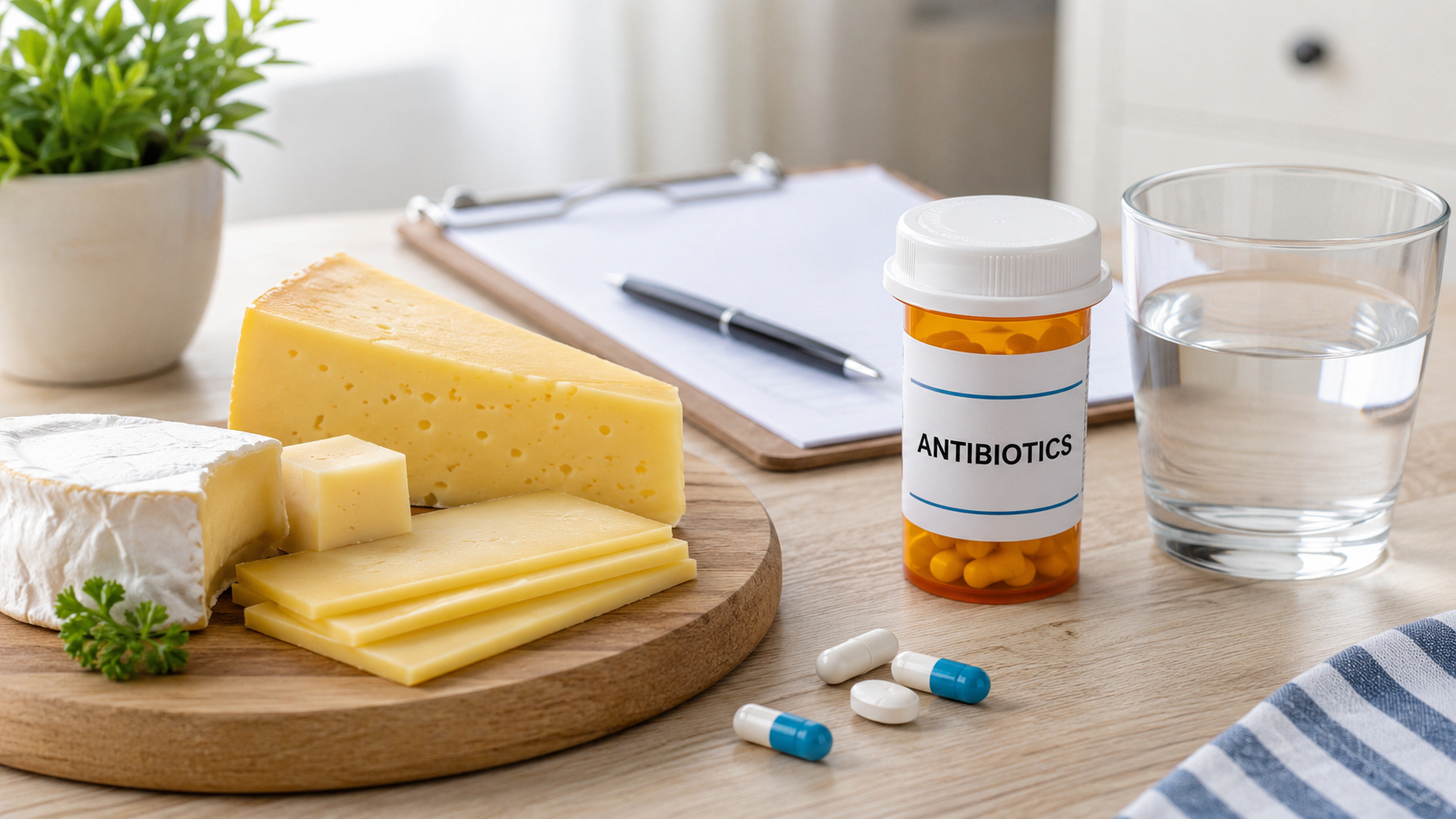
Can You Eat Cheese While Taking Antibiotics, or Is That Always a Problem?
Minjin Park
·
Cheese and antibiotics do not always clash, but some antibiotics can be affected by calcium-rich foods. Here’s when to be careful, when it may be fine, and how to handle it without overthinking every bite.
The Cheese Question Nobody Thinks About Until They’re Holding the Pill Bottle
There are certain questions that only show up when you are already sick, tired, and standing in the kitchen in pajamas.
“Can I take this antibiotic with breakfast?”
“Wait, does cheese count as dairy?”
“Did the pharmacist say no milk, or no food, or no calcium?”
And suddenly your innocent piece of toast with melted cheddar feels like a medical decision.
The short answer is: cheese is not always a problem with antibiotics. But with certain antibiotics, especially some in the tetracycline and fluoroquinolone families, calcium-rich foods can make the medicine harder for your body to absorb. That means the issue is not that cheese becomes toxic or dangerous in a dramatic way. The bigger concern is that the antibiotic may not work as well if taken too close to dairy. MedlinePlus gives this warning for ciprofloxacin, saying not to take it with dairy products or calcium-fortified juices alone.
That little word “some” matters a lot.
Not every antibiotic has this problem. Not every bite of cheese ruins your treatment. And not every instruction means the same thing.
Still, it is worth understanding the pattern, because timing can make the difference between taking your medicine properly and accidentally making it less effective.
Why Dairy Can Interfere With Certain Antibiotics
Cheese contains calcium. So do milk, yogurt, ice cream, calcium-fortified orange juice, some plant milks, and certain supplements.
Calcium is great for bones. It is not always great sitting in your stomach at the exact same time as certain medicines.
With some antibiotics, calcium can bind to the drug in the digestive tract. Once bound, the medicine may not absorb into your bloodstream as well. If less medicine gets absorbed, less is available to fight the infection. The MSD Manual notes that tetracyclines should not be taken with products containing calcium, magnesium, aluminum, or iron, and that dairy products can reduce absorption for tetracycline and omadacycline.
This is why the advice often sounds stricter than people expect.
It is not about cheese being “bad.” It is about the timing.
A slice of cheese at lunch may be fine if your antibiotic was taken hours earlier. But swallowing the pill with a cheese omelet, a latte, or a calcium-fortified smoothie may be a different story, depending on the medication.
And yes, this can get annoying. Nobody wants to build a spreadsheet around a sinus infection.
The Antibiotics Where Cheese Is More Likely to Matter
The main groups people hear about are tetracyclines and fluoroquinolones.
Tetracycline-type antibiotics
This group includes medicines such as tetracycline, doxycycline, minocycline, and others. They are used for different infections and sometimes for skin conditions like acne or rosacea.
Dairy is more of a concern with some tetracyclines than others. Older tetracycline medications are especially known for this interaction. Doxycycline can be a little less sensitive than older tetracycline, but it is still worth following the instructions on your exact prescription.
This is where people often get confused because they search online and find mixed answers.
One source says doxycycline can be taken with food. Another says avoid dairy. Another says take it with a full glass of water and stay upright. All of those can be true depending on the exact product, the person’s stomach, and the reason it was prescribed.
The safest habit is simple: read the pharmacy label and medication guide, then ask the pharmacist if dairy timing is unclear.
Not glamorous advice, I know. But it beats guessing.
Fluoroquinolone antibiotics
This group includes medications such as ciprofloxacin and levofloxacin. They are not used casually for every minor infection, but some people do receive them for specific situations.
Ciprofloxacin has a well-known interaction with dairy and calcium-fortified foods when taken alone with them. MedlinePlus says ciprofloxacin may be taken with or without food, but not with dairy products or calcium-fortified juices alone.
That “alone” part is important.
It does not necessarily mean a tiny amount of dairy hidden in a full meal is the same as taking the pill with a glass of milk. But again, the label wins. If your instructions say separate dairy by a certain number of hours, do that.
Cheese Is Not the Only Thing to Watch
When people hear “avoid dairy,” they usually picture milk, yogurt, and cheese.
Fair enough.
But calcium can hide in places that do not feel especially dairy-like.
Calcium-fortified orange juice. Calcium-fortified almond milk or oat milk. Meal replacement shakes. Protein drinks. Antacids. Multivitamins. Calcium supplements. Some magnesium or iron supplements.
This matters because the interaction is often about minerals, not just cheese.
So if your antibiotic has a calcium warning, a “dairy-free” breakfast is not automatically safe if you swallow the pill with fortified plant milk and a multivitamin.
That sounds fussy, but it is actually helpful once you see the pattern. You are not memorizing every food on earth. You are mostly watching out for mineral-heavy foods or supplements near the dose.
Does a Little Cheese Ruin the Whole Course?
Usually, no. One accidental bite of cheese is not a reason to panic.
Let’s say you took your antibiotic and then remembered you had a cheese stick twenty minutes earlier. Annoying? Yes. Worth spiraling over? Usually not.
The better move is to get back on track with the next dose and follow the spacing instructions going forward. If you are worried, call the pharmacy. Pharmacists answer this type of question all the time, and they can tell you what matters for your specific medication.
What you should not do is double your next dose unless a healthcare professional tells you to. More medicine is not automatically better, and doubling up can increase side effects.
One imperfect dose does not mean the entire course is useless.
What About Cheese in a Full Meal?
This is where the real-life part gets messy.
Some antibiotic instructions say the medicine can be taken with food to reduce stomach upset. Some warn not to take it with dairy. Some say avoid taking it with calcium-rich products by themselves. Some specify a time window, like taking the antibiotic a certain number of hours before or after dairy, antacids, iron, or zinc.
That means a blanket rule like “never eat cheese with antibiotics” is too simple.
A small amount of cheese in a larger meal may not be treated the same way as taking the pill with a glass of milk. But for certain antibiotics, especially those with clear mineral-interaction warnings, spacing is still the safer habit.
Think of it this way:
If your antibiotic does not have a dairy warning, cheese may not be an issue at all.
If it does have a dairy or calcium warning, do not take the pill right alongside cheese, milk, yogurt, calcium drinks, or mineral supplements unless your prescriber or pharmacist says it is okay.
Not dramatic. Just careful.
A Practical Timing Approach That Usually Makes Life Easier
For many antibiotics with dairy interactions, people are often told to separate the medicine from dairy or mineral supplements. The exact timing depends on the drug, so the prescription label or pharmacist should guide you. The NHS also advises that antibiotics can have specific food and alcohol instructions, and the patient information leaflet should be checked for how to take them properly.
A practical example:
You take your antibiotic first thing in the morning with water. You wait before having yogurt, cheese, milk, or a calcium-fortified drink. Later in the day, you enjoy dairy away from the dose. At night, you repeat the same spacing.
That is much easier than banning cheese from your life for a week, especially if cheese is one of the few foods that sounds edible when you are sick.
The real goal is not fear. It is spacing.
The Stomach Problem: When Food Helps but Dairy Complicates Things
Antibiotics can be rough on the stomach.
Some people feel nauseated if they take them without food. Others get stomach cramps, loose stools, or that unpleasant “medicine stomach” feeling that makes every meal seem suspicious.
So when someone says, “Take it with food,” it makes sense to reach for something gentle. Toast. Crackers. Soup. Rice. Eggs. A banana. Maybe a little sandwich.
But if your specific antibiotic has a dairy warning, cheese or yogurt may not be the best “with food” option near the dose.
Try non-dairy options instead:
Toast with peanut butter. Rice and eggs. Crackers and turkey. Oatmeal made with water or a non-fortified option, if allowed. A banana and a handful of nuts. Soup with bread. A simple chicken-and-rice bowl.
Nothing fancy. Sick-day food does not need to win awards.
If nausea is strong or you cannot keep the antibiotic down, call your healthcare provider. Do not just suffer through it quietly and hope for the best.
Probiotics, Yogurt, and the Antibiotic Confusion
This is where people get understandably tangled.
Antibiotics can disturb the gut, and many people hear that yogurt or probiotics may help. Then they also hear not to take dairy with certain antibiotics.
Both ideas can exist at the same time.
Yogurt may be something a person wants to eat during an antibiotic course, but it still may need to be timed away from certain doses. Also, not every yogurt is the same, not every probiotic is necessary, and not everyone tolerates dairy well during an illness.
If you like yogurt and your antibiotic has a dairy warning, ask the pharmacist how far apart to place it. That way you are not taking the medicine and the yogurt together, but you also are not making your week more miserable than needed.
For some people, fermented foods or probiotics may be useful. For others, they may cause bloating or discomfort. Your body gets a vote here.
Cheese, Tyramine, and a Different Kind of Warning
Most of the time, when people ask about cheese and antibiotics, they mean calcium.
But there is another cheese-related issue with a few medications: tyramine.
Aged cheeses can contain tyramine, a compound that can interact with certain drugs. This is more famous with some antidepressants called MAOIs, but it can also come up with specific antibiotics such as linezolid. That is a different warning from the calcium issue.
If you are prescribed linezolid or another medication with a tyramine warning, aged cheese, cured meats, fermented foods, and certain alcoholic drinks may need special attention. This is not the same as “don’t take your pill with milk.” It is a separate food interaction.
That is why reading the actual medication guide matters. The reason behind the warning changes what you should do.
When You Should Ask Instead of Guessing
There are times when it is better to ask a pharmacist or prescriber directly.
Ask if:
Your label says “avoid dairy” but does not explain timing. You take calcium, magnesium, iron, zinc, or multivitamins. You rely on meal replacement shakes or fortified drinks. You have a stomach condition that makes taking medicine difficult. You accidentally took several doses with dairy and are worried. You are pregnant, elderly, immunocompromised, or being treated for a serious infection. You are taking several medications and the instructions are starting to feel like a puzzle.
This is not being annoying. This is exactly what pharmacists are there for.
Also, never assume that advice from an old prescription applies to a new one. “Antibiotic” is a huge category. Amoxicillin is not doxycycline. Doxycycline is not ciprofloxacin. Ciprofloxacin is not linezolid. Same general family of “infection medicine,” very different food instructions.
A Simple Way to Think About It
Cheese and antibiotics are not always enemies.
For many antibiotics, cheese may not matter much. For certain ones, especially tetracyclines and fluoroquinolones, calcium-rich foods can reduce how much medicine your body absorbs. For a few specific medications, aged cheese may matter for a different reason entirely.
So the most practical approach is not panic. It is checking.
Look at the label. Look for words like dairy, calcium, antacids, iron, magnesium, zinc, or fortified foods. Take the pill with water unless told otherwise. Separate dairy when the instructions say to. Ask the pharmacist when the timing is unclear.
And please do not let one accidental cheese snack turn into a full emotional event. Most people make small medication mistakes at some point. The helpful thing is to notice it, adjust, and keep taking the antibiotic the way your healthcare professional instructed.
Hi, I’m the creator and editor behind ZestyHabit. I research everyday safety, first aid, and practical wellness topics using official guidance and reliable public sources, then turn that information into clear, realistic steps for daily life.
My goal is to help readers make safer, better-informed choices at home and beyond.