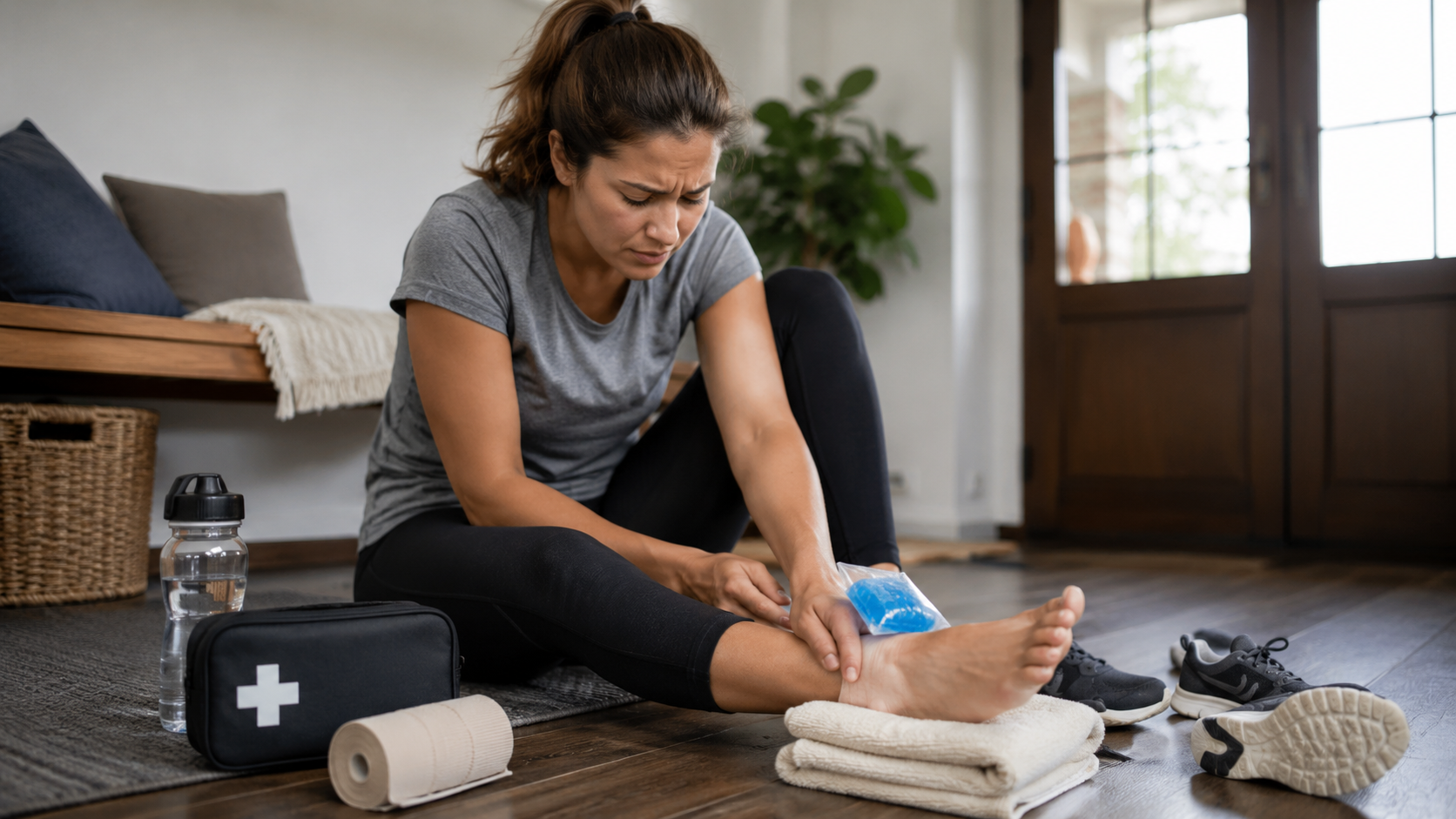
A sprained ankle can look minor at first, then swell and ache hours later. Here’s what to do in the first day, when to get medical help, and how to avoid making it worse.
A sprained ankle usually does not arrive politely.
One second you are stepping off a curb, chasing a dog, walking down stairs, playing pickleball, or trying to carry too many grocery bags like a hero. The next second your ankle turns in a way ankles are not supposed to turn, and you freeze.
There is often that little pause.
Did I just hurt myself? Can I walk? Is this embarrassing? Should I pretend nothing happened?
A sprain happens when ligaments around a joint are stretched or torn. In the ankle, this often happens when the foot rolls inward and stresses the ligaments on the outside of the ankle. Symptoms can include pain, swelling, bruising, tenderness, and trouble bearing weight, and the severity can range from mild stretching to a more serious tear.
The tricky part is that an ankle sprain can feel confusing at first. Sometimes the pain is sharp right away. Sometimes you can limp around for a bit and only later realize the swelling has turned your ankle into something that looks borrowed from another person.
That first response matters. Not because you can magically heal it in ten minutes, but because you can reduce extra irritation, protect the joint, and avoid turning a manageable injury into a longer, more annoying recovery.
First: Stop and Check Before You Keep Walking
The first mistake many people make is trying to “walk it off” immediately.
I get the impulse. Nobody wants to make a scene. If you twisted your ankle in a parking lot or at the gym, your pride may hurt almost as much as the ankle. But pushing through sharp pain is not brave. It is just a good way to make the area angrier.
Sit down if you can. Take your shoe off only if it is safe and not causing more pain. If the ankle is swelling quickly, a tight shoe may become uncomfortable, but yanking it off can also hurt. Go slowly.
Look at the ankle. Is it swelling? Is there bruising? Is the foot sitting at an odd angle? Can you wiggle your toes? Do your toes look normal in color? Do they feel numb, cold, or tingly?
Try not to diagnose the whole injury in the first two minutes. The goal is simpler: decide whether this looks like something you can manage briefly at home or something that needs urgent medical attention.
If there is obvious deformity, severe pain, numbness, an open wound, or you cannot put any weight on it, do not treat it like a routine sprain. Get medical help.
Use R.I.C.E. in the First Phase
For immediate self-care, Mayo Clinic recommends the R.I.C.E. approach: rest, ice, compression, and elevation. It is a simple framework, but it works best when you do it carefully instead of turning it into a vague “I put ice on it once” situation.
Rest: Protect the ankle from more stress
Rest does not always mean lying in bed for three days doing nothing. It means reducing stress on the injured ankle, especially in the early period.
If walking hurts, avoid unnecessary walking. Use crutches or support if you have them and can use them safely. Do not test the ankle every five minutes just to see if it still hurts. Spoiler: it probably does.
That said, total immobility for too long is not always ideal either. Many ankle sprains recover best with a gradual return to gentle movement and rehabilitation once the worst pain and swelling settle. The early goal is protection, not panic.
Ice: Cool it, but do not freeze your skin
Ice can help with pain and swelling. Mayo Clinic suggests using an ice pack or slush bath for 15 to 20 minutes at a time, repeated every two to three hours while awake during the first few days after the injury.
Do not put ice directly on bare skin. Wrap it in a towel. A bag of frozen peas works, too, as long as you are emotionally prepared to never see those peas as dinner again.
More ice is not always better. Leaving ice on too long can irritate or damage skin. Keep it short, repeat as needed, and let the skin return to normal temperature between sessions.
Compression: Snug, not strangling
An elastic bandage or ankle wrap can help control swelling and give the joint a little support.
The key is not to wrap it like you are securing luggage to a roof rack. Compression should feel snug, not painful. Your toes should stay warm and normal-colored. If you notice numbness, tingling, increased pain, or toes turning pale or bluish, loosen the wrap.
Start wrapping from the foot and move upward toward the ankle, overlapping the bandage. If you are unsure how to wrap it properly, a pharmacist, athletic trainer, nurse, or clinician can show you. A poorly wrapped ankle can cause more problems than it solves.
Elevation: Get it above heart level when possible
Elevation helps fluid drain away from the injured area. Prop your ankle on pillows while lying down, ideally above heart level.
This is one of those things people do for five minutes and then forget. Try to make it easy. Put pillows on the couch. Keep water, your phone, and whatever else you need nearby so you are not constantly hopping up.
Elevation is especially helpful in the first day or two when swelling is building.
Pain Relief: Helpful, But Do Not Use It to Ignore the Injury
Over-the-counter pain relievers may help, depending on your health history and what you can safely take. Mayo Clinic notes that self-care and over-the-counter pain medications may be enough for some sprains, though medical evaluation may be needed to determine severity.
Acetaminophen can help pain. Nonsteroidal anti-inflammatory drugs such as ibuprofen or naproxen may help pain and swelling for some people, but they are not right for everyone. People with stomach ulcers, kidney disease, certain heart conditions, blood thinner use, pregnancy, or other medical concerns should check with a healthcare professional before using them.
The important thing is this: pain medicine should not become permission to overuse the ankle.
If medication makes it feel better, that is useful. But the ligament still needs protection. Do not take a pain reliever and then decide this is the perfect moment to reorganize the garage.
When an Ankle Sprain Needs Medical Care
Some ankle injuries are more than a simple sprain. A fracture, tendon injury, or severe ligament tear can look similar at first.
Seek medical care right away if you have severe pain, obvious deformity, inability to bear weight, numbness, an open wound, or signs that circulation is affected. Mayo Clinic also advises prompt care for concerning ankle injuries, and delayed treatment can lead to ongoing pain or joint instability.
You should also get checked if swelling or pain does not improve after a few days of home care, if symptoms get worse, or if you still cannot walk normally. Mayo Clinic’s ankle pain guidance says to see a healthcare professional if constant swelling does not improve after 2 to 5 days of home treatment.
A good practical test is weight-bearing. If you cannot take a few steps without significant pain, it is safer to get evaluated. You may need an X-ray to rule out a fracture.
And please do not rely only on whether you heard a pop. A pop can happen with sprains, but it does not tell the whole story.
What Not to Do in the First Day
The first 24 hours are a bad time for “let’s see what happens if…”
Avoid heat at first. A hot bath, heating pad, or sauna may feel comforting, but early heat can increase swelling in some injuries.
Avoid alcohol if you are using it to dull the pain or “relax” the area. It can affect judgment, increase fall risk, and may not mix safely with pain medications.
Avoid massage directly over a newly swollen, painful ankle. Gentle touch around the area is one thing. Deep rubbing on a fresh injury is another.
Avoid running, jumping, sports, or long walks “just to test it.” Testing an injury is how many people extend the recovery timeline.
Avoid tight shoes or wraps that make numbness or discoloration worse.
The first day is not about proving the ankle is fine. It is about calming things down and watching how symptoms develop.
The Swelling May Look Worse Later
An ankle sprain can swell more over the next several hours. Bruising may also appear later and spread down toward the foot or toes because gravity is not known for being considerate.
This does not automatically mean the injury is disastrous. But increasing swelling, severe bruising, inability to bear weight, or pain that feels out of proportion should be taken seriously.
Take a photo if you are monitoring it at home. That way you can compare swelling rather than relying on memory. Memory gets dramatic when pain is involved.
Also pay attention to function. Can you move the ankle a little more easily? Can you put slightly more weight on it? Is the pain gradually improving? Mayo Clinic notes that with sprain recovery, you should see gradual, progressive improvement in the joint’s ability to support weight or move without pain.
If the trend is going the wrong direction, do not ignore it.
Returning to Movement: Gentle Is the Word
Once the worst pain and swelling start to settle, gentle movement usually becomes part of recovery. This does not mean rushing back to sports. It means helping the ankle regain motion, strength, and balance.
Harvard Health describes a common functional approach: RICE in the first 24 to 48 hours, then range-of-motion and strengthening exercises within 48 to 72 hours, followed by endurance and balance training as recovery continues.
A simple early movement is the “ankle alphabet.” Sit down, lift the foot slightly, and trace letters of the alphabet with your toes. Keep it gentle. If pain spikes, stop.
Later, depending on severity, exercises may include calf stretches, resistance band movements, heel raises, and balance work. Balance is easy to forget, but it matters. A sprained ankle can become more likely to roll again if strength and coordination do not fully return. The AAOS warns that untreated or poorly rehabilitated severe sprains can weaken the ankle and make future injury more likely.
This is where people often mess up. They stop once walking feels “good enough,” then return to basketball, hiking, or running before the ankle is ready.
Good enough for walking to the fridge is not the same as ready for sudden direction changes.
Braces, Shoes, and Support
Support can help during recovery, especially when you need to move around.
An ankle brace, compression sleeve, or supportive wrap may reduce the feeling that the ankle is wobbly. Supportive shoes are better than slippers, flip-flops, or going barefoot on uneven floors.
This is not the week for stylish but unstable footwear. The ankle has already made its opinion clear.
If you are returning to sports or exercise, a brace or taping may be useful for a while, especially if your clinician or physical therapist recommends it. But support should not replace rehab. A brace can help protect the ankle; it does not magically restore strength and balance.
Everyday Situations That Make It Worse
A sprained ankle is annoying because it turns normal life into a small obstacle course.
Stairs become suspicious. Wet bathroom floors feel dramatic. Carrying laundry suddenly seems like an extreme sport. Getting out of a car requires strategy.
For the first few days, make life easier on purpose.
Keep commonly used items nearby. Wear stable shoes indoors if needed. Use handrails. Avoid carrying heavy things while limping. Ask for help with stairs, pets, groceries, or anything that could make you lose balance.
If you live alone, set up a small “ankle station” near your couch or bed: water, snacks, medication, ice pack, wrap, charger, and whatever else prevents unnecessary trips.
It sounds a little ridiculous until you realize how many times you stand up just because your charger is across the room.
Special Cases: Kids, Older Adults, and Athletes
Kids may underreport pain because they want to keep playing, or overreact because everything feels scary. Either way, swelling, limping, or refusal to bear weight deserves attention.
Older adults should be cautious because falls can cause fractures, and balance issues after an ankle injury can raise the risk of another fall.
Athletes may need a more structured return-to-play plan. If the ankle has to handle sprinting, cutting, jumping, or uneven ground, “it doesn’t hurt much anymore” is not enough. Strength, range of motion, balance, and confidence all matter.
A physical therapist can be very helpful after moderate or severe sprains, repeated sprains, or lingering instability.
How Long Does Recovery Take?
Recovery depends on severity.
A mild sprain may improve significantly within days and feel much better in a couple of weeks. A moderate sprain can take several weeks. A severe sprain may take months and may need medical treatment, immobilization, or structured rehabilitation.
That range is frustrating, but it is honest.
Do not compare your ankle to someone else’s. Two people can “sprain an ankle” and have very different injuries.
A better question is: is it steadily improving?
Less swelling. Less pain. Better walking. More motion. More confidence. Those signs matter.
If you are stuck, worsening, or repeatedly rolling the same ankle, get help rather than waiting indefinitely.
A Simple First-Day Plan
Right after the injury, stop and sit down.
Check for severe signs: deformity, numbness, cold toes, open wound, extreme pain, or inability to bear weight.
If it seems mild and you can safely manage it at home at first, use rest, ice, compression, and elevation.
Ice for 15 to 20 minutes at a time, with a cloth barrier.
Wrap snugly but not tightly.
Elevate when resting.
Avoid heat, alcohol, deep massage, and “testing” the ankle with activity.
Monitor swelling, bruising, pain, and ability to walk.
Get medical care if symptoms are severe, if you cannot bear weight, or if swelling and pain do not start improving with home care.
That is not fancy advice, but it is the kind that helps when your ankle hurts and your brain is busy saying unhelpful things.
Treat It Early So It Does Not Become a Long-Term Nuisance
A sprained ankle is common, which makes it easy to dismiss.
But common does not mean harmless.
Most mild sprains do well with good early care and gradual return to movement. The problems often start when people ignore pain, keep walking on it, skip rehab, or return to sports too soon.
The goal is not to baby the ankle forever. It is to protect it when it is freshly injured, then rebuild movement and strength as it heals.
Sit down. Ice it properly. Wrap it carefully. Elevate it. Watch for warning signs. Give it a real chance to recover.
Your future self, walking down stairs without thinking about every step, will appreciate the effort.
Hi, I’m the creator and editor behind ZestyHabit. I research everyday safety, first aid, and practical wellness topics using official guidance and reliable public sources, then turn that information into clear, realistic steps for daily life.
My goal is to help readers make safer, better-informed choices at home and beyond.