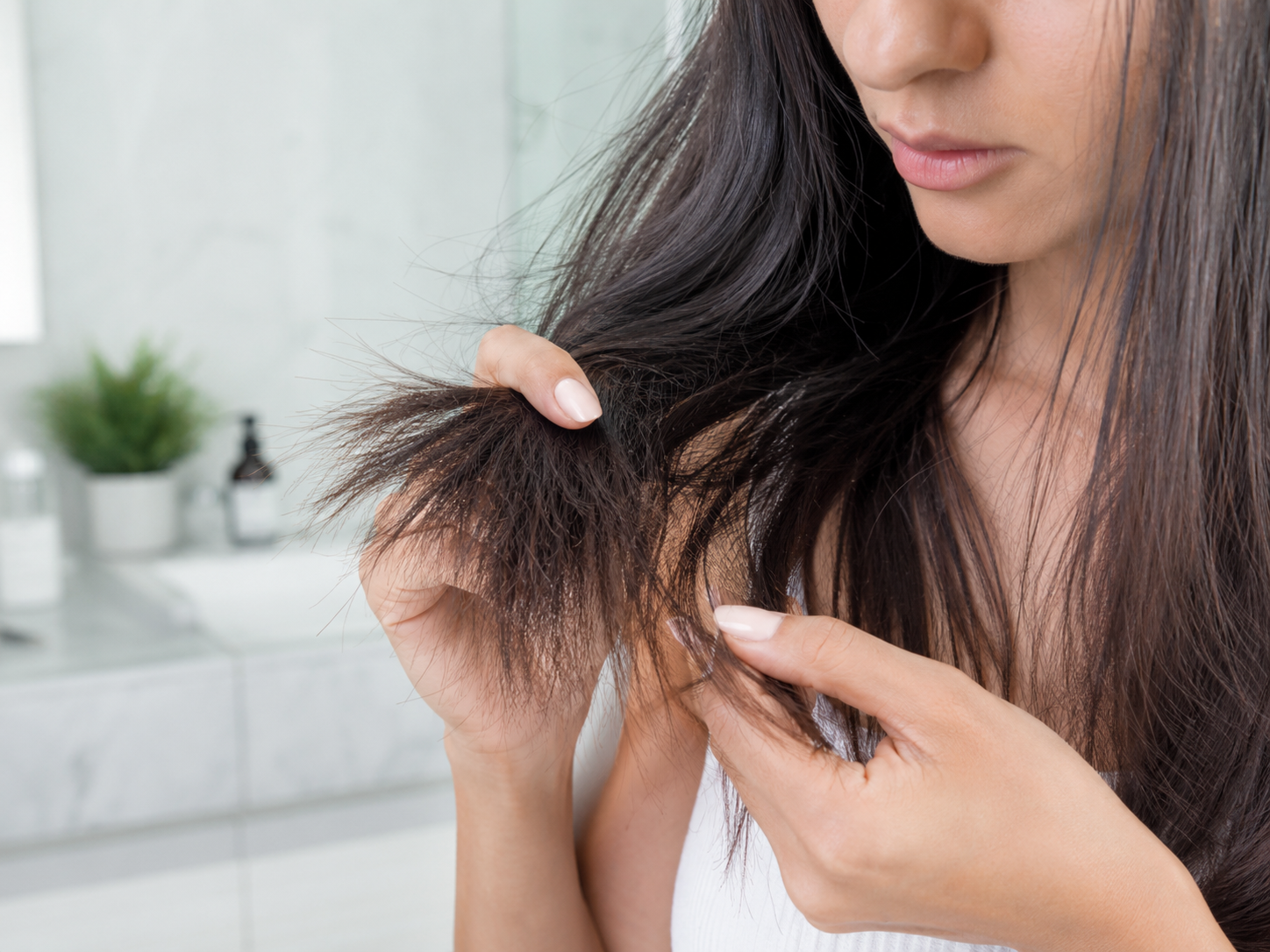
Split ends are one of those tiny beauty problems that somehow feel personal.
You look at one strand of hair under good lighting, notice the end has separated into two little branches, and suddenly you’re inspecting your whole head like a detective. One split end becomes five. Five becomes a crisis. Then you start wondering if your hair is unhealthy, if your shampoo is wrong, if your scalp is suffering, or if you should just cut everything off and start over.
We’ve all been there.
Split ends are extremely common, especially if your hair is long, color-treated, heat-styled, dry, curly, bleached, frequently tied up, or exposed to sun and friction. They don’t mean your hair is ruined. But they do matter, because once the end of a hair strand splits, it cannot truly repair itself back into a perfect strand.
Products can smooth it temporarily. Oils can make it look softer. Leave-in conditioners can reduce roughness. But an actual split end is physical damage to the hair fiber.
And if you ignore it for too long, it can affect more than just the ends. It can change how your hair feels, how it moves, how easily it tangles, and even how healthy your scalp feels indirectly.
A split end happens when the outer protective layer of the hair strand becomes damaged and the inner fiber starts to separate.
Hair may look simple from the outside, but each strand has structure. The outermost layer, called the cuticle, acts a bit like roof shingles. When the cuticle is smooth and intact, hair reflects light better, feels softer, and is easier to detangle. When the cuticle becomes worn down, lifted, or broken, the strand becomes more fragile.
At the ends of the hair, this damage is especially common.
Why? Because the ends are the oldest part of your hair.
If your hair is shoulder-length or longer, the ends may be years old. They have survived shampooing, brushing, sleeping, weather, heat styling, towels, hair ties, and maybe color or bleach. Honestly, they’ve been through a lot.
So when the ends start splitting, it’s not shocking. It’s wear and tear.
The problem is that split ends don’t usually stay neat and polite. If left alone, the split can travel upward along the hair shaft, making more of the strand weak and rough.
Tiny damage can become bigger damage.
Annoying, but true.
Do Split Ends Directly Damage the Scalp?
This is a good question, because people often connect split ends with “hair health” in general.
Split ends themselves do not grow from the scalp. They happen at the ends or along the hair shaft, not at the root. So a split end does not directly damage your scalp in the way dandruff, irritation, clogged follicles, or inflammation might.
Your scalp is living skin. Your hair strand is technically dead keratin once it grows out.
So if the end of the strand is splitting, that does not mean your scalp is automatically unhealthy.
But split ends can affect the scalp indirectly.
When your hair becomes rough, tangled, and hard to manage, you may brush harder. You may pull at knots. You may tie your hair tighter to control frizz. You may use more styling products to smooth the ends. You may wash more aggressively because your hair feels messy.
All of that can stress the scalp.
So no, split ends are not a scalp disease. But the habits that come from dealing with split ends can absolutely make your scalp feel irritated, sore, oily, itchy, or sensitive.
The scalp may not be the starting point, but it can still get dragged into the drama.
Split Ends Make Hair Tangle More Easily
One of the first things people notice with split ends is tangling.
Healthy, smooth hair strands slide past each other more easily. Damaged ends do not. They catch, knot, and cling together. The rougher the ends are, the more likely they are to form tangles, especially around the nape of the neck, shoulders, and outer layers of the hair.
This is why your hair might feel fine near the roots but crunchy, rough, or nest-like near the bottom.
And once hair starts tangling, the damage cycle gets worse.
You brush through knots. The brush pulls on the strands. The ends break. More split ends form. The hair tangles even more.
It becomes a loop.
This is also why detangling gently matters so much. Split ends make hair more fragile, and fragile hair does not appreciate being yanked through with a brush at full force while you’re half-asleep.
I say this as someone who has absolutely done that.
Rough Ends Can Make Your Whole Hair Look Frizzy
Sometimes people think they have “frizzy hair” when the real issue is damaged ends.
Frizz can happen for many reasons: humidity, curl pattern, dryness, breakage, chemical damage, or lack of moisture. But split ends contribute because damaged hair does not lie smoothly. The cuticle is lifted and uneven, so the strand reflects light poorly and sticks out more.
Even if your roots look shiny and healthy, the bottom half of your hair may look dull or puffy if the ends are split.
This can affect the entire shape of your hairstyle. Hair may look wider at the bottom, fluffy in a way you don’t like, or strangely uneven even after styling. Curls may lose definition. Straight hair may look wispy. Waves may become messy instead of soft.
And here’s the frustrating part: you can use smoothing products, but if the ends are severely split, they will still behave like damaged hair.
A serum can make them look better for a day.
A trim actually removes the damage.
Painful truth, I know.
Split Ends Can Make Hair Feel Thinner
Split ends and breakage can make hair look thinner, especially at the bottom.
This is not the same as hair loss from the scalp. Your follicles may be perfectly fine. But if the ends keep splitting and breaking, your hair may lose density through the lengths.
That’s why some people feel like their hair “won’t grow past a certain point.”
The hair may be growing from the scalp normally, but the ends are breaking off at the same rate. So the length seems stuck.
This can make the bottom of the hair look see-through, uneven, or stringy. You might notice that your ponytail feels thinner toward the end. Or that your hair looks full near the roots but sparse at the tips.
This is one of the clearest signs that split ends are not just a cosmetic detail. They can change the whole appearance of your hair.
How Split Ends Affect Hair Texture
Split ends can make hair texture feel completely different.
Hair that once felt smooth may start feeling rough, dry, or straw-like. Even after conditioning, the ends may still feel crunchy. You might notice that your hair does not swing the same way. It feels stiff, tangled, or uneven.
This happens because damaged hair has a disrupted surface.
When the cuticle is smooth, hair feels silky. When it is damaged, the strand feels rough. The more split ends and broken cuticles you have, the more your hair texture changes.
That last one is common. You may use a rich conditioner or oil, and your hair feels softer for a little while. But later, the rough feeling comes back. That is because products can improve the feel of damaged hair temporarily, but they cannot glue a split strand permanently back together.
It’s a little like putting lotion on cracked leather. It helps, but it doesn’t undo the crack.
Why Split Ends Can Make the Scalp Feel Sore
This sounds odd at first. How can damaged ends make the scalp sore?
Usually, it happens through tension and pulling.
When hair tangles badly, brushing pulls from the ends all the way to the roots. That pulling can make the scalp feel tender. Tight ponytails, buns, or clips used to hide messy damaged ends can also create tension at the roots.
If you often wear your hair tied tightly because the ends look frizzy or unmanageable, your scalp may start feeling sore by the end of the day.
The same thing can happen if you sleep with tangled hair and then brush through it roughly in the morning. The scalp gets tugged over and over.
So again, split ends are not directly hurting the scalp. But they create tangles and styling struggles that can lead to scalp discomfort.
Your scalp is basically dealing with the consequences of your ends misbehaving.
Product Buildup Can Become More Noticeable
When hair ends are split and dry, people often use more products.
More oil. More leave-in conditioner. More smoothing cream. More serum. More mask. More everything.
There is nothing wrong with using products to protect and soften damaged hair. But if you apply heavy products often and don’t cleanse properly, buildup can happen. Some of that buildup may sit on the scalp, especially if you apply products too close to the roots.
It can also make the hair look flat at the roots but still dry at the ends, which is possibly one of the most annoying hair combinations.
The solution is not to stop conditioning the ends. The solution is to apply products where they are needed. Most smoothing and repairing products should go from mid-length to ends, not directly on the scalp unless they are specifically made for scalp use.
Your scalp and your ends usually need different things.
The scalp may need clean balance.
The ends may need protection.
Heat Styling Makes Split Ends Worse
Heat tools are one of the biggest contributors to split ends.
Flat irons, curling irons, hot brushes, and blow dryers can all weaken the hair if used too often, too hot, or without protection. Heat can dry out the hair fiber, damage the cuticle, and make the ends more likely to split.
This does not mean you can never style your hair. Real life exists. Some of us simply like looking less like we fought a pillow and lost.
But heat needs limits.
Use a heat protectant. Keep the temperature as low as you can while still getting results. Avoid going over the same section again and again. Don’t use hot tools on wet hair unless the tool is designed for that. And give your hair heat-free days.
If your ends already feel rough, adding more heat will usually make them worse.
Heat styling damaged ends is like ironing a cracked leaf. It may flatten it for a moment, but it is not making it healthier.
Bleach, Color, and Chemical Treatments
Chemical treatments can also lead to split ends.
Bleach is especially hard on hair because it opens the cuticle and changes the hair structure to remove pigment. Coloring, perming, relaxing, and straightening treatments can also weaken the strand, depending on the process and condition of the hair.
This doesn’t mean you can’t have beautiful colored or chemically treated hair. You absolutely can.
But treated hair needs more care. It often needs gentler washing, less heat, regular conditioning, bond-building products if suitable, and more frequent trims.
If you bleach your hair and never trim it, the ends may eventually become thin, rough, or stringy. That is not because your hair stylist is being dramatic when they suggest a trim. Sometimes the ends truly have reached retirement age.
Let them go.
Just a little.
Brushing Habits Matter More Than People Think
Brushing can either protect your hair or damage it, depending on how you do it.
If you brush from the roots downward through knots, you push tangles into bigger tangles. Then you pull harder, and the ends snap.
A better approach is to start detangling from the ends and slowly work upward. Use a wide-tooth comb or a gentle brush if your hair tangles easily. If your hair is curly or textured, detangling with conditioner in the shower may work better than dry brushing.
Wet hair is more fragile, so be careful after washing. Don’t aggressively rub your hair with a towel. Instead, gently squeeze out water with a soft towel or microfiber towel.
Hair care is one of those areas where being gentle feels too simple to matter.
But it matters a lot.
Split Ends Can Travel Up the Hair Shaft
This is one of the main reasons people recommend trimming split ends.
Once the end splits, the damage can move upward along the strand. The longer you leave it, the more hair may become affected. Eventually, instead of needing a tiny trim, you may need to cut off more length to remove the damage.
This is why “dusting” trims can be helpful. Dusting means cutting off a very small amount, just enough to remove damaged tips before they worsen.
If you love your length, regular small trims can actually help you keep it longer in the long run. It sounds backwards, but it makes sense. Removing damage early prevents bigger breakage later.
Skipping trims forever does not always equal longer hair.
Sometimes it equals long hair with very sad ends.
Can Split Ends Be Repaired?
This is where marketing gets a little sneaky.
Some products claim to repair split ends. What many of them actually do is temporarily smooth or seal the split so the hair looks and feels better. That can still be useful. A good serum or leave-in conditioner can reduce friction, improve shine, and make hair easier to manage.
But once a hair strand is physically split, it cannot permanently fuse back together like new.
The only true way to remove split ends is to cut them off.
That doesn’t mean repair products are pointless. They can help protect hair from more damage. They can make the hair look better between trims. They can reduce tangling and breakage.
Just understand what they can and cannot do.
A product can help your ends behave.
Scissors remove the split.
How Often Should You Trim Split Ends?
There is no perfect schedule for everyone.
Some people need trims every six to eight weeks. Others can go three or four months. It depends on your hair type, length, styling habits, color treatments, and how fast your ends get damaged.
If your hair is short, you may trim more often to maintain shape. If your hair is long and healthy, you may stretch trims longer. If your hair is bleached, heat-styled, or prone to breakage, more frequent small trims may help.
Signs you need a trim include:
ends feel rough even after conditioning
hair tangles constantly at the bottom
ends look thin or see-through
curls lose shape at the ends
split ends are visible in many strands
hair breaks when brushing
your style looks messy no matter what you do
A trim does not have to mean a dramatic haircut. Sometimes half an inch can make the whole head feel fresher.
The emotional damage of losing length is real, but so is the relief of healthy ends.
How to Prevent Split Ends
You cannot prevent every split end forever. Hair is exposed to life, and life is rough.
But you can reduce them.
Use conditioner regularly, especially on the ends. Detangle gently. Avoid harsh towel rubbing. Use heat protectant when styling. Limit bleach and high-heat tools if possible. Sleep on a smooth pillowcase if your hair tangles overnight. Avoid tight hairstyles that pull on the same areas. Protect hair from sun, chlorine, and saltwater when needed.
Also, don’t ignore dryness. Hair that is dry and brittle is more likely to split. Regular masks, leave-in conditioners, and oils on the ends can help reduce friction and moisture loss.
Just remember: oils seal and soften, but they do not hydrate hair the way water-based conditioners do. For many people, a combination works best.
Condition first. Seal lightly if needed.
Your ends do not need to be drowned in oil. They need balanced care.
Scalp Care Still Matters
Even though split ends happen at the bottom of the hair, scalp health still matters for future hair growth.
Healthy-looking hair starts with a scalp that is clean, comfortable, and not overly irritated. If the scalp is inflamed, itchy, flaky, or constantly greasy, your hair routine may need adjusting.
But scalp care and split-end care are not the same thing.
For the scalp, focus on proper cleansing, not scratching, and avoiding heavy buildup. For the ends, focus on conditioning, protection, and trimming damage.
People often treat the whole head the same way, but roots and ends live very different lives.
The roots are new. The ends are old.
They should not be expected to need the same care.
When Split Ends Might Signal a Bigger Hair Issue
Most split ends are normal damage. But if your hair suddenly becomes extremely brittle, breaks easily, sheds heavily, or changes texture dramatically, it may be worth looking deeper.
Possible factors can include over-processing, nutritional issues, health changes, stress, hormonal shifts, medication changes, or scalp conditions. If you’re seeing unusual shedding from the root, bald patches, severe scalp irritation, or sudden breakage, a dermatologist can help.
Split ends alone are usually not an emergency.
Sudden major hair changes deserve more attention.
Hair can tell you when something is off, but it doesn’t always speak clearly. Sometimes it mumbles through frizz and breakage.
So, How Do Split Ends Affect the Scalp and Hair Texture?
Split ends mainly affect the hair strand, especially the ends and lengths. They make hair rougher, weaker, more tangled, frizzier, and more likely to break. Over time, they can make hair look thinner at the bottom and feel less smooth overall.
They do not directly damage the scalp, but they can affect it indirectly. Tangled, rough hair leads to more pulling, harsher brushing, tighter hairstyles, and heavier product use. Those habits can make the scalp feel sore, irritated, greasy, or uncomfortable.
The best way to manage split ends is simple, even if it’s not always what we want to hear:
Trim the damaged ends. Be gentle when brushing. Condition regularly. Protect hair from heat. Avoid over-processing. Use products to reduce friction, not to pretend damage never happened. Take care of the scalp and the ends differently.
Split ends are not a beauty failure. They are just a sign that your hair has been through daily life.
But once they show up, ignoring them does not usually help.
Sometimes the healthiest thing you can do for your hair is not adding another product.
It’s cutting off the tiny damaged pieces so the rest of your hair can move, shine, and feel like itself again.
Hi, I’m the creator and editor behind ZestyHabit. I research everyday safety, first aid, and practical wellness topics using official guidance and reliable public sources, then turn that information into clear, realistic steps for daily life.
My goal is to help readers make safer, better-informed choices at home and beyond.