What to Do If You Encounter an Aggressive Dog: The Safest Posture and Response
Minjin Park
·
Encountering a barking or charging dog can be terrifying. Your first instinct may be to run, scream, wave your arms, or stare directly at the animal. Unfortunately, these reactions can increase excitement, trigger pursuit, or make a frightened dog feel even more threatened.
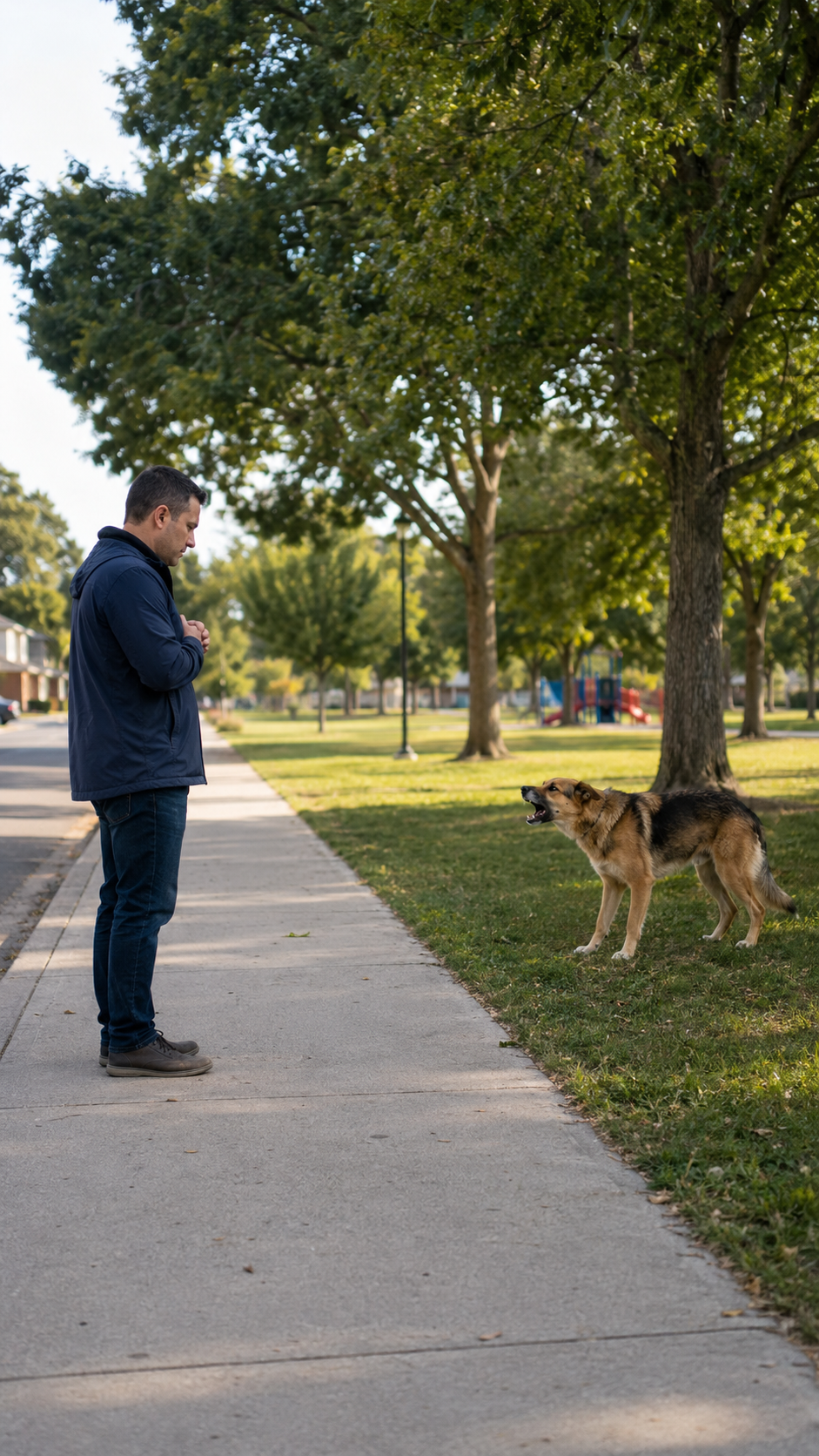
The safest response in most encounters is to remain calm, stop moving, turn slightly sideways, avoid direct eye contact, and slowly create distance. If the dog continues approaching, use a calm, firm voice and place a solid object between your body and the animal.
No technique can guarantee that a dog will not bite. Dogs behave differently depending on fear, pain, territorial instincts, training, health, and the surrounding environment. However, knowing the right posture can make you appear less threatening, reduce chase behavior, and improve your chance of reaching safety without injury.
A large, powerful dog can cause serious injuries, but size or breed alone does not tell you whether a particular dog will attack. Any dog may bite when frightened, injured, guarding puppies or food, protecting territory, or feeling trapped.
Focus on what the dog is doing rather than trying to identify its breed.
An unfamiliar dog should be treated cautiously if it:
Becomes suddenly still or stiff
Stares directly at you
Growls or snarls
Bares its teeth
Raises the fur along its back
Holds its tail high and rigid
Crouches with its tail tucked
Flattens its ears
Moves forward with a stiff posture
Lunges, snaps, or repeatedly charges
Blocks your route or follows your movements
A wagging tail does not always mean friendliness. A tense dog may wag with its body held stiff. Fearful dogs can also bite, sometimes with less obvious warning than a dog that is growling openly. The ASPCA’s dog-bite prevention guidance advises watching the dog’s complete posture, including its ears, tail, body tension, facial expression, and movement.
The Safest Posture Around an Aggressive Dog
If a dog approaches you in a threatening way, think: stop, turn, look away, and stay still.
Stop moving
Do not run. Running can activate a dog’s natural instinct to chase moving objects. Even if you are a fast runner, most dogs can accelerate more quickly than a person.
Stop walking or jogging and plant your feet. If you are riding a bicycle, slow down, stop, and dismount on the side opposite the dog if you can do so without sudden movement.
Turn your body slightly sideways
Standing squarely face-to-face can appear confrontational. Instead, angle your body so one shoulder points generally toward the dog.
Do not turn your back completely. You still need to know where the dog is and whether it is moving closer. A sideways posture allows you to monitor the situation without directly challenging the animal.
Keep your hands still
Let your arms rest close to your sides or hold your hands calmly in front of your body. Do not raise your arms, point, wave, clap, or reach toward the dog.
Keep your fingers together and avoid allowing a hand to hang close to the dog’s mouth. If you are holding a backpack, closed umbrella, bicycle, trash-can lid, or another solid object, keep it ready to use as a barrier without swinging it.
Avoid direct eye contact
Do not stare into the dog’s eyes. A fixed stare can be interpreted as a threat.
Look slightly downward or to the side while keeping the dog within your peripheral vision. You need to observe its movement without locking eyes with it.
Remain quiet
Do not scream, squeal, or make high-pitched sounds. Avoid laughing nervously or repeatedly shouting at the dog.
If you speak, use a low, calm, firm voice. Short phrases such as “No,” “Stay,” or “Go home” may help if the dog recognizes basic commands. Do not rely on commands alone, especially with an unfamiliar or highly aroused dog.
The American Veterinary Medical Association recommends remaining calm, avoiding yelling and direct eye contact, staying still until the dog leaves, or backing away slowly without turning and running.
What to Do Step by Step
Once you have adopted a nonthreatening posture, assess the dog without making sudden movements.
1. Give the dog space
Do not try to pet, touch, feed, or calm an unfamiliar dog with your hand. Do not crouch down to appear friendly. Lowering your face can place it within biting range.
The dog may be protecting a yard, vehicle, food bowl, sleeping place, puppies, or an injured body part. If you unknowingly entered its space, your goal is to leave that area calmly.
2. Wait for the dog to lose interest
Some dogs bark or approach to investigate but do not intend to make contact. Standing still may allow the dog to sniff, assess you, and move away.
Do not suddenly resume walking as soon as the dog looks elsewhere. Wait until it creates meaningful distance or clearly disengages.
3. Back away slowly
When the dog appears less focused on you, begin moving backward or diagonally in small, controlled steps. Keep your body angled and avoid turning your back.
Move toward a secure location such as:
A building
A vehicle
A closed gate
A fence
A raised porch
A large tree or other solid barrier
An area with responsible adults or authorities
Do not corner the dog or move between it and its escape route. A dog that feels trapped may become more defensive.
4. Put a barrier between you and the dog
If the dog follows or moves closer, place a physical object in its path. Useful barriers may include:
Hold the object in front of your torso without swinging it aggressively. The purpose is to give the dog something other than your body to encounter and to create time to reach safety.
What If the Dog Charges?
A charge does not always end in a bite. Some dogs rush forward and stop, bark, or retreat. Running at this point can turn a warning charge into a chase.
Hold your position if possible. Keep your body angled, protect your face and neck, and place your barrier in front of you. Use a firm, low command.
Do not kick at the dog simply because it approaches. Kicking may escalate the situation, cause you to lose balance, and bring your leg within reach. Physical force should be a last resort used only to interrupt an active attack and create a chance to escape.
If the dog bites the object you are holding, do not engage in a tug-of-war if you can safely let it have the item. Move toward shelter when an opening appears.
What If You Are Knocked Down?
If you fall or the dog knocks you over, curl into a ball.
Bring your knees toward your chest.
Tuck your chin down.
Place your hands over the back of your neck.
Cover your ears with your forearms.
Keep your fingers closed.
Protect your face, throat, and neck.
Remain as still and quiet as possible.
Do not roll around, scream, or repeatedly kick. Movement may prolong the attack. The AVMA recommends curling into a ball and using your hands to protect your head, neck, and face if you are knocked down.
If you have a backpack, try to keep it between the dog and your upper body. Once the dog leaves, do not immediately jump up and run. Confirm that it has moved away, then get to a secure location and call for help.
If You Are With a Child
Children may scream or run when frightened, so give instructions in short, direct phrases:
“Stand still. Look down. Hands together.”
Position yourself between the child and the dog without rushing toward the animal. Have the child remain behind you and move only when you tell them.
Do not tell the child to run ahead to safety while you distract the dog. Running may draw the dog toward the child. If the child falls, tell them to curl into a ball and cover the back of their neck.
Adults should teach children never to approach a strange dog, reach through a fence, disturb a sleeping or eating dog, or attempt to retrieve a toy from an unfamiliar animal.
If You Are Walking Your Own Dog
An encounter can become more difficult when both dogs are excited.
Keep your dog close without wrapping the leash around your hand. Avoid jerking, shouting, or allowing the dogs to meet nose-to-nose. Move behind a car, fence, gate, or other barrier if one is available.
Do not reach between fighting dogs or grab collars near their mouths. This is a common way owners receive serious redirected bites.
Picking up a small dog may sometimes place it out of reach, but it can also cause the approaching dog to jump toward your arms and face. Whether lifting is safe depends on distance, the environment, and the approaching dog’s behavior. If a secure vehicle, building, or raised enclosed area is nearby, reaching that shelter is generally preferable.
If You Are Cycling or Jogging
Stop running when an aggressive dog approaches. For cyclists, slowing and dismounting may remove the moving target that attracted the dog.
Keep the bicycle between you and the animal. It provides a much better barrier than trying to pedal faster while the dog is already close. Walk backward slowly with the bicycle separating you from the dog until you reach safety.
Do not strike at the dog with the bicycle unless you are defending yourself during an actual attack. Sudden swinging can escalate a standoff and make it harder to maintain the barrier.
Common Mistakes to Avoid
When an unfamiliar dog appears aggressive:
Do not run.
Do not scream.
Do not stare directly into its eyes.
Do not smile broadly or place your face near it.
Do not turn your back.
Do not make sudden arm movements.
Do not crouch to pick up a rock.
Do not attempt to pet or grab it.
Do not enter a yard to confront it.
Do not approach puppies with an adult dog nearby.
Do not try to separate fighting dogs with your hands.
Do not assume that a wagging tail makes the dog safe.
Throwing food or an object may occasionally distract a dog, but bending down or making a sudden throwing motion can also trigger pursuit. A solid barrier and slow retreat are more reliable strategies.
What to Do After a Dog Bite
Once you are safely separated from the dog, check the injury.
Call 911 if bleeding is severe, the wound is deep or extensive, a body part has been badly damaged, or the person feels faint or has difficulty moving. Apply firm pressure with clean cloth or gauze to control bleeding.
For a wound that has broken the skin:
Wash your hands if possible.
Rinse and wash the wound thoroughly with soap and running water.
Apply gentle pressure if it continues bleeding.
Cover it with a clean dressing.
Seek professional medical advice.
Bites to the face, hands, feet, joints, or genitals require prompt evaluation. Medical care is also important for children, people with diabetes, people with weakened immune systems, deep punctures, crush injuries, and wounds showing redness, warmth, swelling, pus, fever, or increasing pain.
A healthcare professional may assess the need for antibiotics, tetanus protection, or rabies treatment. Do not wait for rabies symptoms to appear. The CDC describes rabies as fatal but preventable when appropriate care is received before symptoms begin.
When rabies exposure is possible, the World Health Organization recommends washing the wound with soap and water for at least 15 minutes and promptly obtaining medical assessment for post-exposure treatment.
Report the bite to local animal control or public health authorities. Record the dog’s appearance, location, direction of travel, and owner information if it can be obtained without approaching the dog. Do not attempt to catch an unknown animal yourself.
Prepare Before an Encounter Happens
People who regularly walk, run, deliver packages, or cycle in areas with loose dogs should plan safe routes and identify gates, businesses, vehicles, and other potential shelters. Keep headphones low enough to hear approaching animals and avoid entering private property with an unsecured dog.
If you repeatedly see a loose or threatening dog, report it to animal control before someone is injured. Take photographs only from a safe location and never provoke the dog to obtain evidence.
The most useful rule to remember is simple: do not run, do not stare, and do not make sudden movements. Stand at an angle, remain quiet, use a barrier, and back away slowly when the dog allows it.
Have you ever encountered an aggressive or loose dog while walking, cycling, or hiking? What helped you stay safe in that moment? Share your experience or questions in the comments so other readers can learn from it too.
Hi, I’m the creator and editor behind ZestyHabit. I research everyday safety, first aid, and practical wellness topics using official guidance and reliable public sources, then turn that information into clear, realistic steps for daily life.
My goal is to help readers make safer, better-informed choices at home and beyond.