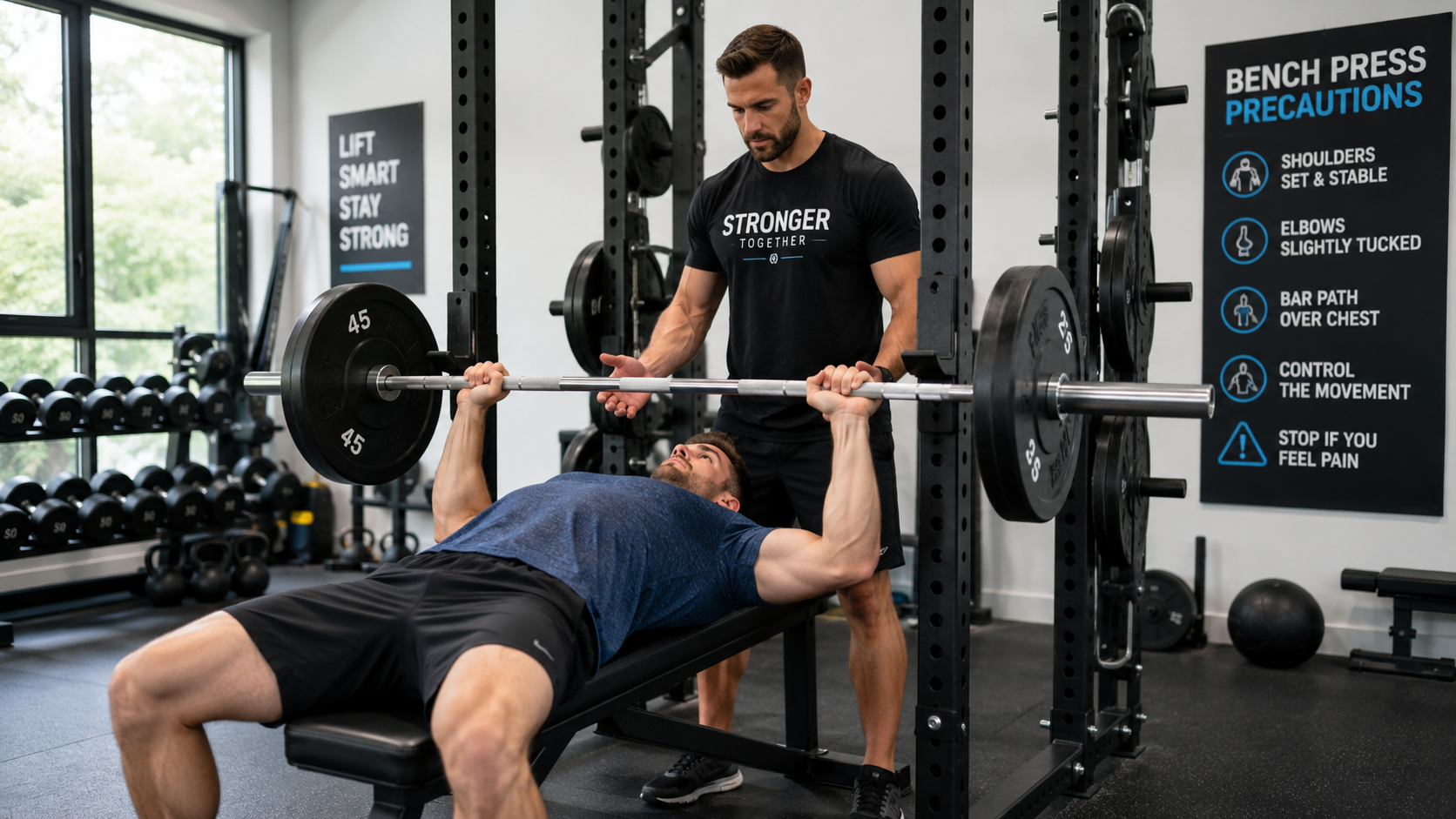
Bench Press Precautions: How to Protect Your Shoulders
Minjin Park
·
The bench press is one of the most popular upper-body exercises for a reason. It builds the chest, shoulders, and triceps, and it is a staple in many strength routines. Whether you train at a commercial gym, a school weight room, or at home with a basic bench setup, the bench press often feels like the exercise people use to measure upper-body strength.
But the bench press can also be rough on the shoulders when it is done carelessly.
Shoulder discomfort during bench pressing is common, especially when people use too much weight, flare their elbows, lose their shoulder blade position, grip the bar awkwardly, or lower the bar beyond a range their body can control. The problem is not always the bench press itself. Often, it is the setup and execution.
A safe bench press should feel strong through the chest, triceps, and upper back. It should not feel like pinching in the front of the shoulder, sharp pain deep in the joint, or unstable pressure as the bar lowers.
If you want to keep bench pressing without irritating your shoulders, the details matter. Here are the main bench press precautions to know, especially around shoulder blade position, grip, spotting, and range of motion.
The shoulder is a very mobile joint. That mobility allows your arms to move in many directions, but it also means the shoulder depends heavily on good positioning and muscular control.
During a bench press, the shoulders move under load while the upper back rests against the bench. If your shoulder blades are unstable, your elbows flare too wide, or the bar path is uncontrolled, the front of the shoulder can take more stress than it should.
This can become more noticeable as the weight gets heavier. A small form issue may feel fine with an empty bar but become uncomfortable once you add plates.
Shoulder strain can also happen when people chase a deeper range of motion than their shoulders tolerate. Some lifters can comfortably touch the bar to the chest. Others may need a slightly reduced range, dumbbells, or a different pressing angle.
The goal is not to copy someone else’s bench press. The goal is to press in a way that fits your structure and keeps your shoulders feeling stable.
Before you unrack the bar, pull your shoulder blades gently back and down into the bench. This creates a stable base for pressing. Think of your upper back as the platform your arms press from.
A common cue is: put your shoulders in your back pockets.
This does not mean forcing your body into an extreme arch or squeezing so hard that you cannot breathe. It means creating enough upper-back tension that your shoulders do not roll forward as the bar comes down.
When the shoulder blades slide forward during the lift, the front of the shoulder can feel crowded or strained. Keeping them stable helps the chest do more of the work and reduces unnecessary shoulder stress.
If you cannot keep your shoulder blades set, the weight may be too heavy or your setup may need practice.
Avoid Letting Your Shoulders Roll Forward
Many shoulder issues during bench pressing happen near the bottom of the movement. As the bar lowers, the shoulders may round forward off the bench. This usually happens when the lifter is trying to touch the bar lower than they can control, or when the chest and upper back lose tension.
Once the shoulders roll forward, the press often stops feeling powerful. You may feel pinching, stretching, or pressure in the front of the shoulder.
To avoid this, keep your chest lifted toward the bar while your shoulder blades stay anchored. Lower the bar with control. If you feel your shoulders tipping forward at the bottom, stop slightly above that point.
A shorter, pain-free range is better than forcing a deep rep that irritates your shoulder joint.
Choose a Grip That Feels Stable
Grip width has a major effect on shoulder comfort.
A grip that is too wide can put the shoulders in a more stretched and vulnerable position. A grip that is too narrow can shift more work to the triceps and wrists, which may also feel awkward. The best grip depends on your arm length, shoulder structure, mobility, and training goal.
For many people, a moderate grip works well. At the bottom of the bench press, your forearms should be close to vertical when viewed from the front. Your wrists should be stacked over your elbows rather than angled far inward or outward.
If your elbows are far outside your wrists, your grip may be too wide. If your wrists are far inside your elbows, your grip may be too narrow.
You do not need to chase an extreme grip just because you saw someone strong use it. Comfort, control, and shoulder stability come first.
Keep Your Wrists Straight
Although this article focuses on shoulders, wrist position affects the entire press.
If your wrists bend backward too much, the bar may sit behind your forearm instead of directly over it. This can make the press feel unstable and may cause you to compensate through your shoulders.
Try to keep the bar stacked over the heel of your palm, with your wrist relatively straight. Your knuckles should point upward, not back toward your face.
Grip the bar firmly, but do not let your hands become so tense that your shoulders and neck tighten. A secure grip gives you better control and makes the bar path safer.
Do Not Flare Your Elbows Too Wide
Elbow position is another key factor in shoulder safety.
When the elbows flare straight out to the sides, the shoulders may be placed under more stress, especially at the bottom of the lift. This position can make the front of the shoulder feel pinched or exposed.
Instead, keep your elbows slightly tucked. They do not need to be glued to your ribs, but they also should not be straight out at 90 degrees. Many lifters feel better with the elbows angled about 30 to 60 degrees from the torso.
This position usually allows the chest, triceps, and shoulders to share the load more evenly.
A helpful cue is: elbows under control, not flying out.
If your elbows flare more as the set gets harder, reduce the weight or stop the set before your form breaks down.
Control the Bar Path
The bench press is not just straight up and down for everyone. For many lifters, the bar lowers slightly toward the lower chest or sternum area, then presses back up toward the shoulder line.
The exact path can vary, but it should always feel controlled.
A common beginner mistake is lowering the bar too high on the chest, close to the neck. This can increase shoulder strain. Another mistake is letting the bar drift forward or backward unpredictably.
Lower the bar slowly enough that you can feel where it is going. Press with control, not panic. The bar should not bounce, wobble, or crash into your chest.
If you cannot control the descent, the weight is probably too heavy.
Use a Range of Motion Your Shoulders Can Handle
Not everyone needs the exact same bench press depth.
For some people, touching the bar lightly to the chest feels natural and pain-free. For others, the shoulders roll forward or feel pinched before the bar reaches the chest. Body structure, mobility, previous injuries, and technique all play a role.
The safest range of motion is the range you can control without pain, shoulder rolling, or loss of tension.
If the bottom position bothers your shoulders, consider using a slightly reduced range. You can use a board press, pin press, floor press, or dumbbells. Dumbbells allow the hands to move more freely and may feel better for some shoulders.
Do not force a deeper range just to satisfy an imaginary rule. Good lifting is not about looking extreme. It is about building strength safely.
Warm Up Your Shoulders and Upper Back
A proper warm-up can make a huge difference before bench pressing.
Do not walk into the gym, load your working weight, and start pressing cold. Your shoulders, chest, triceps, and upper back need preparation.
Start with general movement to increase blood flow. Then add shoulder and upper-back activation. Band pull-aparts, face pulls, scapular push-ups, light rows, and external rotation work can help prepare the muscles that stabilize the shoulder.
After that, warm up with lighter bench press sets before reaching your working weight.
A simple bench press warm-up might look like this:
Warm-Up Step
Example
General warm-up
5 minutes light cardio
Upper-back activation
Band pull-aparts or light rows
Shoulder control
Scapular push-ups or face pulls
Empty bar set
10–15 controlled reps
Gradual loading
Add weight in small jumps
Warm-ups do not need to be long, but they should be intentional. Your first heavy set should not be the first time your shoulders feel the movement.
Do Not Bounce the Bar Off Your Chest
Bouncing the bar off the chest is a common habit, especially when people are trying to lift more weight than they can control.
This can be risky for several reasons. It reduces muscular control, increases impact, and can shift the stress suddenly through the shoulders, sternum, and elbows. It also makes it harder to know whether you are actually strong through the full movement.
Lower the bar under control. Touch lightly if your range allows it. Then press up with tension.
Think “tap and press,” not “bounce and survive.”
If you need to bounce the bar to complete the rep, the weight is too heavy.
Use a Spotter for Heavy Sets
A spotter is not just for people lifting huge weights. A good spotter can make bench pressing safer whenever you are working near your limit.
The bench press can be dangerous because the bar is directly over your chest, neck, and face. If you fail a rep without safety arms or a spotter, you may be stuck under the bar.
A good spotter helps you unrack the bar, watches your form, and assists only when needed. Before the set, agree on what kind of help you want. Do you want a lift-off? Do you want them to let you try the rep unless the bar stops? Do you want help after a certain number of reps?
Clear communication matters.
If you train alone, use a power rack with safety arms set at the right height. The safety bars should be low enough to allow your full range of motion but high enough to catch the bar if you fail.
Never rely on hope when pressing heavy.
Be Careful With Max Attempts
Testing your one-rep max can be exciting, but it carries more risk than regular training sets. Heavy max attempts often expose weak points in technique. The shoulders may lose position, elbows may flare, and the bar path may become messy.
Beginners do not need frequent max testing. You can build strength with controlled sets using moderate weight.
If you do test heavy singles, do it with a spotter or safety arms, after a thorough warm-up, and only when your shoulders feel good. Do not max out when you are tired, rushed, sore, or recovering from shoulder discomfort.
Strength is built over time. You do not need to prove everything in one workout.
Balance Pressing With Pulling
Many shoulder problems come from doing too much pressing and not enough pulling.
The bench press strengthens the chest, front shoulders, and triceps. But the upper back, rear shoulders, and rotator cuff muscles help keep the shoulder joint stable. If those muscles are neglected, your pressing mechanics may suffer.
Include rows, pull-downs, face pulls, reverse flys, and other upper-back exercises in your routine. A simple guideline is to do at least as much pulling as pressing, and possibly more if your shoulders feel tight or your posture is rounded.
A stronger upper back gives you a better base for the bench press. It also helps you keep the shoulder blades stable during the lift.
Do Not Ignore Shoulder Pain
There is a difference between normal training effort and shoulder pain.
Muscle fatigue in the chest, triceps, and shoulders is normal. A challenging set may feel hard. But sharp pain, pinching, clicking with pain, sudden weakness, numbness, or pain that gets worse through the set is not something to push through.
If shoulder pain appears, stop and reassess. Check your setup, reduce the weight, shorten the range, or switch exercises. If pain keeps returning, take a break from bench pressing and consider working with a healthcare professional, physical therapist, or qualified coach.
Pushing through shoulder pain can turn a small issue into a long-term problem.
Try Dumbbells if the Barbell Feels Uncomfortable
The barbell bench press locks both hands into one fixed position. This works well for many lifters, but not for everyone.
Dumbbells allow your hands and arms to move more naturally. You can use a neutral grip, where the palms face each other, which often feels better on the shoulders. You can also adjust the depth more easily.
If barbell bench pressing consistently irritates your shoulders, dumbbell presses may be a better option for a while. Push-ups, machine chest presses, and floor presses can also be useful alternatives.
You do not need to abandon chest training just because one version of the bench press does not feel right.
Avoid Training Chest Hard Every Day
The shoulders need recovery. If you bench press heavily too often, fatigue can build up in the chest, triceps, shoulders, and connective tissues.
Training chest hard every day may feel productive at first, but it can lead to nagging aches and weaker performance. Most lifters do better with planned rest between heavy pressing sessions.
How often you bench depends on your experience, training volume, and recovery, but beginners usually do not need more than two or three pressing sessions per week. Even then, not every session needs to be heavy.
Mix heavy days with lighter technique work, dumbbell work, push-ups, or accessory exercises. Recovery is part of getting stronger.
Common Bench Press Mistakes to Avoid
Here are some common mistakes that can increase shoulder strain:
Mistake
Why It Can Be a Problem
Shoulders rolling forward
Increases stress at the front of the shoulder
Grip too wide
Can place the shoulder in a vulnerable position
Elbows flaring too much
May increase shoulder strain
Bouncing the bar
Reduces control and adds impact
Lowering too deep for your body
Can cause pinching or instability
No warm-up
Leaves shoulders unprepared
No spotter or safety arms
Increases risk during failed reps
Too much pressing, not enough pulling
May reduce shoulder stability
Most bench press issues improve when you slow down, set your upper back, and train within a range you can control.
A Shoulder-Safe Bench Press Checklist
Before your next set, use this quick checklist:
Form Check
What to Do
Shoulder blades
Pull gently back and down
Chest
Lifted, not collapsed
Grip
Moderate and comfortable
Wrists
Stacked over elbows
Elbows
Slightly tucked, not flared straight out
Bar path
Controlled and consistent
Range
Pain-free and stable
Spotter
Use one for heavy sets
Tempo
Lower with control, no bouncing
This checklist takes only a few seconds, but it can make your bench press feel safer and stronger.
Final Thoughts
The bench press can be a powerful upper-body exercise, but protecting your shoulders should always come first. Heavy weight means very little if every set leaves your shoulders irritated.
Set your shoulder blades before you lift. Choose a grip that feels stable. Keep your elbows under control. Use a range of motion your shoulders can handle. Warm up properly, avoid bouncing the bar, and use a spotter or safety arms when the weight gets challenging.
You do not need to bench like everyone else in the gym. Your arm length, shoulder mobility, strength level, and training history all matter.
A good bench press should feel strong, controlled, and repeatable. When your shoulders stay stable and pain-free, you can build strength with much more confidence over time.
Hi, I’m the creator and editor behind ZestyHabit. I research everyday safety, first aid, and practical wellness topics using official guidance and reliable public sources, then turn that information into clear, realistic steps for daily life.
My goal is to help readers make safer, better-informed choices at home and beyond.