
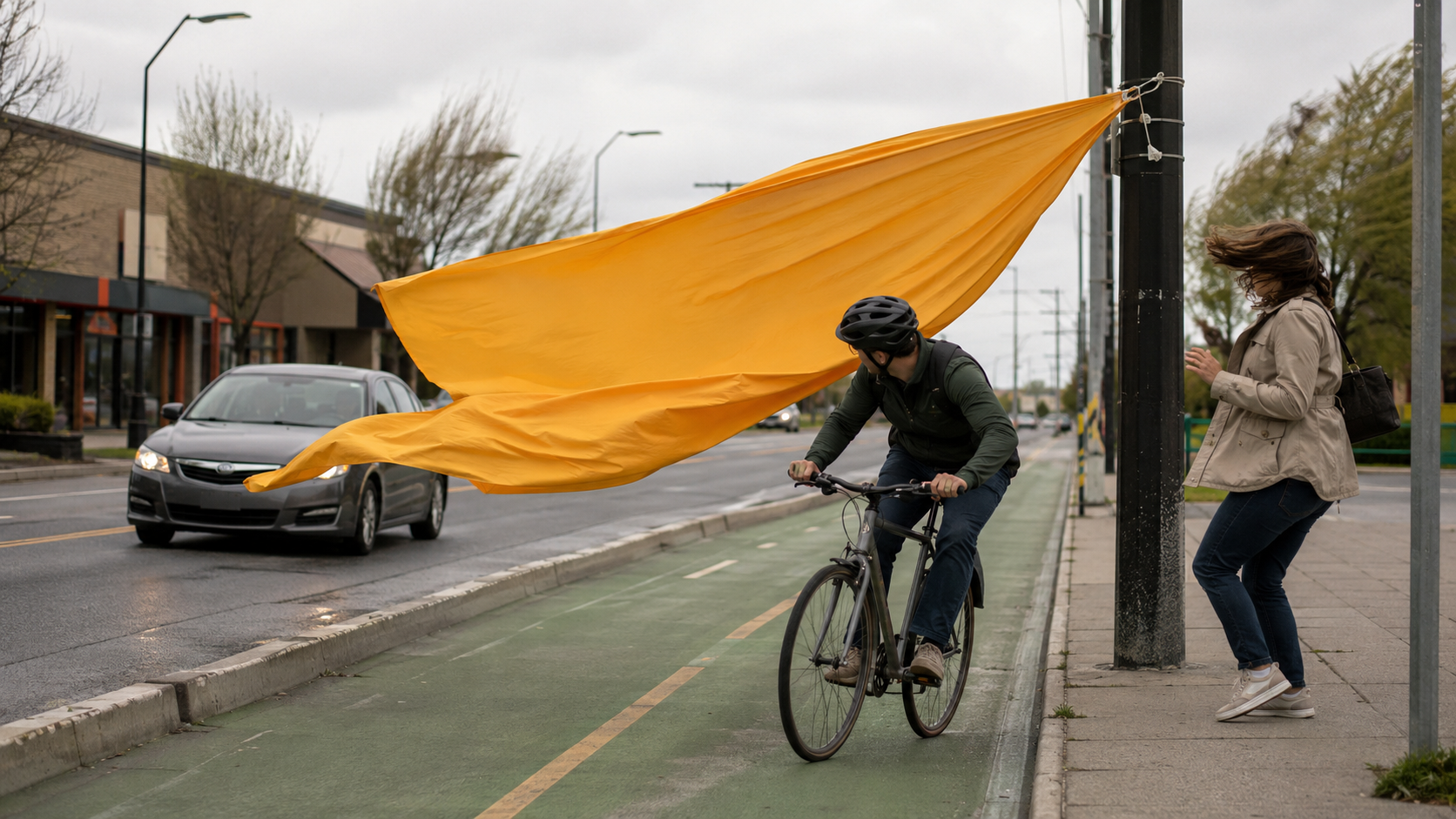

Loose or poorly installed street banners can block traffic signs, fall onto pedestrians, and become dangerous road debris. Learn the risks, warning signs, and steps for reporting unsafe banners.
Street banners are everywhere. They advertise festivals, promote local businesses, announce community events, and decorate commercial districts. Most people walk or drive past them without giving them a second thought.
A banner may seem harmless because it is made from lightweight fabric or vinyl. However, once it is stretched above a sidewalk, attached to a streetlight, or hung near moving traffic, it becomes part of the built environment. Its safety depends on the strength of its supports, the quality of the installation, the weather, and regular maintenance.
A loose banner can obstruct a driver’s view, strike a pedestrian, wrap around a cyclist, or fall into the road. The banner itself may not be the heaviest part of the hazard. Metal brackets, rods, cables, hooks, and damaged signposts can cause much more serious injuries.
Understanding the warning signs—and knowing when to stay back and report a problem—can help prevent an ordinary street decoration from becoming the cause of a serious accident.
Why Street Banners Can Become Dangerous
A banner presents a wide surface to the wind. Even when the air feels relatively calm at ground level, stronger gusts may be acting on a banner several feet above the sidewalk.
As the wind pushes against the material, force is transferred to its ropes, brackets, poles, and attachment points. Repeated flapping can loosen knots, enlarge holes around grommets, wear through fabric, and weaken fasteners. A banner that survived the day it was installed may become unstable after weeks of sun, rain, temperature changes, and wind.
Professional street-banner systems are designed with wind loading in mind. For example, some municipal programs require reinforced brackets, flexible arms, specific mounting heights, and engineering calculations. The City of Redding’s streetlight banner requirements include strong band clamps, flexible banner arms, and wind-load requirements.
A homemade installation using ordinary rope, plastic ties, or improvised hooks may not provide the same protection.
Common Types of Street Banner Accidents
1. A Banner or Its Hardware Falls
A torn banner may detach from one corner and hang above the sidewalk before finally falling. If only the fabric comes down, it may startle or temporarily blind a pedestrian or cyclist. If a rod, metal bracket, hook, or section of a pole falls with it, the impact can cause cuts, head injuries, or fractures.
The risk is greater over crowded sidewalks, bus stops, outdoor seating areas, school routes, building entrances, and crosswalks. Children and people using wheelchairs may have less ability to move away quickly when something begins falling.
A banner does not have to detach completely to cause an injury. A loose lower rod may swing repeatedly like a pendulum, striking anyone who walks underneath.
2. A Loose Banner Blocks a Driver’s View
Road users depend on clear sight lines to see approaching traffic, pedestrians, traffic signals, warning signs, and lane markings. A sagging or oversized banner can interfere with that view, particularly near an intersection, driveway, crosswalk, or sharp curve.
The Federal Highway Administration explains that insufficient intersection sight distance can contribute to crashes. Drivers need unobstructed views of the intersection, traffic-control devices, and approaching road users.
A banner attached to a fence or temporary frame can be just as problematic as one hanging overhead. If it is positioned near a corner, it may prevent a turning driver from seeing a child, cyclist, or oncoming vehicle until it is too late to stop.
3. Fabric Blows Into the Road
When one or more attachment points fail, a banner can flap into an active traffic lane. It may strike a windshield, cover part of a vehicle’s view, become caught under a car, or force drivers to react suddenly.
A driver who sees fabric moving toward the vehicle may instinctively jerk the steering wheel. That reaction can lead to a collision with another vehicle, curb, cyclist, pedestrian, or roadside object.
A detached banner may also behave like other unsecured road debris. Its movement can be difficult to predict, especially in gusty weather. It may remain flat on the pavement for several seconds and then suddenly rise into the air when a vehicle approaches.
4. Ropes and Cables Create Entanglement Hazards
A rope that has fallen to sidewalk level may be difficult to see at night or in bad weather. Pedestrians can trip over it, while cyclists and scooter riders may become entangled.
A line hanging at chest, neck, or face height is particularly dangerous to people traveling on bicycles, e-bikes, scooters, and motorcycles. Even a lightweight cord can cause a rider to lose balance and fall into traffic.
Never assume a loose line is simply a harmless piece of string. It may be connected to heavy hardware, wrapped around a utility pole, or lying near electrical equipment.
5. A Pole or Temporary Frame Tips Over
Some banners are mounted on portable frames, weighted bases, fences, or temporary posts. If the base is too light or the supporting surface is uneven, the entire structure can fall.
A large banner can act like a sail. Increasing the banner’s size without strengthening its base and frame may dramatically change how it behaves in the wind.
Fallen stands can block accessible sidewalk routes, create sharp projections, or extend into a bicycle lane. If a pedestrian steps into the road to get around the obstruction, the banner has created a secondary traffic hazard even if it never strikes anyone directly.
6. The Banner Distracts Drivers
Banners are intended to attract attention, but their design and placement should not compete with essential traffic information. Bright flashing lights, reflective materials, confusing symbols, or text resembling official road signs may distract or mislead drivers.
A banner that moves violently in the wind can also draw a driver’s attention away from a pedestrian or changing traffic signal. The risk may be greater in a visually busy area where drivers already need to process signs, parked vehicles, storefronts, cyclists, and people crossing the road.
Weather Makes Existing Problems Worse
Strong wind is the most obvious threat, but it is not the only weather-related concern.
Rain can add weight to certain banner materials and weaken ropes or fabric edges. Water may collect in folded or poorly tensioned sections, putting extra stress on the supports. Freezing weather can make some materials stiff and brittle, while repeated sunlight can weaken plastic ties and fade or degrade fabric.
During a storm, branches and airborne debris may strike the banner or its supporting pole. A partially damaged installation may remain in place after the weather improves, creating a delayed hazard several hours or days later.
Organizers should not wait for a banner to tear completely before removing it. Severe weather forecasts should trigger an inspection or planned removal, particularly for temporary and improvised installations.
Warning Signs the Public Should Not Ignore
A street banner may need urgent attention if you notice:
- One corner hanging lower than the others
- Violent flapping or twisting in moderate wind
- Torn fabric around the grommets
- Loose, missing, or visibly bent brackets
- Ropes hanging over the sidewalk or road
- A sagging banner covering a sign or signal
- A pole leaning or moving at its base
- Metal rods slipping out of their supports
- Cracking, snapping, or scraping sounds
- An entire frame rocking when the wind blows
- A banner touching electrical equipment or utility lines
Do not stand underneath the banner to inspect it more closely. A person looking upward may fail to notice traffic, uneven pavement, or other falling components.
If a banner appears unstable, move to the opposite side of the sidewalk or choose another route.
What Pedestrians Should Do
If you encounter a damaged banner, keep a safe distance and encourage children to stay away. Do not pull a hanging rope, attempt to untie the material, or shake the supporting pole. Your actions could release a heavy bracket that is still suspended above you.
Avoid walking directly underneath an unstable banner, even if it appears to be held by one remaining attachment. Cross the street at a safe, designated location or move into a protected area away from the structure.
If debris has already fallen, do not step into an active traffic lane to retrieve it. Contact the appropriate local agency so trained workers can control traffic and remove the hazard safely.
Call 911 when the banner is falling into moving traffic, blocking a travel lane, threatening nearby people, or connected to a possible electrical hazard. For a non-immediate problem, report it through the city’s 311 service, transportation department, public works department, code-enforcement office, or police non-emergency line.
What Drivers Should Do
If a banner or section of fabric blows toward your vehicle, avoid making an abrupt steering movement. Ease off the accelerator, maintain control, and increase the distance from surrounding vehicles if possible.
Do not stop suddenly in a travel lane to remove debris. Continue to a safe location away from moving traffic before calling for assistance. If fabric becomes caught on your windshield and blocks your view, slow down smoothly, turn on your hazard lights, and move out of traffic as safely as conditions allow.
Never leave your vehicle in a high-speed lane to retrieve a banner. Roadway debris removal should be handled by police, transportation crews, or another authorized response team.
If the problem creates an immediate crash risk, call 911 once you are safely stopped. Provide the street name, direction of travel, nearest intersection, and a brief description of the hazard.
Extra Risks for Cyclists and Scooter Riders
Cyclists and scooter riders are especially vulnerable because loose cords and fabric may be difficult to see until they are only a few feet away. Riders also have less physical protection if they collide with a pole or fall onto the pavement.
Slow down when approaching a banner that is flapping across a bike lane. If a rope or damaged frame blocks the route, stop before reaching it and dismount in a safe location. Do not ride into the traffic lane without checking carefully for approaching vehicles.
At night, pay attention to moving shadows and unexpected reflections near streetlights. A dark cord may be almost invisible even when the banner itself is brightly colored.
What to Do After a Banner-Related Injury
Move away from traffic and any unstable structure before providing first aid. If the injured person may have been struck on the head or neck, encourage them to remain still unless staying in place creates a greater danger.
Call emergency services for:
- Loss of consciousness
- Confusion or repeated vomiting
- Severe head, neck, or back pain
- Heavy bleeding
- Difficulty breathing
- A suspected fracture
- Weakness, numbness, or trouble walking
- A cyclist or pedestrian struck by a vehicle
For minor bleeding, apply gentle pressure with a clean cloth. Do not attempt to remove a deeply embedded metal object. Wait for emergency professionals.
Photograph the scene only if it can be done safely. Record the location, time, weather, condition of the banner, and contact information of witnesses. Report the damaged installation even if the injury seems minor so the remaining hazard can be removed.
How Organizers Can Prevent Street Banner Accidents
Anyone planning to install a banner over or beside a public street should begin with the local permitting authority. Rules vary considerably between cities. A sign that is allowed on private property may be prohibited on a public sidewalk, streetlight, traffic-sign support, or utility pole.
Some jurisdictions allow only approved vertical banners on designated poles. For example, New York City DOT’s street-banner rules do not permit horizontal banners across streets and require specific dimensions and wind-reduction features for approved pole banners.
Safe planning should include:
- Obtaining all required permits
- Using approved banner locations and dimensions
- Confirming structural and wind-load requirements
- Hiring qualified installers
- Maintaining required clearance above roads and sidewalks
- Avoiding traffic signs, signals, utility equipment, and fire-access routes
- Using hardware designed for the banner and supporting structure
- Scheduling inspections and a firm removal date
- Preparing a severe-weather removal plan
- Carrying appropriate insurance when required
Wind slits, reinforced hems, and strong grommets can support a properly engineered design, but they do not make an unsafe location or improvised attachment acceptable. The entire system—including the banner, arms, brackets, fasteners, pole, and foundation—must work together.
Maintenance Matters as Much as Installation
A banner should be inspected after installation, after severe weather, and regularly throughout its display period. Installers should check the fabric, seams, grommets, rods, brackets, clamps, ropes, and supporting structure.
Damage should lead to prompt repair or removal. Adding another plastic tie to a failing attachment may only hide the underlying problem.
Temporary banners should also be removed when the approved display period ends. Leaving an aging banner outdoors indefinitely increases the chance that sun, wind, and moisture will weaken it.
The City of Wilmington, North Carolina, for example, may require attachment specifications and engineered wind-load calculations for signs extending into the public right-of-way. Although requirements differ by location, the principle is widely applicable: anything installed above public space deserves professional planning and continuing maintenance.
A Quick Street Banner Safety Checklist
When looking at a street banner, ask:
- Is it securely attached at every intended point?
- Is it clear of traffic signals and road signs?
- Does it preserve drivers’ views at intersections and driveways?
- Are all cords and rods well above pedestrians and cyclists?
- Is the supporting pole upright and stable?
- Is the material torn, faded, or flapping excessively?
- Has it been inspected after recent wind or storms?
- Is there a safe way to report damage?
Street banners can make a neighborhood feel lively and welcoming, but public decoration should never come at the expense of traffic and pedestrian safety. Proper permits, wind-resistant hardware, clear sight lines, routine inspections, and timely removal are what keep a harmless announcement from becoming dangerous road debris.
Have you ever seen a street banner hanging into traffic, blocking a sign, or nearly falling onto a sidewalk? What did you do, and does your city provide an easy way to report hazards like this? Share your experience in the comments so other readers can learn how to respond safely.

Hi, I’m the creator and editor behind ZestyHabit. I research everyday safety, first aid, and practical wellness topics using official guidance and reliable public sources, then turn that information into clear, realistic steps for daily life.
My goal is to help readers make safer, better-informed choices at home and beyond.


