What to Do When Water Suddenly Rises in a Canyon or Creek
Minjin Park
·
Flash flooding near creeks, canyons, valleys, and swimming holes can happen fast. Here’s how to spot warning signs, move to safety, help others, and prepare before you go.
Clear water, smooth rocks, kids splashing near the edge, someone taking photos, someone else deciding the flat rock is the perfect snack spot. The sky above you may even look decent. Maybe a little cloudy, but nothing dramatic.
Then the water changes.
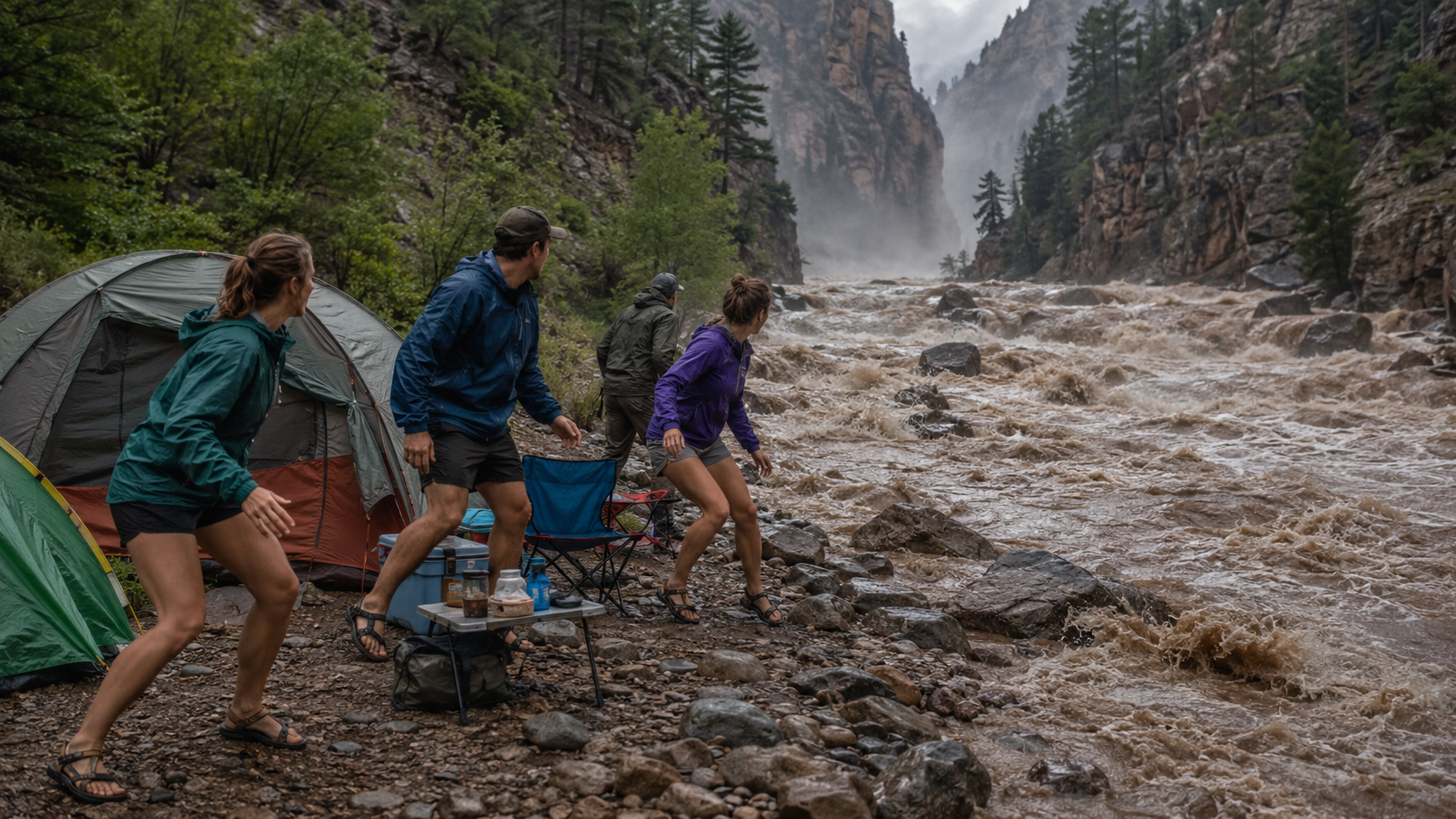
It gets louder. The color turns muddy. Leaves and branches start floating past. The water level climbs over rocks that were dry a few minutes ago. Someone says, “Is it rising?” and suddenly everyone is looking at the same thing.
Water in a canyon, gorge, valley, creek bed, or mountain stream can rise quickly even if it is not raining right where you are. Rain may be falling upstream. A storm may be hidden by the terrain. Water can collect and rush downhill faster than a person expects.
Flash flooding is not just “a lot of water.” It is moving water with force, debris, poor visibility, slippery ground, and very little time for debate.
The safest response is simple, but not always easy: get out early, move upward, and do not try to cross rushing water.
Why Canyons and Creeks Can Become Dangerous So Quickly
Creeks and canyon streams are shaped to move water.
That is beautiful on a normal day. It is dangerous during sudden heavy rain.
Narrow channels, steep slopes, rocky beds, and limited exit routes can turn a rising stream into a fast-moving chute. Water that seems ankle-deep can knock people off balance when it is moving strongly. Knee-deep water can be surprisingly powerful. Add slippery rocks, cold water, and floating branches, and the situation gets worse quickly.
The confusing part is that the danger may come from far away.
You might be standing under a patch of blue sky while rain is falling miles upstream. In mountain areas or desert slot canyons, this can catch visitors off guard. The place where you are standing does not need to be stormy for water to rush through.
That is why “it isn’t raining here” is not enough reassurance.
If you are in a low creek bed, canyon, dry wash, or narrow valley, you are downstream from somewhere.
Warning Signs That Water Is About to Rise
You may not always get obvious warning signs, but there are clues worth taking seriously.
Watch for sudden changes in the water:
The water turns muddy or darker The current gets faster The sound of rushing water grows louder Small sticks, leaves, logs, or foam appear The water level climbs over rocks or banks The water temperature suddenly changes The ground near the edge begins crumbling People upstream start yelling or moving quickly
Dark clouds building upstream, thunder, sudden wind, or distant rainfall can all matter. In a canyon or narrow valley, sound can echo strangely, so a low rumbling noise may be water, thunder, falling rocks, or debris. None of those are things to ignore.
If you notice even one strong warning sign, do not wait for confirmation. That is where people lose time.
You do not need to solve the mystery. You need to move.
The First Rule: Leave the Water Immediately
If water starts rising, get out of the creek or low area right away.
Not after one more photo. Not after packing everything neatly. Not after checking whether the cooler can be saved. Not after debating whether it will stop soon.
Leave.
If you are in the water, move toward the nearest safe bank if it is close and the current is still manageable. Use your hands for balance if needed. Step carefully, but do not move casually. Wet rocks can turn a calm exit into a hard fall.
If the water is already moving fast, do not try to fight across it to reach your original side just because your bag is there. The safest exit may be the nearest high ground, even if it is not where you planned to go.
This is emotionally annoying. Nobody wants to abandon shoes, towels, fishing gear, picnic bags, or a phone sitting on a rock.
But gear can be replaced. People cannot.
Move Up, Not Along the Creek
Once you are out of the water, move to higher ground.
Not just a few steps back from the edge. Higher.
Flash flood water can spread beyond the normal streambed. It can undercut banks, sweep around bends, and carry debris. Standing at the edge to watch is tempting because humans are nosy by design. But the edge is not a safe viewing area.
Move uphill, away from the channel. Look for solid ground, a slope, a trail that climbs, or a ridge. If you are in a narrow canyon, climb to the highest safe place available.
Do not walk downstream along the creek trying to outrun the water. Water moves faster than you think, and downstream routes may be blocked, flooded, or trapped by steep walls.
Do not go into culverts, tunnels, or low underpasses. They can fill quickly and leave no escape.
The safest direction is usually up and away.
Do Not Try to Cross Rushing Water
This is the rule that saves lives.
Do not cross rushing water on foot. Do not drive through flooded roads. Do not assume you can “make it” because the other side looks close.
Moving water is stronger than it looks. It hides holes, loose rocks, broken pavement, and sudden drop-offs. In muddy water, you cannot see what your foot or tire is about to hit. Even if you are athletic, the water does not care. It has physics on its side.
People often get into trouble because they want to return to their group, reach their car, grab belongings, or avoid being stranded on the “wrong” side.
But the wrong side is still safer than being swept away.
If your group is separated by rising water, yell to each other if possible, but do not send someone across. Move to high ground on both sides and call emergency services. It is better to be separated and safe than together in the current.
If You Are With Children
Children can panic, freeze, or run in the wrong direction during sudden water rise. They may also try to go back for shoes, toys, or a favorite item.
Use short, clear instructions.
“Get out now.” “Hold my hand.” “Go uphill.” “Leave the bag.” “Stay with me.”
Do not give a long explanation while the water is rising. This is not the moment for a lecture about hydrology.
Assign adults quickly if you have a group. One adult leads toward high ground. Another checks that no child is left behind. If there are older kids, tell them exactly what to do: climb to that tree, stay with your sibling, do not go back down.
If a child is already in fast-moving water, do not jump in blindly unless there is truly no other option and you understand the danger. Call for help, throw something that floats if available, and try to reach from a safe position. A panicked rescue attempt can turn one victim into two.
That sounds harsh, but water rescues are dangerous even for trained professionals.
If Someone Falls Into Fast Water
The instinct is to chase them or jump in.
Take one breath first.
Call emergency services immediately if possible. Shout instructions to the person in the water: “Float on your back!” “Feet downstream!” “Keep your head up!” “Look for a place to grab!”
If you can safely throw something that floats, do it: a life jacket, cooler lid, dry bag, empty water jug with the cap on, rope bag, or anything buoyant. If you have a rope and can throw it from stable high ground, use it carefully. Do not wrap rope around your hand or body in a way that could pull you in.
The person in the water should try to keep their feet pointed downstream to avoid hitting rocks headfirst. They should avoid standing up in fast current because a foot can get trapped between rocks, which can pull the body underwater.
This is scary to even read, I know. But clear thinking matters.
If they manage to reach the bank, help them move away from the water and watch for injuries, shock, or hypothermia, especially if the water is cold.
Watch for Debris, Not Just Water
Floodwater is not clean, smooth water.
It may carry branches, logs, rocks, trash, mud, broken glass, sharp metal, and anything else it picked up upstream. Even a small log moving with force can injure someone. Mud can make surfaces slick. Debris can jam against rocks or bridges and suddenly release.
Do not stand on low bridges, stepping stones, or narrow crossings to watch floodwater pass under you. Water can rise and cover them, or debris can hit them with force.
Also avoid standing near unstable banks. Fast water can eat away at the ground underneath, leaving the surface looking solid until it collapses.
A good rule: if the water is rising, get farther away than feels necessary.
The extra distance may feel silly for five minutes. It may also be the reason you are safe.
Leave Belongings Behind
This one hurts people’s pride.
A phone on a rock. Shoes near the water. A backpack. A fishing rod. A camera. Car keys. A picnic blanket. A child’s sandal drifting away.
The urge to grab things is strong, especially when the item is expensive or important.
But many flood accidents happen because someone tries to retrieve belongings. They step onto a wet rock, reach too far, get pulled off balance, or underestimate how fast the water is rising.
If something is within arm’s reach while you are already moving out, fine. Take it if it does not slow you down.
But if you have to go back toward the water, cross slippery rocks, or enter the current, leave it.
This is also why it is smart to keep car keys, phones, and medications on your body in waterproof pouches when visiting creeks or canyons. Not buried in a bag on the opposite bank. Not sitting on a towel. On you.
Future-you will appreciate this small inconvenience.
Before You Go: Check the Weather Upstream
Before visiting a canyon, swimming hole, creek trail, or valley, check more than the weather at your exact picnic spot.
Look at the broader area. Is there heavy rain in nearby mountains? Storm warnings? Flash flood watches? Thunderstorms predicted upstream? Recent rain that may have saturated the ground?
If there is any flash flood watch or warning, choose a different activity. It is not worth gambling with narrow terrain and moving water.
This matters even more in places with steep drainage areas, slot canyons, desert washes, mountain streams, and rocky creek beds. Water can arrive fast and with little warning.
If you are traveling, ask local rangers, park staff, campground hosts, or visitor centers about current conditions. Locals often know which areas flood quickly.
A sunny parking lot does not mean the canyon is safe.
Pick Your Spot With Escape in Mind
When choosing where to sit, swim, or rest, look around before you relax.
Ask:
Where is the nearest high ground? Can everyone reach it quickly? Are we in a narrow channel? Are there steep walls on both sides? Is there only one exit? Would water cut off the path back? Are kids or older adults able to climb out fast? Is our stuff on the same side as our exit?
If the place looks like a beautiful natural bowl with steep sides and limited exits, admire it carefully. It may also be a trap during sudden water rise.
Choose spots with easy escape routes. Stay out of dry creek beds if storms are possible. Avoid setting up right on low gravel bars, small islands, or rocks in the middle of the stream. They may feel cozy until the water surrounds them.
A good picnic spot should not require a rescue plan to leave.
What to Carry Near Creeks and Canyons
You do not need a giant emergency pack for every short walk, but a few items are useful around water and remote trails.
Carry:
A charged phone in a waterproof pouch Whistle Small first aid kit Weather app or emergency alert access Drinking water Headlamp or flashlight Light rain jacket Map or offline map A small rope or throw line if you know how to use it Life jackets for children or weak swimmers Emergency blanket for cold conditions
If you are hiking in an area with limited signal, download maps ahead of time and tell someone where you are going. In remote canyons, a satellite messenger can be worth considering.
For casual family outings, the most important items are usually simple: phone, keys, water, shoes, and a plan for getting uphill.
Also, wear shoes you can actually move in. Bare feet on wet rocks are a bad combination. Flip-flops may disappear at the exact moment you need traction.
After You Reach Safety
Once everyone is on high ground, count people.
It sounds obvious, but during stress, groups scatter. Make sure children, pets, and slower walkers are accounted for. Check for injuries. Look for bleeding, sprains, head injuries, shivering, confusion, or signs of shock.
Call emergency services if anyone is missing, injured, trapped, separated by floodwater, or unable to move safely.
Do not go back down just because the water seems to stop rising. Flash floods can come in waves. The first surge may not be the last. Debris jams can break loose. Rain upstream may still be feeding the channel.
Wait until officials say it is safe, or until conditions are clearly stable and you can leave by a safe route. Even then, be cautious. Flooded areas can leave slick mud, unstable banks, loose rocks, and contaminated water.
If your car is parked in a low area near the creek, do not rush toward it through floodwater. A flooded car is not worth a dangerous crossing.
If You Hear a Flash Flood Warning
A watch means conditions are possible.
A warning means flooding is happening or expected soon.
If you receive a flash flood warning while you are near a creek, canyon, wash, or low valley, move to higher ground immediately. Do not wait to see if the water appears. By the time you see it, you may have less time than you need.
If you are driving, avoid low water crossings and flooded roads. Turn around and find another route. It is frustrating, especially when you are tired and close to home, but flooded roads are a major cause of flood deaths.
Water over a road can hide damage underneath. The road may be washed out. The current may be stronger than it looks.
The phrase “turn around” exists for a reason. It is not poetic. It is practical.
Don’t Let Familiar Places Fool You
People are often less cautious in places they know well.
A creek near home. A swimming hole you visited as a kid. A camping spot your family uses every summer. A trail you could walk with your eyes half closed.
Familiar places feel safer because they are familiar. But water does not care how many times you have been there.
A creek that was gentle last weekend can be dangerous after upstream rain. A shallow crossing can become fast and muddy. A rock where you always sit can disappear under water. A trail along the bank can be cut off.
That is why the habit should be the same every time: check weather, notice exits, watch the water, leave early.
Not because you are scared. Because you are paying attention.
The Best Escape Is the One You Start Early
The hardest part of flash flood safety is acting before everyone agrees it is serious.
Nobody wants to be the person who interrupts the fun. Nobody wants to say, “We should leave,” when the water has only risen a little. Nobody wants to seem dramatic.
Say it anyway.
“Water’s rising. Let’s move up.” “That looks muddy. Time to get out.” “I hear thunder. We’re leaving the creek.” “Grab the kids. Leave the towels.”
Clear beats polite when water is changing.
If you are wrong, the worst thing that happens is you move to higher ground and feel a little awkward. That is a fine price to pay.
If you are right, those few minutes matter.
A Calm Plan for a Fast Situation
Sudden rising water in a creek or canyon is not something to negotiate with.
Get out of the water. Move uphill. Stay away from the bank. Do not cross rushing water. Leave belongings behind. Keep children close. Call for help if anyone is trapped, missing, or injured.
Before you go, check weather beyond your exact location. Choose a spot with an escape route. Keep keys and phone on your body. Treat muddy, rising, louder water as a sign to leave, not a thing to watch.
Outdoor places are still worth enjoying. Creeks, canyons, swimming holes, and mountain streams can be beautiful and peaceful. But they deserve respect, especially when weather is changing.
The safest people near water are not the ones who never feel nervous.
Hi, I’m the creator and editor behind ZestyHabit. I research everyday safety, first aid, and practical wellness topics using official guidance and reliable public sources, then turn that information into clear, realistic steps for daily life.
My goal is to help readers make safer, better-informed choices at home and beyond.
[…] Deep-frying is not a “start it and leave it” cooking method. Oil temperature can change quickly. Food can brown fast. Bubbling can rise suddenly. […]
Loading…
Discover more from
Subscribe now to keep reading and get access to the full archive.



[…] Deep-frying is not a “start it and leave it” cooking method. Oil temperature can change quickly. Food can brown fast. Bubbling can rise suddenly. […]