
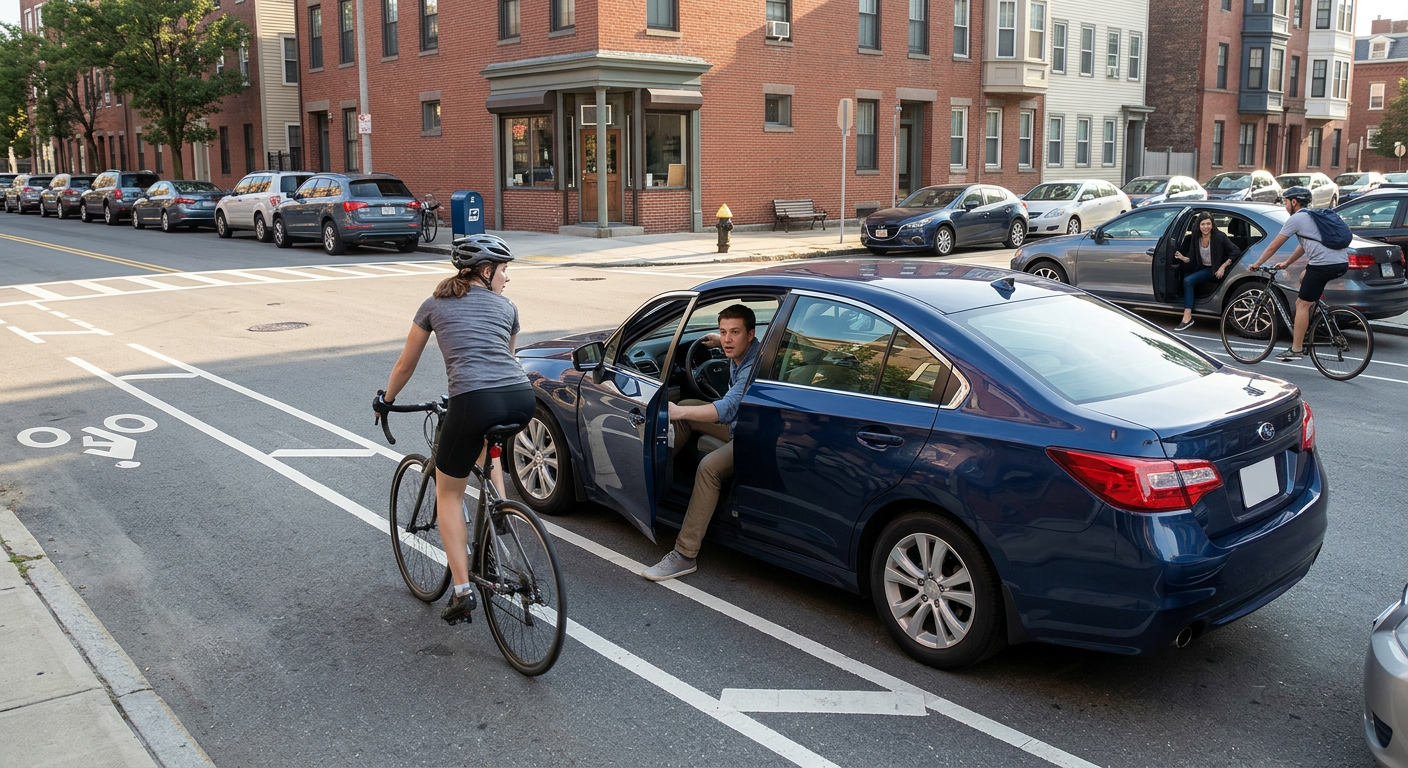

A cyclist is moving alongside a row of parked cars when, without warning, a door swings into the bike’s path. There may be less than a second to brake, turn, or brace for impact. The rider can strike the door directly, flip over the handlebars, or swerve into moving traffic.
This type of collision is often called a dooring accident. It may happen at a relatively low cycling speed, but the consequences can still be severe. A bicycle offers little protection from the sharp edge of a vehicle door, the pavement, or a second vehicle approaching from behind.
Dooring crashes are also unusually preventable. Drivers and passengers can check before opening a door, cyclists can recognize warning clues around occupied vehicles, and road designers can place bicycle routes outside the door zone. Understanding how these collisions unfold is the first step toward preventing them.
What Is a Dooring Accident?

A dooring accident occurs when someone opens a vehicle door into the path of a person riding a bicycle. The cyclist may hit the door, be struck by it as it opens, or fall while attempting an emergency maneuver.
The most familiar situation involves a driver opening the street-side door of a parallel-parked car. However, cyclists can also be injured by:
- Passengers exiting taxis or rideshare vehicles
- Rear-seat passengers opening doors without looking
- Doors opening beside a painted bicycle lane
- Delivery drivers exiting vehicles during a quick stop
- People opening doors in slow or stopped traffic
- Passengers stepping from a vehicle directly into a bike lane
- A cyclist swerving away from a door and into another vehicle
NHTSA specifically advises motorists to look for cyclists before opening a car door or pulling away from a parking space. It also tells cyclists to scan parked vehicles and leave enough room to avoid an opening door.
Why Dooring Crashes Happen So Quickly?
A closed vehicle door appears harmless until it begins moving. Once opened, it can occupy much of the space where a cyclist is riding.
The cyclist may have only a short distance in which to react. Even if the rider sees the door begin to move, sudden braking can lock a wheel or throw the rider forward. Swerving may avoid the door but create a new collision with a passing car, bus, motorcycle, or another cyclist.
Several factors make these accidents especially difficult to avoid:
- Parked cars block sightlines between cyclists and vehicle occupants.
- Tinted windows make it difficult to see whether anyone is inside.
- A cyclist may be riding close to parked cars to avoid traffic.
- A passenger may not expect bicycles to approach from behind.
- Bike lanes are sometimes painted within reach of opening doors.
- Drivers and passengers may be distracted by phones, bags, or children.
- Rideshare passengers may exit as soon as the vehicle stops.
Dooring is not simply a matter of a cyclist “paying more attention.” It is a road-safety problem involving human behavior, vehicle design, street layout, and the limited reaction time available during an unexpected event.
The Door Zone Explained
The door zone is the area beside a parked vehicle that can be occupied by an open door.
Its exact width depends on the vehicle and how fully the door opens. A two-door coupe, large SUV, or commercial vehicle may have a particularly long door. Drivers may also park at an angle, leaving part of the vehicle farther into the street than expected.
Federal Highway Administration research discussing shared-lane markings found that cyclists needed meaningful clearance from parked vehicles to reduce exposure to opening doors. In one studied setting, the estimated door zone extended approximately 9.5 feet from the curb when the parked vehicle’s width and open door were considered. The report discussed positioning cyclists at least 30 inches from parked vehicles as a comparatively safer operating distance in those specific conditions.
That figure should not be treated as a universal rule for every road. Vehicle sizes, lane markings, traffic laws, and street designs vary. The practical lesson is simpler: the edge of a parked car is not a safe line to follow closely.
A cyclist should leave enough space for a door to open without entering the bicycle’s path whenever road conditions and local laws allow. This may require riding closer to the center of a narrow lane rather than squeezing between parked cars and passing traffic.
Common Dooring Accident Scenarios
1. The Driver-Side Door Opens Suddenly
A driver parks, turns off the engine, and immediately opens the door without checking the side mirror or looking over their shoulder. A cyclist approaching from behind has nowhere to go.
This is the classic dooring scenario. It often occurs on commercial streets where parking turnover is high and drivers are focused on reaching a store, office, or restaurant.
2. A Passenger Exits into a Bike Lane
A taxi, rideshare vehicle, or private car stops beside a marked bicycle lane. A rear passenger opens the door directly into the cyclist’s path.
Passengers may be less aware of road traffic than drivers. They may assume the space beside the car is a sidewalk, especially when they are seated on the side away from the steering wheel.
3. A Door Opens While Traffic Is Stopped
A person may open a door while the vehicle is waiting at a red light or trapped in congestion. The cyclist, legally moving past slow or stationary traffic where permitted, may not expect anyone to exit in the roadway.
A vehicle does not have to be parked for a dooring collision to occur.
4. A Cyclist Rides Through a Painted Door-Zone Bike Lane
Some older or constrained bicycle lanes run immediately beside on-street parking. The painted line may create a sense of security even though the lane overlaps the opening range of vehicle doors.
Paint alone does not stop a door. Cyclists still need to observe parked vehicles and choose a position that provides usable clearance.
5. One Door Creates a Multi-Vehicle Crash
The cyclist avoids the door by swerving left but enters the path of a moving vehicle. In these cases, the most serious impact may not be with the door itself.
This is one reason cyclists should avoid riding so close to parked cars that an emergency swerve becomes their only option.
Warning Clues Cyclists Can Watch For
It is impossible to predict every opening door, but parked cars often provide small clues that someone may be about to exit.
Watch for:
- A person visible through the rear or side window
- An illuminated dashboard or interior light
- Brake lights that have just switched off
- A vehicle that has just pulled into a parking space
- A driver moving their head, shoulder, or arm
- A seat belt being released
- A taxi or rideshare vehicle stopping near a destination
- Passengers gathering bags or turning toward the door
- A side mirror moving as the driver prepares to leave
- Exhaust vapor or other signs that the vehicle is occupied
- A gap in parked cars that might attract a driver pulling in or out
These clues should prompt the cyclist to slow down, increase space, cover the brakes, and check behind before making any lateral movement.
However, an apparently empty vehicle can still contain a child or passenger hidden by a seat, pillar, or tinted window. The safest habit is to treat every recently stopped or occupied-looking vehicle as a potential door hazard.
How Cyclists Can Reduce the Risk
Ride Outside the Door Zone

Do not automatically hug the parked cars to make room for faster vehicles. Riding too close removes the space needed to react safely.
Where permitted and necessary, use a more central lane position that keeps you outside the opening range of vehicle doors. The correct position depends on lane width, traffic speed, road design, and local law.
Predictability is important. Maintain a steady line rather than repeatedly weaving toward and away from parked vehicles.
Look Farther Ahead
Staring only at the pavement directly in front of the wheel reduces reaction time. Scan ahead through the entire row of parked vehicles.
Look for occupied cars, recently parked vehicles, delivery activity, and people approaching from the sidewalk. Early recognition allows gradual braking or a controlled lane-position change instead of a last-second swerve.
Check Behind Before Moving Left
A door may tempt you to turn abruptly into the travel lane. Before changing position, look over your shoulder or use a properly adjusted bicycle mirror.
NHTSA recommends riding predictably, signaling turns and lane changes, and looking ahead for traffic and obstacles.
In an immediate emergency, there may not be time for a signal. Maintaining a safe position before the door opens is therefore much safer than relying on evasive steering.
Control Your Speed
Ride at a speed that matches the complexity of the environment. A crowded restaurant district with frequent parking activity requires more caution than a street with no parked vehicles.
Slowing down increases the time available to recognize movement and reduces the force of a possible impact. Lower vehicle speeds also improve reaction time and can reduce injury severity when crashes occur.
Keep Both Hands Ready
Keeping both hands on the handlebars improves control and braking response. Avoid holding a phone, drink, bag, or other object while passing parked vehicles.
Use a backpack, pannier, basket, or secure rack for anything you need to carry.
Use Lights and Visible Clothing
A driver cannot avoid a cyclist they never see. Use a white front light, red rear light, reflectors, and visible clothing as required or recommended in your area.
Daytime lights may also improve visibility in shadows, rain, or streets lined with visual clutter. Visibility does not transfer responsibility away from the person opening the door, but it can make the cyclist easier to notice during a mirror or shoulder check.
Wear a Properly Fitted Helmet
A helmet cannot prevent a door from opening and does not protect every part of the body. It can, however, reduce the risk of head and brain injury when a cyclist hits the pavement or another object.
The CDC recommends that cyclists of every age wear a properly fitted helmet on every ride.
How Drivers and Passengers Can Prevent Dooring
Use the Dutch Reach
The Dutch Reach involves opening the door with the hand farthest from it. A driver seated on the left side, for example, uses the right hand.
This movement naturally rotates the upper body, making it easier to look into the mirror and over the shoulder for an approaching cyclist. The United Kingdom added guidance encouraging this technique to its Highway Code changes that took effect in January 2022.
The method is simple:
- Check the side mirror.
- Check over your shoulder.
- Open the door slowly with the opposite hand.
- Pause with the door only slightly open.
- Exit only when the lane is clear.
The Dutch Reach should support—not replace—a deliberate visual check.
Open the Door Gradually
Do not throw the door open in one movement. Cracking it open slowly gives an approaching cyclist more time to notice the movement and allows the occupant to stop if traffic is present.
Check for More Than Cars
Many people look only for motor vehicles before exiting. Train yourself to search specifically for bicycles, e-bikes, scooters, motorcycles, and pedestrians.
Smaller road users may be harder to see but can still be moving quickly.
Warn Passengers Before They Exit
Drivers should remind passengers to check for cyclists, especially when stopping beside a bicycle lane.
Children may need direct supervision. Whenever practical and legal, passengers should exit on the curb side rather than into moving traffic or a bicycle lane.
Choose a Safe Drop-Off Location
Rideshare and taxi drivers should avoid stopping in a bike lane or unloading passengers where a door will block a cyclist’s path. Continue to a legal curb space or another location where passengers can exit safely.
Passengers should not pressure a driver to stop at the exact destination when doing so would create a hazard.
What Communities and Road Designers Can Do
Individual caution helps, but safer street design can prevent conflicts before they occur.
FHWA identifies bicycle lanes as an important safety countermeasure and notes that separated lanes use physical elements such as posts, curbs, or vegetation to create space between cyclists and motor traffic. Marked buffers can also provide additional lateral separation.
Useful design strategies include:
- Placing a buffer between parked cars and the bicycle lane
- Building parking-protected bicycle lanes
- Using physical separators where appropriate
- Marking bicycle positions outside the door zone
- Managing taxi, delivery, and rideshare loading areas
- Reducing excessive vehicle speeds
- Improving lighting and sightlines
- Providing protected routes on high-volume streets
Infrastructure should account for how people actually use the curb—not merely how the street appears on a plan.
What to Do After a Dooring Crash
First, move out of traffic only when it is safe to do so. A person with possible head, neck, back, or major limb injuries should not be moved unnecessarily unless remaining in place creates immediate danger.
Call emergency services for loss of consciousness, confusion, repeated vomiting, severe headache, breathing difficulty, uncontrolled bleeding, obvious deformity, severe chest or abdominal pain, weakness, numbness, or inability to stand. The Red Cross advises avoiding unnecessary movement when a head, neck, or spinal injury is suspected.
Even when the cyclist initially feels well, adrenaline can mask pain. Watch for delayed concussion symptoms, increasing dizziness, unusual sleepiness, memory problems, worsening pain, or vomiting. Urgent medical evaluation may be needed after a head injury, and another adult should monitor the injured person when clinicians advise home observation.
When medically able, collect:
- The driver’s and passenger’s names and contact information
- Vehicle registration and insurance details
- Photographs of the door, bicycle, road markings, and injuries
- Contact information for witnesses
- Video from nearby businesses or vehicle cameras
- The exact time and location
- A police or incident-report number
Avoid arguing at the scene. Laws concerning fault, reporting, bicycle positioning, and door opening vary by jurisdiction, so seek appropriate legal or insurance guidance when necessary.
Frequently Asked Questions
Should cyclists ride close to parked cars to stay away from traffic?
Usually, riding extremely close to parked cars creates a serious dooring risk. A cyclist may need to use more of the lane to maintain safe clearance. The appropriate position depends on local law and road conditions.
Is a painted bike lane always outside the door zone?
No. Some bike lanes are positioned immediately beside parked cars and may overlap with the space used by open doors. Cyclists should evaluate the actual clearance rather than relying on paint alone.
Can passengers be responsible for dooring a cyclist?
Responsibility depends on local law and the circumstances. In many places, rules prohibit opening a vehicle door when doing so would endanger another road user. Drivers should also instruct passengers and choose safe unloading locations.
Are dooring accidents dangerous at low speed?
Yes. Even a moderate-speed impact can throw a cyclist onto the pavement or into moving traffic. Head injuries, broken collarbones, wrist fractures, facial injuries, chest trauma, and deep cuts are possible.
The Bottom Line
Dooring crashes happen when the space beside a vehicle is treated as empty without checking for bicycles. Cyclists can lower their risk by riding outside the door zone, scanning occupied vehicles, controlling speed, staying visible, and avoiding sudden unpredictable movements. Drivers and passengers can prevent collisions by checking mirrors and blind spots, using the Dutch Reach, opening doors slowly, and choosing safer drop-off locations.
Have you ever had a car door open in front of you while cycling—or realized at the last second that a cyclist was passing your parked car? Share what happened and the safety habit you now use in the comments below. Your experience may help another rider, driver, or passenger prevent the same kind of crash.

Hi, I’m the creator and editor behind ZestyHabit. I research everyday safety, first aid, and practical wellness topics using official guidance and reliable public sources, then turn that information into clear, realistic steps for daily life.
My goal is to help readers make safer, better-informed choices at home and beyond.


