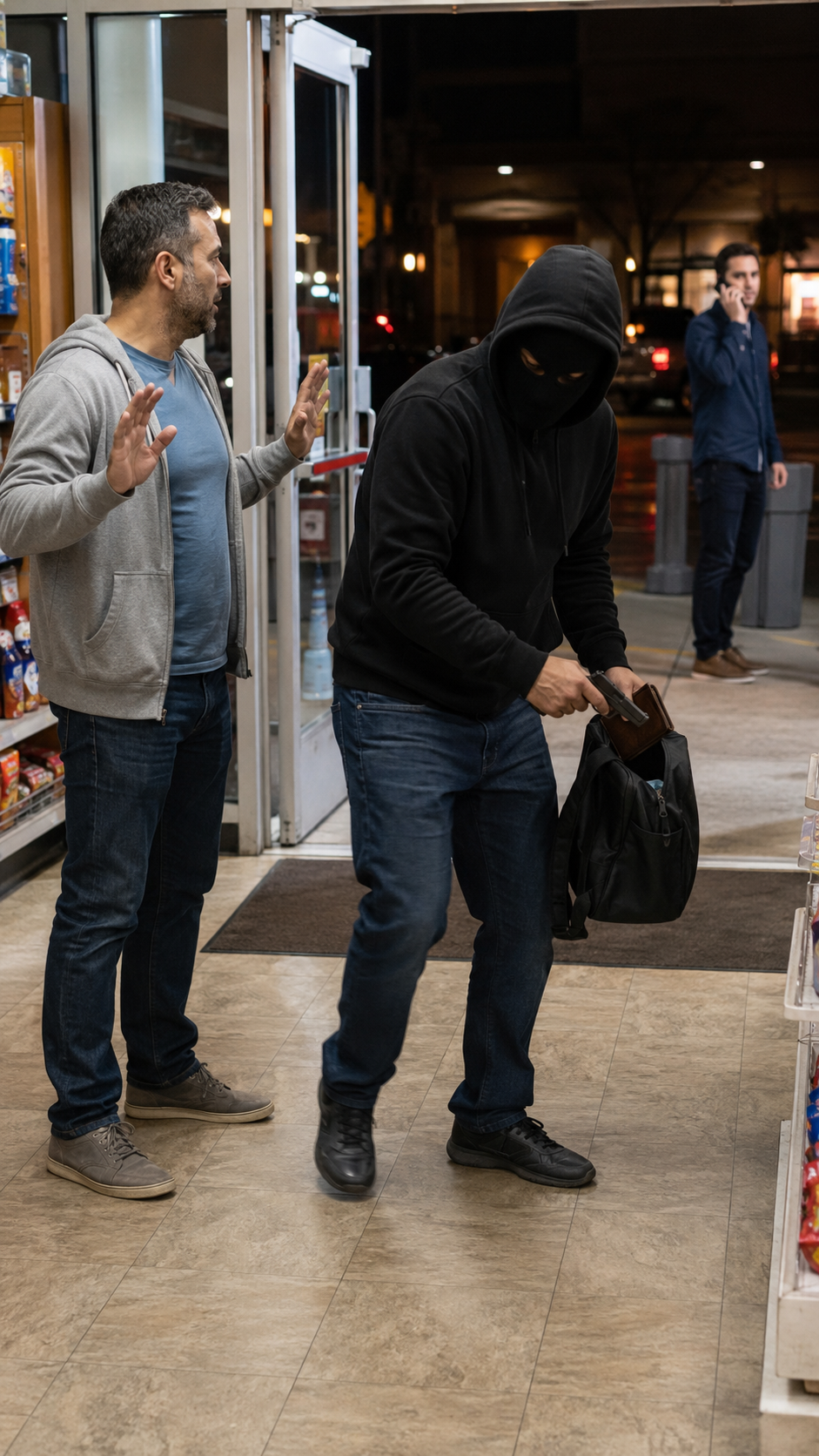
How to Survive and Escape a Robbery Safely: What to Do Before, During, and After
Learn how to respond safely during a street robbery, armed robbery, store robbery, or carjacking—and what to do after reaching safety.
A robbery can unfold in seconds. Someone may display a weapon, block your path, demand your wallet, or threaten employees and customers inside a store. The shock of the situation can make it difficult to think, even if you have imagined what you would do.
There is no response that guarantees safety in every violent encounter. A robber may be nervous, intoxicated, desperate, unpredictable, or acting with other people. The safest general approach is to protect human life, avoid actions that could escalate the confrontation, and look for a safe way out only when an opportunity is clear.
Your phone, wallet, jewelry, vehicle, and other property can be replaced. Your first goal is to survive the robbery and help others avoid being harmed.
The FBI defines robbery as taking or attempting to take something of value through force, a threat of force, violence, or fear. That makes it different from theft that occurs without direct confrontation, such as finding that an unattended bag has disappeared.
During a robbery, the presence or threat of violence changes the priority. Trying to protect property may cause the offender to become more aggressive. Even if you believe you could overpower the person, you may not see a hidden weapon or an accomplice nearby.
Police guidance generally recommends cooperation rather than physical resistance. The Los Angeles Police Department advises people to remain calm, comply with demands, and avoid actions that could endanger themselves or others.
Stay as Calm and Predictable as Possible
Feeling calm during a robbery may be unrealistic. You may experience a pounding heart, shaking hands, tunnel vision, or difficulty understanding what the person is saying. These are common stress reactions.
The practical goal is not to feel relaxed. It is to make your behavior slow and predictable.
Take a breath if you can. Listen carefully and avoid shouting, insulting, arguing, or challenging the robber. Keep your hands where they can be seen. Do not suddenly reach into a bag, pocket, jacket, or glove compartment.
If you need to move, tell the person what you are about to do. For example, you might say, “My wallet is in my right pocket. I’m going to take it out slowly.”
The USC Department of Public Safety similarly recommends avoiding quick or unexpected movements and explaining why you need to reach for something.
Short, clear communication is usually better than lengthy explanations. Do not volunteer personal information or offer additional property that was not requested. Follow reasonable demands involving replaceable belongings while looking for an opportunity to move away safely.
Do Not Fight Over Property
Movies often portray robbery victims grabbing weapons, chasing offenders, or launching a surprise attack. In real life, those actions can turn a property crime into a fatal confrontation.
Do not attempt to:
Grab a weapon
Knock an object from the robber’s hand
Block the person’s escape
Chase the robber
Secretly photograph the person at close range
Refuse to hand over replaceable property
Threaten revenge or police involvement
Make sudden movements toward an alarm
Even an unarmed robber may have a concealed weapon or an accomplice. A person who appears hesitant can still react violently when surprised.
Physical resistance may become a last-resort consideration only when you reasonably believe severe injury or death is immediately occurring or unavoidable. This is very different from fighting to keep a wallet or phone. There is no universal technique that makes fighting safe.
Escape Only When the Route Is Clearly Safe
If you notice the threat before the robber confronts you, move away immediately. Enter a populated business, cross to a well-lit area, drive away if you are already inside a locked vehicle, or call emergency services from a safe location.
Once the confrontation has begun, running may or may not be safer. Consider the distance, the presence of weapons, barriers, other people, and whether the offender is watching you directly. Do not make a sudden escape attempt that requires pushing past the robber or crossing the line of a weapon.
In a store or bank robbery, remain still unless staff, police, or the robber directs you to move. If you are near an exit and can leave without attracting attention or crossing into danger, quietly moving away may be reasonable. If not, stay low-key and avoid becoming involved.
If a robber begins attacking people rather than focusing on property, the emergency has escalated beyond a typical robbery. Official active-shooter guidance uses the priorities Run, Hide, Fight: get away if possible, hide if escape is unsafe, and fight only as a last resort when your life is in immediate danger. The FBI emphasizes that fighting is the final option, not the first response to a property demand.
If the Robber Orders You to Move Somewhere Else
Being ordered into a vehicle, back room, isolated area, or second location can signal a change in risk. Unfortunately, there is no single response that is safest in every situation.
Continue looking for opportunities to reach other people, an open exit, a secure room, or a place where you can attract attention without triggering immediate violence. Your decision may depend on whether a weapon is present, how closely you are being controlled, whether children are with you, and whether help is nearby.
If you can send an emergency alert or call without being seen, do so. Otherwise, avoid obvious phone movements that may be interpreted as resistance.
When the situation involves abduction, sexual violence, or an apparent intent to cause serious harm, compliance with property demands may no longer resolve the danger. Escape, shouting for help, or physical resistance may become necessary if a genuine opportunity appears, but no written guide can account for every circumstance. Focus on surviving the next few seconds rather than following a rigid rule.
What to Do During a Street Robbery
Street robberies often happen quickly and at close range. The person may ask for directions or money before making a threat, or they may approach without warning.
If confronted:
Stop moving suddenly toward the person.
Keep your hands visible.
Avoid prolonged eye contact that could be interpreted as a challenge.
Listen to the demand.
Explain any movement before reaching for property.
Hand over replaceable items without arguing.
Allow the robber to leave.
Move in the opposite direction when it is safe.
Enter a business or other secure place.
Call emergency services.
Do not follow the offender to see where they go. Instead, notice the direction of travel from a safe distance. If a vehicle is involved, remember only what you naturally observe. Do not approach it or step into the road to read the license plate.
What to Do During a Store or Workplace Robbery
Employees may have specific training, silent alarms, security buttons, or workplace procedures. Follow that training without taking an action that the offender can see.
The LAPD advises using a silent alarm only when it can be reached without being noticed. Otherwise, wait until the robber has left. An alarm is not worth activating if doing so places an employee or customer in immediate danger.
Employees should avoid arguing about access to registers or safes. If something requires a key, code, or another employee, explain that calmly. Customers should stay quiet, keep their hands visible, and avoid interfering.
After the offender leaves:
Lock the entrance if it is safe to do so.
Do not touch anything the robber may have handled.
Ask witnesses to remain, but do not force them.
Call emergency services immediately.
Do not discuss descriptions in a way that changes one another’s memories.
Write down individual observations separately.
If You Are Carjacked
A vehicle can feel worth defending, especially when it contains personal belongings. However, attempting to hold onto the door, block the vehicle, or grab the steering wheel can lead to severe injury.
If ordered out of the vehicle, move slowly, keep your hands visible, and avoid arguing. Create distance once you are outside. Do not stand in front of or behind the vehicle, as the driver may move suddenly.
If a child, dependent adult, or pet is inside, state that clearly and immediately. For example: “My child is in the back seat.” Every situation is different, so continue prioritizing human life and call emergency services as soon as possible.
Do not chase the stolen vehicle in another car. Give police the vehicle description, license plate if you know it, direction of travel, and information about any passengers.
Observe Without Staring
Details can help investigators, but your safety comes first. Do not stare at the robber, take obvious photographs, or risk your life trying to memorize every feature.
Notice information naturally, such as:
Approximate height and build
Clothing and footwear
Distinctive voice or speech
Visible tattoos, scars, or accessories
Whether a weapon was displayed
Number of offenders
Direction of escape
General vehicle description
Descriptions can be affected by stress, lighting, masks, and the speed of the event. Be honest about what you remember and what you are uncertain about. Never guess simply because you feel pressure to provide an answer.
Call Emergency Services From a Safe Location
Once the robber has left and you are no longer in immediate danger, call 911 or your local emergency number. The dispatcher will usually need your location first.
Tell them:
The exact address or nearest landmark
Whether anyone is injured
Whether weapons were seen
How many offenders were involved
When they left
Their direction of travel
Whether a vehicle was used
A brief description
Stay on the line and follow instructions. Warn others not to enter the area if doing so is safe. When police arrive, keep your hands empty and visible, avoid sudden movements, and follow commands. Officers may not initially know who the offender is.
Get Medical Help Even for “Minor” Injuries
Adrenaline can temporarily hide pain. A person who was pushed, struck, restrained, or knocked down may have an injury that is not immediately obvious.
Call for medical assistance if anyone has:
Heavy bleeding
Head, neck, or chest pain
Difficulty breathing
Loss of consciousness
Confusion or severe dizziness
A possible broken bone
A gunshot or stab wound
Significant pain after a fall or assault
Apply direct pressure to serious external bleeding if it is safe and you know how. Do not move someone with a possible spinal injury unless remaining in place creates a greater danger.
Preserve Evidence After the Robbery
Avoid cleaning or rearranging the area before police arrive. Do not pick up a weapon, shell casing, note, bag, or object the robber may have touched. If something must be moved to prevent immediate harm, tell officers exactly what was changed.
Save:
Security-camera footage
Doorbell or vehicle recordings
Relevant messages or calls
Transaction records
Photographs of injuries
Damaged clothing or property
Location history that may help establish timing
Write down what you remember as soon as you can, using your own words. Do not post descriptions, video, or investigative details on social media before speaking with police. Public posts may spread incorrect information or complicate the investigation.
If your phone, wallet, or keys were stolen, inform police before remotely erasing the phone. Then contact your carrier, banks, card issuers, employer, and property manager as appropriate. Change compromised passwords from a trusted device and consider replacing locks if identifying documents and keys were taken together.
Reduce Robbery Risk Without Blaming Victims
Responsibility for a robbery always belongs to the offender. Safety habits can reduce opportunity, but they cannot prevent every crime.
Practical precautions include:
Stay aware of people and activity around you.
Use well-lit, populated routes.
Avoid displaying large amounts of cash or expensive jewelry.
Keep headphone volume low enough to hear your surroundings.
Have keys ready before reaching your home or vehicle.
Avoid counting cash in public.
Use ATMs in visible, well-lit locations.
Cancel a transaction if someone is watching too closely.
Travel with others when practical.
Trust your instincts and leave when a situation feels unsafe.
Avoid shortcuts through isolated areas.
Keep vehicle doors locked and windows closed in unfamiliar areas.
If you believe someone is following you, do not go directly home. Move toward a police station, staffed business, security desk, or busy public area and call for help.
Emotional Recovery Matters Too
People can react very differently after a robbery. Some feel afraid immediately, while others feel numb and develop symptoms days later. Trouble sleeping, anger, guilt, jumpiness, intrusive memories, and fear of returning to the location can all occur after a violent crime.
These reactions do not mean that you handled the robbery incorrectly. You survived a threatening event.
Talk to someone you trust and consider professional support if symptoms interfere with daily life. The U.S. Department of Justice’s Office for Victims of Crime provides information about victim services and compensation programs. Local victim advocates may also help with counseling, medical costs, safety planning, property replacement, and the criminal justice process.
Final Thoughts
The safest response during most robberies is to remain as calm and predictable as possible, keep your hands visible, comply with demands for replaceable property, and avoid sudden resistance. Escape only when the route is clearly safe, never chase the offender, and call emergency services after reaching protection. If the situation escalates into an immediate attack on human life, priorities may change—but physical resistance should remain a last resort.
Have you ever taken a personal-safety class or discussed what your family or coworkers should do during a robbery? Share the most useful lesson you learned, or leave your own practical safety tip in the comments below.