Why Sudden Drop-Offs Make Creek and River Swimming More Dangerous
Minjin Park
·
Learn why creek and river swimming areas can become deep without warning, how currents and cold water increase the risk, and what families can do to stay safer.
A shallow creek can look like one of the easiest places to enjoy the water.
You may be able to see rocks beneath the surface, children may be standing comfortably near the bank, and the current may appear much calmer than ocean waves. It is natural to assume that the water will remain shallow as you walk farther out.
But natural swimming areas are rarely as predictable as pools.
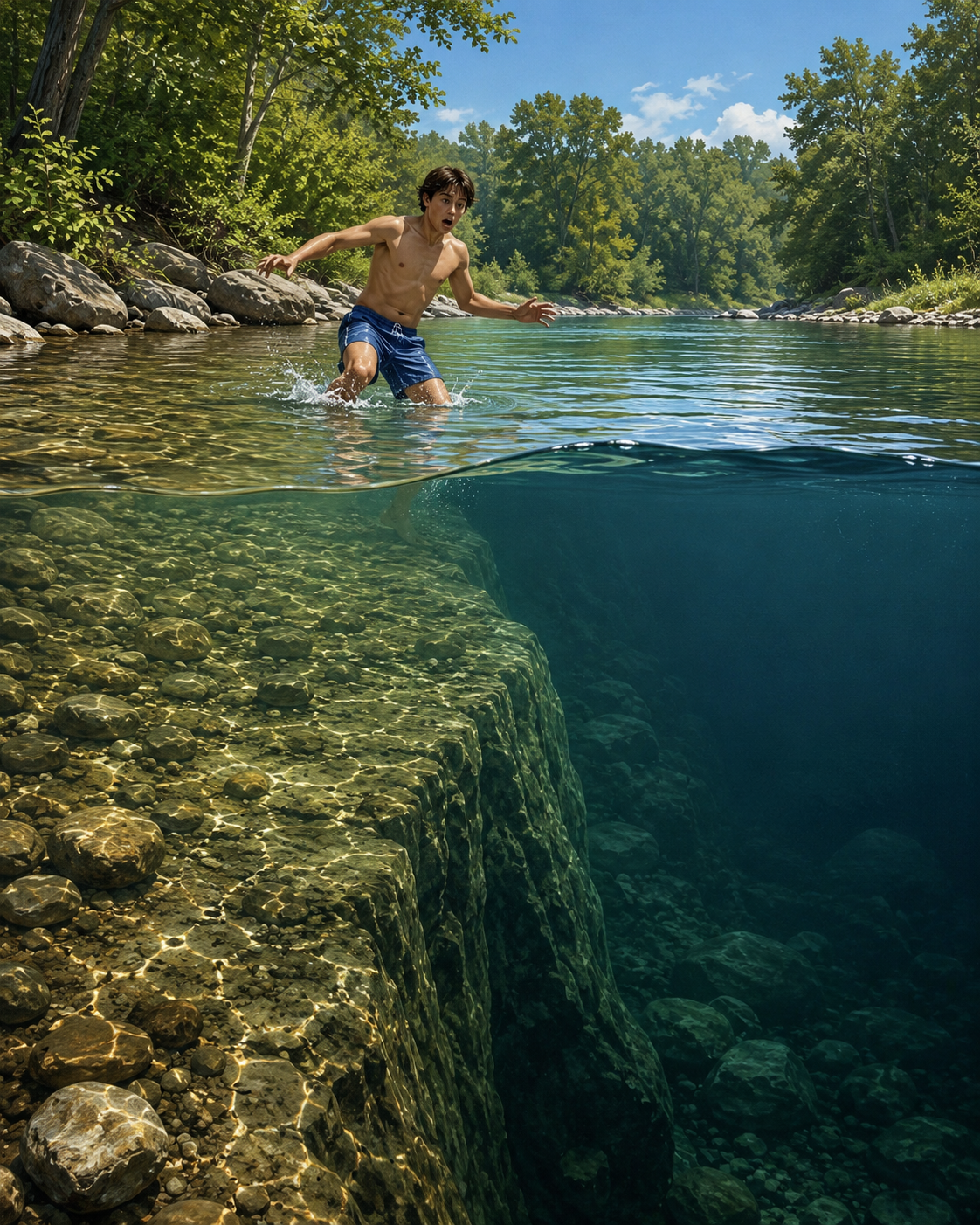
The bottom of a creek, river, or mountain swimming hole can change suddenly. One step may be on a flat rock in knee-deep water, while the next lands in a hole where your feet cannot reach the bottom.
Unexpected holes and steep underwater drop-offs are among the hidden hazards found in natural bodies of water, according to the National Park Service.
A sudden change in depth does not always lead to an emergency. However, it can cause panic, loss of balance, accidental submersion, or separation from children and less confident swimmers. The danger becomes greater when cold water, slippery rocks, or a strong current are involved.
Understanding how these drop-offs form—and why they are difficult to spot—can make creek and river outings much safer.
A swimming pool is built with a planned slope and marked depth changes. Natural waterways are shaped continuously by moving water.
Currents carry sand, gravel, branches, and rocks. Floods can remove material from one area and deposit it somewhere else. Water swirling around boulders can dig deep holes into the creek bed.
As a result, the bottom may be uneven even when the surface looks smooth.
Currents Carve Holes Into the Bottom
Fast-moving water can erode soil, sand, and smaller rocks.
This process may create deep pockets beside large boulders, below small waterfalls, near bends, or where two currents meet. Some holes have soft, unstable edges that can collapse when stepped on.
National Park Service guidance warns that currents can create sudden deep holes and drop-offs with loose edges that may give way under relatively little pressure.
The water above these holes may look no different from the surrounding area.
Flooding Can Rearrange a Familiar Swimming Spot
A creek you visited last summer may have a different bottom this year.
Heavy rain, snowmelt, and seasonal flooding can move large amounts of gravel and debris. A shallow area may become deeper, while a previously deep pool may partially fill with sediment.
Even changes that happened a few days earlier may not be obvious from the bank.
Familiarity should never replace checking current conditions.
Rocks Can Create Sharp Underwater Ledges
Natural rock shelves do not always slope gradually.
You may walk across a broad, flat section and then reach the edge of the shelf without realizing it. Beyond that edge, the water may be several feet deeper.
Dark rock, reflections, shadows, and moving water can hide the boundary.
Calm Water Can Hide a Deep Hole
People often use the surface of the water to judge what is happening underneath.
Unfortunately, the surface does not always reveal depth or current strength. Some rivers contain swift currents and steep drop-offs directly below areas that appear calm.
Reflections Distort What You See
Bright sunlight can reflect off the surface and make it difficult to see the bottom.
Cloud shadows, surrounding trees, and dark rocks can also make shallow water appear deep—or deep water appear shallow.
Polarized sunglasses may improve visibility, but they cannot reveal every underwater change.
Clear Water Can Create False Confidence
Clear water often feels safer than muddy water because you can see some of the bottom.
However, visibility decreases quickly as the water becomes deeper. Distances also look different through moving water, especially when ripples distort the rocks below.
A visible rock may be farther beneath the surface than it appears.
Murky Water Hides Almost Everything
After rain, a normally clear creek may become cloudy with soil and sediment.
You may not be able to see holes, logs, ledges, or changes in the bottom at all. Higher, muddier water can also indicate that the current is stronger than usual.
When visibility is poor, avoiding entry is generally safer than trying to test the depth by walking farther out.
What Happens When Someone Steps Into a Drop-Off
The first problem is often surprise.
A person expects the next step to feel like the last one. Instead, the foot finds no solid ground, the body drops, and the head may briefly go underwater.
Surprise Can Trigger Panic
A confident swimmer may recover quickly after an unexpected dip.
A child, beginner, or nervous swimmer may inhale, flail, grab the nearest person, or struggle to regain footing. Panic can use energy quickly and make it difficult to respond calmly.
Someone who is carrying a bag, wearing loose clothing, or holding a child may have even more difficulty recovering balance.
The Current May Be Stronger in Deeper Water
Shallow water creates friction against the creek bed.
Once a person steps into a deeper channel, more of the body is exposed to moving water. The current may push the legs sideways or carry the swimmer away from the shallow section.
The change can feel immediate even if the surface did not appear fast.
The Edge May Be Difficult to Climb Back Onto
An underwater drop-off is not always shaped like a smooth step.
The edge may be slippery, soft, steep, or covered with algae. A person may be unable to place a foot securely enough to push back into the shallow area.
This is one reason testing the water by walking forward is not always reliable.
Cold Water Makes Sudden Immersion Harder to Manage
Mountain creeks and spring-fed rivers can remain cold even on hot summer days.
The air may feel warm enough for swimming, while the water temperature below the surface is much lower. The National Park Service notes that river and stream water can be extremely cold beneath the surface, even on sunny days.
Sudden Cold Can Affect Breathing
Dropping unexpectedly into cold water may cause a sharp gasp or rapid breathing.
That reaction can make a brief submersion more frightening and reduce the person’s ability to stay calm. It is especially concerning when the face enters the water unexpectedly.
Cold Water Reduces Strength Over Time
Swimming in cold water requires more energy.
Hands, arms, and legs may become less coordinated as exposure continues. A person who could easily swim the same distance in a warm pool may struggle in a cold river.
Water also removes body heat much faster than air at the same temperature.
This is why warm weather alone should not be used to judge whether a creek is comfortable or safe for swimming.
Children Face Particular Risks Around Drop-Offs
Young children may move confidently in water that reaches their knees or waist.
That confidence can disappear instantly when the bottom drops away.
Natural water is an important drowning-risk setting for school-age children. Current CDC data indicate that more than 40 percent of drownings among children ages 5 to 14 occur in natural water.
A Child May Move Out of Reach Quickly
An adult may stand a few feet away and believe the child is within easy reach.
If the child steps into a current or deep hole, those few feet can become significant. The adult may also lose balance while trying to reach the child.
Close, active supervision matters more than simply being somewhere near the water.
Inflatable Toys Are Not Safety Equipment
Pool floats, inner tubes, and inflatable animals can drift, tip, or lose air.
They may give children and adults a false sense of security in water with changing depth. A child can also slip through or fall away from the float.
A properly fitted, U.S. Coast Guard-approved life jacket is a more appropriate layer of protection for children and less confident swimmers near natural water.
Older Children May Overestimate Their Skills
A child who swims well in a pool may expect the same experience in a creek.
Pools do not usually contain cold current, slippery rocks, submerged branches, uneven bottoms, or sudden ledges. Strong swimmers have also drowned in rivers, so swimming ability should not be treated as complete protection.
Other Hazards Often Surround Deep Sections
A drop-off rarely exists by itself.
The same water movement that creates a hole may also create other hazards nearby.
Submerged Rocks and Logs
A person who suddenly drops into deeper water may kick or fall against a hidden rock.
Branches and submerged trees can also catch clothing or make movement more difficult. Natural waters commonly hide rocks, trees, holes, and other obstacles below the surface.
Never dive into an unfamiliar creek or swimming hole, even when you have seen other people jumping there.
Slippery Algae-Covered Surfaces
Rocks near and under the water may be coated with algae.
A foot that feels secure at first can slide when weight shifts. Water shoes may help protect the feet, but they do not guarantee traction.
Move slowly and avoid hopping from one wet rock to another.
Strong Water Below Small Waterfalls
The pool beneath a waterfall may look calm and inviting.
However, falling water can create circulating currents, deep scoured holes, and turbulent areas. Water may push downward or pull objects back toward the falling stream.
Do not assume a popular-looking waterfall pool is safe for swimming.
Common Mistakes at Creek Swimming Areas
Many risky situations begin with reasonable but incorrect assumptions.
Following Someone Else’s Path
You may see another person cross the creek and assume you can walk along the same route.
That person may be taller, more familiar with the area, or standing on rocks you cannot see. Moving water can also make it difficult to follow the exact same line.
Check conditions for yourself rather than relying on another swimmer’s experience.
Assuming the Middle Is the Only Deep Part
Deep channels can run beside shore, around rocks, or along the outside of a river bend.
In some locations, a person can step into deep water only a short distance from the bank.
Do not assume that staying near shore always means staying shallow.
Entering Immediately After Heavy Rain
Rain can increase water level, current speed, cloudiness, and debris.
Conditions upstream may affect the swimming area even when it is not raining where you are. A sudden rise in water, increasing cloudiness, or floating branches can be warning signs that conditions are changing.
Postpone the outing when the water looks higher or faster than normal.
Jumping From Rocks Without Checking Below
A swimming hole may be deep in one spot and shallow in another.
Water depth can also change between visits. Hidden rocks, logs, and debris may have moved into the landing area.
Jumping or diving into unfamiliar natural water is never a reliable way to test its depth.
Assuming a Group Makes the Area Safe
A crowded swimming spot may feel reassuring.
Other visitors may be unfamiliar with the water too. A popular location can still contain unmarked holes, current, and cold water.
Use your own judgment and follow official warnings rather than using crowd size as proof of safety.
Warning Signs of an Unexpected Deep Section
You cannot always identify a drop-off, but certain clues deserve caution:
A sudden change from light to dark water
A visible edge in the rock bed
Water swirling beside a boulder
A line of faster-moving water
Areas where the surface changes texture
A soft bottom that suddenly slopes away
Water flowing in a different direction nearby
A pool directly below a waterfall
Warning signs or barriers near the shore
Other swimmers suddenly changing from standing to swimming
These signs are not perfect. When the depth is uncertain, treat the area as deep.
Practical Ways to Stay Safer
A few simple habits can reduce much of the risk.
Choose a Designated Swimming Area
Whenever possible, use a maintained recreation site where swimming is allowed.
Check park notices, current conditions, and local warnings before entering. The National Park Service recommends finding approved swimming areas and checking for warnings involving current and water levels.
Designated does not mean risk-free, but it may offer clearer information and better access in case assistance is needed.
Wear a Properly Fitted Life Jacket
Children, weak swimmers, and anyone entering moving water should wear an appropriate life jacket.
Fasten every strap and check the fit before approaching the water. An oversized jacket may ride up, while one that is too small may not provide the intended support.
Adults should model the same habit instead of treating life jackets as equipment only for children.
Enter Slowly—Never Dive
Step in from a stable area while facing the water.
Move one foot at a time and keep your weight balanced. If you cannot see the bottom or feel a secure place for the next step, stop rather than continuing forward.
Do not enter from cliffs, boulders, or steep banks.
Establish Clear Boundaries for Children
Choose a visible point that children may not pass.
Keep young children within arm’s reach and avoid dividing attention between supervision, phones, food preparation, and conversation.
An adult should be specifically responsible for watching the water rather than assuming everyone in the group is watching.
Recheck Conditions Throughout the Visit
Waterways can change while you are there.
Notice whether the water is rising, becoming muddier, moving faster, or carrying more debris. Leave the water when conditions begin changing.
A Calm Response to an Unexpected Drop
If you unexpectedly lose the bottom, try to avoid standing forcefully against a strong current.
Focus on keeping your face above water, orienting yourself, and moving toward the nearest safe, shallow area when possible. Call for help early rather than waiting until you are exhausted.
If another person is struggling, get professional help and use a reaching or throwing aid from stable ground when available. Jumping into moving water can place a second person at risk.
The best response depends on the location, which is why prevention and flotation are so important.
Respect What You Cannot See
Creeks, rivers, and mountain swimming holes can be beautiful places to cool off, but they are not naturally built swimming pools.
Their bottoms shift. Rock shelves end abruptly. Currents carve hidden holes, and cold water can make an unexpected drop much harder to manage.
Choose designated areas, check current conditions, use properly fitted life jackets, and keep children close. Enter slowly, avoid diving, and never assume that clear or calm-looking water is shallow.
Most creek outings end with nothing more serious than wet shoes and good memories.
A little caution around changing depth helps keep them that way.
Hi, I’m the creator and editor behind ZestyHabit. I research everyday safety, first aid, and practical wellness topics using official guidance and reliable public sources, then turn that information into clear, realistic steps for daily life.
My goal is to help readers make safer, better-informed choices at home and beyond.