
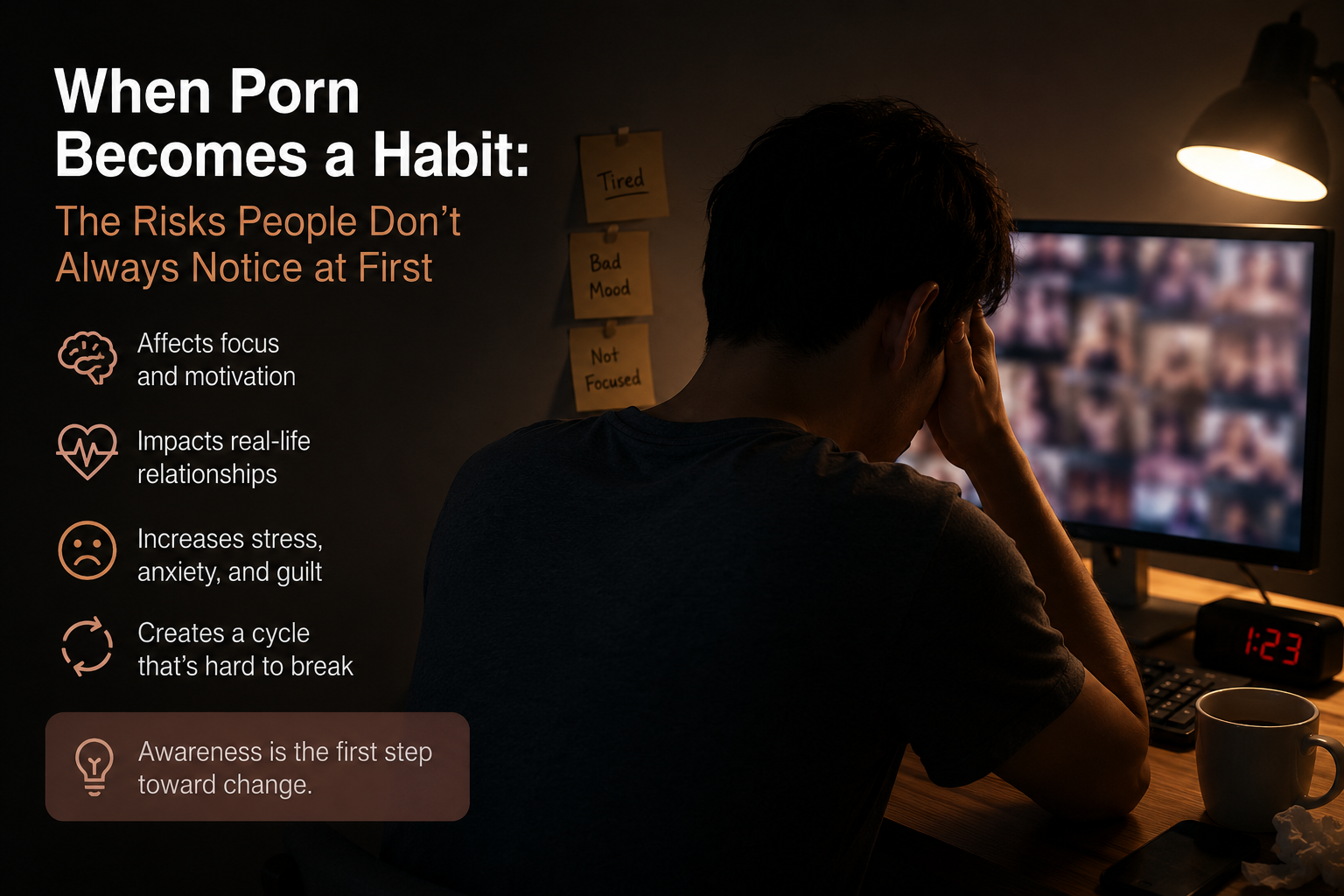

Porn can seem like a private, harmless escape, but for some people it starts affecting focus, relationships, expectations, mood, and daily life. Here’s how the habit can quietly grow and what to watch for.
The private habit that can become louder over time
Porn is one of those topics people often talk about in extremes.
Some people treat it like it is no big deal at all. Others talk about it only with fear or shame. Real life is usually messier than either side admits.
For many adults, porn starts as something private and occasional. A way to relax. A way to deal with stress. A way to avoid loneliness for a while. It can feel separate from the rest of life, tucked away behind a screen and a closed door.
But habits do not always stay in the small corner where they began.
For some people, porn becomes less like a choice and more like a reflex. Stressful day? Watch. Bored at night? Watch. Feeling rejected? Watch. Can’t sleep? Watch. Avoiding a task? Watch.
That is where the risk starts to show up. Not always dramatically. Not always overnight. More often, it shows up in small changes: less motivation, more isolation, unrealistic expectations, weaker intimacy, lower patience, or a sense that ordinary life feels dull compared with what is on a screen.
This article is not here to shame anyone. Shame tends to make secret habits even more secret. The point is to look honestly at how porn can affect daily life when it becomes a regular escape instead of something a person is freely choosing.
Why porn can feel so easy to fall into
Porn is available in a way that most habits were not a few decades ago.
It is private, instant, endless, and designed for quick stimulation. You do not have to plan anything. You do not have to talk to anyone. You do not have to risk rejection, awkwardness, patience, or emotional effort.
That convenience is part of the problem.
Many healthier forms of comfort take more time. Calling a friend takes effort. Going for a walk requires shoes and weather tolerance. Resting means sitting with your own thoughts. Working through relationship tension requires humility. Even getting proper sleep means putting the phone down before your brain is ready to stop being entertained.
Porn skips all of that.
It offers a fast emotional shift. For a short while, stress, loneliness, boredom, or frustration can fade into the background. That does not mean the person is weak. It means the brain tends to repeat things that provide quick relief.
The trouble is that quick relief is not the same as real recovery.
When “just once in a while” turns into a coping routine
A habit becomes more concerning when it starts doing emotional work you do not want to face directly.
Maybe porn becomes the way you calm down after arguments.
Maybe it becomes the thing you reach for when you feel rejected.
Maybe it fills empty evenings when you feel disconnected from other people.
Maybe it becomes your reward after work, then your break during work, then the reason you stay up later than you meant to.
At first, the habit may seem contained. Then it begins attaching itself to more situations.
You are not only watching because you want to. You are watching because you are irritated, tired, anxious, lonely, bored, or avoiding something. The behavior becomes less about pleasure and more about escape.
A useful question is:
“Am I choosing this, or am I using it to get away from how I feel?”
That question can be uncomfortable. It can also be clarifying.
The effect on attention and motivation
Heavy porn use can make ordinary tasks feel painfully slow by comparison.
A work assignment, a sink full of dishes, a textbook chapter, a quiet evening, a normal conversation — these things do not offer instant intensity. They require patience. They unfold at human speed.
Porn does the opposite. It gives quick novelty and stimulation without much effort.
Over time, some people notice they become more restless. They procrastinate more. They reach for their phone more often. They have a harder time sitting through boredom. The brain starts asking for a bigger hit of stimulation whenever life feels flat.
This does not mean porn is the only reason someone struggles with focus. Attention is affected by sleep, stress, mental health, phone habits, workload, and many other things. But if porn is part of a pattern of constant quick stimulation, it may be making the problem worse.
The sign to watch for is not simply “I watched porn.”
It is more like:
“I keep choosing it instead of doing things I actually care about.”
That is a different conversation.
How it can shape expectations around intimacy
Real intimacy is not edited.
It includes pauses, awkward moments, communication, mood, consent, insecurity, tenderness, laughter, timing, tiredness, and sometimes the very unglamorous reality of being a person with a body.
Porn usually does not teach that.
It often presents sex as performance, not connection. It can make bodies seem like products, partners seem like props, and desire seem constantly available. Even when someone knows logically that porn is not real life, repeated viewing can still influence what feels “normal.”
That can create problems in relationships.
A person may become less patient with real intimacy. They may compare their partner to unrealistic images. They may feel disappointed by ordinary human bodies. They may expect certain behaviors without understanding the emotional trust behind them. Or they may struggle to feel present because their mind has become used to a more exaggerated kind of stimulation.
This can be painful for both people.
The partner may feel unseen or compared. The viewer may feel confused, guilty, or frustrated that real connection does not feel as exciting as it “should.”
Real intimacy usually grows through safety and attention. Porn trains the brain toward novelty and instant access. Those are not the same skill set.
The loneliness loop
Porn can feel like a solution to loneliness, but it can also deepen it.
That sounds unfair, but many coping habits work this way. They soothe the feeling briefly, then leave the deeper need untouched.
Someone feels lonely, so they watch porn.
For a while, they feel distracted.
Afterward, the room is still quiet. The phone has no new messages. The relationship problem is still there. The person may also feel shame, secrecy, or emotional distance.
Then the loneliness returns, sometimes heavier than before.
This can create a loop: loneliness leads to porn, porn leads to more isolation, isolation leads to more porn.
The way out is not always as simple as “just go meet people.” Loneliness can be complicated. People may feel socially anxious, busy, burned out, hurt by past relationships, or unsure how to reconnect. Still, it helps to name the real need.
The need may not be sexual at all.
It may be closeness. Comfort. Being known. Being wanted in a non-performative way. Having someone ask how your day was and actually listen.
Porn cannot provide that, no matter how much time it takes.
The problem with secrecy
Private habits are not automatically bad. Everyone deserves personal space.
But secrecy can become heavy when it is built around fear, shame, or hiding from someone you love.
A person may start clearing browser history, lying about screen time, hiding from their partner, or feeling nervous when someone touches their phone. They may promise themselves they will stop, then return to the habit and feel worse.
The secrecy itself can begin to damage self-respect.
It can also damage trust in relationships. Not every couple has the same boundaries around porn, and people disagree strongly about what is acceptable. That is exactly why honest conversations matter. If one person thinks it is harmless and the other experiences it as betrayal or emotional distance, ignoring the difference will not make it disappear.
It is better to have a hard conversation than to live in quiet resentment and hidden behavior.
Not easy. Better.
Escalation: when more is needed to feel the same
Another risk is escalation.
Some people notice that the kind of content that once felt stimulating stops feeling like enough. They look for more novelty, more intensity, or more extreme material. This can happen gradually, almost without a clear decision.
That does not mean everyone who watches porn will escalate. But the possibility matters because the internet makes novelty endless. There is always another clip, another category, another tab.
When someone finds themselves searching for content that conflicts with their values, makes them uncomfortable afterward, or leaves them feeling disturbed, it is worth taking seriously.
A good warning sign is the sentence:
“I don’t even know why I’m watching this anymore.”
That is often the moment when the habit has moved away from simple enjoyment and into compulsion.
The effect on self-image
Porn can also affect how people see themselves.
Some compare their bodies to what they see online and feel inadequate. Others compare their sexual performance, confidence, or desirability. Even when people know what they are watching is staged, curated, or edited, repeated exposure can still chip away at normal expectations.
For younger adults especially, porn can become a first teacher about sex before real-world experience, emotional maturity, or healthy communication has had time to develop. That can make normal uncertainty feel like failure.
But adults are not immune either.
A person can start believing they should always look a certain way, respond a certain way, want certain things, or be endlessly confident. Real bodies and real emotions are more variable than that.
There is nothing wrong with wanting desire or pleasure. The harm starts when a person’s understanding of desire becomes shaped mostly by performance rather than mutual care.
Porn and mood: the aftereffect matters
The clearest sign that a habit is hurting you is often how you feel afterward.
Do you feel calm and fine?
Or do you feel numb, guilty, drained, irritated, lonely, or disappointed in yourself?
Some people describe a kind of emotional drop after watching. The intensity fades, and then they are left with the same stress they were trying to avoid. Maybe worse.
That aftereffect matters.
A habit does not have to be dangerous in a dramatic way to be unhelpful. If it regularly leaves you feeling lower, more disconnected, or less in control, it deserves attention.
You do not need to wait until your life is falling apart to question whether something is good for you.
Signs your porn habit may need a reset
It may be time to reconsider your relationship with porn if:
You watch longer than you intended.
You keep trying to stop or cut back but cannot.
You use it mainly when stressed, sad, lonely, or angry.
You hide it from a partner or lie about it.
It interferes with sleep, work, school, or responsibilities.
You feel less interested in real intimacy.
You compare real people to what you watch.
You need more extreme or specific content to feel stimulated.
You feel guilty or emotionally flat afterward.
One or two of these signs does not mean you should panic. But patterns matter. If several feel familiar, it may be time to step back and ask what role the habit is playing in your life.
How to begin cutting back without turning it into a shame spiral
The first step is not dramatic self-hatred.
In fact, shame often makes the habit stronger. People feel bad, then use the habit to escape feeling bad. Round and round it goes.
Start with honesty instead.
Notice when you watch. What time of day? What mood? What happened right before? Were you bored, angry, stressed, tired, rejected, or avoiding a task?
You may start to see patterns.
Then add friction. Keep your phone out of the bedroom. Use website blockers if needed. Avoid being alone with a screen during your usual trigger time. Set a rule that you do not watch when you are upset, tired, or trying to avoid something.
That last rule can be powerful. It separates desire from emotional escape.
You can also replace the habit with something that meets the real need more directly. If you are stressed, move your body for ten minutes. If you are lonely, text someone. If you are tired, go to bed without bargaining with yourself for “one more video.” If you are avoiding a task, set a timer for five minutes and start badly. Starting badly is still starting.
None of this has to be perfect. You are trying to interrupt the automatic path.
Talk to someone if it feels out of control
If porn use feels compulsive, causes distress, harms your relationship, or connects with deeper anxiety, depression, trauma, or loneliness, it may help to talk with a therapist.
This does not mean you are strange or hopeless. It means you are dealing with a habit that has become bigger than you want it to be.
Some people also find support groups useful. Others prefer private counseling. Couples may need a therapist if porn has damaged trust or intimacy. The right kind of help depends on the situation.
The important thing is not to stay alone with a secret that is making you feel worse.
A more honest way to think about it
The danger of porn is not only that it exists.
The bigger issue is what it can replace.
It can replace rest.
It can replace honest conversations.
It can replace real intimacy.
It can replace dealing with stress.
It can replace boredom, which is sometimes where creativity and self-awareness begin.
It can replace the slow, awkward, human work of connecting with yourself and other people.
That does not happen to everyone in the same way. But when it does happen, it usually happens gradually enough that a person can explain it away for a long time.
So the question is not only, “Is porn bad?”
A better question is:
“What is this habit doing in my life?”
If the answer is “It is taking more than it gives,” that is worth listening to.
You do not have to fix everything overnight. Start with one honest pause. Notice the trigger. Put the phone down once. Choose sleep once. Choose a real conversation once. Let ordinary life feel a little too quiet and stay with it anyway.
That quiet may feel uncomfortable at first.
But it may also be where you start getting your attention, your relationships, and your sense of choice back.

Hi, I’m the creator and editor behind ZestyHabit. I research everyday safety, first aid, and practical wellness topics using official guidance and reliable public sources, then turn that information into clear, realistic steps for daily life.
My goal is to help readers make safer, better-informed choices at home and beyond.


