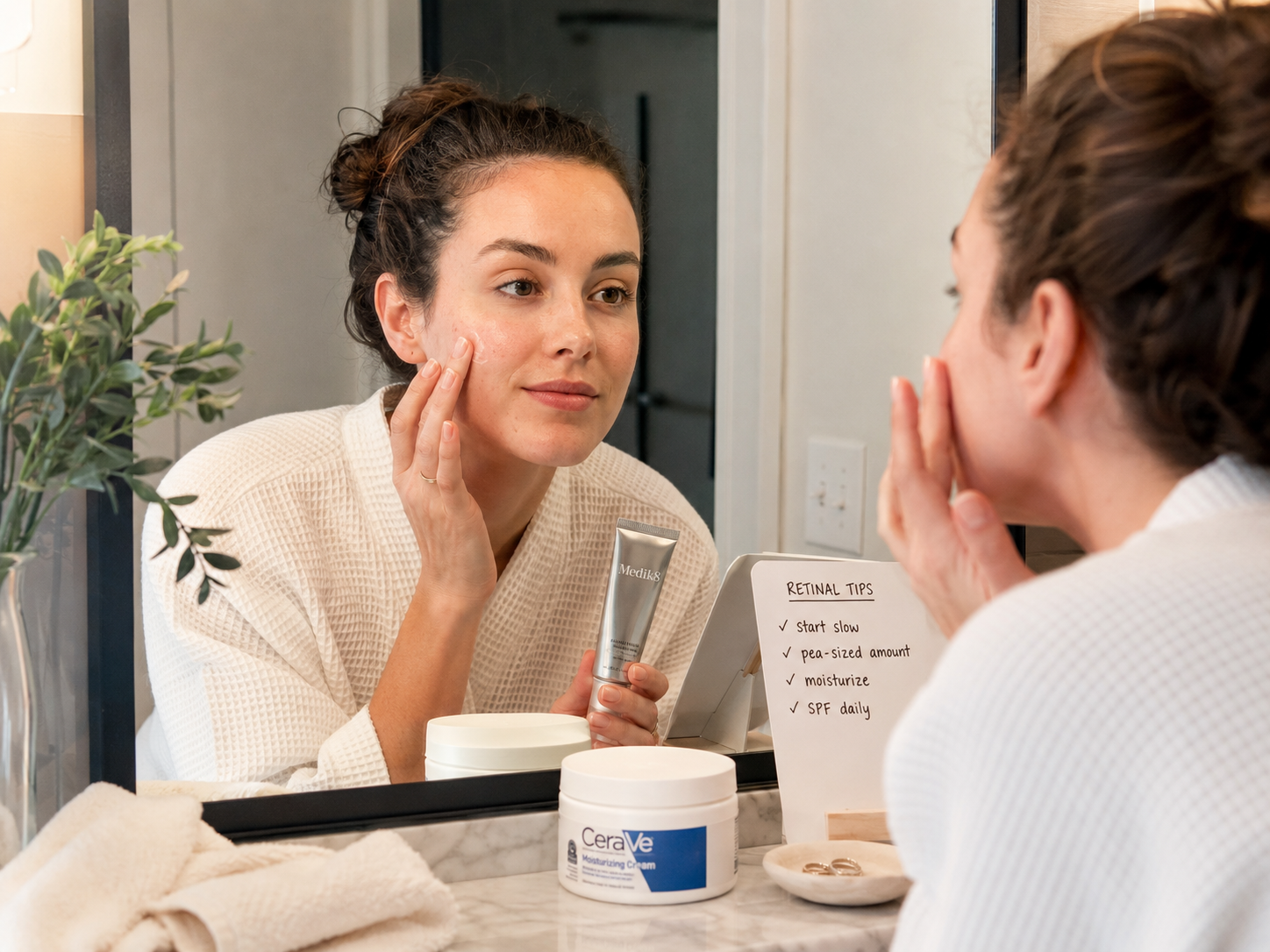
Getting Started with Retinal: How to Use It Without Wrecking Your Skin
Minjin Park
·
Retinal is one of those skincare ingredients that sounds exciting and slightly intimidating at the same time.
You hear people say it helps with fine lines, texture, dullness, pores, breakouts, and overall skin smoothness. Then five minutes later, someone else is talking about peeling, purging, dryness, and “retinoid uglies,” which is enough to make anyone stare at the bottle and quietly put it back in the drawer.
So, is retinal worth using?
For many people, yes. Retinal can be a very effective skincare ingredient when used properly. It belongs to the retinoid family, which is one of the most researched groups of ingredients in skincare. It can support smoother texture, more even-looking skin, and healthy skin renewal over time.
But retinal is not something you want to rush.
The mistake people often make is treating it like a normal moisturizer or serum. They use too much, too often, too soon, and then wonder why their skin feels dry, tight, flaky, or suddenly furious.
Retinal can be great. Your skin just needs a proper introduction.
Retinal, also called retinaldehyde, is a form of vitamin A used in skincare.
It sits in the retinoid family, along with retinol, retinoic acid, adapalene, and other vitamin A derivatives. Retinoids are known for helping with skin cell turnover, texture, acne-prone skin, and visible signs of aging.
The important thing to know is that your skin has to convert many retinoids into retinoic acid before they can do their main work. Retinoic acid is the active form that skin cells can use.
Retinol has to convert into retinal, then retinal converts into retinoic acid.
Retinal is one step closer to retinoic acid than retinol is, which is why many people consider it stronger or faster-acting than retinol, but still gentler than prescription retinoic acid for some skin types.
That does not mean retinal is automatically “better” for everyone. It just means it can be a powerful middle option.
Retinal vs. Retinol: What Is the Difference?
Retinol and retinal are often confused because the names are almost annoyingly similar.
Retinol is more common and often easier to find. It tends to be a good beginner-friendly retinoid, depending on the formula and strength.
Retinal is usually considered more potent because it is closer to the active form. Some people see results faster with retinal than with retinol. It may be a good option if retinol feels too slow, but prescription retinoids feel too intense.
Still, strength is not only about the ingredient name. The formula matters. The percentage matters. The base of the product matters. Your skin barrier matters. Your routine matters.
A gentle, well-formulated retinal product may feel easier than a poorly formulated retinol product. A high-strength retinal can absolutely irritate your skin if you use it recklessly.
Skincare rarely gives us neat little rules. Very rude of it, honestly.
What Can Retinal Help With?
Retinal can help improve several common skin concerns over time.
It may help with uneven texture, roughness, dullness, clogged pores, fine lines, and the look of sun-related aging. It can also be useful for some acne-prone skin types because retinoids help keep pores from clogging as easily.
The key phrase here is “over time.”
Retinal is not an overnight glow trick. It works gradually by supporting skin renewal. Some people notice smoother skin in a few weeks, but more visible improvements usually take a few months.
That is one of the hardest parts of using retinoids. You have to keep going gently and consistently without expecting your face to transform by Friday.
Retinal is a long-game ingredient. Annoying, but worth it for many people.
Who Should Consider Using Retinal?
Retinal may be a good option if you want to address early signs of aging, uneven texture, dullness, clogged pores, or mild acne-prone skin.
It can also be appealing if you have used retinol before and want something a little stronger, but you are not ready for prescription tretinoin or other stronger retinoids.
People in their mid-20s and beyond often start looking at retinoids for prevention and texture. But there is no magical age where you must begin. If your routine is simple and your skin is happy, you do not need to add retinal just because everyone online is talking about it.
Use it because it fits your skin goals, not because you feel late to some imaginary skincare schedule.
Who Should Be Careful with Retinal?
If your skin is very sensitive, easily irritated, or currently dealing with a damaged barrier, retinal may be too much at first.
If your face is already burning, peeling, red, itchy, or reacting to basic moisturizer, do not add retinal yet. Fix the barrier first. A retinoid on damaged skin is like adding hot sauce to a paper cut. Technically possible, spiritually unnecessary.
People with eczema-prone skin, rosacea-prone skin, or very dry skin should introduce retinal very slowly and choose a lower-strength formula.
If you are pregnant, trying to become pregnant, or breastfeeding, talk to your doctor before using retinoids. Many vitamin A skincare ingredients are avoided during pregnancy, so it is better to be cautious.
And if you are using prescription acne treatments, strong exfoliants, or dermatology products already, check whether retinal makes sense with your current routine. Sometimes more active ingredients just mean more irritation.
Start Low and Slow
This is the golden rule.
Do not start retinal every night.
Even if the packaging says it is gentle. Even if your friend uses it daily. Even if your skin is usually tough. Start slowly.
A good beginner approach is using retinal two nights a week for the first few weeks. For example, Monday and Thursday. That gives your skin time to adjust between applications.
If your skin feels fine after a few weeks, you can increase to three nights a week. Later, if your skin tolerates it well, you may use it every other night or more often.
But you do not have to use retinal every night to get benefits. Many people get good results using it three or four times a week.
Consistency matters more than speed. Irritated skin will slow you down anyway, so there is no prize for rushing.
Use a Pea-Sized Amount
With retinal, more product does not mean better results.
A pea-sized amount is usually enough for the entire face. Not a grape. Not a blueberry. A pea.
Dot it on your forehead, cheeks, and chin, then spread it evenly. Avoid the corners of your nose, corners of your mouth, eyelids, and directly under the eyes unless the product specifically says it is safe for that area.
Those areas are more delicate and tend to get irritated faster.
If you apply too much retinal, you are more likely to get dryness, peeling, and burning. You are not doubling the benefits. You are just giving your skin more reasons to be dramatic.
Apply Retinal at Night
Retinal should usually be used at night.
Retinoids can be sensitive to light, and they can also make your skin more vulnerable to dryness and irritation. Nighttime use is the standard approach.
In the morning, sunscreen becomes especially important. This is not optional.
If you use retinal but skip sunscreen, you are working against yourself. Retinoids can help improve the look of skin over time, but sun damage can undo a lot of that progress. UV exposure contributes to wrinkles, pigmentation, collagen breakdown, and uneven tone.
So if retinal is your nighttime investment, sunscreen is your daytime insurance.
Not glamorous. Very necessary.
The Best Way to Apply Retinal
A simple retinal routine looks like this:
Cleanse your face gently. Pat your skin dry. Wait a few minutes if your skin is sensitive. Apply a pea-sized amount of retinal. Follow with moisturizer.
That is enough.
You do not need six steps. You do not need an exfoliating toner first. You do not need to layer every active ingredient you own just because it is nighttime.
Actually, it is better not to.
If you are new to retinal, keep the rest of your routine boring. Gentle cleanser. Moisturizer. Sunscreen in the morning. Let retinal be the main event.
Your skin will adjust much better when it is not being attacked from multiple directions.
Try the Moisturizer Sandwich Method
If your skin is sensitive or dry, the “moisturizer sandwich” method can help.
First, apply a thin layer of moisturizer. Then apply retinal. Then apply another layer of moisturizer on top.
This can buffer the retinal slightly and reduce irritation. It may make the product feel less intense, which is exactly what some skin types need.
Some people worry that buffering makes retinal useless. It does not. It may slow the delivery a bit, but that is often a good trade-off if it helps you stay consistent.
A gentle routine you can maintain is better than a strong routine you abandon after your face starts peeling.
Do Not Mix Retinal with Too Many Actives at First
When starting retinal, be careful with other strong ingredients.
Avoid using exfoliating acids like glycolic acid, lactic acid, mandelic acid, or salicylic acid on the same night at first. Also be cautious with benzoyl peroxide, strong vitamin C, peeling products, harsh scrubs, and acne treatments.
Your skin may eventually tolerate a routine with multiple actives, but the beginning is not the time to test its emotional limits.
Start retinal alone. Once your skin adjusts, you can decide whether to add anything else.
A lot of skincare irritation comes from good products used together in a bad way.
What Is Retinal Purging?
Purging is one of the most confusing parts of retinoids.
Because retinal speeds up skin cell turnover, it may bring existing clogged pores to the surface faster. This can look like more breakouts in the first few weeks.
Purging usually happens in areas where you already tend to break out. It often appears as whiteheads, small pimples, or clogged bumps that come up faster than usual.
But not every breakout is purging.
If you are getting irritated red patches, burning, swelling, itchiness, or breakouts in places you never break out, it may be irritation or a bad reaction instead.
Purging can be frustrating, but it should gradually improve. If your skin keeps getting worse after several weeks, or if it feels painful and inflamed, stop and reassess.
Do not suffer through chaos just because someone online said, “It gets worse before it gets better.” Sometimes it gets worse because your skin hates what you are doing.
Dryness and Peeling Are Common, But Not Required
Many people expect peeling when they start retinal. They almost treat it like proof that the product is working.
But peeling is not the goal.
Mild dryness or flaking can happen, especially in the beginning. But your face does not need to shed like a lizard for retinal to be effective.
If you are peeling heavily, burning, or feeling tight all day, reduce how often you use retinal. Add more moisturizer. Stop other actives. Use a gentler cleanser. Give your skin recovery nights.
Retinal should be a manageable part of your routine, not a weekly skin crisis.
How Long Does It Take to See Results?
Some people notice smoother texture or a slight glow within four to six weeks.
For acne-prone skin or clogged pores, it may take eight to twelve weeks to see clearer improvement.
For fine lines, firmness, and tone, think in months. Three to six months is a more realistic timeline. Some benefits continue building with long-term consistent use.
This is why before-and-after photos can be helpful. Your skin changes slowly, and you may not notice small improvements day to day.
If you are new to retinal, start with a low percentage.
Many retinal products come in strengths like 0.01%, 0.03%, 0.05%, or 0.1%, though this varies by brand. If your skin is sensitive, start very low. If you have used retinol before and tolerated it well, you may be able to start a bit higher.
But higher is not always better.
The best retinal strength is the one you can use consistently without irritation. A lower strength used regularly will often give better results than a strong product that leaves your face angry and forces you to stop.
If you are unsure, choose the gentler option first. You can always increase later.
Retinal and Sunscreen: A Non-Negotiable Pair
If you use retinal, daily sunscreen matters.
Even if you work indoors. Even if it is cloudy. Even if you are “just going out for a little bit.”
Retinal can make your skin more sensitive to irritation, and your skincare goals probably include smoother, clearer, more even-looking skin. UV exposure works against all of that.
Use a broad-spectrum sunscreen every morning and reapply when needed, especially if you are outside.
Honestly, if you are not willing to use sunscreen, retinal may not be the best place to start. Sunscreen is the foundation. Retinal is the upgrade.
You do not build the fancy balcony before the house has walls.
Can You Use Retinal Around the Eyes?
Be careful.
The eye area is delicate and more prone to dryness and irritation. Some retinal products are designed specifically for the eye area, but regular facial retinal may be too strong.
If you want to use retinal near the eyes, start with a product made for that area or apply a tiny amount around the orbital bone, not directly under the lower lashes or on the eyelids.
Avoid the inner corners of the eyes. That area gets irritated easily.
If your eyes become dry, watery, itchy, or flaky, stop using it there.
Fine lines are not worth feeling like your eyelids are made of tissue paper.
Can You Use Retinal on the Neck?
The neck can be more sensitive than the face.
Many people can tolerate retinal on their face but not on their neck. The neck may get red, itchy, or irritated faster.
If you want to use retinal on your neck, start once a week with a very small amount mixed with moisturizer or applied over moisturizer. Do not use the same amount you use on your face.
And definitely use sunscreen on the neck during the day.
The neck is often forgotten until it gets annoyed. Then it makes itself very known.
What to Do If Your Skin Gets Irritated
First, stop retinal for a few days.
Do not try to “push through” serious irritation. Focus on barrier repair. Use a gentle cleanser, plain moisturizer, and sunscreen. Avoid exfoliating acids, scrubs, strong vitamin C, benzoyl peroxide, and anything that stings.
Once your skin feels normal again, restart more slowly.
Use less product. Use it less often. Apply moisturizer before retinal. Avoid sensitive areas. Make sure your cleanser is not too harsh.
If irritation keeps happening even with a low strength and careful use, retinal may not be right for your skin right now. That is fine. There are other skincare options.
Your skin is not failing because it dislikes one ingredient.
Can Retinal Be Used with Vitamin C?
Yes, but be careful when starting.
Many people use vitamin C in the morning and retinal at night. That can work well because vitamin C supports antioxidant protection during the day, while retinal works nicely in a nighttime routine.
But if your skin is sensitive, do not start both at the same time. Introduce one product first, let your skin adjust, then add the other.
Also, strong vitamin C products can irritate some people. If your skin feels stinging or raw, simplify.
The routine that looks impressive on paper is not always the one your skin enjoys.
Can Retinal Be Used with Niacinamide?
Niacinamide usually pairs well with retinal.
It can support the skin barrier, help with the look of uneven tone, and may reduce redness or oiliness for some people. Many retinal products already include niacinamide or soothing ingredients for this reason.
Still, any ingredient can irritate someone. If your skin reacts, look at the whole formula, not just the headline ingredient.
But generally, retinal plus niacinamide is a reasonable combination.
Retinal for Acne-Prone Skin
Retinal may help acne-prone skin by supporting cell turnover and reducing clogged pores over time. This can be especially useful for closed comedones, texture, and recurring congestion.
But acne-prone skin can also be sensitive, especially if you are already using acne treatments.
Do not combine retinal with every acne product you own right away. If you use benzoyl peroxide or salicylic acid, alternate nights at first. Moisturize properly. Avoid drying cleansers.
Acne routines often fail because they become too harsh. The skin gets irritated, the barrier weakens, and breakouts look worse.
Retinal can be helpful, but it needs patience.
Retinal for Fine Lines and Texture
This is one of the main reasons people use retinal.
Over time, retinal can help the skin look smoother, more refined, and more even. Fine lines may look softer. Rough texture may improve. Skin may look a little fresher and less dull.
But it is not filler. It is not Botox. It is not a laser. It is a topical ingredient that works gradually.
The best results usually come when retinal is paired with sunscreen, moisturizer, and a routine that does not constantly irritate the skin.
A retinoid can do a lot, but it cannot outwork daily sun damage and barrier abuse.
What Not to Do When Starting Retinal
Do not start every night.
Do not use a large amount.
Do not apply it to damp skin if you are sensitive. Damp skin can increase penetration and irritation.
Do not use strong exfoliating acids on the same night at first.
Do not apply it right after waxing, shaving, facial scrubs, or professional treatments unless your provider says it is okay.
Do not use it when your skin barrier is already damaged.
Do not skip sunscreen.
Do not panic after one small flake.
And please do not start retinal the night before a wedding, vacation, photoshoot, first date, or any event where you need your skin to behave. Retinoids deserve a calm testing period, not a dramatic debut.
A Simple Beginner Retinal Routine
Here is a gentle way to start:
Morning: gentle cleanse or water rinse, moisturizer if needed, sunscreen.
Night on non-retinal days: gentle cleanser, moisturizer.
Night on retinal days: gentle cleanser, wait until skin is dry, apply moisturizer if you want to buffer, apply a pea-sized amount of retinal, apply moisturizer again if needed.
Do this two nights a week for a few weeks.
If your skin stays calm, increase slowly.
That is it. Very boring. Very effective.
How to Know Retinal Is Working
Retinal working well usually looks like gradual improvement.
Your skin may feel smoother. Makeup may apply more evenly. Clogged pores may appear less often. Texture may soften. Dullness may improve. Fine lines may look a little less noticeable over time.
It should not feel like constant burning, peeling, or irritation.
A little adjustment period can happen. A long-term battle with your own face should not.
Good skincare should make your skin more resilient, not more fragile.
Final Thoughts
Retinal is a powerful and useful skincare ingredient, but it needs respect.
It can help with texture, dullness, clogged pores, acne-prone skin, and visible signs of aging. It may work faster than retinol for some people, while still being easier to tolerate than stronger prescription retinoids.
But the best way to use retinal is slowly.
Start with a low strength. Use a pea-sized amount. Apply it at night. Moisturize well. Avoid overloading your routine with other actives. Wear sunscreen every morning. Give your skin time.
Retinal is not a quick fix. It is a long-term relationship ingredient.
And like most long-term relationships, it goes better when you do not rush, overdo it, or ignore obvious warning signs.
Used properly, retinal can become one of the most effective steps in your routine. Used too aggressively, it can turn your skin into a flaky little protest sign.
Hi, I’m the creator and editor behind ZestyHabit. I research everyday safety, first aid, and practical wellness topics using official guidance and reliable public sources, then turn that information into clear, realistic steps for daily life.
My goal is to help readers make safer, better-informed choices at home and beyond.