
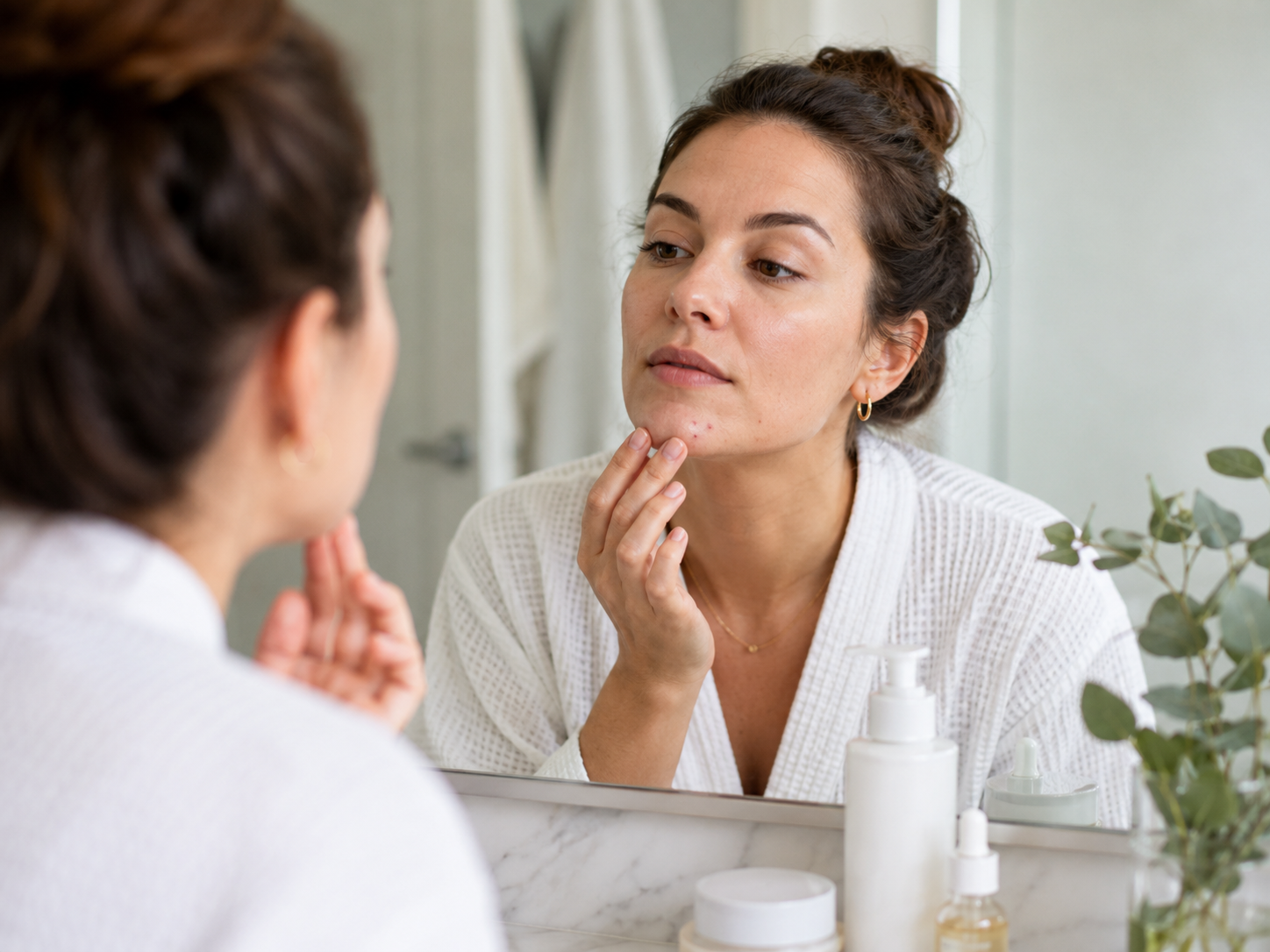

Adult chin acne can be frustrating, especially when it keeps coming back in the same area. Here’s why it happens and how to care for it gently without making your skin more irritated.
Chin acne has a special talent for showing up at the worst possible time.
Right before a meeting. Before a date. Before taking photos. Or just when your skin was finally starting to behave and you thought, very foolishly, that peace had arrived.
Adult chin acne is especially annoying because it often feels stubborn. It may come back in the same spots. It may be deep and sore. It may sit under the skin for days before turning into a visible bump. And unlike a tiny forehead pimple you can kind of ignore, chin acne lives right in the middle of your expressions. Talking, eating, smiling, resting your hand on your face, wearing a mask, shaving, applying makeup — the chin is always involved.
And when you want a clean, polished impression, chin acne can feel more noticeable than it probably is.
The goal is not to have perfect skin. Real skin has texture, pores, marks, and occasional breakouts. But if adult chin acne keeps bothering you, there are ways to manage it more calmly and effectively.
Not by attacking your face.
By understanding what might be triggering it and building a routine your skin can actually tolerate.
Why chin acne is so common in adults
Adult acne is different from teenage acne for many people.
Teen breakouts often show up across the forehead, nose, cheeks, and jaw. Adult acne often likes the lower face: chin, jawline, around the mouth, and sometimes the neck.
This area can be influenced by hormones, stress, skincare habits, makeup, shaving, masks, toothpaste residue, touching the face, and even hair products that transfer onto the skin.
The chin is also an area where pores can clog easily. Oil, dead skin cells, sweat, sunscreen, makeup, and bacteria can mix together and create congestion. If inflammation gets involved, that clogged pore becomes a red, swollen, or painful pimple.
The frustrating part is that chin acne may not have one obvious cause. It is often a combination of things.
That is why random harsh scrubbing rarely helps. It might make the skin feel cleaner for five minutes, but it often leaves the barrier irritated, which can make breakouts look angrier.
Hormones are often part of the story
When adults get recurring chin or jawline acne, hormones are one of the first things people think about.
And yes, hormones can play a real role.
Hormonal fluctuations can increase oil production and make pores more likely to clog. This is why some people notice chin acne before their period, during stressful seasons, after changes in birth control, or around major hormonal shifts.
Hormonal acne often feels deeper, more tender, and more stubborn than small surface pimples. It may appear as painful bumps under the skin, especially around the chin and jaw.
This does not mean every chin pimple is hormonal. But if your acne follows a monthly pattern or keeps forming in the same lower-face area, hormones may be involved.
The tricky thing is that hormonal acne usually cannot be solved with face wash alone. Good skincare can help manage it, but if the breakouts are severe, painful, or constant, a dermatologist may be the most useful step.
Stress can make chin acne worse
Stress does not always “cause” acne by itself, but it can absolutely make breakouts worse for some people.
When you are stressed, your body can produce more stress-related hormones, and your habits often change too. You may sleep less, touch your face more, eat differently, skip cleansing, drink less water, or lean your chin into your hand while working.
The skin notices.
Stress acne can feel especially unfair because the breakout itself becomes another source of stress. Then you stare at it, touch it, cover it, pick it, worry about it, and suddenly one pimple has become a full emotional project.
I wish the advice were as simple as “just don’t stress.” Very helpful, thank you, universe.
A more realistic approach is to reduce the skin-related stress habits: do not pick, keep your routine steady, wash your pillowcase, cleanse at night, and use spot treatments carefully.
You may not be able to remove stress from your life, but you can stop stress from turning into a face-touching marathon.
Touching your chin can trigger breakouts

The chin is one of the easiest places to touch without noticing.
You rest your face in your hand. You tap your chin while thinking. You hold your phone against your lower face. You adjust your mask. You pick at dry skin. You check a bump repeatedly to see if it is still there, as if it might politely leave if inspected enough.
Hands carry oil, bacteria, dirt, and product residue. Constant touching also adds friction. For acne-prone skin, that can be enough to irritate the area and contribute to breakouts.
This does not mean your skin is dirty or that you need to become paranoid about germs. It just means the chin gets handled more than we realize.
A simple habit: keep your hands away from your lower face while working or watching TV. If you catch yourself resting your chin in your palm, move your hand. No guilt. Just reset.
Your skin does not need extra traffic.
Masks and chin acne
Masks can be another trigger for chin breakouts.
The combination of heat, moisture, friction, sweat, oil, and trapped skincare or makeup can irritate the skin. Breakouts from mask wearing often show up around the chin, jaw, cheeks, and mouth area.
If you still wear masks often for work, travel, healthcare settings, or personal comfort, the type and cleanliness of the mask matter.
Change disposable masks regularly. Wash reusable masks after use. Avoid heavy makeup under masks if it tends to clog your skin. Apply a lightweight moisturizer to reduce friction. Make sure the mask fits well without rubbing aggressively in one spot.
Mask-related acne is not a moral failure. It is just skin reacting to a warm, covered, high-friction environment.
The fix is usually not harsher cleansing. It is reducing friction, keeping masks clean, and supporting the skin barrier.
Makeup can clog or irritate the chin area
Makeup is not automatically bad for acne-prone skin.
Plenty of people wear makeup and manage acne just fine. The problem is when makeup is too heavy, not removed properly, or not a good match for your skin.
The chin is a tricky area because makeup there rubs off easily. It touches hands, masks, scarves, collars, cups, and food. People often reapply or layer more product to cover redness or bumps, and that can create buildup.
If you use foundation or concealer on chin acne, choose non-comedogenic formulas if possible. Apply thin layers instead of thick coverage. Remove makeup thoroughly at night. And clean makeup brushes, sponges, and puffs regularly.
A dirty concealer applicator touching an active pimple every day is not exactly helping the situation.
Also, do not use makeup as an excuse to pick. Cover gently, then leave it alone.
Toothpaste and mouth-area irritation
Sometimes what looks like chin acne may be partly irritation around the mouth.
Toothpaste residue, especially strong minty or foaming formulas, can irritate the skin near the lips, corners of the mouth, and chin. This does not happen to everyone, but if your breakouts or bumps cluster around the mouth and lower chin, it is worth noticing.
A simple trick is to brush your teeth before washing your face. That way, cleanser can remove toothpaste residue from the skin afterward.
Also rinse well around the mouth after brushing. Pat dry gently. Do not let toothpaste foam sit on the chin while you wander around doing other things.
Small habit, surprisingly useful.
Hair products can travel to the chin
This one is easy to miss.
Leave-in conditioners, hair oils, styling creams, sprays, and gels can transfer from hair to skin. If your hair touches your chin or jawline, those products may end up on your face. Even if your hair does not touch the chin directly, product can transfer through hands, pillowcases, or towels.
Some hair products are too heavy for facial skin and may clog pores.
If your chin acne comes with jawline or cheek breakouts, check your hair routine. Try keeping hair away from your face, washing pillowcases more often, and being careful not to touch your face after applying hair products.
Your skincare routine may be innocent.
Your hair cream may be sneaking onto the scene.
Over-cleansing can make chin acne angrier
When breakouts appear, the instinct is to wash more.
Wash in the morning. Wash at night. Use a stronger cleanser. Scrub the chin. Use a cleansing brush. Try to “deep clean” the acne into submission.
Unfortunately, acne-prone skin does not usually respond well to punishment.
Over-cleansing can strip the skin barrier, causing dryness, irritation, tightness, and more visible redness. When the barrier is damaged, acne treatments may sting more and pimples may look more inflamed.
A gentle cleanser used consistently is usually better than a harsh cleanser used aggressively.
At night, cleanse well enough to remove sunscreen, makeup, sweat, and oil. In the morning, cleanse if your skin feels oily or if you use heavy nighttime products. If your skin is dry or sensitive, a water rinse may be enough.
Clean is good. Stripped is not.
Picking makes everything last longer
I know. This is the hardest one.
Chin acne is extremely pickable. It is right there. You can feel it when you talk. You can see it in the mirror. A deep bump feels like it should be squeezed, even when it clearly is not ready.
But picking almost always makes things worse.
It increases inflammation, damages the skin, pushes bacteria and debris deeper, and raises the chance of scabbing, dark marks, and scars. One pimple that might have healed in a few days can become a two-week situation because it was “just checked” one too many times.
If you struggle with picking, use pimple patches on surface-level spots. They create a physical barrier and can stop the wandering hand. For deep cystic bumps, patches may not do much, but they can still remind you not to touch.
Sometimes the best acne treatment is simply not turning a bump into a wound.
Build a simple chin acne routine
A good routine for adult chin acne does not need to be complicated.
In fact, complicated routines often make it harder to know what is helping or irritating your skin.
Start with the basics:
Gentle cleanser
Lightweight moisturizer
Sunscreen in the morning
Targeted acne treatment if needed
Thorough makeup and sunscreen removal at night
That is the foundation.
If you wear makeup or water-resistant sunscreen, consider a gentle double cleanse at night. Use an oil cleanser, cleansing balm, or micellar water first, then a mild cleanser. The goal is to remove buildup without scrubbing.
After cleansing, moisturize. Yes, even if you have acne. A healthy barrier helps your skin tolerate acne treatments better.
Ingredients that may help chin acne
Different acne ingredients work in different ways.
Salicylic acid can help unclog pores and reduce oiliness. It is often useful for blackheads, whiteheads, and congested skin.
Benzoyl peroxide can help reduce acne-causing bacteria and inflammation. It can work well for red pimples, but it can also be drying and may bleach fabric.
Adapalene, an over-the-counter retinoid in some countries, can help prevent clogged pores and improve acne over time. It usually takes patience and can cause dryness at first.
Azelaic acid may help with acne, redness, and post-acne marks for some people, and it is often gentler than harsher treatments.
Niacinamide can support the skin barrier and help with oiliness and redness, though not everyone’s skin loves it.
The key is not to use everything at once.
Choose one acne-focused ingredient and introduce it slowly. If you throw salicylic acid, benzoyl peroxide, retinoid, exfoliating toner, and clay mask at your chin all in the same week, your skin may not become clear. It may become furious.
Spot treatments: helpful, but not magic
Spot treatments can be useful for individual pimples, especially small red bumps or surface-level breakouts.
But they are not always enough for recurring adult chin acne. If acne keeps forming in the same area, you may need a preventive routine rather than only treating pimples after they appear.
Think of spot treatment as handling the fire.
A consistent acne routine is more like reducing the sparks.
Use spot treatments carefully. Apply a small amount only where needed. Do not coat your entire chin in a strong drying treatment unless the product is meant for that. And do not apply spot treatment to broken, picked skin unless the label says it is safe for that.
A pimple and an open wound are not the same thing.
Moisturizer is not the enemy
People with chin acne often fear moisturizer.
It makes sense. If your skin feels oily or clogged, adding cream seems wrong. But skipping moisturizer can backfire, especially if you use acne treatments.
Dry, irritated skin can produce more visible flakes, redness, and discomfort. Makeup sits worse. Acne treatments sting. The whole lower face looks more inflamed.
Choose a lightweight, non-comedogenic moisturizer. Gel-cream or lotion textures often work well for oily or acne-prone skin. Look for soothing or barrier-supporting ingredients like glycerin, ceramides, panthenol, or squalane if your skin tolerates them.
Moisturizer does not have to be heavy.
It just has to keep your skin from feeling like it is being punished.
Sunscreen matters for acne marks
Chin acne often leaves marks.
Even after the bump is gone, you may be left with a red, brown, or purple spot. These post-acne marks can last much longer if you skip sunscreen.
Sun exposure can darken pigmentation and make marks more stubborn. If you are using acne treatments like retinoids or exfoliating acids, sun protection becomes even more important.
Use sunscreen every morning, including the chin and jawline. If sunscreen tends to break you out, look for lightweight, non-comedogenic formulas. It may take some trial and error.
Acne marks are frustrating, but sunscreen is one of the simplest ways to stop them from lingering longer than necessary.
Shaving and chin acne
For people who shave their chin or jawline, acne and shaving can be a difficult combination.
Shaving over bumps can cause cuts, irritation, and more inflammation. Dull razors can drag on the skin. Shaving too close may contribute to ingrown hairs that look like acne.
Use a sharp, clean razor. Shave after softening the hair with warm water. Use shaving cream or gel with good slip. Do not press hard. Shave in the direction that causes the least irritation for your skin.
If you get frequent bumps, an electric trimmer that leaves the hair slightly longer may be gentler than a close shave.
After shaving, use a gentle moisturizer. Avoid alcohol-heavy aftershaves if they sting or dry out your skin.
Clean shaving habits matter as much as acne products.
Food and chin acne: be realistic
Food and acne is a complicated topic.
Some people notice breakouts after certain foods. Others do not. For some, high-glycemic foods or dairy may play a role, but it is not universal.
The problem is that people often become too extreme. They cut out everything, feel stressed, and still break out because hormones, skin habits, and genetics are involved too.
A realistic approach is to observe patterns without obsessing. If you consistently notice chin acne flaring after a specific food or dietary pattern, it may be worth adjusting and seeing what happens. But do not blame every pimple on one cookie.
Skin is not that simple.
And shame is not a skincare routine.
Clean impression while dealing with chin acne
If you want your skin to look cleaner and more polished while acne is healing, focus on reducing redness, dryness, and rough texture.
A pimple on calm, moisturized skin usually looks less noticeable than a pimple surrounded by dry flakes and irritation.
Do not pick. Use a pimple patch when helpful. Apply concealer lightly if you want coverage. Set only where needed. Avoid thick layers that crack or draw attention to texture.
Also, take care of the surrounding area. Keep lips moisturized. Clean up dry skin around the mouth. Wash off toothpaste residue. Keep facial hair or peach fuzz groomed if that matters to you.
A clean impression comes from the whole area looking cared for, not from having zero blemishes.
When chin acne needs professional help
If your chin acne is deep, painful, cystic, leaving scars, or not improving after consistent over-the-counter care, it is worth seeing a dermatologist.
This is especially true if breakouts are hormonal, recurring, or affecting your confidence a lot. There are prescription options that can help, including topical treatments, oral medications, or hormone-related treatments depending on your situation.
You do not have to wait until acne is severe to ask for help.
Adult acne can be stubborn, and sometimes the kindest thing is to stop guessing.
Common mistakes that keep chin acne going
One mistake is changing products too often. Acne treatments need time, usually several weeks, to show meaningful results.
Another mistake is using too many active ingredients at once. More treatment can mean more irritation, not faster healing.
Picking is a big one. So is sleeping with makeup on, using dirty makeup tools, resting your chin in your hand, and wearing tight or dirty masks.
People also forget pillowcases. If your lower face touches your pillow often, wash pillowcases regularly.
And finally, do not ignore your skin barrier. If your chin is peeling, burning, and breaking out at the same time, it may need a gentler routine before it can handle stronger acne treatment.
A simple routine to try
Morning:
Cleanse gently or rinse if your skin is dry.
Apply a lightweight moisturizer.
Use sunscreen.
Apply makeup lightly if you wear it.
Night:
Remove makeup and sunscreen properly.
Cleanse with a gentle cleanser.
Apply acne treatment, if using one.
Moisturize.
Weekly:
Exfoliate gently only if your skin tolerates it.
Clean makeup brushes or sponges.
Change pillowcases.
Check whether masks, toothpaste, shaving, or hair products may be irritating the chin.
Keep it steady for a few weeks before judging.
Skin likes consistency more than panic.
So, how do you manage adult chin acne for a cleaner look?
Adult chin acne is common, stubborn, and often influenced by more than one factor. Hormones, stress, touching, masks, makeup, toothpaste residue, shaving, hair products, and harsh skincare can all play a role.
The best approach is gentle consistency.
Cleanse well, but do not strip your skin. Use acne ingredients carefully, not all at once. Moisturize even if you are acne-prone. Wear sunscreen to help prevent marks from lingering. Keep hands away from your chin. Remove makeup properly. Avoid picking. Notice patterns.
And remember: a clean impression does not require perfect skin.
It comes from skin that looks cared for, calm, and not over-attacked. A few blemishes do not ruin your face. But irritation, picking, dryness, and panic routines can make everything look worse.
Treat your chin like skin that needs support, not a problem area that needs punishment.
That mindset alone can change the way you care for it.

Hi, I’m the creator and editor behind ZestyHabit. I research everyday safety, first aid, and practical wellness topics using official guidance and reliable public sources, then turn that information into clear, realistic steps for daily life.
My goal is to help readers make safer, better-informed choices at home and beyond.


