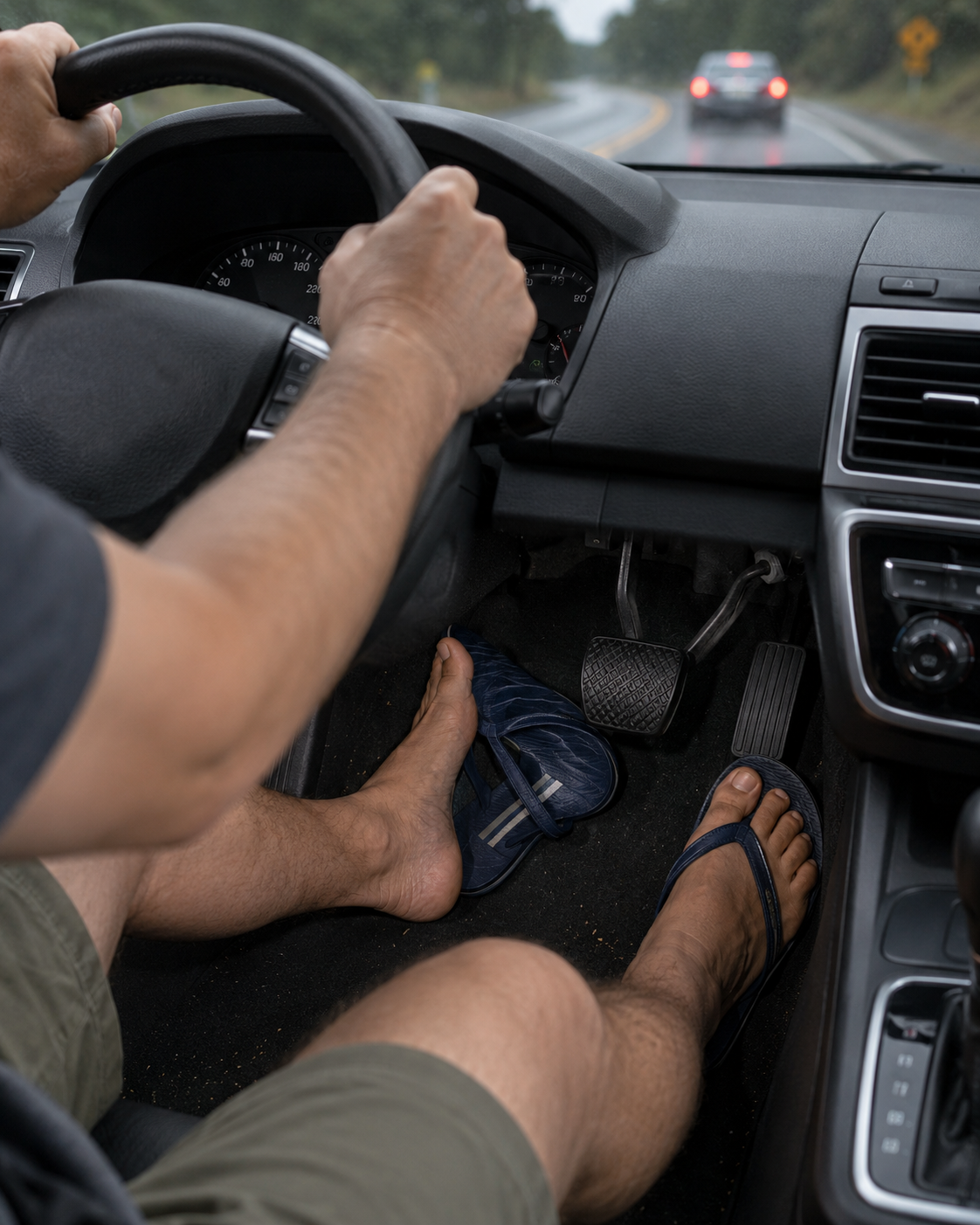
Why Driving in Slippers Can Be More Dangerous Than It Seems
Driving in slippers, slides, or flip-flops may feel harmless, but loose footwear can affect pedal control. Learn the risks, warning signs, and simple safer habits for everyday driving.
Most people think carefully about their car before driving. They check the gas tank, mirrors, seatbelt, phone charger, or GPS. But shoes? That is easy to overlook.
After all, if you are only driving a few minutes to the grocery store, school pickup line, gym, beach, or drive-thru, slippers may seem harmless. They are comfortable, quick to slip on, and part of everyday life. In warmer parts of the United States, people may spend half the year wearing flip-flops or slides without thinking twice.
The problem is that driving depends on small, precise movements. Your foot has to move smoothly between the gas pedal and brake pedal. You need to feel how much pressure you are applying. You need your shoe to stay on your foot and not slide, twist, fold, or catch on anything.
Slippers, flip-flops, slides, and loose house shoes are not designed for that job. They are designed for comfort and convenience, not pedal control.
This does not mean every person who drives in slippers will get into trouble. But it does mean loose footwear can add an avoidable risk to an activity that already requires attention.
What Makes Slippers Risky Behind the Wheel?
They Can Slip Off Your Foot
The biggest issue with many slippers is that they do not stay firmly attached to your foot.
A sneaker wraps around the heel and stays in place. A driving-friendly shoe moves with your foot. A slipper or flip-flop may shift every time you lift your foot, pivot your heel, or move from the accelerator to the brake.
That small delay may not matter while walking around the house. But while driving, timing matters. If your slipper slips halfway off as you try to brake, your foot may not land where you expect it to.
Even a brief moment of hesitation can feel scary when traffic suddenly slows down.
They Can Get Caught Under the Pedals
Loose footwear can also fall off and end up in the footwell, which is the space around the pedals.
If a slipper slides under the brake pedal, it may interfere with how far the pedal can move. If it wedges near the accelerator, it can distract the driver or make the foot movement awkward.
This kind of situation is especially stressful because it usually happens suddenly. The driver may look down, reach with their foot, or panic for a second. That divided attention is exactly what you do not want while the vehicle is moving.
A shoe that comes off your foot while driving is not just uncomfortable. It becomes a loose object in the one area where your feet need clear space.
They Reduce Pedal Feel
Driving safely is not only about pressing the right pedal. It is also about pressing it with the right amount of force.
Good driving shoes let you feel the pedals clearly. You can sense pressure, grip, and movement. Many slippers have soft, floppy, thick, or overly flexible soles. Some have smooth bottoms with very little traction.
That can make the pedals feel less predictable. Your foot may slide slightly, press unevenly, or feel less connected to the car.
This matters most during quick stops, parking, backing out of a driveway, or driving in rain, where small pedal movements can make a big difference.
They Can Make Your Foot Position Awkward
Many slippers do not support the heel. Because of that, drivers may unconsciously curl their toes to keep the slipper on.
That may sound minor, but it changes how your foot moves. Instead of naturally pivoting between gas and brake, your foot is partly focused on holding the shoe in place.
This can lead to slower reactions, less stable braking, or foot fatigue during longer drives.
A shoe should help your foot do its job, not give it an extra task.
Common Everyday Situations Where This Happens
The Quick Errand
A lot of slipper-driving happens during short trips.
You are taking out the trash and remember you need milk. You slip into slides and drive two blocks. Or you are picking up takeout and think, “It is only five minutes.”
Short trips still involve stop signs, pedestrians, parking lots, cyclists, delivery trucks, and sudden braking. In fact, parking lots and driveways can be especially tricky because there is so much close-range movement.
The length of the drive does not always match the level of attention required.
The Beach or Pool Day
Flip-flops and driving often go together in summer. People leave the beach, shake sand off their feet, and get into the car wearing wet sandals.
Wet feet plus loose shoes plus sandy pedals can be a bad combination. The slipper may slide more easily. The sole may lose grip. Sand can make the floor mat slippery or uneven.
A simple pair of dry driving shoes in the car can make beach days much safer and more comfortable.
The Morning School Run
Parents are often rushing in the morning. It is easy to drive in pajama pants, house slippers, or whatever shoes are by the door.
The school drop-off line may seem routine, but it involves children walking between cars, sudden stops, and lots of distraction. This is exactly the type of setting where full pedal control matters.
A dedicated pair of slip-on sneakers near the door can help make the habit easier.
The Driveway Move
Some people put on slippers just to move the car from the driveway to the street, garage, or parking spot.
These short movements can still involve reversing, steering in tight spaces, and braking near people, pets, walls, or other cars. Because the driver may feel “not really driving,” they may pay less attention.
It is still a moving vehicle. Your footwear still matters.
Types of Footwear That Can Cause Problems
Flip-Flops
Flip-flops are probably the most obvious risk. They are open, loose, and attached only by a small strap between the toes. They can bend, twist, slip off, or catch on the pedal.
They are great for the beach. They are not ideal for controlling a car.
Slides
Slides may feel more stable than flip-flops, but they still do not secure the heel. They can slide forward or come off when you lift your foot.
Some athletic slides also have thick soles, which may reduce pedal feel.
Soft House Slippers
House slippers are made for comfort. Many have soft soles, loose uppers, and little traction. Some are oversized or floppy.
They may feel cozy, but they can make pedal control less precise.
Backless Sandals or Mules
Any shoe without a secure back can shift while driving. Even if the shoe looks dressier than a slipper, the same problem can happen.
If your heel lifts out of the shoe when you walk, it may also lift out when you drive.
Very Thick or Platform Slippers
Some casual shoes have thick foam soles or platform bottoms. These can create distance between your foot and the pedal, making it harder to feel pressure accurately.
The shoe may be comfortable for walking, but too bulky for smooth pedal control.
Warning Signs Your Footwear Is Not Safe for Driving
You do not need a complicated test. Your body will often tell you when a shoe is not working well for driving.
Your Shoe Moves When You Lift Your Foot
If your slipper slides, flops, or separates from your heel when you move between pedals, it is not secure enough.
A driving shoe should stay with your foot.
You Have to Curl Your Toes
If you need to grip the shoe with your toes to keep it on, that is a warning sign.
Your toes should not be busy holding your footwear in place while you are trying to brake or accelerate.
Your Foot Slips on the Pedal
Smooth soles, wet shoes, or worn-out bottoms can reduce traction. If your foot slips even once, take it seriously.
That is a sign to change shoes before driving again.
The Sole Feels Too Thick or Too Soft
If you cannot clearly feel the pedal, the shoe may be too thick, squishy, or unstable.
You should be able to apply pressure smoothly and predictably.
You Feel Distracted by Your Shoes
If you notice yourself adjusting your slipper, looking down, or thinking about your shoe while driving, that is enough reason to switch footwear.
Driving already has enough distractions.
Safer Footwear Choices for Driving
Choose Shoes That Stay Secure
The best driving shoes are not necessarily fancy. A simple sneaker, flat walking shoe, or secure slip-on can work well.
Look for shoes that stay attached to your heel, do not flop, and allow your foot to move naturally.
Pick Flat Soles With Good Grip
Flat soles help you apply even pressure to the pedals. Good traction helps prevent slipping.
Avoid shoes with very slick bottoms, tall heels, thick platforms, or unstable soles when driving.
Keep a Pair of Driving Shoes in the Car
This is one of the easiest habits.
If you love wearing flip-flops, slides, heels, or slippers, you do not have to give them up completely. Just keep a pair of flat, secure shoes in the car and change before driving.
A basic pair of sneakers can stay under the passenger seat or in the trunk. Just make sure shoes are not loose in the driver’s footwell where they could roll under the pedals.
Change Shoes Before Starting the Car
Do not wait until you are already driving to decide your shoes feel awkward.
Before you start the engine, check your feet. If the shoes feel loose, slippery, or distracting, change them while parked.
It takes less than a minute and can prevent a stressful situation later.
What About Driving Barefoot?
Some people wonder whether barefoot driving is safer than driving in slippers.
The better answer is this: the safest choice is usually a secure, flat shoe with good traction. Bare feet may give more pedal feel than a loose flip-flop, but bare feet can also become sweaty, slippery, or uncomfortable. They may not provide enough protection or consistent pressure.
This article is not legal advice, and rules or interpretations can vary by place. The practical safety point is simple: choose footwear that gives you steady control of the pedals.
Simple Habits to Make Driving Safer
Check the Driver’s Footwell
Before driving, make sure there are no loose shoes, bottles, toys, bags, or floor mats near the pedals.
Even the right shoes cannot help much if something else is blocking the pedals.
Secure the Floor Mat
A floor mat that slides forward can interfere with pedal movement. Make sure it is properly placed and attached according to your vehicle’s design.
Never stack floor mats on top of each other in the driver’s area.
Avoid Changing Shoes While Driving
This may sound obvious, but some people kick off uncomfortable shoes while the car is moving.
Do not do this. Pull over safely and park first. A loose shoe near the pedals can create a new problem.
Make It a Family Rule
If you have teen drivers, this is a good habit to teach early. Many new drivers focus on mirrors, speed, and parking, but footwear is rarely discussed.
A simple rule works well: no flip-flops, slides, or loose slippers while driving.
Plan Ahead for Special Outfits
If you are going to the beach, a wedding, the gym, or a quick errand in slippers, bring driving shoes. It is much easier to make a good choice when the shoes are already in the car.
Common Mistakes to Avoid
One common mistake is assuming that comfort means safety. Slippers may feel comfortable, but comfort does not always equal control.
Another mistake is thinking, “I have driven like this before and nothing happened.” That may be true, but safe habits are not only about what happened last time. They are about reducing small risks before they turn into problems.
A third mistake is tossing kicked-off shoes into the driver’s footwell. If you change shoes, place the pair you are not wearing somewhere away from the pedals.
Finally, avoid relying on confidence alone. Even experienced drivers can be caught off guard if a shoe slips at the wrong moment.
Conclusion: A Small Change That Can Make Driving Feel Safer
Driving in slippers may seem like a tiny habit, but your feet are what control the gas and brake pedals. Loose footwear can slip off, get caught, reduce pedal feel, or distract you when you need to focus.
The good news is that this is an easy risk to reduce.
Before driving, choose shoes that stay securely on your feet, have flat soles, and provide good grip. Keep a pair of simple driving shoes in the car if you often wear flip-flops, slides, or house slippers. Check that the floor area around the pedals is clear.
You do not have to overthink it. Just treat driving shoes the same way you treat your seatbelt or mirrors: a small part of getting ready before the car moves.
A safer drive can start with something as simple as changing your shoes.