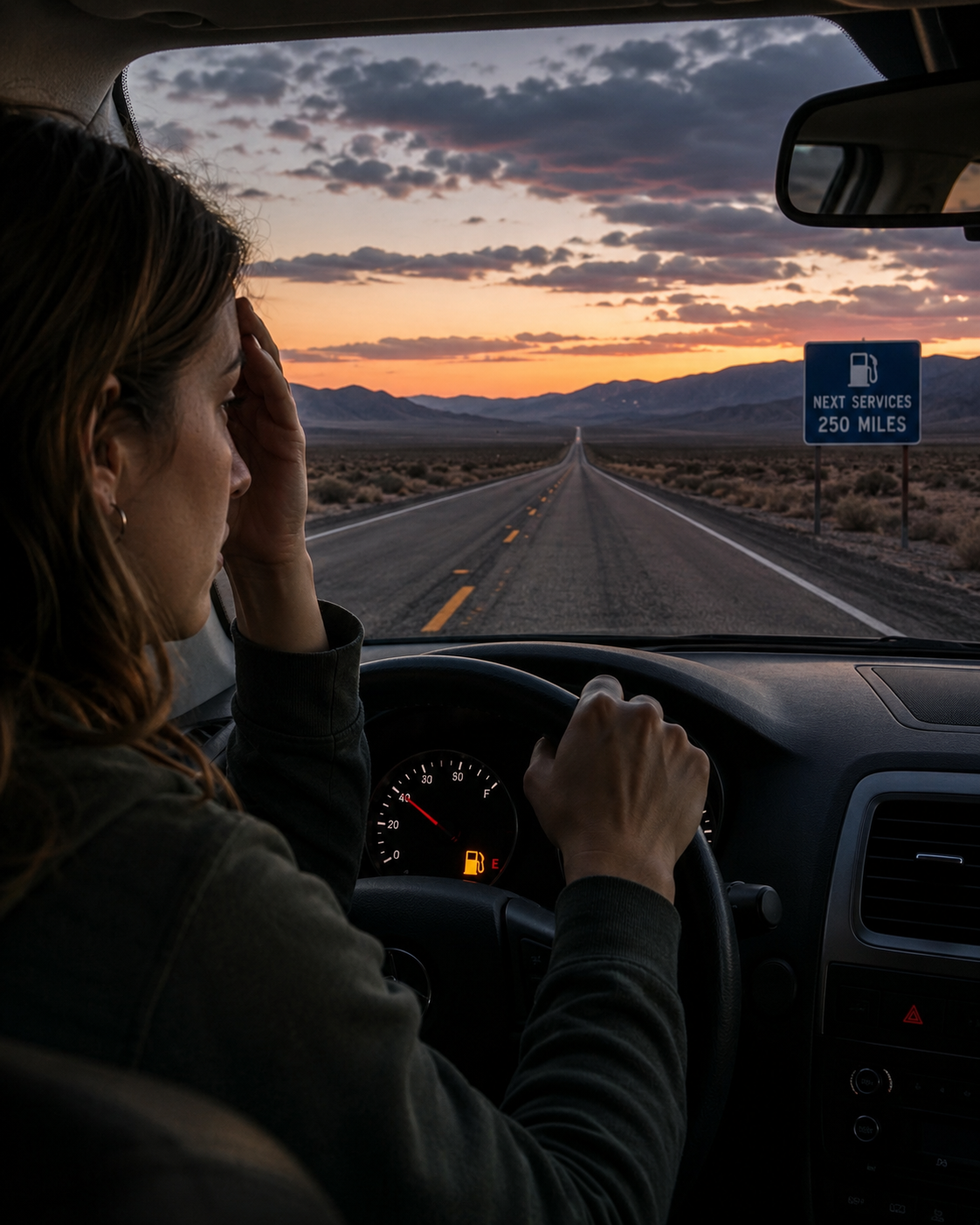
Why Delaying Gas Stops on a Long Road Trip Can Be Riskier Than You Think
Minjin Park
·
Putting off gas stops on a long road trip may seem harmless, but it can create stressful and unsafe situations. Learn simple fuel-planning habits for safer travel.
A long road trip has a way of making people optimistic.
You get on the highway, the weather looks fine, the playlist is working, and the GPS says the next gas station is only 40 miles away. So when the fuel gauge drops below a quarter tank, it is easy to think, “We can make it a little farther.”
Sometimes you can. But sometimes that small decision creates unnecessary stress.
Running low on fuel is not just inconvenient. On a long road trip, especially through rural areas, mountains, deserts, winter highways, or unfamiliar regions, delaying a gas stop can leave you with fewer options than you expected.
Gas stations may be farther apart. Some may be closed late at night. A detour may add miles. Traffic may trap you in slow movement. Bad weather may force you to use heat, defrost, or air conditioning longer than planned. Cell service may be weak. The next exit may not have the services you thought it did.
Fuel planning is not about being anxious. It is about keeping your trip flexible. A fuller tank gives you choices. An almost-empty tank takes choices away.
The Problem With Thinking “I’ll Stop at the Next One”
One of the most common road-trip mistakes is waiting for the “perfect” gas stop.
Maybe the current station looks crowded. Maybe prices seem high. Maybe everyone in the car wants to keep going. Maybe you are trying to make good time. Maybe you assume there will be another station soon.
In familiar neighborhoods, that thinking may not matter much. On a long drive, it can.
The Next Station May Not Be Open
Not every gas station is open 24 hours. This is especially true in small towns, remote highway exits, rural areas, and scenic routes.
A station may show up on your navigation app, but that does not guarantee it is currently open, staffed, or operating normally. Pumps may be closed, card readers may be down, or the station may no longer be in business.
This is especially important if you are driving late at night, early in the morning, or on holidays.
The Next Exit May Not Have Fuel
Highway signs can be helpful, but they are not a promise that every exit has gas. Some exits lead to residential areas, closed businesses, industrial roads, or long stretches before the actual town.
If your tank is already very low, discovering that the next exit has no fuel can be stressful.
Navigation Apps Are Helpful, But Not Perfect
Apps are useful for finding gas stations, prices, and distances. But they can be wrong or outdated.
A station may be listed but closed. A road may be blocked. A rural shortcut may take longer than expected. The “nearest” station may be on the other side of a divided highway or require extra turns.
Use navigation as a tool, not as your only safety plan.
Why Low Fuel Becomes More Serious Far From Home
When you are close to home, running low on gas is usually a simple problem. You know the area. You know which stations are reliable. You may have friends or family nearby.
In an unfamiliar place, it is harder to judge distance, road conditions, neighborhood layout, and service availability.
A gas station that is “only 12 miles away” may require driving through winding roads, construction, or poorly lit areas. A station in a small town may close earlier than you expect.
When you do not know the area, keeping more fuel in the tank gives you more room to make calm decisions.
Cell Service May Be Limited
Many drivers assume they can always search for a nearby gas station or call for help. But cell service can disappear in mountains, deserts, national parks, rural highways, and even some low-lying areas.
If your fuel is low and your phone has no signal, a small inconvenience can become much more stressful.
Before driving through remote regions, it is smart to check your route, fuel stops, and offline maps.
Weather Can Change the Plan
Weather affects both driving time and fuel use. Heavy rain, snow, strong wind, extreme heat, or icy roads can slow you down.
You may need to run the heater, defroster, headlights, wipers, or air conditioning longer than planned. Traffic may crawl. Roads may close. A detour may add miles.
A fuller tank gives you a buffer when weather changes the plan.
Common Road-Trip Situations Where Fuel Runs Low Fast
Running low on fuel does not always happen because someone was careless. Often, it happens because the trip changes.
Long Traffic Jams
A highway backup can turn a 30-minute stretch into two hours. You may be moving slowly, idling, stopping, starting, and using climate control the whole time.
When fuel is already low, traffic can feel much more stressful.
This is especially uncomfortable with children, older adults, pets, or passengers who need regular stops.
Mountain Roads
Mountain driving can use more fuel than flat highway driving. Climbing grades, shifting speeds, and winding roads can reduce fuel efficiency.
A distance that looks short on the map may take longer and use more fuel than expected.
Desert and Rural Highways
In some parts of the U.S., gas stations can be widely spaced. This is common in desert regions, rural western highways, remote scenic routes, and areas between small towns.
Passing a station with a quarter tank left may not seem risky until the next one is much farther away than expected.
Night Driving
At night, fewer businesses may be open. Some stations may keep the pumps on for card payment, but others may not. Lighting may be poor, and you may feel less comfortable stopping in unknown areas.
Fueling earlier in the evening, before the tank gets low, can make night driving less stressful.
Holiday and Weekend Travel
During busy travel periods, stations near major highways can be crowded. Some pumps may be out of service. Lines may be long. Traffic around exits can be slow.
If you wait until the warning light comes on, you have less flexibility to choose a better stop.
Why the Low Fuel Warning Light Should Not Be Your Plan
Many drivers treat the low fuel warning light as the real reminder to stop. But on a long road trip, waiting for the light is not a great strategy.
The warning light usually means you have some fuel left, but the exact range can vary by vehicle, driving conditions, speed, terrain, cargo weight, and weather.
“Miles to Empty” Is Only an Estimate
Many modern cars show an estimated range. This number can be helpful, but it is not guaranteed.
If you were driving efficiently on flat roads, the estimate may look generous. But if conditions change, the range can drop faster. Hills, wind, traffic, speed, and heavy loads all matter.
Do not treat the display like a promise.
The Fuel Gauge Can Move Faster Near Empty
Some drivers notice that the gauge seems to drop faster once it gets low. Whether that is due to tank shape, driving conditions, or perception, the result is the same: the last part of the tank can feel unpredictable.
It is better not to build your plan around the final few miles.
Stress Can Lead to Poor Decisions
When the warning light is on and the next station is uncertain, drivers may start making rushed choices.
They may speed up to “get there faster,” take unfamiliar exits, ignore better stopping places, or become distracted by constantly checking the gauge.
A planned fuel stop prevents that stressful spiral.
Practical Rule: Refill Before You Feel Forced To
A simple road-trip habit is to refuel when the tank reaches around one-quarter full, especially in unfamiliar or rural areas.
In remote regions, some drivers prefer refueling closer to half a tank. That may sound overly cautious in a city, but it can be very reasonable on long stretches where services are limited.
The point is not the exact number. The point is to stop while you still have choices.
Stop When the Stop Is Easy
If you see a clean, well-lit, convenient station and your tank is getting low, it is often smarter to stop than to gamble on a later option.
This is especially true if passengers also need restrooms, snacks, water, or a chance to stretch.
Combining fuel breaks with comfort breaks can keep the trip smoother.
Plan Fuel Around People, Not Just the Car
Road trips involve human needs too. Kids get restless. Older passengers may need more frequent stops. Pets need breaks. Drivers need rest.
Instead of seeing gas stops as delays, treat them as part of the rhythm of a safer trip.
A 10-minute stop can reset the car and the people inside it.
Common Mistakes Drivers Make With Fuel on Road Trips
Fuel problems often come from small assumptions.
Mistake 1: Chasing Cheaper Gas Too Long
Saving money is reasonable. Gas prices vary, and road trips can be expensive. But driving far out of your way or passing multiple stations just to save a small amount can backfire if your tank is low.
Price matters, but so does safety, convenience, and location.
Mistake 2: Ignoring Remote Stretches
Some routes have long gaps between services. This is especially true near national parks, rural highways, mountain passes, desert roads, and scenic byways.
Before entering a remote stretch, top off the tank even if it is not very low.
Mistake 3: Assuming Every Town Has Gas
Small towns do not always have full services. Some may have limited hours. Some may have only one station. Some may be several miles off the main road.
Do not assume a town name on the map means easy fuel access.
Mistake 4: Starting the Day With a Half-Empty Tank
Leaving in the morning with low fuel may seem fine if there is a station near the highway. But morning routines can get busy. You may hit traffic sooner than expected or miss the planned exit.
Starting a long driving day with a full tank is one of the simplest ways to reduce stress.
Mistake 5: Forgetting About Rental Cars
When driving a rental car, you may not know the fuel range, gauge behavior, fuel door location, or fuel type right away.
Take a minute before leaving the rental lot to understand the vehicle. Check whether it takes regular gas, diesel, or something else. Know how to open the fuel door.
Warning Signs You Should Refuel Soon
Sometimes the car and the trip give you clues that it is time to stop.
You Are Below a Quarter Tank
This is the easiest sign. If you are below a quarter tank on a long trip, start looking for a reasonable stop.
Do not wait until the last possible station.
You Are Entering a Rural or Remote Area
If signs show fewer towns ahead, or your map shows a long gap, top off before continuing.
Even if you have enough fuel in theory, a buffer is helpful.
The Weather Is Getting Worse
Rain, snow, high winds, fog, or extreme temperatures can slow travel and increase stress. Refuel before conditions become more difficult.
You Are Getting Tired
Fatigue affects judgment. A fuel stop can also be a rest stop. Stretch, use the restroom, drink water, and reset your attention.
Passengers Are Already Uncomfortable
If passengers need a break and fuel is getting low, stop once instead of pushing ahead and needing another stop soon after.
What to Do If You Realize Fuel Is Very Low
If the tank is already low, stay calm and focus on practical steps.
Reduce Unnecessary Detours
Use your navigation to find a nearby station, but avoid complicated routes if possible. Choose a reachable, straightforward option.
Drive Smoothly
Aggressive acceleration and high speeds can use more fuel. Drive steadily and calmly.
Do not make unsafe driving choices to save fuel. The goal is a controlled trip to the nearest reasonable station.
Avoid Passing a Usable Station
When fuel is very low, do not pass an open station because you prefer another brand, lower price, or cleaner restroom. Get fuel first. You can make a better stop later if needed.
If You Run Out, Prioritize Safety
If the vehicle runs out of fuel, move as far out of traffic as safely possible if you still have momentum. Turn on hazard lights. Stay aware of traffic. Call roadside assistance if you can.
Avoid walking along a highway or busy road unless there is no safer option. General safety comes first.
Simple Fuel-Planning Tips Before a Long Drive
Good fuel habits start before the trip.
Check the Route
Look at the route ahead, especially if it crosses rural areas, mountains, deserts, or long interstate stretches.
Notice where towns and services are located.
Fill Up Before Leaving
Starting with a full tank gives you flexibility. It also avoids a rushed first stop.
Keep a Basic Emergency Kit
A road-trip kit can include water, snacks, a phone charger, flashlight, reflective items, weather-appropriate clothing, and any personal essentials.
This is useful for many delays, not just fuel problems.
Use Rest Stops Strategically
Pair fuel stops with restroom breaks, stretching, snacks, and driver changes. This makes the stop feel useful rather than inconvenient.
Talk About the Plan
If you are traveling with others, let them know you plan to stop before the tank gets too low. This helps avoid pressure to “just keep going.”
Final Thoughts: A Fuller Tank Gives You More Choices
Delaying gas stops on a long road trip may feel efficient in the moment, but it can quickly reduce your options. A closed station, unexpected detour, traffic jam, storm, or remote stretch can turn a low tank into a stressful situation.
The safer habit is simple: refuel before you are forced to.
Use the quarter-tank mark as a helpful reminder, top off before remote areas, and start long driving days with plenty of fuel. Treat gas stops as part of the trip, not interruptions to it.
A road trip should feel open and flexible. Keeping enough fuel in the tank helps it stay that way.
Hi, I’m the creator and editor behind ZestyHabit. I research everyday safety, first aid, and practical wellness topics using official guidance and reliable public sources, then turn that information into clear, realistic steps for daily life.
My goal is to help readers make safer, better-informed choices at home and beyond.