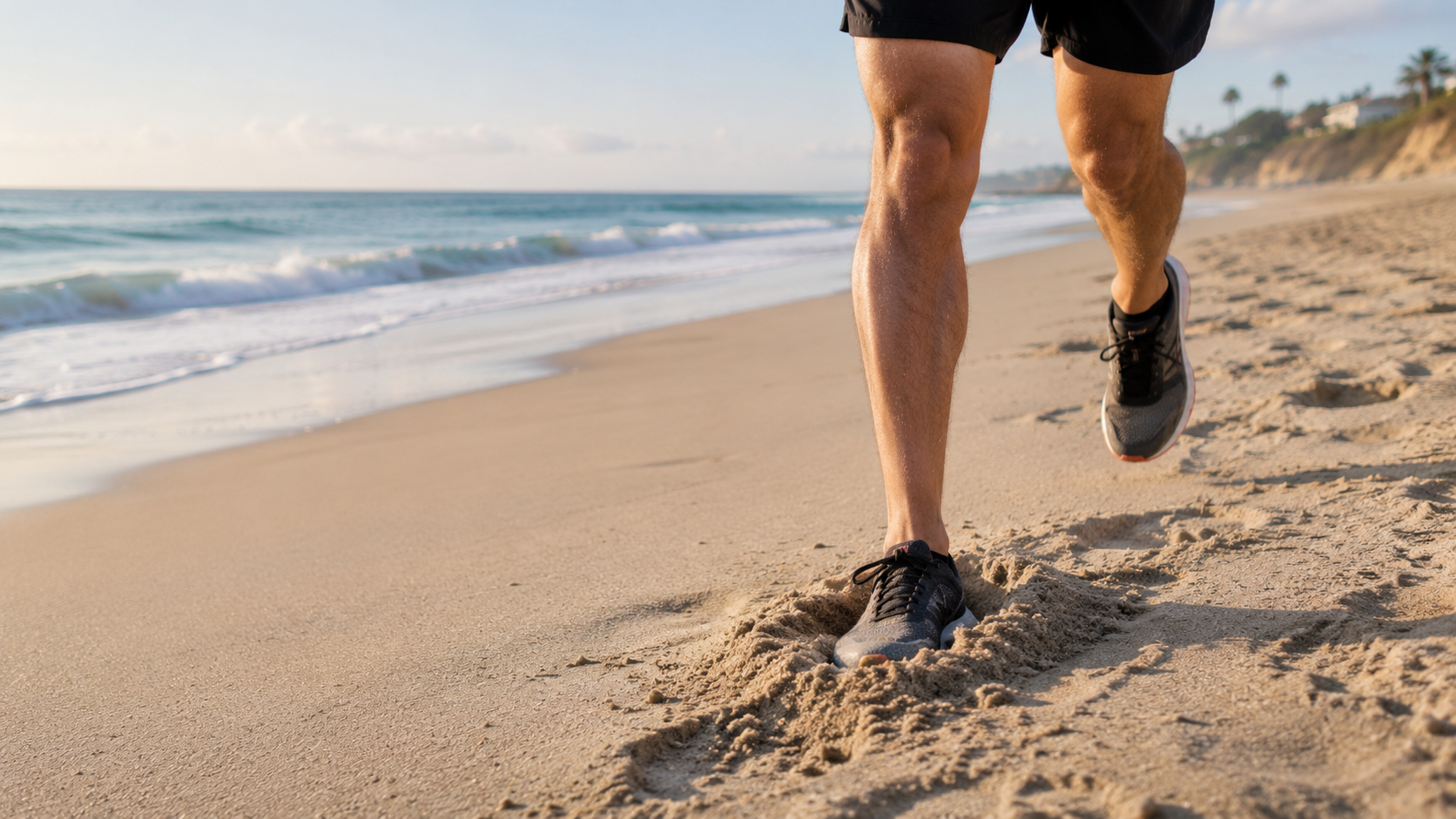
Beach Running Precautions: How Sand Can Affect Your Feet and Ankles
Minjin Park
·
Beach running looks peaceful from the outside. There is open space, fresh air, ocean sound, and a softer surface than pavement. It feels like the kind of workout that should be gentle on the body.
In some ways, it can be. Running on sand may reduce the hard impact you feel on concrete or asphalt. It can also make your feet, calves, and stabilizing muscles work in a different way. That is part of why many people enjoy it.
But beach running is not automatically easy or low-risk.
Sand changes how your feet land, how your ankles stabilize, and how much effort each step takes. Soft sand can make your muscles fatigue faster. Sloped beaches can place uneven stress on your hips, knees, ankles, and feet. Barefoot running can feel freeing, but it can also expose your skin and joints to problems you may not notice until later.
Beach running can be a great workout, but it needs a little more caution than simply taking your regular road run onto the sand.
When you run on pavement, the ground pushes back firmly against your foot. On sand, the surface shifts under you. Your foot sinks, slides, or rolls slightly with each step. Your body has to work harder to stay balanced and move forward.
This means your feet and ankles are constantly making small adjustments. Your calves, arches, toes, and lower-leg muscles also work more than usual. Even if the distance is short, the effort can feel surprisingly high.
That extra effort is not necessarily bad. It can build strength and coordination. But if your body is not used to it, it can also lead to soreness, strain, or overuse.
A beach run should not be treated exactly like a normal road run. The surface changes the workout.
Soft Sand Can Tire Your Feet Quickly
Soft, dry sand is the most demanding type of beach surface. It absorbs energy every time your foot lands. Instead of bouncing off the ground, you have to push through a shifting surface.
That makes each step harder.
Your toes may grip more. Your calves may work harder. Your arches may feel more loaded. Your ankles may wobble slightly as they try to stabilize your foot.
Because of this, soft sand can fatigue your feet faster than you expect. A run that feels short by distance may feel long by effort. If you usually run 30 minutes on the road, 30 minutes in soft sand may be too much at first.
The risk is not just feeling tired. When your feet and ankles fatigue, your form often gets sloppy. You may drag your feet, land awkwardly, or stop lifting your toes enough. That is when strains and stumbles become more likely.
For beginners, it is better to start with short intervals. Run for a few minutes, walk, then run again. Let your feet adapt gradually.
Firm Wet Sand Is Easier, But Not Perfect
Many beach runners prefer firm, wet sand near the waterline. It usually feels smoother and more stable than dry sand. Your foot does not sink as much, and your stride can feel more natural.
This is often a better place to start if you are new to beach running.
Still, wet sand has its own concerns. It may be sloped toward the water, which means one side of your body is slightly higher than the other. It may also have hidden shells, small stones, or uneven patches. Some areas can be slippery, especially where water has recently washed over the surface.
Firm sand can make you feel more confident, but it is not the same as a flat track. Pay attention to the angle of the beach and the texture of the ground.
If the wet sand is very hard and compact, it may also feel more similar to pavement than expected. In that case, the impact may not be as soft as you imagined, especially if you are running barefoot.
Watch Out for Sloped Beaches
One of the easiest beach-running problems to overlook is the slope.
Many beaches are angled toward the ocean. If you run for a long time in one direction, one foot may always land slightly lower than the other. That can create uneven stress through the ankles, calves, knees, hips, and lower back.
You may not notice it immediately. The first few minutes can feel fine. But over time, the repeated imbalance can become irritating.
To reduce this, avoid running long distances on a steeply sloped section of beach. If the beach angle is mild, try running out and back so each side of your body gets a more even load. You can also move farther from the waterline if there is a flatter area available.
If you feel one ankle, knee, or hip working harder than the other, take it seriously. That may be a sign that the slope is affecting your form.
Your Ankles Work Harder Than Usual
Beach running asks a lot from the ankles.
On sand, the foot rarely lands on a perfectly stable surface. It may sink at the heel, shift at the toes, or roll slightly inward or outward. Your ankle has to respond quickly to keep you balanced.
This can be useful training, but it can also be risky if your ankles are not prepared. People who have a history of ankle sprains should be especially careful. Sand can expose weakness or instability that does not show up as much on flat roads.
A smart approach is to build ankle strength before increasing beach running distance. Simple exercises like single-leg balance, calf raises, slow heel drops, and controlled side steps can help prepare the lower legs.
During your run, avoid sudden direction changes in soft sand. Sharp turns can place extra stress on the ankle because the foot may get stuck while the body rotates. If you need to turn around, slow down first.
Barefoot Beach Running Is Not for Everyone
Running barefoot on the beach sounds natural and comfortable. For some people, short barefoot runs can feel great. The sand under your feet, the open air, and the lack of shoes can make the run feel refreshing.
But barefoot running changes how your body absorbs impact.
Without shoes, your feet, calves, Achilles tendons, and arches may work much harder. If you are used to supportive running shoes, suddenly running barefoot can overload tissues that are not ready for that much work.
Barefoot running also exposes your feet to cuts, burns, shells, rocks, glass, fishing hooks, rough sand, and hot surfaces. Even small injuries can become annoying when sand gets into them.
If you want to try barefoot beach running, start very small. Think minutes, not miles. Walk first. Jog lightly. Notice how your feet and calves feel during the run and the next day.
Do not assume that barefoot is automatically better. It is simply different.
Shoes May Still Be the Better Choice
Many runners are better off wearing shoes on the beach, especially at first. Shoes can protect your feet from sharp objects, hot sand, and rough surfaces. They can also provide familiar support while your body adjusts to the unstable ground.
The best shoe depends on the beach. For packed wet sand, regular running shoes may work well enough. For trails near the beach, uneven dunes, or mixed surfaces, lightweight trail shoes may offer better grip.
The downside is that shoes can collect sand and water. Wet shoes may rub and cause blisters. Sand inside the shoe can irritate the skin quickly.
To reduce rubbing, wear moisture-wicking socks and make sure your shoes fit securely. After the run, remove sand from your shoes and socks as soon as possible. Do not ignore small hot spots on your feet. They can turn into blisters quickly.
Foot Fatigue Can Sneak Up on You
Beach running often feels fun at the beginning. The scenery distracts you, the ocean breeze feels good, and the soft surface may make you feel lighter.
Then, halfway through, your feet suddenly feel heavy.
This happens because sand demands constant stabilizing work. Your smaller foot muscles may fatigue before your lungs or legs feel fully tired. When that happens, your stride may change without you realizing it.
Signs of foot fatigue include:
Toes gripping the sand too hard
Arches feeling tight or achy
Calves burning earlier than usual
Ankles feeling wobbly
Feet dragging during each step
A sudden drop in coordination
When these signs show up, slow down or walk. There is no benefit in forcing tired feet to keep running on an unstable surface. That is when injury risk goes up.
Be Careful With Your Achilles and Calves
Sand can place extra demand on the calves and Achilles tendons. This is especially true in soft sand or barefoot running.
When your foot sinks into the sand, your calf has to work harder to push you forward. If you are running barefoot, your calf and Achilles may also take more load than they usually do in cushioned shoes.
This can lead to tightness or soreness after the run. In some cases, doing too much too soon can irritate the Achilles tendon.
If you already have calf tightness, Achilles discomfort, or plantar fascia issues, keep beach running short and conservative. Warm up first. Avoid sprinting in soft sand. Do not suddenly replace all your normal runs with beach runs.
A little sand running can be useful. Too much too quickly can become a problem.
Start With Time, Not Distance
Beach running is better measured by time and effort than distance.
A two-mile beach run may feel much harder than a two-mile road run. Soft sand, wind, heat, and slope can all increase effort. Trying to match your normal road pace or mileage can lead you to overdo it.
For your first few beach runs, try short sessions. For example, jog for 10 to 15 minutes on firm sand and see how your body feels. Another option is to alternate one minute of running with one or two minutes of walking.
Once your feet and ankles adapt, you can gradually increase the duration.
The next-day test matters. If your feet, calves, or ankles feel unusually sore the following day, your body may need more time before increasing distance.
Start with a few minutes of walking on the sand. Let your feet adjust to the surface. Then add gentle movements like ankle circles, calf raises, leg swings, and easy marching.
If you plan to run barefoot, spend extra time walking first. Your feet need a chance to sense the surface and adjust.
Avoid starting with fast running, sprints, or deep soft sand right away. That is a lot to ask from cold muscles and tendons.
A beach warm-up does not need to be complicated. It just needs to wake up the lower body before the run becomes demanding.
Avoid Sprinting Too Soon
Sprinting on sand is popular for athletes because it is intense. But that does not mean it is a good starting point for casual runners.
Sand sprints place heavy demands on the calves, hamstrings, feet, and ankles. Soft sand makes the push-off harder. If your muscles are not ready, sprinting can cause strains or sharp soreness.
If you want to include faster running, build up gradually. Start with short, relaxed pickups on firmer sand. Keep the effort controlled. Avoid all-out sprints until your body is used to the surface.
Also avoid sprinting barefoot unless you have already built up to it carefully. The combination of high speed, unstable ground, and no shoe support can be rough on the lower legs.
Sun Exposure Is Part of Beach Safety
Beach running is not only about sand. The sun can affect your run just as much as the surface.
Beaches often have little shade. Sunlight reflects off water and sand, and the breeze can make you underestimate how hot you are getting. You may feel cooler than you actually are.
Use sunscreen before running, especially on exposed areas like your face, neck, shoulders, arms, ears, and the tops of your feet if you are barefoot or wearing open footwear before and after the run. A hat and sunglasses can also help.
Try to avoid the strongest midday sun when possible. Morning or late afternoon runs are usually more comfortable.
Hydration matters too. Even a short beach run can feel draining in heat, humidity, or wind. Bring water if you will be out for more than a short session.
Check the Sand Temperature
Hot sand can burn your feet. This is easy to forget until you step onto it barefoot.
If the beach has been sitting under strong sun, test the sand before running without shoes. If you cannot comfortably stand or walk on it, do not run barefoot.
Even with shoes, heat can make the run more tiring. Your body works harder to cool itself, and the beach may offer little shade.
When in doubt, choose cooler parts of the day. Your feet and energy levels will thank you.
Pay Attention to Hidden Objects
Sand can hide things. Shells, rocks, sticks, broken glass, bottle caps, and fishing gear may not be visible until you are right on top of them.
Choose cleaner, well-maintained areas for running. Avoid running near crowded party areas, fishing spots, rocky sections, or places with a lot of debris.
Look ahead as you run. Just like trail running, beach running requires scanning the ground instead of zoning out completely.
Be Careful Near the Waterline
Running near the water can feel refreshing, but the waterline changes constantly. A wave may suddenly cover your path. The sand may become softer or more slippery than it looks. Small dips and ridges can form where the water pulls back.
Do not run so close to the water that you are constantly dodging waves. Sudden side steps can strain your ankles or knees, especially on wet sand.
Also be cautious with tide changes. A wide running area can become narrow later. If you are running somewhere unfamiliar, check the tide or at least pay attention to how much space you have to return.
Cool Down and Care for Your Feet Afterward
After beach running, your feet may need a little extra attention.
Walk for a few minutes to cool down. Rinse sand and saltwater from your feet. Dry between your toes. Check for small cuts, blisters, redness, or irritated areas.
If you ran barefoot, inspect the soles of your feet carefully. Tiny cuts may not hurt much at first but can become uncomfortable later.
Gentle calf stretching may help if your lower legs feel tight. Avoid aggressive stretching if something feels sharp or strained.
If your feet or ankles feel unusually sore, take a break from sand running and return to easier surfaces until things settle.
Final Thoughts
Beach running can be refreshing, challenging, and fun. The scenery is beautiful, the surface is different, and the workout can make you feel more connected to your body.
But sand changes everything.
Soft sand can tire your feet quickly. Sloped beaches can create uneven stress. Barefoot running can increase demand on your calves, arches, and ankles. Sun, heat, hidden objects, and changing waterlines add extra things to watch.
The safest approach is to start small, choose firmer sand when you are new, protect your feet when needed, and let your body adapt gradually. Pay attention to how your feet and ankles feel during the run and afterward.
Beach running does not need to be avoided. It just needs to be respected. With the right precautions, it can become a satisfying part of your fitness routine without leaving your feet and ankles paying the price.
Hi, I’m the creator and editor behind ZestyHabit. I research everyday safety, first aid, and practical wellness topics using official guidance and reliable public sources, then turn that information into clear, realistic steps for daily life.
My goal is to help readers make safer, better-informed choices at home and beyond.