Growth Plate Injuries in Children: Warning Signs, First Aid, Treatment, and Prevention
Minjin Park
·
A child falls from the monkey bars, collides with another player, or twists an ankle while running. At first, the injury may look like an ordinary bruise or sprain. The child might even be able to move the affected arm or leg. However, injuries that seem minor can sometimes damage a growth plate—an area of developing tissue that plays an important role in determining the length and shape of a child’s bones.
Growth plate injuries require particular attention because children’s bones are still developing. Although most injuries heal well with prompt diagnosis and appropriate treatment, an untreated or severe injury can occasionally interfere with normal bone growth.
Parents do not need to panic after every playground fall. They should, however, know which symptoms deserve medical evaluation and why persistent pain near a joint should never be dismissed simply because the child can still move.
Growth plates, medically called physes, are sections of cartilage located near the ends of many long bones. They are found in areas such as the wrists, arms, fingers, legs, ankles, and feet.
As a child grows, these plates produce new bone tissue. Eventually, once physical growth is complete, the cartilage hardens and becomes mature bone. Until that process is finished, the growth plate remains softer and more vulnerable to injury than the surrounding adult-like bone.
A fracture that reaches or passes through this area is called a growth plate fracture or physeal fracture. These injuries occur only in growing children and adolescents because adults no longer have open growth plates.
Growth plates may be injured by a sudden accident, such as a fall, or by repetitive stress that builds up over time. According to the National Institute of Arthritis and Musculoskeletal and Skin Diseases, early diagnosis is important even when the initial injury is not clearly visible on an X-ray.
Common Accidents That Cause Growth Plate Injuries
Almost any activity involving a fall, forceful twist, direct impact, or crushing pressure can damage a growth plate. Some of the most common situations include:
Falling from playground equipment, stairs, bicycles, or skateboards
Landing awkwardly after a jump
Colliding with another child during sports
Twisting an ankle or wrist during running or play
Being struck by a ball or piece of sports equipment
Repetitive throwing, running, jumping, or gymnastics training
Increasing sports intensity too quickly
Training in the same sport throughout the year without adequate rest
Contact sports are not the only concern. Basketball, gymnastics, skiing, volleyball, baseball, and distance running can all place repeated stress on developing bones. Overuse injuries may develop gradually, without one dramatic accident that parents or coaches can identify.
A child who repeatedly complains about pain in the same location should not be encouraged to “push through it.” Pain is often the body’s first warning that training load, technique, or recovery needs attention.
Symptoms Parents Should Not Ignore
Growth plate injuries do not always produce a dramatic deformity. In some cases, swelling is mild and the child can still move the limb. The most reliable clue may be persistent, localized pain near the end of a bone or close to a joint.
Difficulty moving the arm, wrist, hand, leg, or ankle
Limping or refusing to put weight on one leg
Holding an arm close to the body
Pain when pressure is placed on the injured area
Reduced performance or pain during sports
A limb or joint that looks bent, crooked, or out of position
Younger children may not be able to explain where or how much they hurt. Instead, they may cry when the area is touched, avoid using one hand, crawl differently, or suddenly refuse to walk.
The American Academy of Orthopaedic Surgeons advises that persistent pain, deformity, inability to use the limb, limping, swelling, warmth, and tenderness near the end of a bone are all reasons to suspect a growth plate fracture.
What to Do Immediately After the Accident
If you think a child may have a fracture, stop the activity and keep the injured area as still as possible. Do not ask the child to “test it” repeatedly by walking, jumping, twisting the joint, or throwing a ball.
Take the following steps:
Support the injured limb. Keep it in the position in which you found it. A folded towel, pillow, sling, or piece of clothing can provide gentle support.
Do not straighten it. Never try to push a crooked arm or leg back into place. Unnecessary movement can worsen pain and damage nearby tissue.
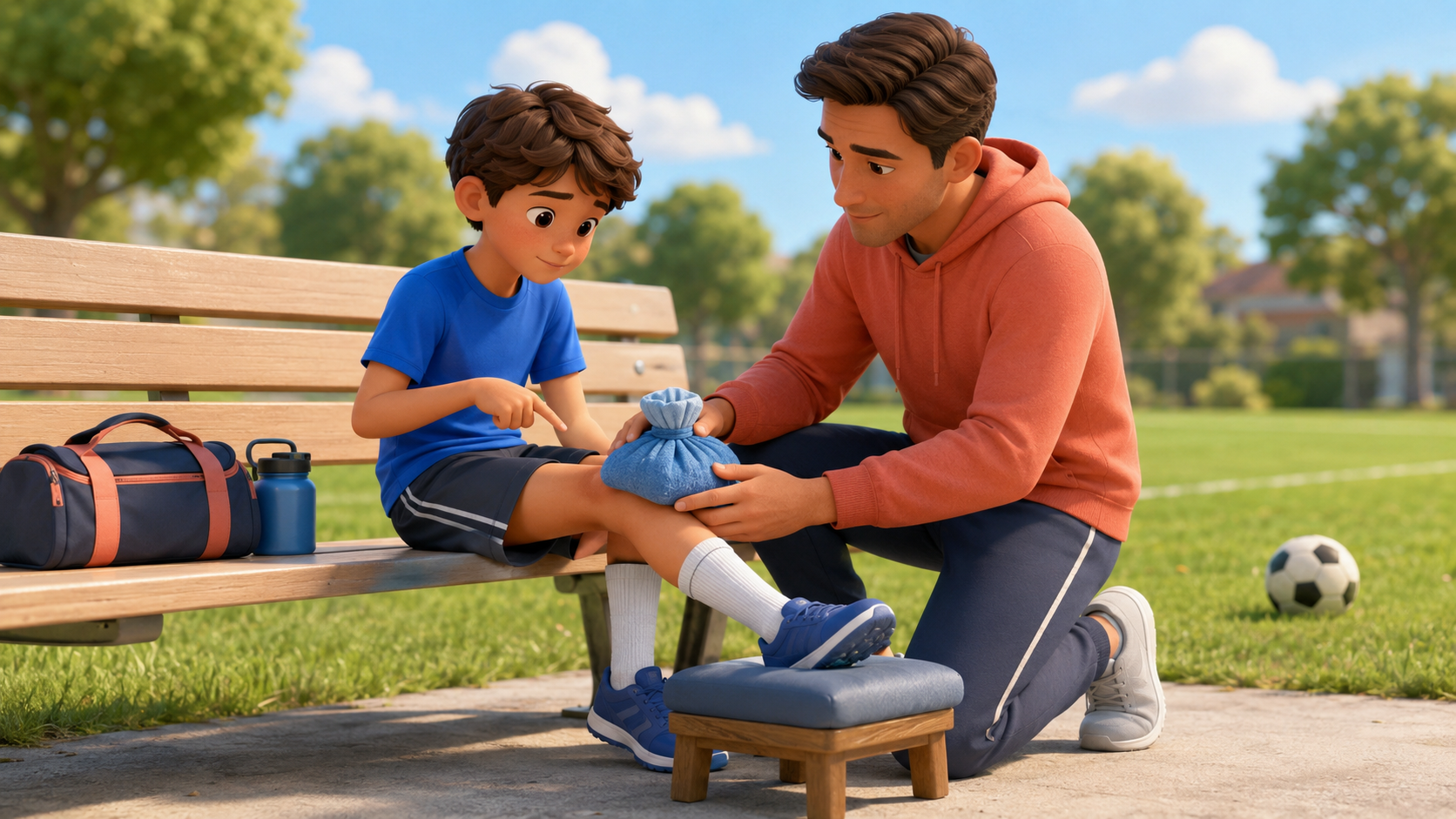
Apply a wrapped cold pack. Place a cold pack or ice wrapped in cloth over the area to help control pain and swelling. Never place ice directly on the skin.
Remove tight items when appropriate. If a hand or wrist is injured, gently remove rings, watches, or bracelets before swelling increases—unless doing so requires moving the injured area excessively.
Arrange medical evaluation. Contact the child’s pediatrician, an urgent care clinic, or an emergency department depending on the severity of the injury.
These steps are consistent with general fracture first aid from the Mayo Clinic, which recommends limiting movement and using a wrapped ice pack rather than placing ice directly on the skin.
When Is It an Emergency?
Call 911 or seek emergency treatment immediately if:
A bone is visible through the skin
There is heavy bleeding
The limb is severely bent or deformed
The child has intense or rapidly worsening pain
Fingers or toes become pale, blue, cold, numb, or difficult to move
The accident involved a vehicle, a major fall, or significant crushing force
You suspect injuries to the head, neck, back, pelvis, or thigh
The child appears faint, confused, unusually sleepy, or has trouble breathing
If there is an open wound, cover it gently with clean gauze or cloth. Do not push exposed bone back under the skin and do not apply pressure directly over a protruding bone.
Why a Normal X-Ray May Not Rule Out an Injury
Growth plates are made of cartilage rather than mature bone. Because cartilage does not appear on an X-ray as clearly as bone, an early growth plate injury may be difficult to see. On an X-ray, the plate may look like a normal gap near the end of the bone.
Doctors therefore consider more than the image. They examine the exact location of tenderness, swelling, range of motion, and the way the accident happened. They may compare the injured limb with the uninjured side.
If symptoms strongly suggest a growth plate injury despite an inconclusive X-ray, the doctor may recommend immobilization, repeat X-rays, or additional imaging. MRI, CT, or ultrasound may be used in selected cases, as explained by the NIAMS growth plate injury guide.
This is why a child with persistent pain should be re-evaluated even after an initial X-ray appears normal.
Understanding the Salter-Harris Classification
Doctors commonly classify growth plate fractures using the Salter-Harris system. It describes which parts of the growth plate and surrounding bone are involved.
Type I: The fracture passes through the growth plate.
Type II: It crosses the growth plate and extends into the bone shaft. This is the most common type.
Type III: It crosses the growth plate and enters the end of the bone near the joint.
Type IV: It passes through the shaft, growth plate, and end of the bone.
Type V: The growth plate is damaged by a crushing force.
Parents do not need to memorize these categories. The important point is that the fracture’s location, alignment, severity, and effect on the joint help determine treatment and the likelihood of future growth problems.
How Growth Plate Injuries Are Treated
Treatment depends on the child’s age, the injured bone, the fracture pattern, and whether the bone remains properly aligned.
A mild, stable injury may be treated with a splint, brace, or cast. Immobilization protects the area while it heals and prevents the child from accidentally worsening the injury.
If the bone has shifted, the doctor may perform a closed reduction, which means carefully moving the bone back into its correct position without making a surgical incision. More complex fractures may require surgery to restore alignment. Pins, screws, or other fixation devices may occasionally be used.
Many growth plate fractures heal within several weeks, but recovery time varies. A child’s pain may improve before the bone is strong enough for running, jumping, or contact sports. Follow the treating clinician’s return-to-activity instructions rather than relying only on how the child feels.
Johns Hopkins Medicine notes that fractures requiring reduction usually need closer orthopedic follow-up, including monitoring after healing to confirm that the bone continues growing normally.
Can a Growth Plate Injury Stop Bone Growth?
Most children recover without lasting problems, especially when the injury is recognized and treated promptly. Still, some severe injuries can cause part or all of a growth plate to close too early.
If the entire plate stops growing, the affected bone may become shorter than the matching bone on the other side. If only one section stops growing, the bone may gradually become angled or curved. Injuries involving a joint may also affect joint alignment and movement.
The risk depends on several factors, including:
Which growth plate was injured
How severe the damage was
Whether the fracture was displaced
How much growth the child has remaining
Whether normal alignment was restored
Whether an infection or repeated injury occurred
Growth disturbances may not be obvious immediately. They can appear months after the original pain has disappeared, which is why follow-up appointments matter. The Children’s Hospital of Philadelphia recommends follow-up care after growth plate injuries so clinicians can verify healing and identify developing problems.
Preventing Growth Plate Injuries
No parent can prevent every childhood fall, and healthy physical activity should not be discouraged. The goal is to reduce avoidable risks while allowing children to move, play, and build confidence.
Helpful precautions include:
Choose sports equipment that fits the child properly.
Make sure helmets, wrist guards, pads, and protective footwear are worn correctly.
Inspect playgrounds for damaged surfaces or unsafe equipment.
Teach children to follow traffic and bicycle safety rules.
Increase training duration and intensity gradually.
Avoid year-round specialization in one sport at a young age.
Encourage children to report pain early.
Do not let an injured child return to play simply because an important game is approaching.
Work with qualified coaches who understand age-appropriate training.
Replace worn-out shoes and damaged protective gear.
Rest is not laziness. For a growing athlete, recovery is part of training. Persistent pain, changes in technique, limping, or declining performance should be treated as useful warning signs rather than inconveniences.
Returning to Sports Safely
A child should return to sports only after receiving appropriate medical clearance. Depending on the injury, the child may need to regain pain-free movement, strength, balance, and sport-specific skills.
Returning too early increases the risk of another accident, especially if the child is protecting one side of the body or moving differently because of weakness. Even after the cast comes off, stiffness and muscle loss are common. Some children benefit from physical therapy or a gradual return-to-play plan.
Growth plate injuries can look deceptively minor, but timely attention usually leads to excellent recovery. Has your child ever experienced persistent pain after a fall or sports accident, and which warning sign was hardest to recognize? Share your experience or questions in the comments—your story may help another parent know when it is time to seek care.
Hi, I’m the creator and editor behind ZestyHabit. I research everyday safety, first aid, and practical wellness topics using official guidance and reliable public sources, then turn that information into clear, realistic steps for daily life.
My goal is to help readers make safer, better-informed choices at home and beyond.