Home Safety Accidents Involving Babies and Toddlers: A Practical Prevention Guide for Parents
Minjin Park
·
Learn how to prevent common home accidents involving babies and toddlers, including falls, choking, poisoning, burns, drowning, suffocation, and furniture tip-overs.
Home is supposed to be the safest place for a young child. Yet for babies and toddlers, ordinary household items can quickly become serious hazards. A warm cup of coffee, an unlocked bathroom door, a loose button battery, or a chair placed near a window may not look dangerous to an adult. To a curious child who is learning to crawl, climb, reach, and explore, however, each one can create an opportunity for injury.
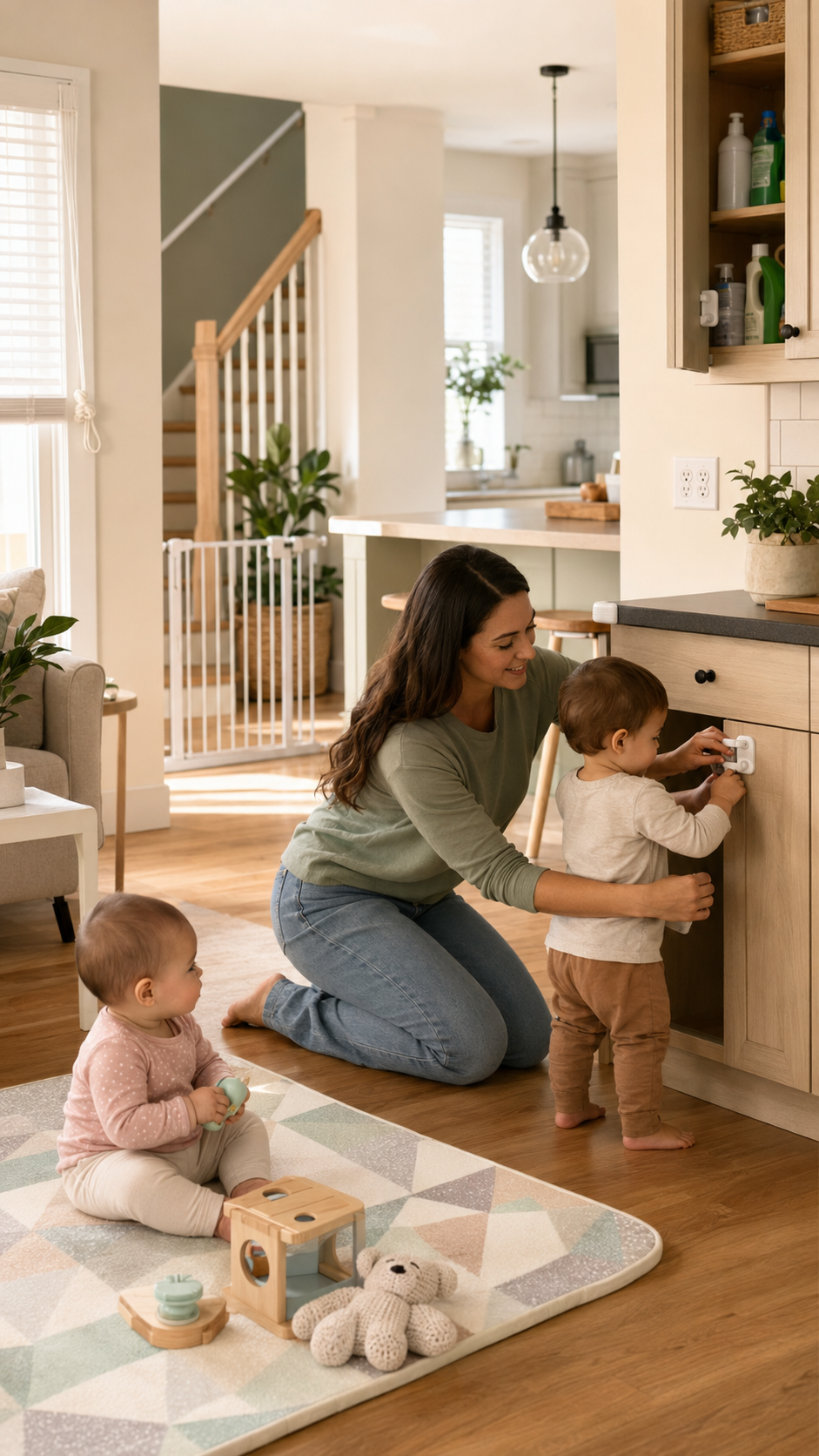
This does not mean parents need to live in constant fear. Most household injuries can be prevented through a combination of supervision, thoughtful childproofing, and routines that make safe behavior automatic. The key is to view the home from a child’s height and update safety measures as the child develops.
Why Babies and Toddlers Are Vulnerable to Home Accidents
Young children do not understand danger in the same way adults do. A toddler may recognize that a stove feels hot but not understand that pulling a pan handle could spill boiling liquid. A crawling baby may put a small object into their mouth because mouthing is a natural part of development.
Their physical abilities also change rapidly. A baby who could not roll over last week may suddenly reach the edge of a bed. A toddler who has never climbed may discover how to scale a dresser using open drawers. Childproofing should therefore be treated as an ongoing process rather than a one-time project.
Supervision remains important, but no caregiver can maintain uninterrupted eye contact every second. Effective home safety uses layers of protection so that one brief distraction does not immediately become an emergency.
1. Unsafe Sleep and Accidental Suffocation
A baby’s sleep area should be simple, firm, flat, and free of unnecessary objects. Decorative pillows and soft blankets may make a nursery look cozy, but they can obstruct an infant’s breathing.
The CDC recommends placing babies on their backs for every sleep, including naps. Babies should sleep on a firm, flat mattress in a safety-approved crib, bassinet, or play yard, covered only with a fitted sheet. Pillows, loose blankets, stuffed animals, bumper pads, and other soft items should remain outside the sleep space. Room-sharing is recommended, but the baby should have a separate sleeping surface rather than sharing an adult bed. CDC safe sleep guidance
Sofas, recliners, adult beds, nursing pillows, and infant loungers are not safe substitutes for an approved sleep space. If a baby falls asleep in a car seat, swing, or stroller outside of travel, move the baby to a proper sleep surface as soon as it is safe to do so.
Keep baby-monitor wires, charging cables, and lamp cords well beyond the crib. As babies become mobile, they may reach farther than parents expect.
2. Falls From Furniture, Stairs, and Windows
Falls are among the most frequent household accidents involving young children. They can happen from changing tables, beds, high chairs, sofas, stairs, balconies, and open windows.
Never leave a baby alone on a raised surface, even before the baby has started rolling regularly. When using a high chair, stroller, or changing station with a safety strap, fasten it correctly every time. Keeping one hand on a baby during diaper changes is a useful habit, but preparing diapers, wipes, and clothing beforehand is even safer.
Install safety gates near stairs and check them frequently. Gates must be appropriate for their location and installed according to the manufacturer’s directions. At the top of a staircase, a properly secured hardware-mounted gate is generally preferable because a loose or pressure-mounted barrier may be pushed out of position.
Windows deserve special attention. Insect screens are designed to keep insects outside; they are not strong enough to stop a child from falling. The CPSC recommends window guards or safety netting and limiting accessible window openings to four inches or less. Any guard used on a potential fire-escape window must also allow an adult to open it quickly during an emergency. CPSC window safety guidance
Move beds, toy boxes, chairs, and other climbable furniture away from windows and balcony railings.
3. Furniture and Television Tip-Overs
A dresser may appear stable until a toddler opens several drawers and uses them as steps. The child’s weight changes the furniture’s center of gravity, causing the entire unit—and anything placed on it—to fall forward.
Secure dressers, bookcases, cabinets, televisions, and other heavy furniture to the wall with suitable anti-tip hardware. Do not rely on an item’s weight or assume that low furniture cannot tip. Place televisions on sturdy, low stands designed to support them, and anchor the television as recommended by its manufacturer.
Avoid placing toys, remote controls, snacks, or other attractive objects on top of furniture. These items may encourage climbing. Drawer locks can provide an additional barrier, but they do not replace proper anchoring.
Parents should also check anti-tip straps after moving furniture, remodeling a room, or relocating to a new home.
4. Choking on Food and Small Objects
Babies and toddlers explore with their mouths, and their airways are small. Coins, toy parts, pen caps, balloons, magnets, screws, jewelry, and pieces from an older sibling’s toys can all become choking hazards.
Get down on the floor and inspect the room from a child’s perspective. Look under sofas, cabinets, tables, and cushions. Vacuuming regularly helps, but a deliberate visual check is still necessary.
Food is another major concern. Young children should sit upright and remain supervised while eating. Avoid letting them run, play, recline, or ride in a moving vehicle with food in their mouths. Prepare foods according to the child’s developmental abilities. Whole grapes and cherry tomatoes should be cut lengthwise into small pieces, while hot dogs should be sliced lengthwise and then cut into smaller sections. Hard candy, popcorn, whole nuts, spoonfuls of nut butter, and chunks of raw vegetables may be unsafe for very young children.
Always follow age labels on toys, particularly when younger children share a home with older siblings. The CPSC prohibits small parts in products intended for children under three when those parts create choking or ingestion hazards. CPSC small-parts guidance
Parents, grandparents, and regular caregivers should consider taking an age-appropriate CPR and choking first-aid course. Infant choking care differs from care for a child over one year old, so hands-on training is far better than trying to remember an online video during an emergency.
5. Button Batteries and High-Powered Magnets
Button batteries can be found in remote controls, key fobs, watches, thermometers, hearing aids, flameless candles, toys, and greeting cards. If swallowed, a battery can become lodged in a child’s esophagus and cause severe internal burns. A child may initially have few obvious symptoms, so a missing battery should always be taken seriously.
Choose products with battery compartments that require a tool to open. Store new and used batteries in locked storage, and do not leave depleted batteries on a counter while waiting to recycle them. Tape alone should not be treated as child-resistant storage.
If you suspect that a child swallowed a button battery, seek emergency medical assistance immediately. Do not make the child vomit, and do not delay care while waiting for symptoms. The CPSC provides specific interim instructions, including limited honey use for certain children aged 12 months or older, but these instructions never replace immediate emergency evaluation. CPSC button-battery guidance
Multiple high-powered magnets are also dangerous if swallowed because they can attract each other through intestinal tissue. Keep magnet sets and damaged magnetic toys away from young children.
6. Accidental Poisoning
Medicines, vitamins, cleaning products, laundry pods, cosmetics, nicotine products, alcohol, cannabis products, pesticides, essential oils, and automotive fluids should be locked away—not simply placed on a high shelf.
Toddlers can climb, and child-resistant packaging is not childproof. Return every medicine to locked storage immediately after use, even if the next dose will be needed soon. Keep products in their original containers so that labels and ingredients remain available during an emergency.
Never describe medicine as candy. Avoid taking pills in front of a young child when possible, since children naturally imitate adults. Visitors’ handbags, suitcases, and coat pockets may also contain medication and should be stored out of reach.
In the United States, contact Poison Control at 1-800-222-1222 or use its online tool if a child may have swallowed or been exposed to a harmful substance. Help is free and available around the clock. If the child collapses, has a seizure, cannot breathe normally, or cannot be awakened, call 911 immediately. Poison Control emergency guidance
Do not induce vomiting or give a home remedy unless a medical professional or poison specialist specifically tells you to do so.
7. Burns and Scalds
Hot liquids are especially dangerous because they can be pulled or knocked onto a child in seconds. Keep mugs, kettles, pots, slow cookers, and their cords away from counter edges. Turn pan handles toward the back of the stove, and use rear burners whenever practical.
Avoid holding a baby while cooking or carrying hot food. A child can suddenly grab a handle, kick, or cause an adult to lose balance. Tablecloths and hanging placemats can also allow a toddler to pull hot dishes from a table.
Set the home’s water heater to approximately 120°F, or 49°C, to reduce the risk of severe tap-water scalds. The CPSC notes that children under five are among the groups most frequently harmed by these burns. CPSC tap-water scald guidance
Test bathwater before putting a child into the tub, and keep the child away from the faucet. Unplug hair straighteners, curling irons, space heaters, and similar appliances after use, then place them somewhere inaccessible while they cool.
8. Drowning in Bathtubs and Other Household Water
A swimming pool is not the only drowning hazard. Bathtubs, toilets, buckets, inflatable pools, fountains, and containers filled with rainwater can all be dangerous to small children.
Stay within arm’s reach of a baby or toddler in the bath. Do not leave to answer the phone, open the door, or retrieve a towel. If you must leave, take the child with you. Bath seats and nonslip mats may be useful accessories, but they are not substitutes for adult supervision.
Empty buckets, tubs, and wading pools immediately after use and store them where they cannot collect water. Keep bathroom doors closed and consider toilet-lid locks if a young child can access the bathroom.
When several adults are present, do not assume someone else is watching. Designate one responsible adult to provide active supervision. Drowning may be quiet and difficult to notice, so supervision should be close, attentive, and free from phone use or other distractions. CDC drowning prevention information
9. Strangulation, Entrapment, and Electrical Hazards
Keep necklaces, drawstrings, pacifier cords, and bags with long straps away from cribs and play areas. Never attach a pacifier to a child using a ribbon or string around the neck.
Use outlet covers that cannot easily be removed and replace broken outlet plates. Hide or secure power strips and keep electrical appliances away from water. Inspect toys and chargers for damaged wires.
Young children may also crawl inside appliances, coolers, or storage containers. Keep front-loading washers and dryers closed and locked when possible, and check appliances before starting them.
Build Safety Into the Family’s Daily Routine
The safest home is not necessarily the one with the most childproofing products. It is the one where adults use protective measures consistently.
Perform a brief safety check whenever a child reaches a new developmental stage. Repeat the check after visitors leave, furniture is moved, groceries are unpacked, or older children bring home new toys. Review product recalls through the CPSC website and register major nursery products so manufacturers can contact you about safety notices.
Make sure every caregiver follows the same rules. Grandparents and babysitters should know the child’s sleep routine, food restrictions, medication risks, and emergency contacts. Post essential phone numbers where they can be found quickly, keep a first-aid kit available, and ensure that smoke and carbon-monoxide alarms work properly.
No family can prevent every scraped knee or minor bump, and perfection is not the goal. The goal is to remove hazards that could cause life-threatening or permanent injury while allowing children to explore in a safer environment. Which area of your home do you think needs the most attention after reading this guide? Share your experience or favorite childproofing tip in the comments—it may help another parent protect their little one.
Hi, I’m the creator and editor behind ZestyHabit. I research everyday safety, first aid, and practical wellness topics using official guidance and reliable public sources, then turn that information into clear, realistic steps for daily life.
My goal is to help readers make safer, better-informed choices at home and beyond.



[…] accident involved a vehicle, a major fall, or significant crushing […]