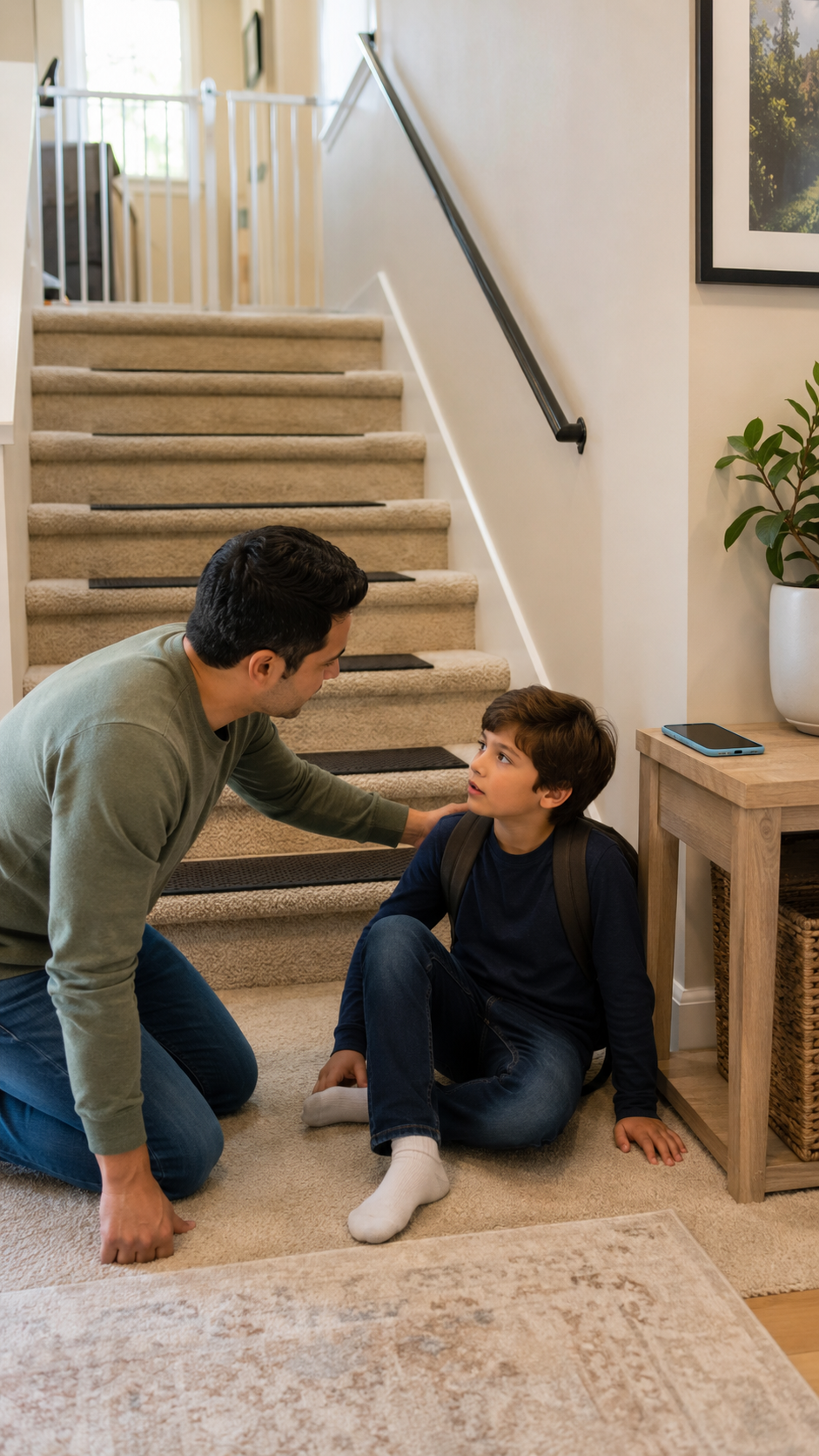
Child Fell Down the Stairs? First Aid Steps, Warning Signs, and When to Get Help
Minjin Park
·
Learn what to do when a child falls down the stairs, including immediate first aid, signs of concussion or spinal injury, and when to call 911.
The sound of a child falling down the stairs can send any parent into a panic. You may want to run over, pick your child up, and check every part of their body immediately. However, moving too quickly can sometimes make a serious head, neck, or back injury worse.
Many stair falls result only in bruises, small bumps, or a frightened child. Still, a child can also suffer a concussion, broken bone, deep cut, or spinal injury. Some symptoms may not appear until several hours after the accident.
Knowing what to do during the first few minutes can help you protect your child and decide whether emergency medical care is needed.
Important: This article provides general safety information and is not a substitute for medical advice. Call your local emergency number if you believe your child may have a serious injury.
If the injury appears minor, comfort and observe the child closely.
The way the child fell also matters. Falling from one low step is different from tumbling down an entire flight of stairs. Take note of approximately how many steps were involved, what part of the body hit first, and whether the child landed on a hard surface.
1. Make Sure the Scene Is Safe
Before approaching, check for hazards that could cause another accident. Toys, spilled liquids, loose rugs, broken stair parts, or objects still falling from above could put both you and your child at risk.
If other children are nearby, move them away from the stairs. Avoid stepping over the injured child or trying to lift them while standing in an unstable position.
Once the area is safe, kneel beside the child and speak calmly. Even if you are frightened, a steady voice can help keep the child from panicking or trying to stand up too quickly.
2. Do Not Rush to Pick Up the Child
Parents naturally want to scoop up a crying child. Before doing that, pause and look at the child’s position.
Ask an older child not to move for a moment. Questions such as “Can you hear me?” and “Where does it hurt?” can help you check responsiveness without requiring movement.
Do not move the child if they:
Are unconscious or unusually confused
Complain of severe neck or back pain
Cannot move an arm or leg normally
Report numbness, weakness, or tingling
Are lying in an unusual position
Have an obviously deformed limb
Fell down many steps or struck the head hard
The American Red Cross advises keeping someone with a possible head, neck, or spinal injury in the position in which they were found unless movement is necessary for safety, CPR, or bleeding control. Tell the child to remain still and gently support the head in its current position without twisting or straightening the neck. American Red Cross
3. Check Responsiveness and Breathing
Call the child’s name and gently tap their shoulder, taking care not to shake them. Watch the chest and listen for normal breathing.
Call 911 immediately if the child:
Does not respond
Is not breathing normally
Is gasping or struggling to breathe
Has a seizure
Cannot stay awake
Has lost consciousness, even briefly, and is not acting normally
Appears limp, pale, blue, or seriously injured
If the child is not breathing normally, begin age-appropriate CPR if you know how and follow the emergency dispatcher’s instructions. A dispatcher can coach you while help is on the way.
If the child is unconscious but breathing, protect the airway while minimizing movement of the head and neck. Do not leave the child alone. If vomiting blocks the airway, the child may need to be carefully rolled onto their side while keeping the head, neck, and body aligned. Follow the dispatcher’s instructions whenever possible.
4. Control Serious Bleeding
A small scalp cut can bleed more than expected, so the amount of blood may look frightening. For an ordinary cut, place clean gauze or a clean cloth over the wound and apply steady pressure for about 10 minutes.
Do not repeatedly lift the cloth to check the wound because this can interrupt clotting. If blood soaks through, place another cloth over the first one and continue applying pressure.
Do not press directly on the wound if:
An object is embedded in it
The skull looks dented or unusually shaped
You suspect a skull fracture
Clear fluid or blood is draining from an ear
Soft tissue or bone is visible
Call 911 for bleeding that is heavy, spurting, or cannot be controlled with direct pressure. Deep or gaping wounds may also require stitches or another form of medical closure.
5. Look for Injuries Without Forcing Movement
If the child is awake and breathing normally, observe them from head to toe. Do not force a painful joint to move.
Check for:
A bump, cut, or swelling on the head
Blood or clear fluid around the nose or ears
Unequal pupil size
Missing, loose, or broken teeth
Neck or back pain
Tenderness around the ribs or abdomen
Swelling, bruising, or deformity of an arm or leg
An inability to stand, walk, or use a limb normally
Also compare the child’s behavior with what is normal for them. A child who looks physically unharmed but seems confused, unusually quiet, unsteady, or difficult to comfort may have a head injury.
Emergency Warning Signs After a Stair Fall
A blow to the head or body can cause a concussion, even if the child never loses consciousness. Symptoms may begin immediately or develop later.
Call 911 or go to an emergency department immediately if your child develops any of the following:
Loss of consciousness
A seizure or repeated twitching
Repeated vomiting
A worsening or severe headache
Increasing confusion, agitation, or unusual behavior
Slurred speech
Weakness, numbness, or poor coordination
Trouble walking or maintaining balance
One pupil larger than the other
Double vision or another serious vision problem
Increasing drowsiness or difficulty waking
Clear fluid or blood coming from the ears or nose
Bruising behind the ears or around the eyes without a direct eye injury
Severe neck or back pain
Difficulty breathing
Uncontrolled bleeding
An open fracture or visibly deformed limb
The CDC also identifies inconsolable crying, refusal to nurse or eat, and loss of interest in usual activities as important warning signs in babies and toddlers who cannot explain how they feel. CDC HEADS UP
A fall involving many stairs or a significant height should be treated more cautiously. The NHS lists a fall from more than approximately five stairs or one meter as a mechanism requiring emergency assessment, particularly when a head injury may be involved. NHS head injury guidance
First Aid for a Minor Bump or Bruise
If your child is fully alert, communicating normally, moving all limbs comfortably, and showing no emergency warning signs, you may be able to provide basic first aid at home.
Wrap a cold pack or bag of ice in a thin, damp towel and place it on the swollen area for up to 20 minutes. Never put ice directly on the skin. A cold compress can reduce pain and swelling after a minor head bump. American Academy of Pediatrics
Wash small scrapes gently with soap and clean running water. Cover the area with a clean dressing if necessary.
Let the child rest in a quiet, comfortable place. Avoid rough play, climbing, running, sports, bike riding, and any activity that could cause a second fall. Do not force the child to eat, but offer small amounts of water if they are fully alert and not nauseated.
Before giving pain medication after a possible head injury, ask a pediatrician or pharmacist which medicine and dose are appropriate for the child’s age and weight.
How Long Should You Watch the Child?
Close observation is important because head injury symptoms can change over time. A responsible adult should stay with the child during the hours following the fall and continue watching for new or worsening symptoms.
Pay attention to:
Headache or increasing pain
Nausea or vomiting
Dizziness or balance problems
Sensitivity to light or sound
Trouble concentrating or answering questions
Irritability or unusual emotional behavior
Changes in eating or nursing
Sleeping significantly more or less than usual
Difficulty using an arm or leg
Any behavior that seems noticeably different
Write down when the fall occurred, how it happened, how many stairs were involved, whether the child lost consciousness, and when each symptom appeared. This information can help a medical professional evaluate the injury.
Can a Child Sleep After Falling Down the Stairs?
Sleep itself is not dangerous after a minor head injury. If a child is alert, behaving normally, and has no danger signs, it is generally acceptable to let them sleep. The CDC notes that children do not routinely need to be awakened every few hours after a diagnosed concussion unless a healthcare professional gives different instructions.
However, unusual drowsiness and an inability to wake normally are emergency warning signs. Before bedtime, make sure the child recognizes you, responds appropriately, and can move and communicate as expected. If the fall was significant or you are uncertain about the child’s condition, contact a medical professional before simply putting them to bed.
Do not assume that extreme sleepiness is normal because the accident happened near bedtime.
Do not dismiss symptoms simply because the child did not lose consciousness.
A child can have a concussion without being “knocked out.” When in doubt, calling your pediatrician, an urgent care service, or an emergency medical line is safer than relying on appearance alone.
Recovery After a Possible Concussion
If a healthcare professional diagnoses or suspects a concussion, follow the recovery plan they provide. The CDC recommends relative rest during the first one or two days rather than keeping a child in a dark room for long periods.
Quiet activities may be acceptable if they do not worsen symptoms. Screen time, bright lights, loud environments, demanding schoolwork, and strenuous exercise may need to be temporarily reduced. Light activity can then be introduced gradually under medical guidance.
The child should not return to contact sports or activities with a risk of another head injury until cleared by a healthcare professional. A second injury before the brain has recovered can be especially dangerous.
How to Prevent Future Stair Falls
Once the immediate situation is under control, examine how the fall happened. A few practical changes can reduce the chance of another accident:
Install properly secured safety gates at the top and bottom of stairs.
Use a hardware-mounted gate at the top rather than a pressure-only gate.
Keep toys, laundry, bags, and electrical cords off the steps.
Repair loose carpet, uneven boards, and unstable handrails.
Make sure the stairway is well lit.
Add non-slip surfaces where needed.
Teach children to use the handrail and walk instead of run.
Avoid carrying too many items while carrying a child.
Never allow children to play with baby gates or climb over them.
Supervise toddlers closely around stairs.
No home can be completely accident-proof, but a clear, well-lit stairway with secure barriers can significantly reduce everyday risk.
Stay Calm, Observe Carefully, and Trust Your Instincts
When a child falls down the stairs, the most helpful first response is not to panic or immediately pick them up. Check breathing and responsiveness, avoid unnecessary movement, control serious bleeding, and look carefully for signs of head, neck, back, or limb injuries.
Most minor falls end with bruises and tears rather than lasting harm. Still, parents and caregivers know their children well. If your child seems different, becomes worse, or causes you serious concern, seek medical advice even if none of the symptoms fits neatly into a checklist.
Has your child ever taken a frightening fall, and what safety change did you make afterward? Share your experience or stair-safety tip in the comments—it may help another parent respond more confidently.
Hi, I’m the creator and editor behind ZestyHabit. I research everyday safety, first aid, and practical wellness topics using official guidance and reliable public sources, then turn that information into clear, realistic steps for daily life.
My goal is to help readers make safer, better-informed choices at home and beyond.