
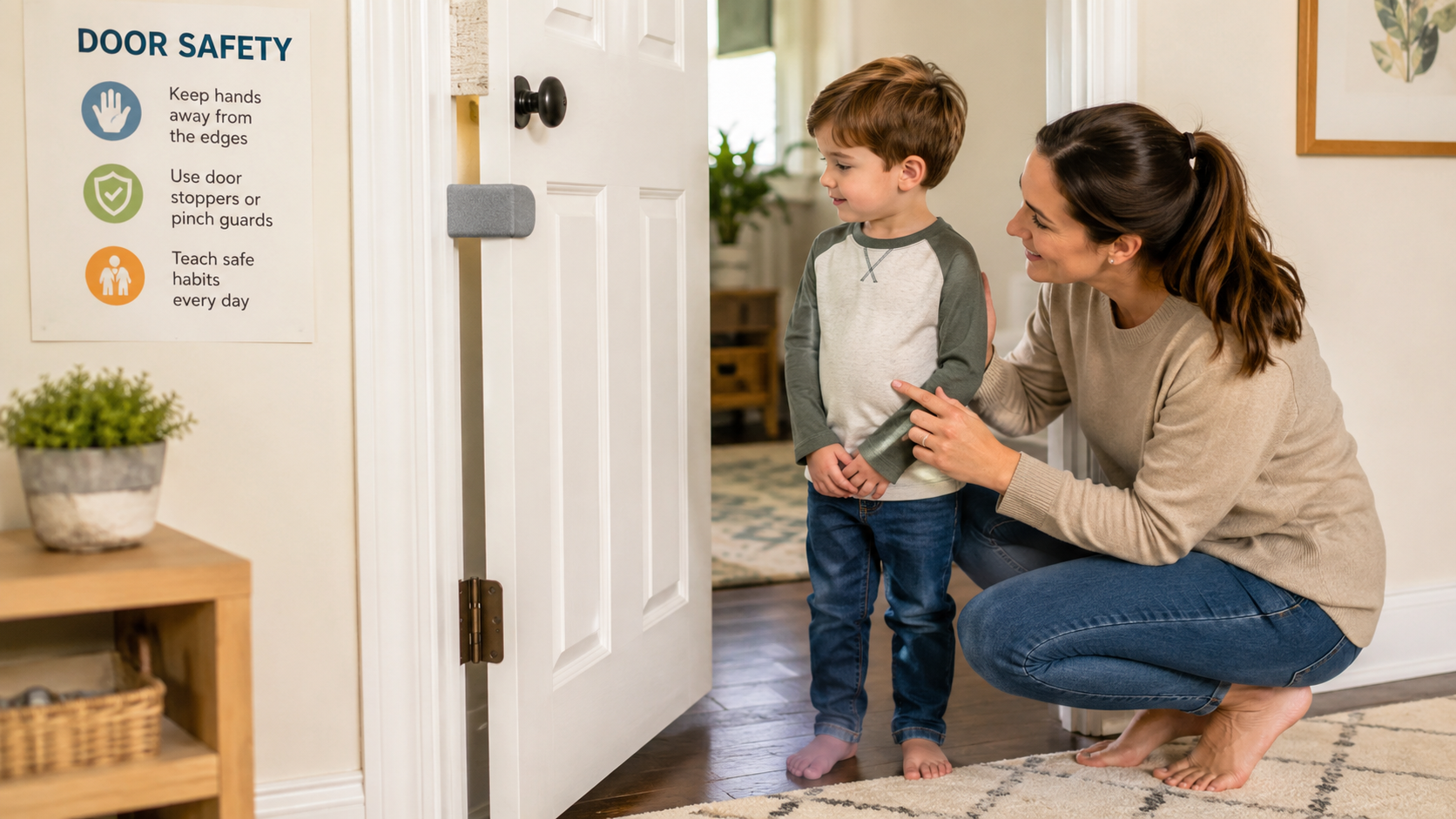

Finger injuries from doors can happen quickly, especially with children, pets, heavy doors, and windy rooms. Learn simple ways to prevent door-pinching accidents at home, in cars, and around everyday spaces.
The Small Door Accident That Happens Fast
A door seems harmless until it closes at the wrong moment.
One child is chasing another through the hallway. A toddler rests their hand on the hinge side of a bedroom door. A pet bumps a door while someone is reaching through. A gust of wind slams a patio door shut. Someone closes a car door before checking where everyone’s hands are.
In a split second, a finger can get pinched, bruised, cut, or seriously injured.
Finger injuries from doors are common because doors are part of everyday life. We open and close them dozens of times without thinking. Bedrooms, bathrooms, closets, garages, cars, screen doors, apartment entry doors, school doors, and heavy exterior doors all create pinch points.
The good news is that many door-related finger accidents are preventable. You do not need to make your home look like a padded playroom. A few smart habits, simple safety devices, and better awareness around high-risk doors can make a big difference.
The goal is not to make everyone afraid of doors. It is to help the whole household slow down around them, especially when children, pets, wind, or heavy doors are involved.
Why Fingers Get Caught in Doors So Easily
Doors have two danger zones
Most people think of the latch side of a door—the side with the handle—as the risky area. That is where a finger can get caught when the door closes.
But the hinge side can be even more dangerous.
The hinge side is the narrow gap where the door swings. When a door closes, that gap can squeeze shut with a lot of force. Children often place their fingers there without realizing the risk, especially when they are leaning, hiding, playing, or following someone through a doorway.
A good prevention plan pays attention to both sides: the handle side and the hinge side.
Children move faster than adults can predict
Young children are curious, quick, and not always aware of where their hands are. They may hold the edge of a door while talking, push a door during a game, or stick fingers into gaps because they are exploring.
They also tend to follow adults closely. A parent may close a door assuming the child is behind them, not realizing tiny fingers are on the frame.
Doors can move without warning
A door does not always close because someone closes it.
Wind can slam it. A loose hinge can make it drift. A pet can push it. A sibling can run into it. A spring-loaded door closer can pull it shut. A heavy exterior door may swing faster than expected.
This is why prevention is not only about telling kids to be careful. It is also about controlling how doors move.
Common Places Where Finger-Pinching Accidents Happen
Bedroom and bathroom doors
These are everyday doors children use constantly. They are also used during play, privacy, bedtime routines, and sibling arguments.
A child may slam a door during a game or close it quickly without checking whether someone else is holding the frame.
Closet doors
Closet doors can be tricky because children often play near them, hide inside them, or slide them back and forth. Folding closet doors and sliding doors have their own pinch points.
Front doors and apartment doors
Exterior doors are usually heavier than interior doors. Apartment doors may have automatic closers, strong hinges, or tight seals. They can close faster and harder than a typical bedroom door.
Garage doors and utility doors
Doors leading to garages, basements, laundry rooms, and utility spaces may be heavy, fire-rated, or self-closing. These doors can create stronger pinch forces and deserve extra caution.
Car doors
Car doors are one of the most common places for finger-pinching accidents outside the home. Children may place hands on the door frame, B-pillar, seat edge, or door opening while climbing in or out.
Adults may close the door too quickly, especially when loading groceries, managing multiple kids, or rushing in bad weather.
Screen doors and patio doors
Screen doors can slam in the wind. Sliding patio doors can catch fingers along the edge or track. Glass doors may also be difficult for children to judge because they look different from standard doors.
Warning Signs Around the Home
Some doors deserve attention before an accident happens.
Look for:
Doors that slam shut easily
Doors that drift closed on their own
Loose or squeaky hinges
Heavy doors children struggle to control
Doors with automatic closers
Doors children use during play
Doors near stairs or busy hallways
Doors that pets push open or closed
Door gaps where children like to place fingers
Windy rooms where doors bang shut
Closets used as hiding spots
If a door makes you say, “That one always slams,” it is worth fixing.
Teach a Simple Door Rule
Children need clear rules, not long explanations.
A simple rule is:
Hands stay on the handle, not on the edge or hinge.
That one sentence teaches the safest place to touch the door.
You can also teach:
“Check both sides before closing.”
“Close doors slowly.”
“Do not slam doors.”
“Keep fingers out of the cracks.”
“If someone is near the door, wait.”
For young children, repeat the rule often. They may understand it one day and forget it during play the next.
Make Door Safety Visual for Kids
Children learn better when they can see what you mean.
Show them the two pinch zones on a door:
The side where the door closes into the frame
The hinge side where the gap gets smaller
Use calm language. You do not need to scare them. You might say:
“This part can pinch fingers when the door closes, so we keep our hands on the handle.”
Then demonstrate closing the door slowly while keeping hands away from the edge.
For toddlers, keep it even simpler. Point to the handle and say, “Touch here.”
Use Door Stoppers and Finger Guards
Foam door stoppers
Foam door stoppers are small, inexpensive pieces that fit over the top or side of a door to keep it from closing fully. They can be helpful for toddlers and preschoolers because they prevent the door from slamming shut completely.
They are especially useful for bedroom doors, playroom doors, and doors children use often.
Make sure they are placed high enough that a child cannot remove or chew them. Also remember that they may prevent a door from latching, so do not use them where a closed door is needed for safety, privacy, or fire separation.
Hinge guards
Hinge guards cover the hinge-side gap of the door. These can be helpful in homes with very young children, daycares, schools, and play areas.
The hinge side is easy to overlook, so hinge guards can be a strong prevention tool for high-use doors.
Door closers and soft-close devices
Some doors slam because they close too quickly. A properly adjusted door closer can slow the movement. Soft-close devices may also help in certain situations.
For exterior, garage, or fire-rated doors, do not remove or disable required closers without understanding why they are there. Those doors may need to close for fire safety, security, or building-code reasons. Instead, have the closer adjusted so it closes firmly but not violently.
Door wedges
Door wedges can hold a door open temporarily, but they should be used carefully. A wedge left on the floor can become a tripping hazard. It may also be a choking hazard for very young children depending on the size and material.
Use wedges only where appropriate and remove them when not needed.
Stop Door Slamming Before It Becomes a Habit
Door slamming is not just noisy. It is one of the easiest ways for fingers to get hurt.
Children may slam doors during play, frustration, hide-and-seek, chase games, or sibling arguments. Adults may slam doors when carrying items or rushing.
A calmer household rule helps:
“Doors close slowly in this house.”
If a child is upset and slams doors often, focus on both safety and emotion. You can say:
“I know you’re upset, but doors can hurt fingers. We can close it gently.”
Then practice. Have the child open and close the door slowly a few times when everyone is calm.
Watch for Wind
Wind is one of the most underrated door hazards.
A gentle breeze can suddenly become strong enough to slam an interior door, patio door, or screen door. This often happens when windows are open on opposite sides of the home, creating a cross-breeze.
Be extra careful when:
Windows are open
Storms are coming
Balcony or patio doors are open
Fans are running
The front door and back door are open at the same time
Children are playing near doorways
Use door stops or keep doors fully latched when wind is moving through the home.
Do not leave a door half-open in a windy room if children are nearby.
Car Door Safety: Slow Down the Routine
Car doors deserve their own attention because families often use them while distracted.
You may be carrying groceries, buckling a child, managing a stroller, holding a coffee, or trying to get out of the rain. That is exactly when hands end up in the wrong place.
Teach children where to place their hands
Before closing a car door, teach children to keep hands in their lap or on their own body.
A simple phrase works well:
“Hands in, door closed.”
For older kids:
“Move your hands away from the frame before I close it.”
Check before closing
Make it a habit to glance at the door frame before closing. Look for fingers on the edge, near the hinge area, or gripping the side of the car.
This matters when multiple children are getting in and out at once.
Let adults close doors for young children
Young children may not have the strength or coordination to close car doors safely. They may pull the door shut while their other hand is still on the frame.
For toddlers and preschoolers, adults should usually manage the door.
Be careful in parking lots
Parking lots create distractions. Cars are moving, children are excited, and adults are often trying to move quickly.
Slow the door routine down. It takes only a second to check hands.
Pet-Related Door Accidents
Pets can contribute to door-pinching accidents in surprising ways.
A dog may push through a door while a child’s fingers are on the edge. A cat may dart into a room, causing someone to close the door quickly. A child may hold a door open for a pet and get fingers caught as the door swings.
Teach children not to trap, chase, or block pets with doors. Keep hands on handles, not door edges, when letting pets in and out.
If a pet frequently pushes doors open or closed, consider a door stopper, pet gate, or latch solution.
Make High-Risk Doors Less Accessible
Some doors are simply not good for unsupervised child use.
These may include:
Garage entry doors
Basement doors
Utility room doors
Heavy front doors
Doors with strong closers
Doors near stairs
Sliding glass doors
Doors leading outdoors
Doors to storage areas
Use childproof doorknob covers, latches, gates, or supervision where needed. The goal is not to trap children, but to prevent them from playing with doors that are too heavy or risky for their age.
Keep Play Away From Doors
Doors often become part of children’s games: hiding, chasing, pretending, blocking, knocking, and slamming.
Try to redirect play away from doorways. If children like hide-and-seek, set a rule that closets and doorways are not hiding spots. If they chase each other, make hallways and door areas “slow zones.”
For playrooms and bedrooms, consider leaving doors open with a foam stopper during active play so children are not constantly opening and closing them.
Maintenance Helps Prevent Accidents
Door safety is not only about behavior. Sometimes the door itself needs attention.
Fix loose hinges
Loose hinges can make a door sag, stick, or close unpredictably. Tighten screws or have the door repaired.
Adjust doors that slam
If a door always slams, figure out why. It may be wind, uneven flooring, a loose hinge, a strong closer, or poor alignment.
Repair sticking doors
A door that sticks can suddenly release when pushed hard. That quick movement can catch fingers.
Check sliding door tracks
Sliding doors should move smoothly. Dirty or damaged tracks can make them jerk, stick, or suddenly close.
Clean tracks and repair damaged rollers when needed.
Check automatic closers
Doors with closers should not whip shut. If a closer is too fast or too strong, it may need adjustment.
What to Do Right After a Finger Gets Pinched
This article is about prevention, but minor accidents still happen.
For a mild pinch, comfort the child, check the finger, and use basic first-aid judgment. If there is severe pain, heavy bleeding, a deep cut, deformity, numbness, trouble moving the finger, nail damage, or swelling that worries you, seek medical advice promptly.
Do not force a stuck finger out if the door is still pressing on it. Open the door carefully and calmly.
For children, the emotional shock may be as big as the injury. Stay calm and reassure them while you check what happened.
Build a Simple Family Habit
A good door-safety routine does not have to be complicated.
Try this:
Open doors fully or close them fully.
Do not leave doors swinging halfway.
Keep hands on handles.
Close slowly.
Check both sides before closing.
Use stoppers or guards on high-risk doors.
Keep play away from doorways.
Watch for wind.
Check car door frames before closing.
These small habits are easy to repeat and easy for children to learn.
A Quick Home Door Safety Checklist
Walk around your home and ask:
Which doors slam easily?
Which doors do children use most?
Are any doors heavy or self-closing?
Do children put their hands near the hinge side?
Are there windy rooms where doors move suddenly?
Do closet doors get used during play?
Are car doors rushed during school mornings?
Would a foam stopper or hinge guard help?
Are any doors sticking, sagging, or closing too fast?
You do not have to fix everything at once. Start with the doors children use most often.
Final Thoughts: Door Safety Is Mostly About Slowing Things Down
Finger-pinching accidents happen because doors are ordinary, familiar, and fast. Nobody expects a normal bedroom door or car door to cause an injury until it does.
The safest approach is simple. Teach children to keep hands on the handle, not the edge or hinge. Close doors slowly. Watch for wind. Use finger guards or door stoppers where needed. Keep play away from doorways. Check car door frames before closing. Repair doors that slam, stick, or drift shut.
You do not need to turn every doorway into a danger zone in your mind. Just give doors the same small attention you give hot pans, sharp drawers, and stairways.
A few seconds of awareness can prevent a painful accident and make everyday spaces safer for children, pets, and adults alike.

Hi, I’m the creator and editor behind ZestyHabit. I research everyday safety, first aid, and practical wellness topics using official guidance and reliable public sources, then turn that information into clear, realistic steps for daily life.
My goal is to help readers make safer, better-informed choices at home and beyond.


