Can Rubbing Your Eyes Cause Keratoconus? Risks, Symptoms, and Prevention
Minjin Park
·
Rubbing tired or itchy eyes can feel almost automatic. You may do it after staring at a screen, during allergy season, or while waking up in the morning. A quick, gentle touch is unlikely to cause a serious eye disorder on its own, but frequent and forceful rubbing is not as harmless as it seems.
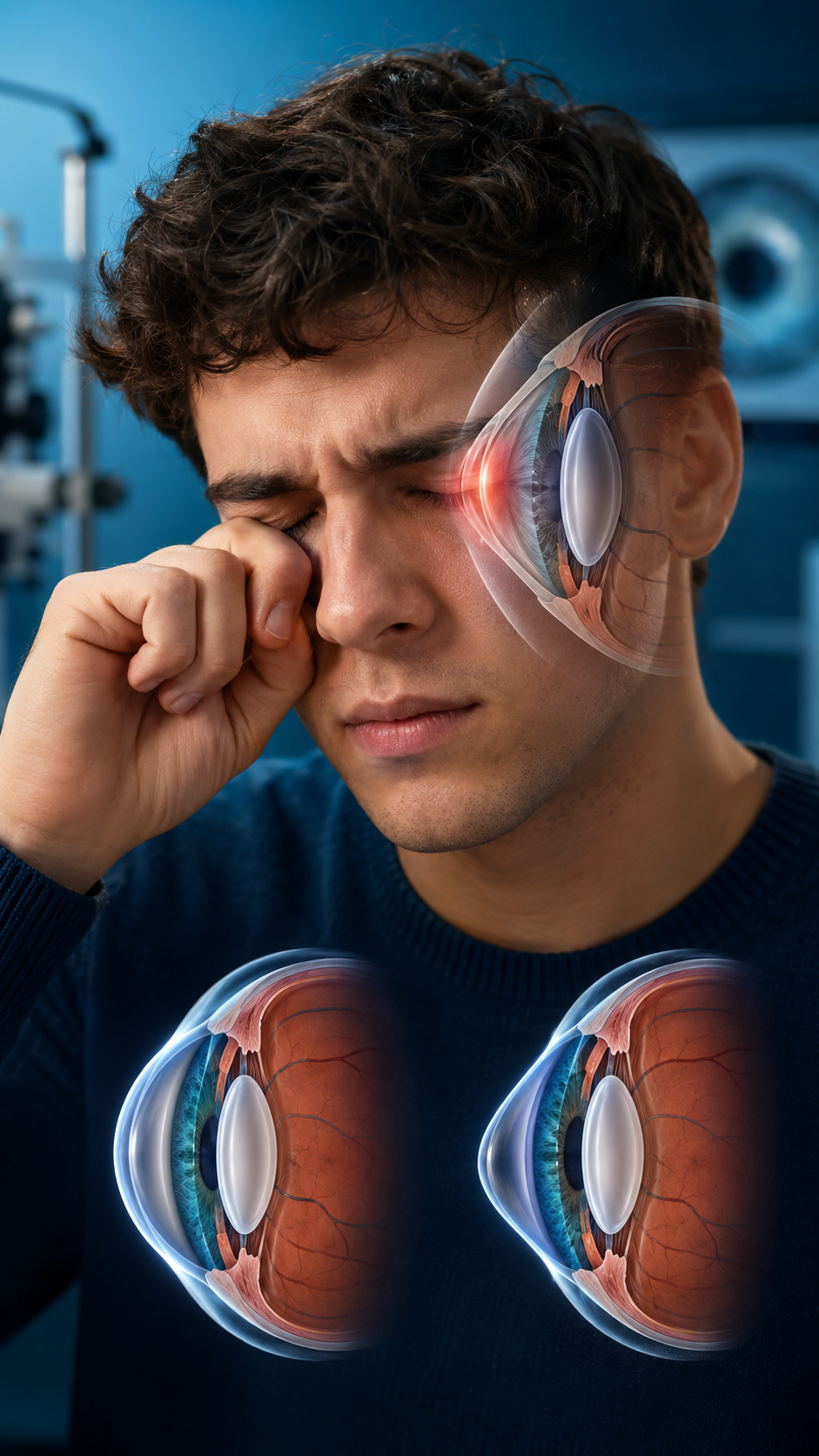
Repeated eye rubbing is strongly associated with keratoconus, a condition in which the cornea gradually becomes thinner, weaker, and more cone-shaped. As the cornea changes shape, it can no longer focus light properly. The result may be increasing astigmatism, distorted vision, glare, and repeated changes in an eyeglass prescription.
Eye rubbing is not the only cause of keratoconus, and not everyone who rubs their eyes will develop it. Genetics, allergies, age, and certain medical conditions also affect susceptibility. Still, avoiding chronic rubbing is one of the few risk factors a person can control.
Understanding the connection is especially important because keratoconus often begins during adolescence or early adulthood, when delaying diagnosis may allow the condition to progress.
The cornea is the transparent, dome-shaped tissue covering the front of the eye. A healthy cornea has a smooth, regular curve that helps focus light onto the retina.
In keratoconus, the corneal tissue becomes progressively thinner and bulges forward. Instead of maintaining a rounded dome, it develops an irregular cone-like shape. The change is often uneven, producing irregular astigmatism that ordinary glasses may eventually be unable to correct fully.
Keratoconus usually affects both eyes, although one eye may be noticeably worse. According to Johns Hopkins Medicine, it commonly begins around puberty and may continue progressing into a person’s 30s.
The speed of progression varies widely. Some people experience relatively mild changes that remain stable for years. Others, especially younger patients, may develop rapidly worsening vision and require treatment to strengthen the cornea.
Does Eye Rubbing Actually Cause Keratoconus?
Researchers have not identified one universal cause. Keratoconus appears to develop through a combination of genetic susceptibility, corneal biology, environmental exposure, and mechanical stress.
Eye rubbing is best described as a significant risk factor rather than a guaranteed direct cause. A person may carry a genetic tendency toward weak corneal tissue, while years of aggressive rubbing add repeated mechanical stress that contributes to thinning or progression.
A systematic review and meta-analysis examining keratoconus risk factors found that people who reported eye rubbing had approximately three times the odds of keratoconus compared with those who did not. The same study also identified family history, allergies, asthma, and eczema as important risk factors. Its findings are available through PubMed.
Association does not prove that rubbing caused every case. Some people may rub because an already-irregular cornea or related dry-eye condition makes their eyes uncomfortable. Allergies can also produce both itching and rubbing, making the relationship more complicated.
Nevertheless, the evidence is strong enough that eye-care professionals routinely advise people with keratoconus—or those at increased risk—to stop rubbing their eyes.
How Rubbing May Weaken the Cornea
The cornea is remarkably strong, but it is not designed to be repeatedly pressed, twisted, and displaced. Forceful rubbing can temporarily change the cornea’s shape and increase pressure inside the eye.
Several mechanisms have been proposed:
Repeated mechanical stress may weaken or disrupt collagen fibers.
Rubbing may cause small injuries to corneal cells.
Pressure and friction may encourage the release of inflammatory enzymes.
Oxidative stress may reduce the cornea’s ability to repair itself.
Existing weak areas may become thinner and steeper over time.
A short, accidental rub is very different from pressing a knuckle firmly into the eye for several seconds, repeating the movement throughout the day, or sleeping with a hand pushing against the eye.
The amount of pressure matters. The duration, frequency, technique, and underlying condition of the cornea may all influence risk.
A Clinical Study Shows Why Rubbing Technique Matters
A prospective case-control study conducted in Paris evaluated 202 people with keratoconus and 355 control participants. Researchers collected detailed information about rubbing behavior, allergies, dry eye, sleep position, screen use, and other possible risk factors.
After adjusting for multiple variables, rubbing with the knuckles was associated with substantially higher odds of keratoconus than not rubbing. Rubbing with the fingertips was also significantly associated with the condition, although the estimated association was stronger for knuckle rubbing.
The study did not prove that rubbing alone produced keratoconus, but it demonstrated that the way a person rubs may matter. The research can be reviewed on PubMed.
This finding reflects a familiar real-life pattern. Someone with seasonal allergies may wake with intensely itchy eyes and grind both knuckles into the closed eyelids until the itching temporarily improves. Repeating that action daily for years can expose the cornea to much more force than a person realizes.
Why Allergies Create a Dangerous Cycle
People with allergic conjunctivitis frequently experience itching, tearing, redness, and swollen eyelids. Rubbing provides momentary relief, but it can stimulate further irritation and encourage another round of rubbing.
This creates a cycle:
Itching leads to rubbing, rubbing increases irritation, and irritation causes more itching.
Allergies are also associated with keratoconus in several studies. It can be difficult to separate the biological effects of allergic inflammation from the mechanical effects of rubbing, because they often occur together.
The most useful response is to address both. Instead of relying on willpower alone, a person with persistent itching should have the cause treated. Depending on the diagnosis, an eye doctor may recommend lubricating drops, allergy medication, cold compresses, environmental allergen control, or treatment for eyelid inflammation.
Do not repeatedly use “redness relief” drops without professional guidance. Some constrict blood vessels temporarily but do not treat the underlying allergy or dryness, and overuse may cause rebound redness.
Early Warning Signs of Keratoconus
Early keratoconus may not cause pain or visible changes. Many people first notice that their glasses no longer provide crisp vision.
Possible symptoms include:
Increasing nearsightedness or astigmatism
Frequent changes in an eyeglass prescription
Blurred or distorted vision
Ghost images or double outlines around objects
Glare and halos around lights
Difficulty driving at night
Increased sensitivity to bright light
Vision that cannot be fully corrected with glasses
One eye seeing much worse than the other
Contact lenses becoming uncomfortable or fitting poorly
A teenager whose astigmatism changes significantly between yearly examinations should not simply receive stronger glasses without further evaluation. The same applies to someone whose corrected vision continues to decline despite an updated prescription.
Keratoconus cannot be diagnosed by symptoms alone. An ophthalmologist or optometrist must examine the cornea.
How Keratoconus Is Diagnosed
An ordinary vision test may detect changing astigmatism, but early keratoconus can be too subtle to identify through an eyeglass prescription alone.
Corneal topography or tomography creates a detailed map of the cornea’s shape. These tests can reveal localized steepening and irregular curvature before obvious changes are visible during a routine examination. Pachymetry measures corneal thickness, while slit-lamp examination can identify characteristic changes in more advanced disease.
The American Academy of Ophthalmology’s EyeWiki lists progressive or asymmetric astigmatism, inferior corneal steepening, and localized thinning among the important findings used in diagnosis.
People with a family history of keratoconus may benefit from screening, particularly if they frequently rub their eyes or have severe allergies. Early testing is also important before elective laser vision correction, since an abnormally weak cornea may be unsuitable for procedures that remove corneal tissue.
How to Stop Rubbing Your Eyes
“Just stop rubbing” is easy advice to give and surprisingly difficult to follow. The habit is often unconscious, especially during sleep, screen work, or allergy attacks.
These practical alternatives may help:
Use a Cold Compress
Place a clean, cool compress over closed eyelids for several minutes. Cooling can reduce itching and swelling without applying direct friction to the cornea. Rest the compress gently; do not push it into the eyes.
Use Appropriate Lubricating Drops
Preservative-free artificial tears may help when dryness or screen use triggers irritation. If symptoms are caused by allergies, an eye-care professional can recommend a suitable antihistamine or mast-cell-stabilizing product.
Eye drops are not interchangeable. Contact lens wearers, children, pregnant people, and anyone with other eye conditions should confirm which product is appropriate.
Blink and Take Screen Breaks
People blink less often when using a phone or computer. This allows the tear film to evaporate and can produce burning, grittiness, and an urge to rub.
Look away from the screen regularly, blink slowly several times, and avoid placing fans or air-conditioning vents directly toward the face.
Pat Around the Eye Instead
If you need to remove tears, gently blot the skin below the eye with a clean tissue. Avoid pressing on the eyeball itself. If there is an eyelash or particle in the eye, rinse with sterile saline or clean water rather than trying to rub it out.
Keep Nails Short
Short nails reduce the chance of scratching the eyelid or corneal surface during an unconscious rubbing episode. They do not prevent pressure damage, but they may reduce accidental injury.
Treat the Reason for the Itching
Persistent itching should be investigated. Common causes include allergies, dry eye disease, blepharitis, contact lens irritation, and exposure to smoke or cosmetics. The rubbing habit is unlikely to stop permanently while the original discomfort remains untreated.
What If You Already Have Keratoconus?
Stopping eye rubbing cannot return a cone-shaped cornea to its original form. It may, however, remove a potentially harmful source of mechanical stress and is generally recommended as part of long-term management.
Treatment depends on severity and evidence of progression.
Glasses and Soft Contact Lenses
Glasses may correct vision during early disease. Some people can also use specialized soft lenses. These options improve vision but do not strengthen the cornea or stop progression.
Rigid and Scleral Contact Lenses
Rigid gas-permeable, hybrid, or scleral lenses create a smoother optical surface over the irregular cornea. They may provide much clearer vision than glasses in moderate or advanced keratoconus.
These lenses do not permanently reshape or stabilize the cornea. They must be professionally fitted, and regular follow-up is necessary to avoid irritation or injury.
Corneal Cross-Linking
Corneal collagen cross-linking uses riboflavin and controlled ultraviolet light to create additional bonds within the corneal tissue. Its main purpose is to slow or stop progression—not necessarily to eliminate the need for glasses or contacts.
Cross-linking is most valuable when progression is detected before the cornea becomes extremely thin or scarred. In the United States, an epithelium-off treatment received FDA approval in 2016, and a newer epithelium-on approach was approved more recently. Eligibility, availability, risks, recovery, and insurance coverage differ, so treatment must be discussed with a corneal specialist.
Corneal Ring Segments or Transplantation
Implanted corneal ring segments may flatten part of the cornea and improve contact-lens fit in selected patients. Advanced disease involving significant scarring, extreme thinning, or contact-lens intolerance may require a corneal transplant.
Most people diagnosed early will not automatically need transplantation. Early monitoring and cross-linking have changed the treatment outlook considerably.
When Sudden Symptoms Require Urgent Care
Advanced keratoconus can occasionally lead to acute corneal hydrops. This occurs when a break in an inner corneal layer allows fluid to enter the cornea, causing sudden swelling and clouding.
Symptoms may include:
A rapid decline in vision
Sudden corneal cloudiness
Significant light sensitivity
Tearing
Eye pain
Eye rubbing has been reported as one possible trigger for this complication. Anyone with keratoconus who experiences sudden cloudy vision or pain should seek urgent ophthalmic care rather than waiting for a routine appointment.
Rubbing should also be avoided after eye surgery, with a suspected corneal scratch, or when a chemical or foreign object has entered the eye.
Parents Should Watch for Eye Rubbing in Children
Keratoconus can progress more aggressively in children and teenagers than in older adults. Unfortunately, young people may not realize that their vision is changing, particularly if one eye still sees well.
Parents should pay attention to repeated forceful rubbing, sitting unusually close to screens, squinting, complaints about glare, or frequent prescription changes. A child with eczema, asthma, severe eye allergies, Down syndrome, or a family history of keratoconus may deserve particular attention.
Stopping the rubbing habit is helpful, but controlling allergies and arranging a comprehensive eye examination are equally important.
The Bottom Line
Frequent eye rubbing does not guarantee that someone will develop keratoconus, but research consistently identifies it as an important and avoidable risk factor. The danger appears greater when rubbing is forceful, prolonged, repeated over many years, or performed with the knuckles.
If your eyes itch regularly, treat the cause instead of repeatedly pressing on them. If your astigmatism changes quickly, your night vision worsens, or glasses no longer provide clear sight, ask about corneal topography rather than assuming you simply need a stronger prescription. Keratoconus cannot always be prevented, but avoiding mechanical stress and detecting progression early may help protect vision.
Do you catch yourself rubbing your eyes during allergy season, after screen time, or when you wake up—and which safer alternative could you realistically try first? Share your experience or questions in the comments so other readers can learn from the discussion.
Hi, I’m the creator and editor behind ZestyHabit. I research everyday safety, first aid, and practical wellness topics using official guidance and reliable public sources, then turn that information into clear, realistic steps for daily life.
My goal is to help readers make safer, better-informed choices at home and beyond.