
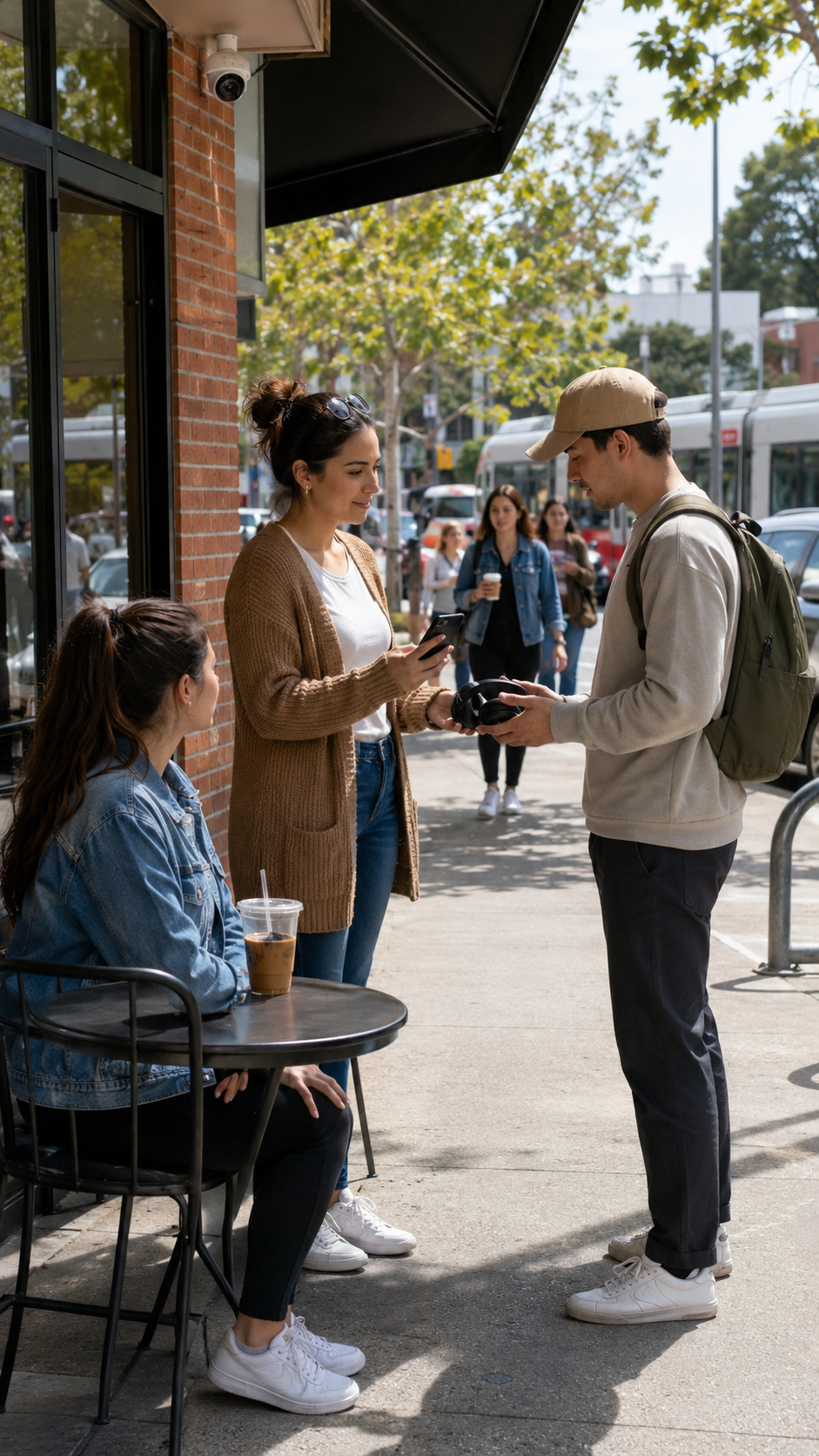

Selling an unused phone, piece of furniture, bicycle, or appliance through an online marketplace can be convenient. Most in-person transactions are simple: two people meet, the buyer checks the item, payment is completed, and both leave.
Still, meeting a stranger creates risks that do not exist when selling through a staffed store. A dishonest buyer may present a fake payment screen, attempt to change the meeting location, pressure you to reveal your home address, or arrive with unexpected companions. In rare cases, a transaction can escalate into theft, robbery, stalking, or physical confrontation.
The goal is not to approach every buyer with fear. It is to make a few decisions in advance so that you do not have to improvise under pressure. A good safety plan should feel ordinary, polite, and easy to follow.
This checklist explains how to screen a buyer, choose a safer meeting place, protect your personal information, verify payment, handle large-item pickups, recognize warning signs, and leave calmly if something does not feel right.
1. Keep Early Communication Inside the Marketplace
Use the marketplace’s messaging system whenever possible. Moving immediately to personal text messages, email, or another app may expose your phone number and make it harder for the platform to review the conversation if something goes wrong.
In-app messages also create a record of the agreed price, item condition, meeting place, and time. OfferUp recommends keeping communication inside its service rather than sharing personal contact information with someone you have not met.
Be cautious when a buyer quickly asks for:
- Your personal phone number
- Your email address
- A verification code sent to your phone
- Your full home address
- A photograph of your identification
- Your bank login or account details
- Communication through an unfamiliar link
A buyer does not need a one-time security code to prove that you are a real seller. The Federal Trade Commission warns that scammers may request verification codes to create accounts linked to another person’s phone number. Never send a code that arrives by text or through an authentication app.
2. Review the Buyer Without Trying to Investigate Them
You do not need to conduct a private investigation. A quick review is enough to identify obvious inconsistencies.
Look at the buyer’s marketplace profile, account age, ratings, completed transactions, and recent feedback. A new account is not automatically dangerous—everyone starts somewhere—but a nearly empty profile combined with rushed, unusual, or contradictory messages deserves more caution.
Pay attention to the conversation itself. A legitimate buyer should generally be able to confirm:
- Which item they want
- The agreed price
- When they can meet
- Where the exchange will occur
- How they plan to pay
Generic messages such as “Is this available?” are common and not necessarily suspicious. The concern is a pattern: refusing to discuss the item, offering more than the listed price, sending a representative without explanation, demanding immediate action, or trying to move the transaction outside the marketplace.
The FTC recommends checking a marketplace participant’s ratings and recent feedback but cautions against relying on star ratings alone because online reviews can be incomplete, fake, or misleading.
3. Choose the Meeting Place Before Sharing Your Schedule
The safest default is a public, well-lit place with regular foot traffic and visible security cameras.
Many police departments, sheriff’s offices, and local businesses provide designated exchange zones for online transactions. These locations may be near law-enforcement buildings, monitored parking areas, or other public facilities. OfferUp’s official Community MeetUp Spots, for example, are intended to provide brightly lit, public, camera-monitored exchange areas.
Suitable alternatives can include:
- A police-station exchange zone
- A busy coffee shop
- A grocery-store entrance
- A shopping-center security area
- A bank lobby or monitored exterior area
- A staffed public facility during business hours
The Miami-Dade Sheriff’s Office advises people conducting online transactions to meet publicly, avoid secluded locations, tell someone where they are going, carry a phone, and consider bringing another person.
Choose a location where you can enter a staffed building if you become uncomfortable. A crowded parking lot may look public, but an isolated corner behind the building offers little practical protection.
4. Meet During Daylight or Normal Business Hours
Arrange the exchange during daylight whenever possible. If that is not practical, choose a location with strong lighting, active businesses, nearby people, and working cameras.
Normal business hours provide several advantages. Employees are present, doors are open, public transportation may still be operating, and it is easier to ask for assistance.
Avoid agreeing to meet:
- Late at night
- In an empty parking garage
- Beside a closed business
- At an isolated roadside pull-off
- In a park after dark
- Behind a warehouse or apartment building
- Anywhere the buyer chose specifically because “nobody will bother us”
A legitimate buyer may have scheduling limitations, but your safety requirements do not need to disappear for their convenience.
5. Tell Someone Exactly Where You Are Going
Before leaving, send a trusted person the buyer’s profile, meeting address, scheduled time, item description, and expected completion time.
You can also share your live phone location temporarily. Arrange a simple check-in, such as sending “done” after the exchange. When possible, bring a friend or family member. They do not need to act intimidating or participate in the negotiation; their presence alone provides another observer and an easier way to leave.
OfferUp and law-enforcement guidance both recommend bringing someone or, when meeting alone, giving a trusted person the exact location and transaction details.
Keep your phone charged and accessible. Do not leave it buried beneath the item in your trunk.
6. Agree on the Price and Payment Method in Advance
Price negotiations are easier through messages than in a parking lot. Confirm the final price before meeting unless you are genuinely comfortable allowing inspection-based negotiation.
A useful message is:
“Please inspect the item when we meet. The agreed price is $___, payable after inspection.”
This reduces surprise and gives both parties a shared understanding. It does not prevent the buyer from making a lower offer, but it makes it easier for you to decline without a long argument.
Payment recommendations differ depending on the platform and transaction. Some services recommend cash for local exchanges, while others favor secure electronic payments to reduce the need to carry money. Every method has risks. The essential rule is to confirm payment independently rather than trusting a screenshot, email, text notification, or statement from the buyer.
For cash:
- Agree on the exact amount
- Meet somewhere you can count it safely
- Decline unusually large bills when you cannot verify them
- Do not display additional cash
- Complete the exchange before separating from the item
For electronic payment:
- Open the official payment or banking app yourself
- Verify the transaction inside your own account
- Do not rely on the buyer’s phone screen
- Do not click a payment link sent through chat
- Do not pay a fee to “upgrade” your account
- Do not return an alleged overpayment
- Never send a verification code
The FTC warns about fake payment notifications, bogus overpayment claims, and counterfeit checks that may initially appear to clear before the bank discovers the fraud.
7. Do Not Hand Over the Item Before Payment Is Confirmed
Let the buyer inspect the product, but maintain reasonable control of it until payment is complete.
For a small electronic device, remain close while the buyer tests basic functions. Remove personal accounts, SIM cards, saved passwords, payment information, and location data before meeting. Back up anything important and perform the appropriate factory reset.
For higher-value items, avoid letting the buyer walk to another vehicle, “show a friend,” or take the product for an unsupervised test. The inspection should occur where both of you agreed to meet.
Do not allow embarrassment to rush you. It is normal to pause for a moment while checking your account or counting payment.
8. Treat Last-Minute Location Changes as a Warning
A buyer may message shortly before the meeting and say that their car stopped, their phone battery is low, or they are waiting “just around the corner.” Sometimes the explanation is genuine. You still do not have to follow them.
OfferUp specifically warns against last-minute requests to relocate or follow someone to a different location, because such changes can draw a seller away from the safer place originally selected.
A calm response is enough:
“I can only meet at the agreed public location. We can reschedule if today no longer works.”
Do not drive to a private address, alley, secluded parking lot, or unfamiliar vehicle simply because you have already traveled to the area. The time you spent getting there does not obligate you to continue.
9. Keep the Exchange Polite, Brief, and Boring
A safe transaction does not need to feel like a confrontation. Greet the buyer, identify the item, allow a reasonable inspection, complete payment, and leave.
Avoid discussing where you live, whether you live alone, your daily routine, your workplace, your travel plans, or other valuables you own. Friendly conversation is fine, but personal details are unnecessary.
Maintain comfortable physical space. Do not allow yourself to become surrounded between multiple people, parked vehicles, a wall, or an open trunk. Position yourself so that you can move toward a public building or your vehicle without pushing past anyone.
Keep your car keys, phone, wallet, and identification on your body rather than placing them on the hood, seat, or ground.
10. Recognize Pressure Without Arguing About It
A buyer does not need to threaten you openly for a situation to become unsafe. Pressure may appear as repeated boundary testing.
Warning signs include:
- Arriving with several unannounced people
- Demanding access to your vehicle or home
- Refusing the agreed public location
- Becoming angry when you verify payment
- Insisting that you open a link or reveal a code
- Trying to grab or carry away the item before paying
- Blocking your path or vehicle
- Pressuring you to decide immediately
- Offering an implausible story involving urgent payment problems
- Reaching inside clothing or a vehicle in a threatening way
Do not accuse the person of being a criminal. You do not need to prove dishonesty or win the disagreement.
Use a simple statement:
“I’m not comfortable completing the sale, so I’m ending the transaction.”
Then move toward people, staff, security, or your locked vehicle. Portland police advise marketplace users to trust their instincts and end the transaction when something appears suspicious.
11. Leave Instead of Trying to Protect the Sale
The item, the payment, and the buyer’s opinion are less important than your safety.
If you feel uneasy before arriving, cancel. If the buyer changes the plan, reschedule or leave. If someone becomes aggressive, do not argue over whether their behavior is reasonable.
Enter a nearby business and alert an employee or security officer. Call emergency services when you believe you are in immediate danger, someone displays a weapon, you are being followed, or the person blocks you from leaving.
OfferUp advises users who feel endangered during a meetup to call emergency services and seek shelter in a nearby business when necessary.
If property is taken by force or threat, prioritize creating distance. Do not chase a fleeing person or vehicle. Observe details only from a safe position and report what happened.
12. Handle Large Items Without Giving Up Every Safety Measure
Furniture, exercise equipment, and major appliances may be too large to bring to a public exchange zone. That does not mean the buyer must immediately receive unrestricted access to your home.
Consider meeting the buyer first at a designated public location. Once you are satisfied that the transaction appears legitimate, provide the pickup address. OfferUp recommends this two-stage approach for items that are difficult to transport.
For a home pickup:
- Schedule it during daylight
- Have another adult present
- Move the item to a garage, driveway, lobby, or entrance if possible
- Close doors leading to private rooms
- Secure medications, documents, keys, electronics, and valuables
- Keep pets and children in a separate area
- Limit the buyer’s access to the pickup zone
- Confirm payment before loading is completed
- Do not help lift beyond your physical ability
Avoid telling the buyer that you will be home alone. If the item must be removed from inside, keep the route clear and supervise access without physically blocking or confronting anyone.
13. Protect Your Address After the Transaction
Listings can unintentionally reveal more than expected. Photographs may show house numbers, street signs, school uniforms, mail labels, family photos, vehicle license plates, reflections, or recognizable views from a window.
Before posting, crop or blur unnecessary identifying details. Do not use a photograph containing location metadata when the platform preserves it. Avoid publicly listing your precise address.
After the sale, save the conversation and payment record until you are confident the transaction is complete. Report suspicious accounts through the marketplace. The FTC advises retaining communications and transaction records when resolving marketplace disputes or reporting fraud.
A Quick In-Person Marketplace Safety Checklist
Before leaving, confirm that you have:
- Reviewed the buyer’s profile and messages
- Agreed on the item, price, payment, place, and time
- Selected a public, bright, monitored location
- Told someone where you are going
- Charged your phone
- Removed personal data from the item
- Planned how you will confirm payment
- Decided what behavior will make you leave
At the meeting:
- Stay in the agreed location
- Keep control of the item until payment is confirmed
- Verify money through your own account or carefully count cash
- Decline unexpected links, codes, fees, or refunds
- Keep the exchange brief
- Leave at the first sign of intimidation or manipulation
Final Thoughts
Meeting a secondhand buyer does not have to feel frightening. The most effective safety measures are usually quiet and ordinary: communicate through the app, meet publicly during active hours, bring someone, share your plans, verify payment yourself, and refuse unexpected location changes.
You do not need to act suspicious, aggressive, or confrontational. Clear boundaries are enough. A trustworthy buyer will usually understand a public meeting place and a reasonable payment check. Someone who becomes angry about basic precautions is giving you useful information—and you are free to cancel the sale.
What safety habits do you use when meeting buyers from Facebook Marketplace, Craigslist, OfferUp, or another resale platform? Share your best meeting-place ideas, payment tips, or lessons from an uncomfortable transaction in the comments. Your experience may help another seller complete their next exchange with more confidence and less stress.

Hi, I’m the creator and editor behind ZestyHabit. I research everyday safety, first aid, and practical wellness topics using official guidance and reliable public sources, then turn that information into clear, realistic steps for daily life.
My goal is to help readers make safer, better-informed choices at home and beyond.


