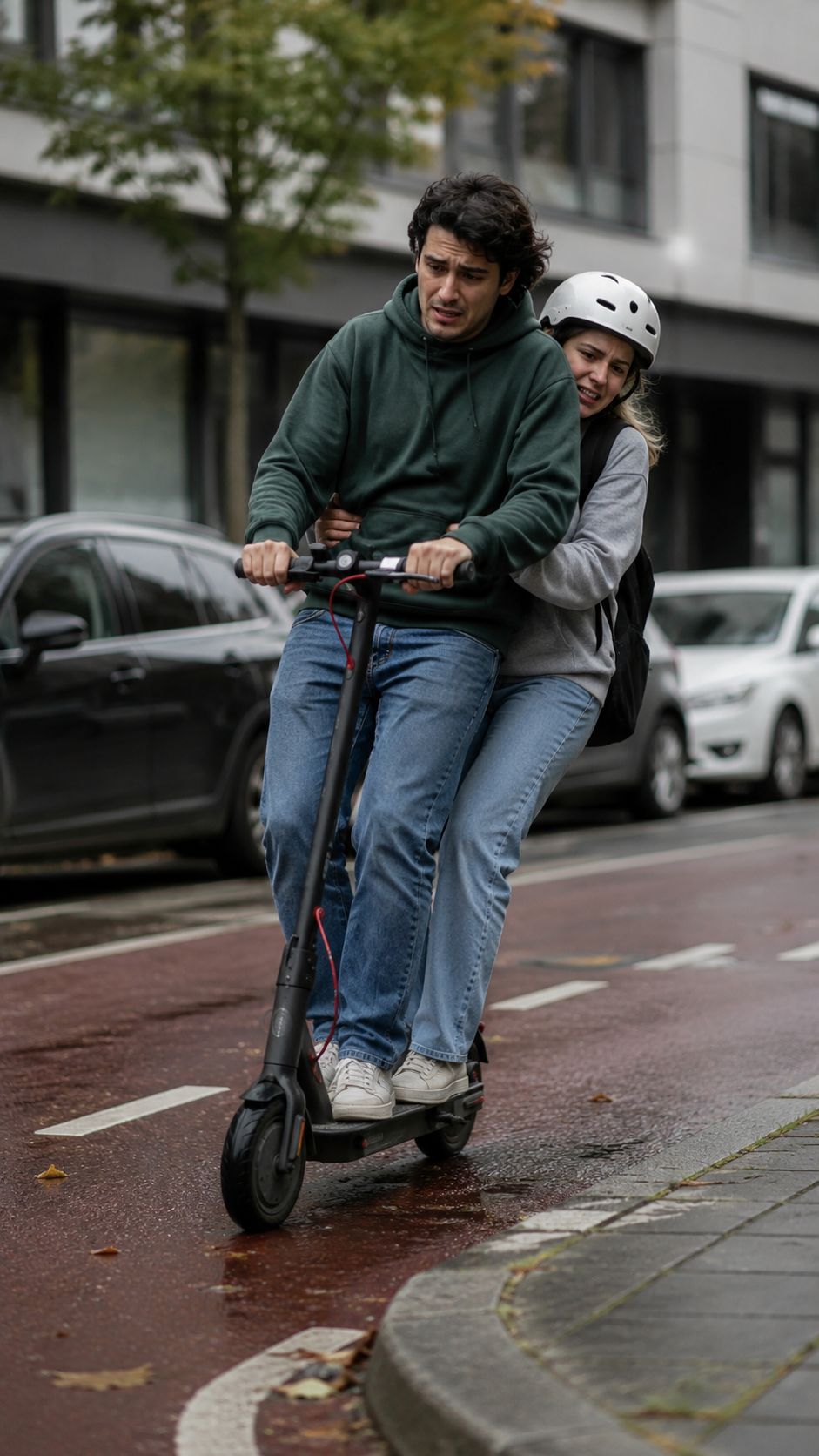
Two People on One Electric Scooter: Why Tandem Riding Dramatically Increases Accident Risk
Minjin Park
·
Riding two people on one electric scooter reduces balance, steering control, and braking performance. Learn why tandem e-scooter riding is dangerous and how to prevent serious injuries.
Electric scooters are designed to make short urban trips quick and convenient. Because they are easy to unlock, compact, and often available at a moment’s notice, sharing one scooter with a friend may seem like a harmless shortcut.
Perhaps the destination is only a few blocks away. Maybe there is only one rental scooter nearby. One person stands at the front, the other squeezes onto the back, and both assume that riding slowly will keep them safe.
Unfortunately, carrying two people on one electric scooter—sometimes called tandem riding, double riding, or riding two-up—changes the way the scooter handles. It reduces space for stable foot placement, shifts the center of mass, increases the load on the brakes and tires, and makes it harder for the driver to react to obstacles.
The U.S. Consumer Product Safety Commission advises people to ride solo, stating that an e-scooter should carry only one person because additional riders can increase both the likelihood and severity of a collision.
The risk is not theoretical. A 2026 analysis from Norway’s Institute of Transport Economics found that people who reported recently riding with more than one person on an e-scooter also reported nearly 500% more accidents requiring medical attention than other users. The result shows a strong association, although the survey-based analysis cannot prove that tandem riding alone caused every crash.
Here is why two-person electric scooter riding is far more dangerous than it looks.
Electric Scooters Are Generally Designed for One Rider
Most conventional electric scooters have one narrow deck, one handlebar, and controls that can be operated by only the person standing at the front.
Unlike a motorcycle or moped built for two people, a typical e-scooter does not have:
A separate passenger seat
Passenger footrests
A handhold designed for a second rider
Suspension calibrated for two occupants
Brakes selected specifically for passenger transport
A frame designed around two stable riding positions
Current product-safety language also reflects this basic design. In a 2026 U.S. federal rulemaking proposal, personal e-mobility products covered by the relevant standard were described as consumer mobility devices intended for a single rider.
Rental operators commonly impose their own one-rider rules as well. In the United Kingdom’s official rental e-scooter trials, government guidance explicitly states that a rental scooter must be used by only one person at a time.
The exact law varies by country, state, and city. However, even where enforcement is limited or the rules are unclear, the scooter’s physical limitations remain the same.
1. Two Riders Make Balance Much Harder
An electric scooter has small wheels, a short wheelbase, and a narrow platform. These features make it portable and maneuverable, but they also leave little margin for error.
A solo rider controls the scooter by coordinating several movements at once. The rider adjusts foot pressure, bends the knees, leans slightly, turns the handlebar, and shifts body weight in response to acceleration, braking, corners, and road conditions.
Add a second person, and the driver is no longer controlling only one body.
The passenger may lean in a different direction, shift position unexpectedly, or tighten their grip when frightened. Even a small movement can affect steering because both people are standing on the same narrow platform.
Balance becomes especially difficult when:
Starting from a complete stop
Riding at very low speed
Turning sharply
Looking behind for traffic
Crossing a sloped surface
Riding over a curb cut
Braking suddenly
Swerving around a pedestrian or vehicle
The passenger often reacts a fraction of a second later than the driver. When the driver leans into a turn but the passenger remains upright—or leans the opposite way—the scooter may wobble or move outside the intended path.
2. The Passenger Has No Secure Place to Stand
The deck of a standard electric scooter is usually large enough for one rider’s feet positioned in line or at a slight angle. With two riders, both people must compromise their stance.
The front rider may place both feet unusually far forward. The passenger may stand on the rear edge, turn both feet sideways, or keep only part of each shoe on the platform.
This unstable position creates several hazards.
A foot may slip off during acceleration. A shoe may contact the rear wheel or fender. The passenger may step onto the ground while the scooter is still moving. The driver may be unable to shift into a safer stance before braking.
Poor foot placement also prevents the riders from absorbing bumps with their knees. Instead of allowing the body to move naturally, both people may become stiff and depend on each other for support.
That dependence can become a problem during a fall. When one person loses balance, the other is often pulled down too.
3. Extra Weight Can Increase Stopping Distance
A scooter carrying two adults has more total mass than the same scooter carrying one. The brakes must manage that larger moving load whenever the driver slows down or stops.
The precise stopping distance depends on many factors, including speed, combined rider weight, brake design, tire condition, road surface, slope, and whether the pavement is wet.
The Consumer Product Safety Commission advises riders to test the brakes and learn how long their particular scooter takes to stop, noting that stopping distance can vary significantly between models.
With two people aboard, the scooter may not respond the way the driver expects from previous solo trips. Braking may feel slower, less predictable, or more abrupt.
A rider who notices a pedestrian, opening car door, pothole, or red light may begin braking at the usual point—only to discover that the scooter needs more space to stop.
Extra weight can also make it easier to overload the front wheel during hard braking. Both riders continue moving forward, and the passenger may push into the driver. The driver can be forced toward the handlebar while trying to keep the front wheel straight.
If the wheel locks, loses traction, or turns sideways, both riders may be thrown onto the road.
4. Steering Control Becomes Restricted
The person at the front needs space to move the arms, rotate the upper body, and shift weight while steering. A passenger standing directly behind may restrict those movements.
The passenger may hold the driver’s shoulders, waist, backpack, or arms. Although holding on feels necessary, it can interfere with steering and balance.
For example, the passenger may:
Pull the driver backward during acceleration
Push the driver forward during braking
Restrict the driver’s torso during a turn
Grab one shoulder more tightly than the other
Block the driver from stepping off safely
Distract the driver by talking or moving
The driver also has limited information about what the passenger is doing. A sudden movement from behind may feel like a mechanical problem, a tire slip, or an impact.
By the time the driver understands what happened, there may not be enough room to correct the scooter’s path.
5. Small Road Hazards Become More Dangerous
Small scooter wheels are vulnerable to road irregularities that a car—or even a bicycle with larger wheels—may cross without difficulty.
Common hazards include:
Potholes
Drain covers
Cracked pavement
Loose gravel
Wet leaves
Road debris
Raised sidewalk edges
Railroad or tram tracks
Metal construction plates
Uneven transitions between surfaces
A recent systematic review found that most injured e-scooter riders were involved in single-vehicle events, with falls representing the most common accident mechanism.
When two people are riding together, the driver may not be able to lift or lighten the front wheel, shift around an obstacle, or absorb an impact effectively. The overloaded scooter may hit the obstacle more heavily, while the passenger’s movement adds another unpredictable force.
Road conditions become especially dangerous when several demands occur at once. Research on accidents involving cyclists, pedestrians, and e-scooter users has highlighted situations in which braking or turning coincides with slippery, uneven, narrowed, or difficult-to-read surfaces.
Two riders have less room and less time to respond to those combined hazards.
6. The Passenger Often Cannot See the Road Clearly
The rear rider’s view may be blocked by the driver’s head and shoulders. This means the passenger may not see a pothole, corner, curb, or sudden stop coming.
Without visual warning, the passenger cannot prepare by bending the knees or leaning appropriately. Instead, their full body weight may move unexpectedly when the scooter changes direction.
The driver may shout instructions such as “lean,” “stop,” or “hold on,” but urban traffic rarely provides enough time for clear communication.
Noise from vehicles, wind, music, and nearby conversations can make communication even harder. A passenger who does not anticipate a maneuver may accidentally destabilize the scooter at the most dangerous moment.
7. Falls Can Cause Serious Head and Limb Injuries
Electric scooter users have little physical protection. There is no passenger compartment, seat belt, crumple zone, or airbag. When control is lost, the rider often lands directly on the pavement or strikes a vehicle, pole, curb, or other solid object.
A 2026 systematic review and meta-analysis found that head, facial, and upper-extremity injuries were especially common among people presenting for emergency care after e-scooter incidents. The authors noted that riders frequently extend their arms during a fall, while the head or face may still strike the ground when the arms cannot fully stop the impact.
Other studies have documented fractures involving the wrist, elbow, ankle, shin, and knee. One Level I trauma-center study found notable numbers of ankle fractures, tibial shaft fractures, tibial plateau fractures, and radial head fractures among injured e-scooter and e-bike users.
With tandem riding, either person may land first. The second rider may then fall onto the first, increasing the chance of crushing injuries, additional head impact, or tangled limbs.
The passenger may be particularly vulnerable because they cannot control the handlebar or brakes and may have no clear view of the approaching hazard.
8. One Helmet Does Not Protect Two People
Tandem riding often occurs spontaneously, which means the second person may not have a helmet. In some cases, neither rider wears one.
A helmet cannot prevent the scooter from crashing, but a properly fitted helmet may reduce the risk of certain head injuries. Both individuals would need their own correctly fitted helmets; sharing one helmet or giving it only to the driver does not protect the passenger.
Even when both people are wearing helmets, tandem riding remains unsafe. Helmets do not correct the unstable stance, overloaded deck, limited steering, altered braking, or lack of passenger controls.
Protective equipment should support safer riding behavior—not create confidence to continue a dangerous practice.
9. Riding Slowly Does Not Remove the Risk
A common argument is that carrying a passenger is acceptable when the scooter moves slowly.
Lower speed generally reduces impact energy, but it does not eliminate instability. Electric scooters can be difficult to balance at very low speeds, particularly when starting, turning, or crossing uneven ground.
A passenger can still fall backward during acceleration or forward during braking. A wheel can still catch in a crack. The scooter can still tip sideways into traffic.
Low-speed falls can cause broken wrists, facial injuries, dental damage, or head trauma, especially when the person has no time to put a foot down safely.
The safest speed for two people on a one-person scooter is therefore not “slow.” It is zero.
10. Tandem Riding Can Put Pedestrians and Drivers at Risk
The consequences are not limited to the two people on the scooter.
An unstable tandem scooter may enter a pedestrian path, drift into another lane, or fall in front of a moving vehicle. Pedestrians may be struck directly or injured while trying to jump out of the way.
Drivers may swerve or brake suddenly to avoid the scooter, creating a secondary collision. Cyclists and other micromobility users may also be forced off their intended path.
Because e-scooters are relatively small, quiet, and quick, other road users may already have difficulty noticing them. The CPSC recommends anticipating that drivers and pedestrians may not see a scooter and avoiding abrupt, unpredictable movements.
Two-person riding makes smooth, predictable movement more difficult.
Common Situations That Lead to Two-Person Riding
Most tandem riders do not intend to take a major risk. The decision often develops from an ordinary situation:
Two friends find only one available rental scooter
A couple wants to travel a short distance together
An adult gives a child a ride
Someone misses the last bus or train
A friend is tired or has uncomfortable shoes
One person does not have the required app or account
The group assumes the trip is too short for anything to happen
These explanations may be understandable, but none changes the scooter’s design.
The safer choice is to unlock a second scooter, walk, use public transportation, call a taxi or rideshare vehicle, or have one person travel first and meet the other later.
A few minutes of inconvenience is preferable to an emergency-room visit.
How to Ride an Electric Scooter More Safely
Safer riding begins with treating the scooter as a one-person vehicle.
Before riding:
Check the tires, brakes, handlebar, throttle, lights, and frame.
Confirm that the scooter is within its stated weight limit.
Wear a properly fitted helmet.
Choose footwear that fully covers and grips the feet.
Avoid riding after drinking alcohol or using impairing drugs.
Plan a route that uses permitted, lower-risk infrastructure.
Put away the phone and remove headphones that block surrounding sounds.
While riding, keep both hands on the handlebar, maintain a stable stance, slow down before turns, and leave extra stopping distance. The CPSC also advises riders to keep objects off the handlebar and to avoid abrupt movements and distractions.
Never carry a passenger, even for a very short trip.
What to Do After a Tandem E-Scooter Crash
Move out of traffic only when it is safe to do so. Do not immediately stand up if there is severe pain, confusion, weakness, numbness, or possible neck or back injury.
Call emergency services for:
Loss of consciousness
Confusion or unusual behavior
Repeated vomiting
Seizure
Severe headache
Neck or spinal pain
Difficulty breathing
Heavy bleeding
An obviously deformed limb
Inability to stand or walk
A collision involving a motor vehicle
Symptoms that rapidly worsen
A damaged helmet should not be reused. The scooter should also be taken out of service when the brakes, stem, handlebar, wheels, deck, or folding mechanism may have been damaged.
Report problems with a rental scooter through the operator’s app so another person does not unknowingly ride unsafe equipment.
The Bottom Line
Two people on one electric scooter do not simply create twice the fun or save the price of a second ride. The additional passenger changes balance, steering, braking, visibility, foot placement, and the driver’s ability to respond to hazards.
A standard electric scooter is designed around one rider controlling one moving body. When a second person steps onto the deck, both riders lose some of that control—and neither receives meaningful protection in a fall.
Ride solo, wear a helmet, inspect the scooter, follow local traffic laws, and choose another form of transportation when two people need to travel together. A trip that lasts only a few minutes can still result in injuries that take months—or longer—to recover from.
Have you seen two people sharing an electric scooter, or have you ever felt pressured to carry a passenger for a “quick” trip? Share your experience and thoughts in the comments. Your story may help another rider recognize why choosing a safer alternative is worth the extra time.
Hi, I’m the creator and editor behind ZestyHabit. I research everyday safety, first aid, and practical wellness topics using official guidance and reliable public sources, then turn that information into clear, realistic steps for daily life.
My goal is to help readers make safer, better-informed choices at home and beyond.