Why You Should Never Pick Up Unknown Objects: Hidden Dangers and Safe Responses
Minjin Park
·
Picking up an unfamiliar object may expose you to sharp injuries, toxic chemicals, explosives, malware, or legal trouble. Learn what not to touch and how to respond safely.
Most of us have picked something up from the ground without thinking twice. A dropped wallet, an interesting bottle, a shiny piece of metal, or an unattended bag naturally attracts attention. Sometimes we want to help the owner. At other times, curiosity simply takes over.
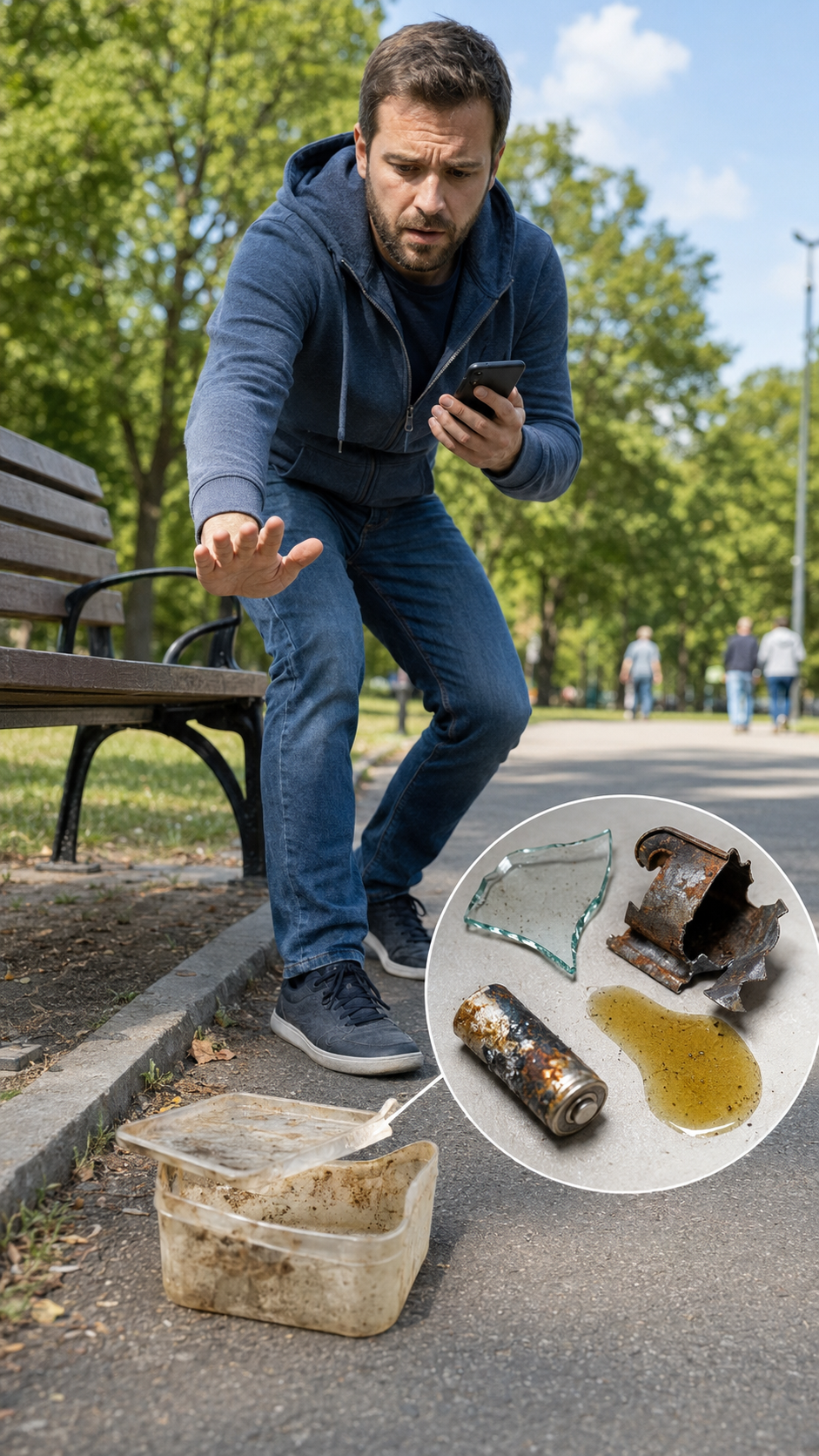
In most cases, the object is harmless. The problem is that its appearance cannot tell you everything about its history, contents, or condition. A bottle may contain something other than what its label suggests. An old metal object may be unexploded ammunition. A discarded needle may be hidden beneath paper or clothing. Even a seemingly ordinary USB drive can carry malicious software.
This does not mean you should panic every time you see litter. It means you should pause before touching something that does not belong to you—especially when the object is damaged, concealed, leaking, unusually placed, or difficult to identify.
Understanding why you should never pick up unknown objects can protect you from injuries, poisoning, infection, cybersecurity threats, and unnecessary legal problems.
When you find an object in a public place, you usually lack three important pieces of information:
Who left it there
What it contains
What happened to it before you found it
That uncertainty matters. An item may have been exposed to bodily fluids, chemicals, insects, extreme heat, water, or physical damage. It could also have been intentionally abandoned because it was unsafe.
Your first reaction should therefore be observation, not contact. Look from a safe distance and consider the location, condition, and surrounding circumstances before deciding what to do.
1. Discarded Needles and Other Sharp Objects Can Cause Injury
Needles, lancets, broken glass, razor blades, fishing hooks, and jagged pieces of metal can easily puncture the skin. Some are difficult to see, particularly when they are inside a bag, wrapped in tissue, buried in sand, or mixed with ordinary trash.
A needlestick injury is not simply a painful cut. A used sharp may have been exposed to blood or other bodily fluids. The Centers for Disease Control and Prevention notes that needlestick injuries can potentially transmit bloodborne pathogens such as hepatitis B, hepatitis C, and HIV. Used sharps should be placed in suitable puncture-resistant containers by people who know how to handle them safely—not carried in bare hands or dropped into ordinary waste bins. CDC guidance on needlestick prevention
If you see a needle in a park, restroom, parking lot, or playground, keep children and pets away. Contact the property manager, local sanitation department, park staff, or police non-emergency line. Local procedures differ, so allow the appropriate authority to arrange its removal.
Never try to break, bend, recap, or hide a discarded needle. Regular gloves may protect against dirt, but they do not necessarily prevent puncture injuries.
2. Bottles and Containers May Hold Toxic Substances
An abandoned drink bottle does not necessarily contain a drink. People sometimes store gasoline, pesticides, cleaning products, solvents, or other chemicals in ordinary beverage containers. Labels may be missing, false, or left over from a product that is no longer inside.
A swollen, corroded, warm, leaking, or pressurized container is especially concerning. Opening it could release irritating vapor, splash chemicals into your eyes, or trigger a reaction. Mixing unknown liquids can also produce heat, fire, toxic gas, or an explosion.
The U.S. Environmental Protection Agency advises people not to mix household hazardous waste and to contact local hazardous-material officials or the fire department for guidance when dealing with corroded containers. EPA household hazardous waste guidance
Do not shake an unidentified bottle to “see what is inside,” smell it closely, or pour out its contents. Move away and prevent others from approaching. If you notice fumes, a strong odor, bubbling, or a visible spill, call emergency services from a safe location.
3. A Harmless-Looking Item Can Have a Dangerous History
One of the clearest real-world examples occurred in England in 2018. Charlie Rowley came into possession of what appeared to be a discarded perfume bottle. The bottle contained the nerve agent Novichok. Rowley became seriously ill, and his partner, Dawn Sturgess, died after being exposed to its contents.
A later official inquiry concluded that the bottle had been disguised as perfume and recklessly discarded following the attempted assassination of Sergei Skripal. Rowley had no reason to know that the contents were toxic. The Dawn Sturgess Inquiry
This was an extraordinary event, not an everyday risk. Still, it demonstrates an important safety principle: appearance and packaging cannot prove that an abandoned product is genuine or safe. An unopened cosmetic, medicine bottle, food package, or drink found outdoors should not be used, tasted, or given to another person.
4. Old Metal Objects May Be Unexploded Ammunition
People occasionally discover ammunition, military debris, grenades, shells, or other unexploded ordnance while hiking, fishing, digging, magnet fishing, or exploring former military areas. Age and corrosion do not make these objects safe. In some cases, deterioration can make their condition less predictable.
Unexploded ammunition may resemble a rusty pipe, tool, toy, or scrap metal. You cannot reliably determine whether it is active simply by looking at it.
The National Park Service warns visitors not to touch, kick, move, uncover, or collect suspected military munitions. Some fuzes may react to movement, magnetism, or temperature changes. Anyone who finds a suspicious metal object in an affected area should move away and report its location to park staff or emergency authorities. National Park Service munition safety guidance
Do not take such an object home as a souvenir. Do not place it in a vehicle, photograph it from close range, or attempt to clean it. Leave the exact area by retracing your steps if it is safe to do so, warn nearby people, and contact the authorities.
5. Unattended Bags and Packages Require Caution
Most forgotten backpacks, shopping bags, and packages are exactly what they appear to be: lost property. Nevertheless, an item may deserve additional caution if it is deliberately concealed, leaking, producing an unusual odor or sound, showing wires, or placed in a location where it does not belong.
Do not open the item to identify its owner. Opening, moving, covering, or carrying a suspicious object may increase the danger and interfere with an official investigation.
The U.S. Cybersecurity and Infrastructure Security Agency recommends avoiding the area, directing others away, isolating the suspected item, and notifying the proper authorities. CISA guidance on suspicious items
In an airport, station, school, office building, mall, or event venue, notify security or an employee. If the circumstances suggest an immediate threat, move to a safe location and call emergency services. Describe what you saw without exaggerating or declaring that the object is definitely a bomb.
6. Unknown Powders, Pills, and Drug Paraphernalia Should Not Be Handled
Loose powder, unmarked pills, foil, pipes, or small bags may be related to illegal drugs, but they may also contain pesticides, industrial chemicals, cleaning agents, or other hazardous materials. Either way, do not touch, sniff, taste, sweep, or vacuum an unidentified substance. Those actions can spread particles into the air.
It is important to keep the risk in perspective. Contrary to some alarming online claims, brief skin contact with powdered fentanyl is not expected to cause opioid poisoning when visible contamination is promptly removed. Inhalation, ingestion, contact with the eyes or mouth, liquid exposure, and accidental needle punctures are more concerning routes. CDC/NIOSH information on fentanyl exposure
That does not make an unknown powder safe to handle. Avoid direct contact, move away, keep others out of the area, and contact the property manager or emergency authorities as appropriate. Only trained responders with suitable protective equipment should collect or test a suspected hazardous substance.
7. Found USB Drives Can Create a Cybersecurity Risk
Physical safety is not the only concern. A USB drive found in a parking lot, office lobby, café, or school may contain private information or malicious software.
Curiosity can be costly. When an unknown drive is connected to a computer, it may expose the device or its network to malware. Renaming files, scanning folders, or opening a document to identify the owner may be enough to create a security incident.
CISA specifically advises people not to plug unknown USB drives into their computers. A found drive should be turned over to the location’s security staff or appropriate authorities. CISA guidance on unknown USB drives
This rule is particularly important at workplaces, schools, hospitals, and government facilities. Do not connect the drive “just for a second,” even if you plan to use an old or unimportant computer.
8. Damaged Electronics and Batteries May Catch Fire
Discarded phones, power banks, e-cigarettes, toys, and rechargeable devices may contain lithium-ion batteries. A battery that has been crushed, punctured, overheated, or exposed to water can become unstable.
Warning signs include swelling, hissing, popping, leaking, excessive heat, or a sharp chemical odor. If a device is smoking or burning, do not pick it up and carry it indoors. Move away, warn others, and call the fire department.
A device that looks intact may simply be lost property, but it should still be handled thoughtfully. Notify nearby staff or police rather than charging it, switching it on, or taking it home.
What About Wallets, Phones, Keys, and Cash?
Helping someone recover a clearly lost possession is different from opening an unidentified container. Still, you should use common sense.
If a wallet, phone, or set of keys is lying in an ordinary, visible place and shows no suspicious characteristics, you may be able to alert an employee without touching it. For example, tell a cashier about a wallet beside a checkout counter or notify transit staff about a phone left on a seat.
If handling appears necessary and the item looks safe, avoid searching through private contents. Turn it over promptly to the business, venue, transit authority, or local police according to local procedure. Laws governing lost property vary, so “finders keepers” should never be treated as a universal rule.
You can also protect yourself from misunderstandings by handling the item in view of staff or another witness. Do not post photographs showing identification, addresses, credit cards, tickets, or other personal information on social media.
What Should You Do When You Find an Unknown Object?
Use this simple response:
Stop before touching it. Do not let curiosity make the decision for you.
Observe from a distance. Look for leaks, damage, wires, sharp edges, fumes, heat, or unusual placement.
Move other people away if necessary. Keep children and pets out of the immediate area.
Notify the right person. Depending on the location, this may be an employee, property manager, park ranger, sanitation department, security officer, police non-emergency line, or emergency service.
Remember the location. Give responders a clear description, but do not approach again to obtain a better photograph.
Follow official instructions. Do not attempt to clean up or transport the item unless a qualified authority tells you it is safe.
Call emergency services immediately if the object is smoking, leaking heavily, associated with threatening behavior, suspected to be explosive, or causing someone to become ill.
What If You Already Touched It?
Do not panic. The correct response depends on the type of exposure.
If an unknown chemical gets on your skin, remove contaminated clothing and rinse the area with plenty of room-temperature running water for at least 15 minutes. If it enters your eyes, remove contact lenses and irrigate continuously for 15 to 20 minutes. In the United States, contact Poison Control at 1-800-222-1222 for individualized advice; outside the U.S., contact your local poison center or emergency service. Poison Control first-aid guidance
If you are punctured by a discarded needle or sharp, wash the wound with soap and water. Do not squeeze it aggressively or apply bleach. Seek immediate medical evaluation because a clinician may need to assess infection risk and time-sensitive post-exposure treatment. CDC guidance following a sharps exposure
Move to fresh air if you inhaled fumes or powder. Call emergency services for trouble breathing, confusion, severe drowsiness, seizures, collapse, significant burns, or rapidly worsening symptoms.
Teach Children: “Don’t Touch, Step Back, Tell an Adult”
Children often pick up unfamiliar objects because they are colorful, shiny, or shaped like toys. Give them a short rule they can remember: Don’t touch it, step back, and tell an adult.
Explain that this rule applies to needles, pills, bottles, fireworks, weapons, animal traps, electronic devices, and closed containers. Avoid frightening them with extreme stories. The goal is to build a pause between curiosity and action.
Adults should model the same behavior. Telling a child not to touch a strange object is less convincing if the adult immediately grabs it for a closer look.
A Moment of Caution Can Prevent a Serious Emergency
Most objects found on sidewalks, beaches, trails, or public transportation will never cause harm. Even so, you cannot always identify danger by appearance alone. Pausing, keeping your distance, and notifying the appropriate person costs very little—and may prevent a puncture wound, toxic exposure, fire, cybersecurity breach, or far more serious emergency.
Have you ever found an object that looked harmless but turned out to be dangerous or suspicious? What did you do, and is there a safety rule you think more people should know? Share your experience in the comments so other readers can learn from it too.
Hi, I’m the creator and editor behind ZestyHabit. I research everyday safety, first aid, and practical wellness topics using official guidance and reliable public sources, then turn that information into clear, realistic steps for daily life.
My goal is to help readers make safer, better-informed choices at home and beyond.