
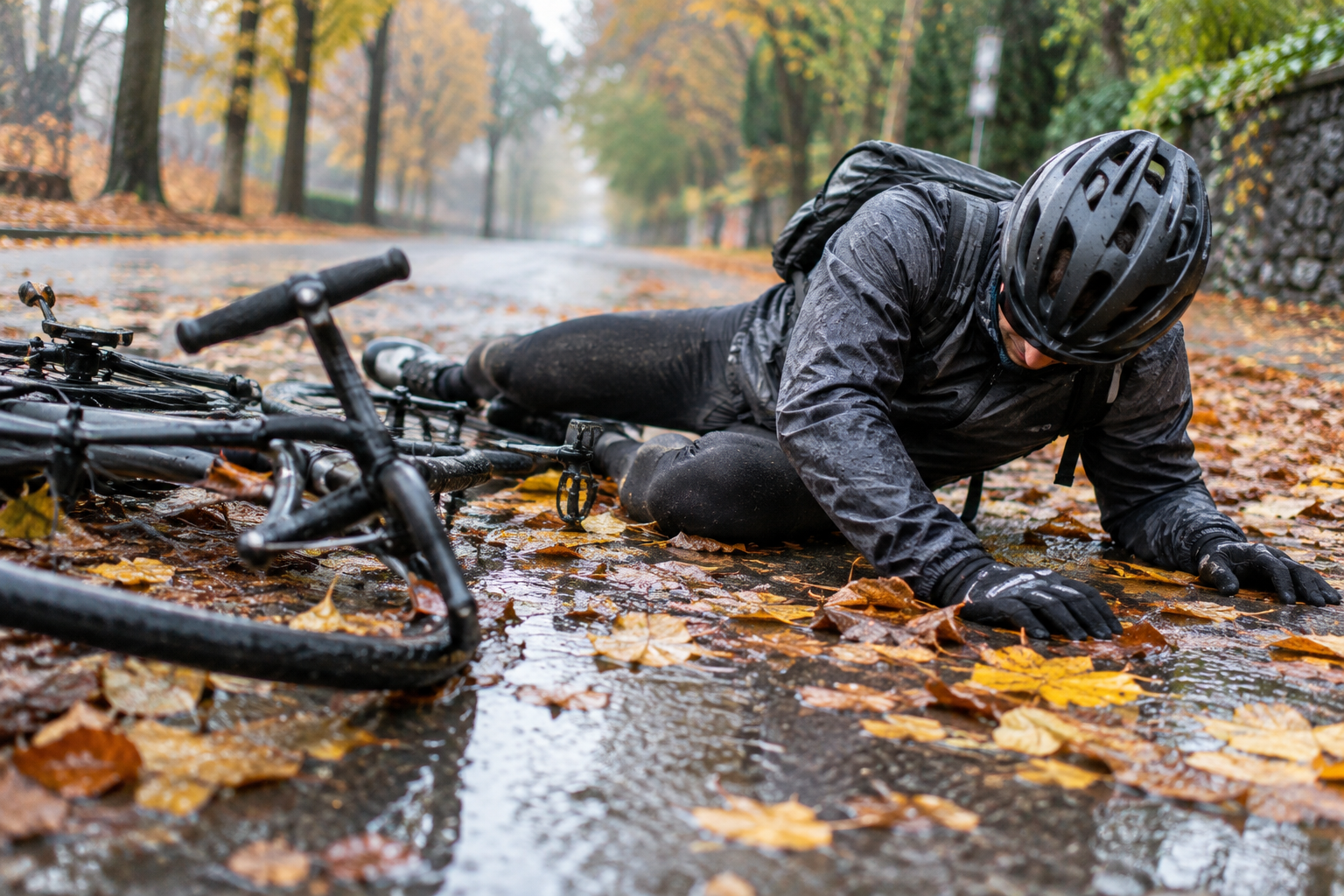

Autumn can be one of the most enjoyable seasons for cycling. The air is cooler, popular routes are often quieter, and tree-lined roads become especially beautiful. Unfortunately, the same leaves that make fall rides attractive can create one of the season’s most underestimated cycling hazards.
Wet leaves can become surprisingly slippery when they collect on roads, bike lanes, bridges, and shared-use paths. A thin layer may hide painted markings, potholes, gravel, drain covers, or uneven pavement. A deeper pile can interfere with steering and make it difficult to judge where the safe riding surface actually begins.
Many wet-leaf bicycle accidents happen without warning. A rider enters a corner at a normal speed, touches the brake, and suddenly loses the front wheel. Another cyclist swerves around a pile of leaves, only to move into traffic or collide with a curb. Even experienced riders can fall when changing direction or braking on a surface that offers less traction than expected.
Understanding the most common accident situations can help cyclists adjust their speed, braking, route choice, and body position before a slide begins.
Why Are Wet Leaves So Slippery for Bicycles?

A bicycle depends on two relatively small tire contact patches to provide traction. When a tire rolls over clean, dry pavement, the rubber can maintain relatively dependable contact with the road. Wet leaves create an unstable layer between the tire and the pavement.
Leaves hold water and may begin to break down into a soft organic film. When compressed by vehicles, bicycles, or pedestrians, they can form a smooth surface that behaves more like mud than dry vegetation. Several overlapping leaves may also slide against one another.
The danger increases when leaves collect over another low-grip surface, such as:
- Painted lane markings
- Metal utility covers
- Drain grates
- Wooden bridges
- Smooth paving stones
- Mud or loose gravel
- Algae-covered pavement
- Previously spilled oil or fuel
A cyclist may believe the tires are gripping the road when they are actually gripping a loose layer that can move independently.
Wet and icy roads reduce tire grip and increase the distance needed to stop. British Cycling and the UK Met Office advise riders to apply both brakes smoothly and complete their braking before entering a corner when conditions are slippery.
Common Wet-Leaf Bicycle Accident Scenarios
1. Braking Hard on a Leaf-Covered Surface

One of the most common accidents occurs when a cyclist notices a hazard and suddenly squeezes the brakes while riding over leaves.
Hard braking asks the tires to generate a large amount of traction. If the available grip is low, a wheel may lock and begin to slide. A locked rear wheel can cause the back of the bicycle to move sideways. A sliding front wheel is often more difficult to recover from and can cause an immediate fall.
This situation frequently happens near:
- Stop signs and traffic lights
- Pedestrian crossings
- Driveways
- Trail intersections
- Park entrances
- Downhill turns
- Areas where vehicles are pulling out
The safest response is to reduce speed before reaching the leaves. Apply the brakes progressively while the bicycle is upright and preferably while the tires are still on clear pavement. Release or significantly reduce brake pressure before crossing the most slippery section.
When braking is unavoidable, avoid grabbing either lever abruptly. Use controlled pressure and keep the bicycle as straight as possible.
2. Leaning Too Far in a Corner
Cornering requires sideways traction. The faster a cyclist travels and the more sharply the bicycle leans, the more grip the tires must provide.

On dry pavement, a familiar corner may feel easy. After rain or morning dew, the same corner may be covered by wet leaves and provide far less traction. If the rider enters at the usual speed, the tires may slide outward.
Front-wheel slides are especially common when a cyclist:
- Turns sharply on top of the leaves
- Brakes while already leaning
- Makes a sudden steering correction
- Looks at the hazard instead of the exit
- Enters the corner too fast
- Crosses a painted line beneath the leaves
Slow down before the turn, not in the middle of it. Keep the bicycle more upright than you would in dry conditions and follow a wider, smoother line where traffic conditions allow. Avoid abrupt steering inputs.
Look through the turn toward the route you want to follow. Staring directly at the leaf pile can encourage tense, exaggerated corrections.
3. Hidden Potholes and Road Debris
Leaves do not merely reduce traction. They can conceal hazards.
A shallow-looking pile may cover a pothole, broken pavement, a curb edge, branches, rocks, glass, or a storm drain. When the front wheel strikes a hidden object, the handlebars may twist or the tire may stop abruptly.
This risk is particularly high in bike lanes because wind and passing vehicles often push leaves and debris toward the edge of the road. Drainage areas also collect water, leaves, and sediment.
Do not assume that a leaf-covered area is flat simply because the surrounding pavement is smooth. When you cannot see the surface, reduce your speed enough to respond to an unexpected change.
Choose a clear path when one is available, but check behind you before moving sideways. Swerving suddenly into a traffic lane may create a greater danger than crossing the leaves carefully.
4. Sudden Swerving Around a Leaf Pile
Cyclists sometimes recognize the hazard too late and make a sharp turn to avoid it. This can lead to a collision with a curb, parked car, another rider, pedestrian, or moving vehicle.
A last-second swerve may also cause the tires to lose traction, especially when the maneuver begins on wet pavement.
Scan farther ahead so you can identify leaf piles early. Before changing your position:
- Look over your shoulder for approaching traffic.
- Signal when appropriate.
- Move gradually and predictably.
- Return to your normal line only after clearing the hazard.
If you cannot safely move around the leaves, slow down and travel through them in a straight line. In particularly deep or uncertain sections, it may be safer to stop and walk the bicycle.
Cyclists remain vulnerable to weather and road-surface conditions, making early hazard recognition and predictable riding important parts of crash prevention.
5. Descending Through Wet Leaves
Downhill riding combines speed, gravity, longer stopping distances, and limited reaction time. Leaves often accumulate in shaded descents, wooded roads, switchbacks, and gutters.
A cyclist may accelerate into a leaf-covered section and then discover that braking traction is much lower than expected. Excessive rear braking can cause a skid, while abrupt front braking may destabilize the bike.
Before beginning a descent, assume that shaded corners may remain wet even when nearby roads look dry. Reduce speed early and maintain a margin for unexpected hazards.
Use both brakes smoothly while the bicycle is upright. Avoid dragging the brakes aggressively through a leaf-covered turn. On a long descent, keep your fingers ready on the brake levers and leave more distance behind other cyclists.
Never follow a rider so closely that their fall leaves you no escape route.
6. Group-Riding Collisions
Wet-leaf crashes can involve several cyclists when a group rides closely together.
The first rider may brake suddenly after spotting a slippery patch. Riders behind may overlap wheels, collide, or attempt abrupt evasive movements. Alternatively, one rider may fall and bring down those following.
Increase the gap between bicycles in wet conditions. Communicate hazards clearly with a verbal warning or hand signal when it is safe to do so. Avoid pointing so dramatically that you lose control of your own bike.
Group leaders should reduce the pace before entering wooded or heavily leaf-covered sections. Riders should avoid riding side by side when the safe line is narrow.
Everyone in the group should understand that autumn conditions require a larger safety margin than dry summer pavement.
7. Slipping When Starting or Stopping
Not every fall happens at speed.
Wet leaves near intersections, trail entrances, and curbs can cause a foot to slip when a cyclist stops. A rear tire may also spin when the rider applies too much force while starting, particularly on an incline.
Approach stops slowly and choose a visible patch of pavement for your foot whenever possible. Unclip early when using clipless pedals. Avoid placing a shoe on a wet painted marking, metal cover, or thick pile of leaves.
When starting, use a moderate gear and apply power smoothly. Standing on the pedals and pushing hard can cause the rear tire to lose traction.
How to Ride Safely Over Wet Leaves
Sometimes avoiding the leaves completely is not possible. In that situation, the goal is to minimize the demands placed on your tires.
Approach the section slowly and keep the bicycle upright. Relax your shoulders, bend your elbows slightly, and maintain a light grip on the handlebars. Tension can cause sudden steering movements.
Travel in a straight line with a steady speed. Avoid pedaling forcefully, braking sharply, or turning while crossing the leaves. Let the bicycle roll smoothly until both tires return to clear pavement.
If the leaves are deep enough to hide the ground, get off and walk. Losing a few minutes is preferable to suffering a head injury, broken wrist, shoulder injury, or collision with traffic.
Adjust Your Speed and Following Distance
The correct speed depends on visibility, gradient, traffic, tire condition, and the depth of the leaves. There is no single safe number.
A useful rule is to travel slowly enough that you can stop within the distance of road you can clearly see. When the visible pavement disappears beneath leaves, your safe speed should decrease.
Allow extra space behind cars, bicycles, and pedestrians. They may stop or change direction unexpectedly, and your own braking distance may be longer than usual.
Drivers may also need additional stopping distance on wet roads, so do not assume a vehicle can stop quickly simply because the driver sees you.
Check Your Tires Before Autumn Rides
Tires cannot eliminate the danger of wet leaves, but worn or improperly inflated tires may make control more difficult.
Inspect both tires regularly for:
- Excessively worn tread
- Cracks or cuts
- Embedded glass
- Sidewall damage
- Bulges
- Incorrect pressure
- Slow leaks
Use a pressure appropriate for your tire size, bicycle, load, and manufacturer’s recommendations. Overinflating tires can reduce comfort and may make the bicycle feel less controlled on uneven surfaces. Extremely low pressure, however, can cause poor handling, rim damage, or pinch punctures.
Wider tires operated at a suitable pressure may offer more confidence on rough or wet roads, but no bicycle tire can make a slick layer of leaves completely safe.
Check that both wheels are properly secured and that the tires have not deteriorated with age.
Maintain Your Brakes
Wet conditions can affect braking performance, particularly on bicycles with rim brakes. Water and debris on the wheel rim may delay braking response until the pads begin to clear the surface.
Test your brakes at low speed before entering traffic or beginning a descent. The levers should not pull all the way to the handlebars, and the braking action should feel predictable.
Inspect the brake pads for wear and contamination. Clean braking surfaces according to the bicycle or component manufacturer’s instructions.
Disc brakes generally provide dependable wet-weather performance, but they still require maintenance. Contaminated pads, worn rotors, air in hydraulic lines, or poorly adjusted mechanical cables can reduce braking effectiveness.
No brake system can overcome a complete loss of tire traction. Strong brakes are useful only when their force is applied smoothly enough for the tires to remain in contact with the surface.
Improve Your Visibility
Wet-leaf conditions often occur during rain, fog, overcast weather, or shorter autumn days. Drivers may have difficulty seeing a cyclist against a dark background.
Use a white front light and a red rear light when visibility is poor or when required by local law. Reflective details on clothing, shoes, bags, and pedals can also make movement more noticeable.
Bright clothing does not replace lights, and visibility equipment does not replace defensive riding. Use both.
British Cycling recommends reflective clothing in poor conditions, while NHTSA emphasizes visibility, helmet use, predictable movement, and defensive riding as core bicycle-safety practices.
Wear a Properly Fitted Helmet
A helmet cannot prevent a bicycle from sliding, but it may reduce the risk of serious head injury during a fall.
Wear a helmet that meets an applicable safety standard and fits securely. It should sit level on your head rather than tilted backward. Adjust the side straps so they form a “V” around each ear, and tighten the chin strap enough that the helmet does not shift significantly.
Replace a helmet after a substantial impact, even when the outer shell appears undamaged. Internal protective material may have absorbed energy during the crash.
A helmet is only one layer of protection. Speed control and early hazard recognition remain the best ways to prevent the fall itself.
What to Do After a Wet-Leaf Bicycle Fall
Move out of traffic only when you can do so safely. If you may have injured your neck, back, hip, or leg, avoid unnecessary movement and call emergency services.
Seek urgent medical care after a crash when there is:
- Loss of consciousness
- Confusion or unusual drowsiness
- Repeated vomiting
- Severe or worsening headache
- Neck or back pain
- Difficulty breathing
- Heavy bleeding
- Obvious deformity
- Inability to bear weight
- Weakness, numbness, or loss of coordination
Even a low-speed slide can cause a concussion, wrist fracture, collarbone fracture, deep abrasion, or shoulder injury. Do not continue riding simply because the bicycle appears usable.
Inspect the helmet, wheels, handlebars, brake levers, derailleur, chain, and frame before riding again. A twisted handlebar or damaged brake may not be immediately obvious.
A Simple Wet-Leaf Safety Routine
Before an autumn ride, check the weather, lights, brakes, and tires. Assume shaded roads may remain damp long after rainfall stops.
During the ride, scan well ahead and reduce speed before reaching leaves. Brake while upright, keep extra distance, and avoid sudden changes in direction. Cross unavoidable patches smoothly and in a straight line.
After the ride, remove leaves and moisture from the bicycle. Clean the braking surfaces, inspect the tires, and lubricate the chain with a product suitable for wet conditions when necessary. Regular cleaning is especially important because wet roads can carry grit and debris into the bicycle’s moving components.
The Bottom Line
Wet leaves can turn an ordinary road or bike path into a low-traction surface while hiding potholes, gravel, metal covers, and other hazards. The most common accidents involve hard braking, sharp cornering, sudden swerving, excessive downhill speed, or riding too closely behind another cyclist.
Preventing these crashes begins before the tires reach the leaves. Reduce speed early, complete most of your braking while the bicycle is upright, maintain a relaxed grip, and choose a smooth, predictable line. When you cannot see the ground or safely control the bike, stop and walk through the hazardous area.
Have you ever lost traction or narrowly avoided a crash on wet leaves? Share your experience in the comments, including where it happened, what caused the problem, and what you now do differently during autumn rides. Your lesson may help another cyclist recognize the danger before their next fall.

Hi, I’m the creator and editor behind ZestyHabit. I research everyday safety, first aid, and practical wellness topics using official guidance and reliable public sources, then turn that information into clear, realistic steps for daily life.
My goal is to help readers make safer, better-informed choices at home and beyond.


