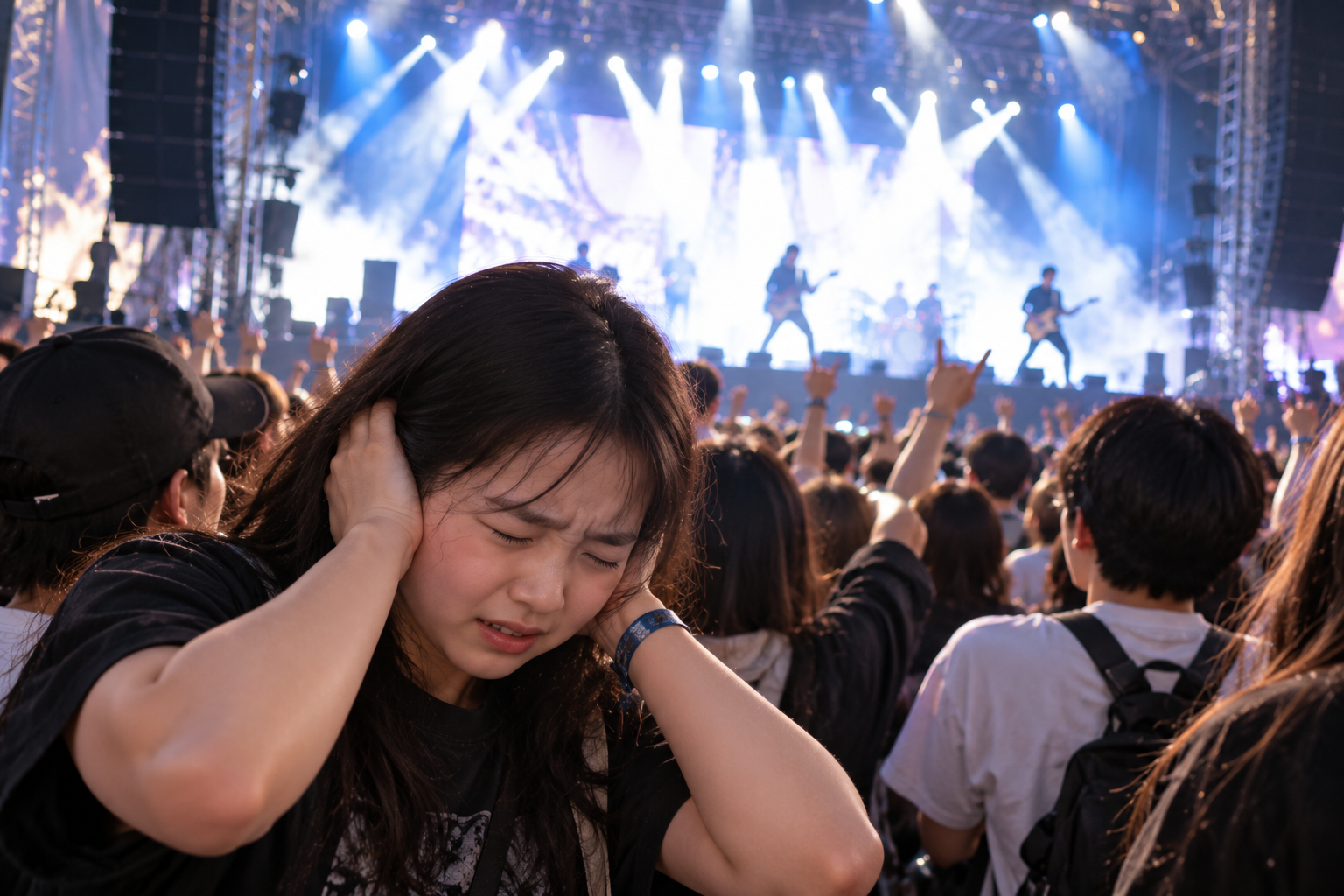
Concert Speakers and Hearing Safety: Ear Damage, Hearing Loss, and Safer Ways to Enjoy Live Music
Minjin Park
·
Learn how loud concert speakers can damage hearing, why ringing and muffled ears matter, which symptoms need urgent care, and how earplugs, distance, and listening breaks can make concerts safer.
The lights go down, the crowd erupts, and the first bass note is powerful enough to feel in your chest. That intensity is part of what makes live music exciting. Unfortunately, the sound levels that create an unforgettable concert can also place significant stress on the inner ear.
Concert hearing damage is not limited to people who attend festivals every weekend. A single extremely loud event can affect hearing, while repeated concerts can gradually add to a person’s lifetime noise exposure. You may leave with ringing ears, muffled sound, or a feeling of fullness and assume that it is simply part of the experience. Those symptoms are better understood as warnings that the ears have been exposed to more sound than they could comfortably handle.
Concerts, sporting events, and music played at maximum volume commonly reach approximately 94 to 110 A-weighted decibels. At those levels, the amount of time considered acceptable under hearing-protection guidelines becomes much shorter than the typical length of a concert.
The good news is that enjoying live music and protecting your hearing are not opposing goals. Distance, well-fitted hearing protection, quiet breaks, and smarter venue choices can dramatically reduce your exposure without requiring you to give up concerts.
Important: Sudden hearing loss, especially in one ear, should be treated as a medical emergency. Seek immediate medical evaluation rather than waiting for the ear to “pop” or recover on its own.
Sound travels through the ear canal and vibrates the eardrum. Those vibrations pass through the small bones of the middle ear and into the cochlea, a fluid-filled structure in the inner ear. Inside the cochlea, delicate sensory hair cells help convert movement into electrical signals that the brain interprets as sound.
When sound is excessively loud, these hair cells and their microscopic projections can become overstressed or damaged. Human inner-ear hair cells do not reliably grow back after they die, which is one reason noise-induced hearing loss can be permanent.
The risk depends on three closely connected factors:
How loud the sound is
How long you remain exposed
How close you are to the sound source
This means that standing directly beside a speaker stack for ten minutes may create a very different exposure from listening to the same show farther back in the venue. It also means that a three-day festival can place more cumulative stress on hearing than a shorter performance, especially when there is little quiet recovery time between sets.
The National Institute on Deafness and Other Communication Disorders offers a useful principle: avoid sounds that are too loud, too close, or last too long.
How Loud Is Too Loud at a Concert?
Decibels use a logarithmic scale, so a relatively small increase in the number represents a meaningful increase in sound energy. You should not interpret 100 dBA as only slightly louder than 90 dBA in terms of potential exposure.
The National Institute for Occupational Safety and Health recommends an occupational exposure limit of 85 dBA averaged over eight hours. Under its three-decibel exchange rate, every three-decibel increase cuts the recommended exposure time in half:
85 dBA: 8 hours
88 dBA: 4 hours
91 dBA: 2 hours
94 dBA: 1 hour
97 dBA: 30 minutes
100 dBA: 15 minutes
These limits were developed for workplace hearing conservation and should not be treated as a guarantee that every person can tolerate that exact exposure without harm. They do, however, demonstrate how quickly permitted exposure time falls as volume increases.
A concert lasting two or three hours may therefore exceed conservative exposure recommendations when the average sound level remains in the upper 90s or above.
You may not have a calibrated sound meter with you, but your surroundings can still provide clues. According to World Health Organization guidance, an environment may be excessively loud when you must raise your voice to communicate with someone approximately an arm’s length away. Pain, ringing, or a blocked sensation in the ears are even clearer warning signs.
Ringing and Muffled Hearing Are Not Harmless Souvenirs
Many concertgoers have experienced temporary ringing, buzzing, hissing, or roaring after a show. This is tinnitus. Others notice that speech sounds distant or dull, as though cotton has been placed in the ears.
These symptoms sometimes improve over several hours or within a day or two. NIDCD notes that temporary hearing loss after loud noise may disappear within approximately 16 to 48 hours. However, research suggests that some long-term damage may remain even when hearing appears to return to normal.
That is why the absence of permanent symptoms after a previous concert does not prove that the exposure was safe.
Repeated episodes of temporary muffling may gradually become more noticeable. Over time, a person might struggle to follow conversations in restaurants, misunderstand speech on the phone, turn up the television, or find that voices sound unclear even though they can still hear that someone is speaking.
Noise-induced hearing loss often develops gradually enough that people adjust without realizing how much clarity they have lost.
Common Signs of Concert-Related Ear Stress
After a loud performance, pay attention to symptoms such as:
Ringing, buzzing, roaring, or hissing
Muffled or distorted sound
Ear fullness or pressure
Difficulty understanding speech
Needing others to repeat themselves
Sounds seeming unusually distant
Increased sensitivity to ordinary sounds
Ear discomfort or pain
Dizziness or balance problems
A noticeable difference between the two ears
Ringing that fades does not necessarily mean that nothing happened. It means the auditory system reacted to the exposure.
If you repeatedly leave concerts with symptoms, your current protection strategy is not sufficient. The answer is not to train your ears to tolerate louder sound. Instead, reduce the sound dose at future events.
What to Do Immediately When a Concert Feels Too Loud
Do not wait until the final song to respond.
Move farther away from the speakers, ideally toward the back or side of the venue. Avoid standing beside speaker stacks, stage monitors, or barriers positioned close to amplified equipment.
Insert earplugs correctly. Earplugs that sit loosely at the entrance of the ear canal may provide much less protection than expected. Foam plugs need to be rolled, inserted, and held in place while they expand. Reusable musician’s plugs should fit securely without causing pain.
Take a break in a quieter lobby, hallway, outdoor area, or designated relaxation zone. Even a short break reduces the amount of continuous sound exposure, although it does not erase exposure that has already occurred. WHO safe-listening guidance encourages venues to provide quiet areas and audiences to take breaks away from loud sound.
Leave the area when your ears hurt, ring, or suddenly sound muffled. Staying because you have already paid for the ticket only increases the exposure.
Safer Alternative 1: Wear High-Fidelity Concert Earplugs
Ordinary foam earplugs can provide useful protection, but some people dislike how they change the sound of music. They may reduce high frequencies more noticeably, making a performance seem dull or muddy.
High-fidelity or musician’s earplugs are designed to reduce sound more evenly across frequencies. They usually lower the overall level while preserving more of the balance between vocals and instruments. This can make them easier to use consistently at concerts.
Reusable filtered plugs are widely available, while custom-molded musician’s earplugs can be fitted by an audiologist for people who attend concerts frequently, perform music, work in venues, or find that standard plugs do not fit well.
No earplug works when it remains in your pocket. Put the plugs in before entering the loudest area rather than waiting for your ears to begin ringing. NIOSH specifically recommends hearing protection designed for musicians when appropriate.
Safer Alternative 2: Choose Your Location Carefully
Front row does not always mean best sound.
The area immediately beside a large speaker may be dramatically louder than a position farther away. Stepping back can reduce sound intensity while often producing a more balanced mix, because you are hearing more of the overall sound system rather than one nearby speaker.
Avoid lingering directly in front of subwoofers or speaker towers. When attending general-admission events, walk around before the main performance and notice where conversation becomes especially difficult.
For seated concerts, choose seats farther from speaker arrays when the venue map makes their location clear. At festivals, do not assume that standing behind a barrier or along the side of the stage is safer; smaller side-fill speakers may still be nearby.
Distance is one of the basic hearing-protection measures recommended by NIDCD, WHO, and hearing professionals.
Safer Alternative 3: Take Planned Listening Breaks
People often remain in the loudest area continuously because they do not want to lose their place. A safer plan is to decide in advance when you will step away.
For example, take a short quiet break between performers or after approximately an hour in the main crowd. During a festival, avoid filling every break with another amplified stage, nightclub, or maximum-volume headphone session.
The ears do not become protected simply because the sound is enjoyable. Sound energy still counts whether it comes from machinery, a favorite band, or a stadium crowd.
NIOSH recommends using breaks in quiet areas whenever possible, particularly for musicians and workers who face repeated exposure.
Safer Alternative 4: Monitor the Sound Level
Many phones and smartwatches can estimate environmental sound levels. These readings are not always as precise as professional equipment, particularly at very high volumes or when the microphone is obstructed. Still, they can help identify that an environment is consistently loud enough to justify protection.
Use the measurement as a warning tool rather than a challenge. A reading of 100 dBA does not mean that you have exactly 15 safe minutes remaining or that your ears are guaranteed to be unharmed before the timer ends.
Venue sound can also fluctuate. The average may appear reasonable while peaks are substantially louder.
WHO encourages people to use sound-monitoring technology and choose devices with safe-listening features. NIOSH likewise notes that smartphone tools may provide useful information when professional measurement equipment is unavailable.
Children Need Proper Hearing Protection Too
Children’s ears are not immune to noise injury, and young children cannot reliably judge when an environment is too loud or insert earplugs correctly.
Well-fitted hearing-protection earmuffs are often easier for children to use than small earplugs. The earmuffs should fit securely over both ears without gaps caused by hats, glasses, or hair.
Do not use ordinary music headphones as hearing protectors unless they are specifically designed and rated for that purpose. Turning on music inside headphones to cover the concert sound can increase the total noise exposure.
NIDCD recommends protecting children who are too young to protect their own hearing.
Infants and very young children may be better served by attending lower-volume, family-oriented performances or staying away from amplified venues altogether.
What to Do After an Overly Loud Concert
Move to a quiet environment and avoid additional loud sound. Do not immediately listen to music through headphones at a high volume on the trip home.
Notice whether hearing is equal in both ears and whether speech sounds clear. Give your ears quiet recovery time, but do not use rest as a reason to ignore significant symptoms.
There is no proven drink, supplement, ear massage, or home remedy that can reverse inner-ear noise damage. Do not place oil, hydrogen peroxide, or other liquids into the ear unless a clinician has identified a condition that requires them.
Arrange a hearing assessment when ringing, muffled hearing, or sound sensitivity persists, recurs frequently, or interferes with communication. NIDCD recommends hearing testing when you believe you may have hearing loss.
When Hearing Changes Are an Emergency
A sudden major reduction in hearing—often affecting one ear—should not be assumed to be temporary concert muffling.
Sudden sensorineural hearing loss can occur all at once or over several days. It may be accompanied by ear fullness, tinnitus, dizziness, or a popping sensation. NIDCD classifies sudden deafness as a medical emergency because delayed diagnosis and treatment can reduce the chance of recovery.
New neurological symptoms, facial weakness, or confusion
Blood or fluid coming from the ear
Severe ear pain after an explosive sound
A suspected ruptured eardrum
Hearing changes after a head injury
Rapidly worsening tinnitus with hearing loss
Persistent ringing or muffling without a sudden major loss still deserves evaluation, especially when symptoms do not continue improving after leaving the noisy environment.
Concert Hearing Myths That Increase Risk
“My ears do not hurt, so the sound is safe.”
Pain is not required for hearing damage. Sound can injure the inner ear before it becomes physically painful.
“I only attend a few concerts each year.”
A limited number of events can still involve hazardous exposure, particularly near speakers or at multi-hour festivals. Risk depends on intensity and duration, not simply the number of events.
“My ears always recover the next morning.”
Apparent recovery does not guarantee that no residual injury occurred. Temporary muffling itself is a warning sign.
“Earplugs ruin the music.”
Poorly fitted foam plugs may alter the sound, but musician’s earplugs are designed to preserve more sound quality while lowering the overall level.
“A sound-level app says I am safe.”
A phone provides an estimate, not a medical guarantee. Microphone limitations, brief sound peaks, exposure from earlier in the day, and individual susceptibility all matter.
Enjoy the Music Without Sacrificing Your Hearing
Live music should leave you remembering the performance, not struggling to hear conversations for the next several days.
Bring hearing protection to every concert, even when you are unsure whether you will need it. Put it in before the headliner begins. Stay away from the speakers, take quiet breaks, monitor warning signs, and protect children with properly fitted equipment.
Noise-induced hearing loss is preventable, but hearing that has been permanently lost cannot simply be restored by resting after the show. A few small choices during a concert can protect the hearing you will rely on for every future song, conversation, and everyday sound.
Have you ever experienced ringing or muffled hearing after a concert? Do you prefer foam plugs, high-fidelity musician’s earplugs, or another hearing-protection strategy? Share your experience in the comments—your tip may help another concertgoer enjoy live music more safely.
Hi, I’m the creator and editor behind ZestyHabit. I research everyday safety, first aid, and practical wellness topics using official guidance and reliable public sources, then turn that information into clear, realistic steps for daily life.
My goal is to help readers make safer, better-informed choices at home and beyond.