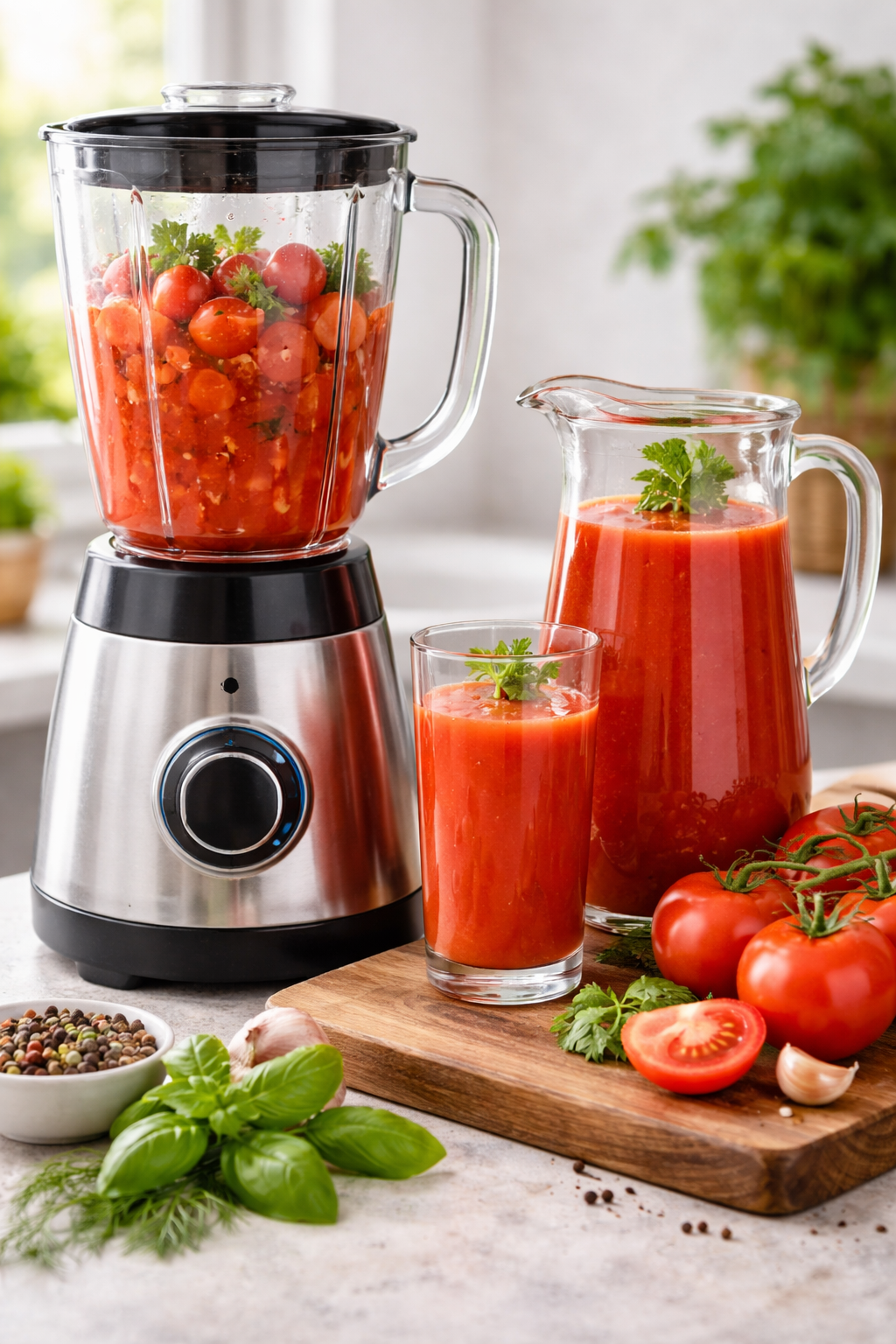
Tomato juice is one of those drinks people rarely feel neutral about.
Orange juice is easy. Apple juice is familiar. Grape juice barely asks for interpretation. Tomato juice, on the other hand, lands with a savory thud. It is thicker, earthier, a little grassy, sometimes sharply acidic, sometimes oddly comforting. It can feel like breakfast, a health ritual, an airline beverage, a hangover companion, or the liquid form of a salad, depending on who is drinking it and why.
That ambiguity is part of what makes it interesting. Tomato juice is not simply “juice made from tomatoes.” It occupies a strange middle ground between beverage and food, refreshment and nourishment, convenience and compromise. People often talk about it as if it were obviously healthy or obviously unpleasant, but neither reaction says much on its own. The more useful question is: what kind of drink is tomato juice, really?
Its character comes from a combination of things that do not usually appear together in the juice aisle. It has natural sweetness, yes, but also acidity, umami, some bitterness, and a texture that reminds you tomatoes are not fruit in the way apples are fruit, no matter what botany says. Tomato juice can be restorative or disappointing depending almost entirely on how it is made, what has been added, and what you expected from the first sip.
This is the first thing worth understanding. Most juices are built around sugar and aroma. Tomato juice is built around balance.
A decent tomato juice has tartness from the tomato’s natural acids, mild sweetness from its sugars, a savory depth from glutamates, and a texture that feels substantial rather than slick. Even when chilled, it does not read as a purely refreshing drink in the way citrus juice does. It feels heavier in the mouth, more meal-adjacent.
That is why people who dislike it often say it feels like “drinking soup,” though that is not quite right either. Soup usually carries seasoning, broth notes, fat, or herbs. Plain tomato juice is cleaner than that, but still distinctly food-like.
This is one of its defining traits: tomato juice offers flavor that asks to be considered rather than simply swallowed. That alone sets it apart from the sweeter, simpler juices most people grow up with.
The main characteristics of tomato juice
If someone asked what tomato juice is like without ever having tried it, several traits would matter more than any nutritional claim.
It is savory in a category that is mostly sweet
This may be the most obvious characteristic, but it is also the most important. Tomato juice does contain natural sugars, yet sweetness is not the headline. Its savory quality is what makes it memorable.
The umami comes from naturally occurring glutamates in tomatoes. That is why tomato juice can feel surprisingly satisfying even without much else going on. It has some of the same appetite-awakening quality people respond to in cooked tomatoes, broth, aged cheese, mushrooms, or soy-based foods. It gives the impression of substance.
That savory note is also why tomato juice is one of the only juices people routinely season like food. Salt, pepper, celery salt, hot sauce, lemon, even Worcestershire sauce all make sense with tomato juice in a way they never would with pear juice.
It has body
Tomato juice is usually thicker than standard fruit juice, though not as thick as a smoothie. That slight heaviness changes how people experience it.
A thin beverage disappears quickly. Tomato juice lingers. It coats the mouth a little. It asks for slower drinking, especially when chilled. This is why some people find it more filling and others find it vaguely tiring. Texture is not incidental here; it is part of the drink’s identity.
It can taste fresh or strangely flat
Tomato juice has a narrower margin for error than people realize. A good one tastes bright, vegetal, slightly sweet, and lively. A bad one tastes metallic, dull, or aggressively salty, with all the life cooked out of it.
This difference is crucial because many people think they dislike tomato juice when what they really dislike is mediocre packaged tomato juice. The category is only as good as its handling.
Why people often associate it with health
Tomato juice has a long-standing health-minded reputation, and there are understandable reasons for that.
Tomatoes contain vitamin C, potassium, and various plant compounds, especially lycopene, the carotenoid that gives tomatoes their red color. Lycopene is one of the main nutritional reasons tomato products get attention. It has been studied for its antioxidant properties, and tomatoes remain one of the better-known dietary sources.
Tomato juice also tends to feel more virtuous than many other packaged drinks because it is not obviously sugary in the way fruit punch or soda is. It looks serious. It tastes adult. It is served in small glasses instead of oversized cups. All of that contributes to the impression that it belongs to the category of sensible choices.
Sometimes that impression is justified. Sometimes it is doing more work than the label deserves.
Many commercial tomato juices contain a great deal of sodium, which helps with flavor but can change the nutritional picture. Others may include added ingredients that make them more processed than people assume. So yes, tomato juice can be a useful drink. No, the category should not get a free pass simply because it is red and vegetable-based.
A surprising detail: processed tomatoes can have an advantage
Lycopene becomes more available to the body after tomatoes are cooked and processed. That means tomato juice, canned tomatoes, and tomato paste can in some cases make this specific compound easier to absorb than raw tomato slices in a salad. Add a little fat alongside them, and absorption may improve further.
This does not mean processed tomato products are always “better” than fresh tomatoes. Fresh tomatoes bring their own appeal, texture, freshness, and nutritional value. But it does mean tomato juice is not just a second-rate substitute for the whole vegetable. In at least one respect, processing changes the equation in a favorable way.
That is the kind of nuance food conversations often miss. A product can lose something in processing and still gain something else.
Why tomato juice tastes better in some situations than others
Tomato juice is unusually dependent on context.
It can taste excellent when you are hungry but not ready for a full meal. It can feel restorative after travel, especially when dry air and irregular eating have made sweeter drinks cloying. It can work with breakfast in a way most vegetable beverages do not, because its acidity and savoriness cut through eggs, toast, and richer foods.
It can also taste terrible if you expected something refreshing and sweet.
This gap between expectation and experience explains a lot of tomato juice’s mixed reputation. People often approach juice expecting easy sweetness and immediate pleasure. Tomato juice is not built that way. It is more like a drink you negotiate with, then gradually understand.
There is also the cold factor. Tomato juice served properly chilled is far more appealing than lukewarm tomato juice, which can seem flat and vaguely medicinal. Temperature sharpens its edges and makes the acidity feel cleaner.
A practical example: when tomato juice actually works
One of the best uses for tomato juice is as a small, savory bridge between meals.
Imagine a late morning when breakfast was too small and lunch is still a while off. Sweet options start to sound irritating. Another coffee feels like a mistake. A small glass of tomato juice with a few crackers, a boiled egg, or a piece of toast can work surprisingly well because it does not behave like a sweet snack. It offers salt, acidity, and that faintly filling quality that comes from its texture.
This is where tomato juice’s “food-like” nature becomes an advantage. It can steady appetite in a way lighter drinks often do not.
It also works well as part of a brunch spread, where its savory profile creates contrast. That is one reason tomato juice has survived in settings where many other juices feel interchangeable. It brings something structurally different to the table.
The common mistake: assuming all tomato juice is basically the same
This is probably the biggest misunderstanding around the drink.
Tomato juice varies enormously depending on the tomatoes used, whether it is strained heavily, how much salt is added, whether it is from concentrate, and what sort of acid balance it has. Some versions are vibrant and fresh-tasting. Others are thick, overly salted, and dead on arrival.
People also confuse plain tomato juice with vegetable cocktails that include celery, beet, carrot, lemon, spices, and other additions. Those drinks can be enjoyable, but they are not the same thing. Their flavor is often more assertive, more seasoned, and more engineered. Plain tomato juice is simpler and, at its best, more transparent.
Another mistake is treating homemade and store-bought juice as if the difference were trivial. It is not trivial. Freshly made tomato juice, especially from ripe tomatoes and a touch of salt, can taste vivid and almost sweet in a way boxed versions rarely do. The bottled kind is often built for shelf life and consistency, which can mute what makes tomatoes appealing in the first place.
Salt is both the making and the problem
Tomato juice without enough salt can taste oddly hollow. Tomato juice with too much salt can taste like punishment disguised as health food.
This tension is built into the category.
Salt does important work here. It rounds out acidity, heightens umami, and makes the tomato taste more fully like itself. A pinch can transform the drink. But because salt is so effective, manufacturers often lean hard on it. The result is a beverage that feels robust at first sip and exhausting by the end of the glass.
This is one reason low-sodium versions get mixed reviews. Some are genuinely better balanced. Others taste stripped and joyless because the makers removed sodium without solving the underlying flavor problem.
For readers who are trying to be sensible about salt, tomato juice is a good example of why “healthy” labels deserve a second look. A glass may offer nutritional value, but the sodium content can still be substantial. That does not mean no one should drink it. It means the details matter.
If you are wondering whether tomato juice is better than eating tomatoes
Not exactly. It is different.
Whole tomatoes provide more chewing, more satiety from the act of eating, and often more freshness. Juice is faster, easier, and sometimes more concentrated in specific compounds like lycopene depending on how it is processed. But it also changes the experience. A drink rarely satisfies in quite the same way as food you bite into.
If your goal is simply to include more tomato flavor and some of the nutritional benefits, tomato juice can help. If your goal is to replace vegetables entirely with a beverage, that is a less convincing strategy.
The better view is to treat tomato juice as one format among several. Raw tomatoes, cooked tomatoes, canned tomatoes, sauces, soups, and juice all do slightly different jobs.
Tomato juice and the airline effect
There is a long-running curiosity about why tomato juice seems especially popular on airplanes. Even people who never order it on the ground suddenly consider it at cruising altitude.
Some of that is ritual. Some of it is the limited beverage menu. But there is also a sensory explanation: altitude and dry cabin air can dull sweetness and salt perception, while savory, umami-rich flavors may remain more appealing. Tomato juice, already sturdy and savory, survives that environment better than delicate drinks do.
This is a small but telling insight about the beverage. Tomato juice is not dependent on bright sweetness to make its case. Its appeal rests on structure and savoriness, which can hold up under less-than-ideal conditions.
A drink that still tastes like itself in a pressurized metal tube has a certain stubborn dignity.
The texture question people rarely mention directly
A lot of tomato juice opinions are really texture opinions disguised as taste opinions.
Some people dislike pulp, sediment, or that slight graininess natural tomato solids can produce. Others find ultra-strained tomato juice too thin and characterless. There is no single correct texture, but there is a narrow band where the drink feels balanced: substantial enough to feel tomato-like, smooth enough to remain drinkable.
This matters because food preferences are often more tactile than people admit. Someone may say tomato juice tastes weird when what they actually mean is that drinking a vegetable with this level of body feels wrong to them. Once you understand that, the divided reactions make more sense.
Texture is also why tomato juice does not usually invite large servings. A small glass can feel satisfying. A very large one can start to feel like work.
It is more versatile than its reputation suggests
Tomato juice is often boxed into two roles: health drink or cocktail base. It can be both, but that is too narrow.
It can be used in chilled soups, rice dishes, stews, marinades, and quick braises. It can be warmed gently with spices as a light savory drink. It can anchor a breakfast alongside eggs or cheese better than sweet juice can. In cooking, it sometimes functions almost like a lighter substitute for crushed tomatoes when you want liquid and tomato flavor at once.
This versatility is another defining characteristic. Tomato juice is not only something you drink straight. It is an ingredient with beverage status, which is a strange and useful thing to be.
Why tomato juice keeps its niche
Tomato juice has survived for decades not because it is universally loved, but because it offers something unusually specific.
It is savory without being a broth, nutritious without being a smoothie, and convenient without pretending to be indulgent. It appeals to people who want a drink that feels grown-up, substantial, and slightly medicinal in the best sense of the word—not because it tastes like medicine, but because it feels like it does something.
That usefulness gives it staying power. It can sit in a pantry or refrigerator as the drink for the moment when sweetness is too much, coffee is a bad idea, and plain water feels insufficient.
The truth is that tomato juice is a somewhat demanding beverage. It asks you to like acidity, tolerate texture, and appreciate savory flavors in a context where most drinks go the other direction. That demand filters out casual enthusiasm. The people who like tomato juice tend to mean it.
And maybe that is its most distinctive characteristic of all. Tomato juice is not popular because it flatters the broadest possible audience. It remains relevant because it fills a narrow role exceptionally well. It tastes like a tomato made practical—concentrated, portable, imperfect, and more interesting than it first appears.
As an Amazon Associate I earn from qualifying purchases.
Hi, I’m the creator and editor behind ZestyHabit. I research everyday safety, first aid, and practical wellness topics using official guidance and reliable public sources, then turn that information into clear, realistic steps for daily life.
My goal is to help readers make safer, better-informed choices at home and beyond.