
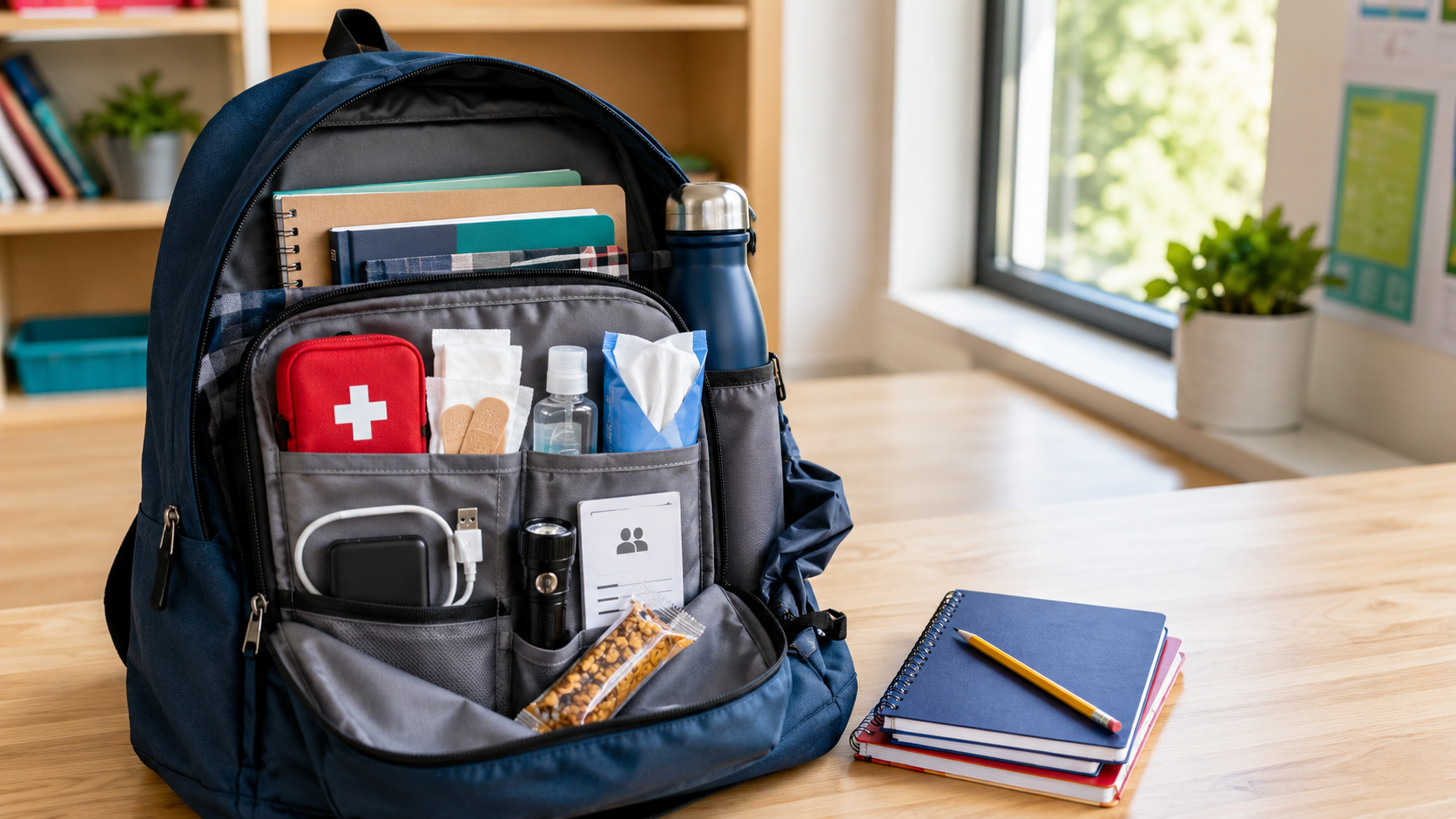
A school emergency kit does not need to be bulky or scary. A few small, practical items in a backpack can help kids feel safer and more prepared during unexpected situations.

Preparedness does not have to feel dramatic
A school backpack is already doing a lot.
It carries books, folders, snacks, water bottles, mystery crumbs, half-used pencils, permission slips that somehow become urgent at 7:42 a.m., and maybe one hoodie that never comes home when it should.
So when people talk about adding emergency supplies to a school bag, it can sound like one more thing. Another list. Another responsibility. Another reason the backpack feels like it weighs as much as a small appliance.
But a school emergency kit does not have to be big or intense.
The point is not to turn a child’s backpack into a survival bunker. It is simply to add a few useful items that can help during ordinary disruptions and rare emergencies: a delayed bus, a power outage, bad weather, a lockdown, a long wait after school, a minor scrape, a forgotten lunch, or a situation where reaching a parent takes longer than usual.
A good backpack kit is small, light, age-appropriate, and realistic. If it is too bulky, it will get removed. If it is too complicated, nobody will use it. If it feels scary, it may create more anxiety than comfort.
The best version is boring in the nicest way: practical, simple, and quietly helpful.
Start with the school rules
Before packing anything, check the school’s policies.
This matters more than people think. Some items that sound useful at home may not be allowed at school. Medications, pocket tools, certain sprays, sharp objects, and even some personal care items may be restricted.
Schools also have different rules about phones, food, allergy-sensitive classrooms, and emergency supplies. A small kit is only helpful if it does not cause trouble for the student.
For younger children, parents may need to coordinate with the teacher or school nurse. For older students, it is still worth asking what is allowed, especially if the kit includes medical items or personal safety supplies.
Preparedness works best when it fits the setting. A school backpack is not a camping bag. It has to live inside a school day.
A small water bottle
Water is one of the simplest items to overlook because many students already carry it. Still, it deserves a place on the list.
A small refillable water bottle can help if a student gets stuck at school longer than expected, waits outside during dismissal, or deals with a hot day. It does not need to be huge. In fact, a giant bottle may make the backpack too heavy and become annoying enough that the student stops carrying it.
For younger kids, choose something they can open and close without help. For older students, the main issue is usually remembering to refill it.
If the school allows it, keeping the bottle in an outside pocket makes sense. Nobody wants a loose bottle leaking onto homework. That is a disaster too, just a quieter one.
A shelf-stable snack
A small snack can make a surprisingly big difference.
Hunger makes everything harder. Waiting feels longer. Emotions get bigger. Concentration drops. A child who was coping at 2:30 may be completely done by 4:00 if lunch was small, dismissal is delayed, or practice runs late.
A backpack emergency snack should be shelf-stable, sealed, and not too messy. Think granola bar, nut-free protein bar if allergies are a concern, crackers, dried fruit, or another school-safe option.
Avoid anything that melts easily, leaks, smells strong, or turns into crumbs if you look at it too sternly.
Also, check expiration dates now and then. Backpack snacks have a way of becoming ancient. A snack from last September is not preparedness. It is archaeology.
For students with allergies, diabetes, or other medical needs, the snack plan should follow guidance from the family and healthcare provider, and the school should know what is needed.
Emergency contact card
Phones are useful, but they are not perfect.
They can die. They can be forgotten. They can lose service. A younger child may not remember a phone number under stress. Even teenagers who know everything can suddenly blank when they are upset.
A simple emergency contact card is worth packing.
It can include:
Parent or guardian names and phone numbers
A backup trusted adult
Home address, if appropriate
Important medical information, if needed
Allergies
Doctor or clinic information, if the family wants to include it
For privacy, do not put highly sensitive details in large print on the outside of the bag. A small card tucked into a zippered pocket is better.
You can laminate it, put it in a small plastic sleeve, or simply write it on an index card and replace it when it gets worn out. The goal is not perfection. The goal is making sure important information exists somewhere besides a phone.
A tiny first-aid pouch
A school nurse handles many medical situations, and students should follow school procedures. Still, a very small first-aid pouch can help with little moments, especially during after-school activities or commuting.
Keep it basic.
A few adhesive bandages, a small packet of gauze, and maybe alcohol-free cleansing wipes if allowed by the school. That may be enough.
Do not pack medications unless the school allows it and the proper forms are completed. This includes pain relievers, allergy medicine, inhalers, and anything prescription. Medication rules are there for safety, even when they feel inconvenient.
For younger kids, first-aid items may be better kept with a teacher or nurse rather than in the backpack. For older students, a tiny pouch can be useful, especially if they commute, play sports, or stay after school.
The key word is tiny. If the pouch grows into a full medical kit, it will either get heavy or become a mess.
A small pack of tissues and wipes
Tissues are not glamorous, but they are useful.
Runny nose, spilled drink, dusty desk, unexpected tears, no toilet paper in a restroom stall — tissues handle more tiny emergencies than they get credit for.
A small pack of wet wipes or hand wipes can also be helpful, especially before eating, after outdoor activities, or when a student ends up touching something questionable. School life contains many questionable surfaces. That is just reality.
If wipes are not allowed or the student has sensitive skin, skip them. A small hand sanitizer may be useful too, but again, check school rules and age appropriateness.
For younger kids, anything liquid can become a toy, a science experiment, or a sticky backpack problem. Choose carefully.
A flashlight or small keychain light
A tiny flashlight or keychain light can be useful during a power outage, a late bus ride, a walk home in dim weather, or simply looking inside a backpack that has apparently become a black hole.
This does not need to be tactical, huge, or dramatic. A small LED light is enough.
Check the batteries occasionally. A dead flashlight is just backpack decoration.
For younger students, attach the light to an inside zipper or small pouch so it does not get lost. For older students, a keychain light can go on a house key, backpack loop, or pencil pouch.
Some schools may have rules about keychain items, so keep it simple and non-distracting.
A portable phone charger for older students
For middle school, high school, or college students who carry phones, a small portable charger can be genuinely useful.
During normal days, it helps if the phone battery runs low after school. During an unexpected delay, weather problem, transportation issue, or emergency, it can help a student stay reachable.
The charger should be charged. That sounds obvious, but many portable chargers live their lives at 3% battery, full of good intentions and no usefulness.
A short charging cable should stay with it. Wrap the cable neatly or keep it in a small pouch so it does not become tangled with pencils and snack wrappers.
For younger children who do not carry phones, this item may not be needed. For schools with strict phone policies, students should still follow the rules. The charger is for communication when allowed and necessary, not for secretly extending game time in math class.
A weather layer
Weather can change quickly, and school days are not always kind to clothing choices.
A lightweight poncho, compact rain jacket, or small foldable layer can help if a student walks, bikes, waits outside, or takes the bus. In colder seasons, gloves or a warm hat may matter more.
Do not pack a full second wardrobe unless there is a specific need. Backpacks are heavy enough already.
For younger kids, a spare pair of socks can be a quiet hero. Wet socks after recess, rain, snow, or a spilled water bottle can make the rest of the day miserable. Socks are light and easy to tuck into a plastic bag.
For older students, a packable layer is more realistic than expecting them to carry a bulky coat “just in case.” Teenagers have strong feelings about coats. History has shown this.
A small amount of cash
If the student is old enough to handle it responsibly and the school allows it, a small amount of cash can be helpful.
Not a lot. Maybe a few dollars.
It can help with an unexpected bus fare, a forgotten lunch situation, a vending machine in a pinch, or a phone call in places where that is still possible. Cash is less central than it used to be, but when digital payments fail or a student’s phone dies, a little cash can still matter.
Keep it hidden in a small envelope or card sleeve, not loose in the main pocket.
For younger kids, this may not be appropriate. A better option might be arranging emergency lunch credit through the school or making sure the office has parent contact information.
A printed mini plan
A backpack kit works better when the student knows what to do.
A small printed plan can help, especially for younger children or students who get anxious under pressure.
It might say:
If school ends early, wait at the office unless told otherwise.
If you cannot reach Mom or Dad, call Grandma.
If the bus does not come, go back inside and ask the office for help.
If you feel unsafe, find a teacher, staff member, or police officer.
If your phone dies, use the contact card in your backpack.
Keep the language calm and clear. This is not the place for scary scenarios. Children do not need a disaster movie script in their backpack.
For teens, the plan can be more practical: meeting place, backup ride options, emergency contacts, and what to do if transportation changes.
A plan reduces guessing. Guessing is hard when someone is scared, tired, or separated from their usual routine.
Personal hygiene items
A few hygiene items can make a long or disrupted school day much easier.
Depending on the student’s age and needs, consider:
A small pack of tissues
Hand wipes
A spare mask, if the student uses one
Lip balm
Menstrual products
A travel-size deodorant for older students
A hair tie
Menstrual products deserve special mention. Even students who are usually regular can be caught off guard, and having supplies in a backpack can save a lot of stress. It is also kind to have an extra for a friend.
Keep hygiene items in a small pouch so they are private and easy to find. Nobody wants to dig through a backpack in the hallway while pretending everything is fine.
Any required medical information or supplies
Some students have specific needs that should be handled with the school: asthma, severe allergies, diabetes, seizures, heart conditions, or other medical concerns.
For these students, the backpack kit may need to include emergency information or approved supplies, but this should be coordinated carefully.
An inhaler, epinephrine auto-injector, glucose tablets, or other medical item may require school forms, storage rules, and staff awareness. Parents should work with the school nurse or administration so the student is not left managing something alone without support.
The backpack can be part of the plan. It should not be the entire plan.
Comfort items for younger kids
Preparedness is not only about practical tools. Sometimes comfort matters too.
For younger children, a small comfort item can help during stressful moments: a family photo, a tiny note from a parent, a small soft keychain, or a card that says, “You are safe. Ask a grown-up for help.”
Keep it small and not distracting. The goal is reassurance, not something that becomes a classroom toy.
A familiar object can help a child feel grounded if routines change suddenly. It is a small thing, but small things are sometimes exactly what a child can hold onto.
Do not overpack the bag
This is where good intentions can get out of hand.
Once you start thinking about emergencies, the list can grow fast. Extra food. Extra clothes. Tools. Blankets. Water. More water. A radio. A poncho. A complete first-aid kit. Three kinds of tape. Suddenly the child is carrying a weekend camping load to third period.
That is not helpful.
A school backpack kit should stay light. Students already carry too much. Heavy backpacks can be uncomfortable, and if the emergency pouch is annoying, it may get removed and left at home.
Think small and useful.
A snack. Water. Contact card. Tiny first-aid items. Tissues. Weather item. Phone charger for older students. Maybe a little cash. That is a strong start.
You can keep larger supplies at home, in the car, or in a family emergency kit. The school backpack only needs to cover what a student might reasonably use during the day.
Review the kit a few times a year
Emergency items are not “pack once and forget forever” items.
Snacks expire. Phone numbers change. Bandages get used. Wipes dry out. Batteries die. Kids outgrow clothing. A charger disappears into the household cable ecosystem and is never seen again.
Check the backpack kit at the start of the school year, after winter break, and before summer weather gets intense. That is enough for most families.
Make it quick. Pull out the pouch, replace old snacks, check the contact card, charge the power bank, and make sure the student still knows what is inside.
For younger kids, review it together. Ask, “Where is your contact card?” or “What would you do if the bus was late?” Keep it calm and matter-of-fact. Preparedness should feel like learning where the spare key is, not like preparing for constant danger.
Let the student help choose the kit
A student is more likely to use a kit they understand.
Let them help choose the pouch, snack, flashlight, or comfort item. Let older students decide where the kit fits best in their bag. Ask what situations actually happen in their school day.
You may discover practical details you would not have guessed. Maybe their locker is far away. Maybe their bus is often late. Maybe the classroom gets cold. Maybe they already carry a charger but never have a cable. Maybe they would be embarrassed by a bright red “emergency kit” pouch but fine with a plain pencil case.
The kit should fit the student, not just the parent’s imagination of the student.
A calm kind of preparation
Putting emergency items in a school backpack is not about expecting the worst every day.
It is about making small problems easier to handle and giving students a little support when routines break.
A snack can soften a long wait. A contact card can help when a phone dies. A flashlight can make a power outage less stressful. A spare pad, wipe, or pair of socks can save a student from an uncomfortable afternoon. A simple plan can help a child know who to ask and where to go.
None of these items are dramatic. That is the point.
Preparedness does not have to be loud. It can be a small pouch in a backpack, checked every few months, mostly forgotten until the day it quietly helps.
And honestly, that is the best kind of emergency item: not scary, not heavy, not complicated — just useful when life does something inconvenient.

Hi, I’m the creator and editor behind ZestyHabit. I research everyday safety, first aid, and practical wellness topics using official guidance and reliable public sources, then turn that information into clear, realistic steps for daily life.
My goal is to help readers make safer, better-informed choices at home and beyond.


