The Small Battery Leak You Shouldn’t Wipe Up With Bare Hands
Minjin Park
·
Battery leaks can look harmless, but the crusty residue can irritate skin, damage devices, and spread around your home if cleaned carelessly. Here’s why you should handle leaking batteries with more caution.
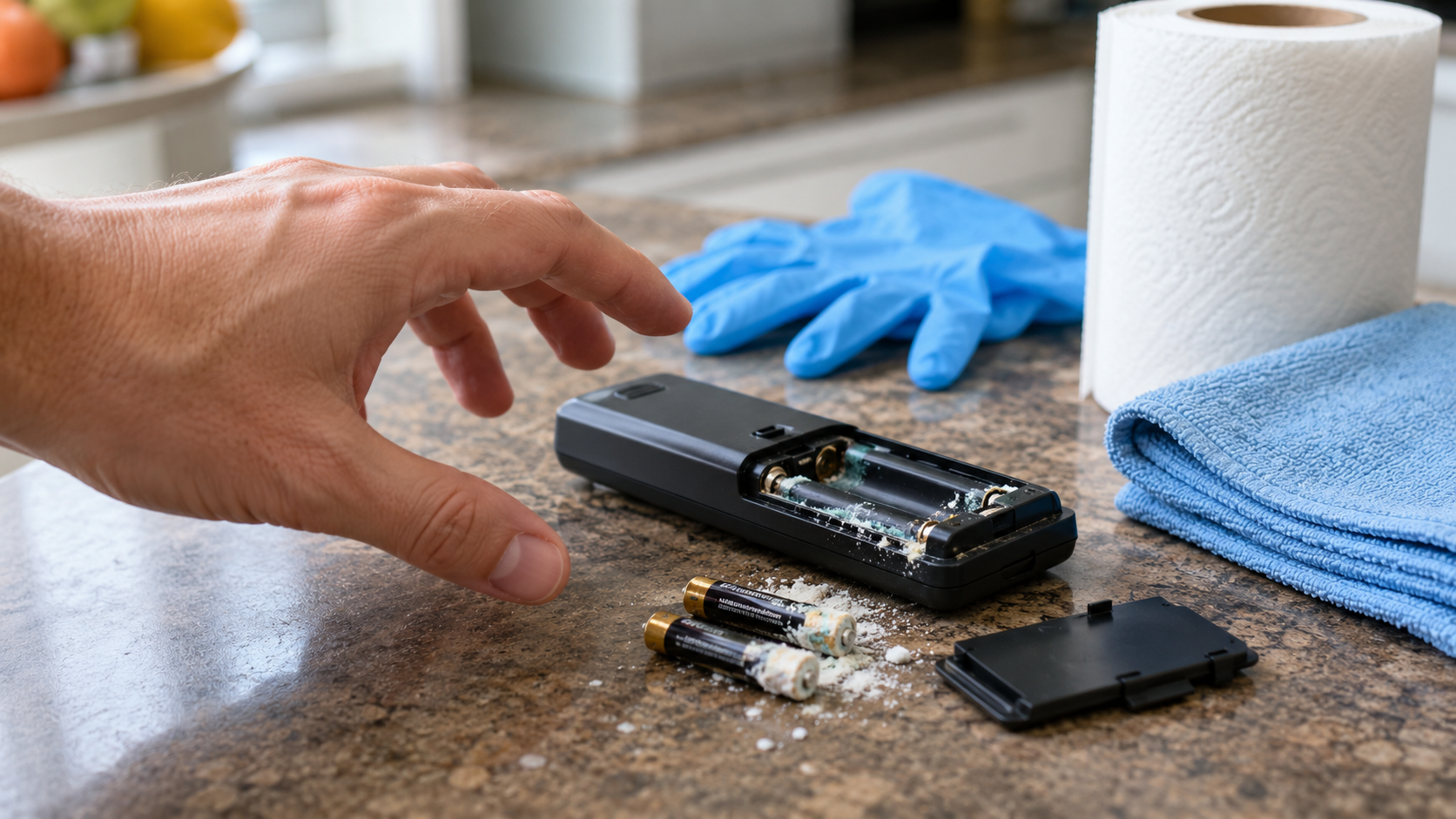
You open the back of a TV remote, flashlight, wall clock, toy, or old computer mouse, and there it is: a little crusty mess around the battery. Maybe it looks like dried salt. Maybe it has a bluish or greenish tint. Sometimes it looks almost powdery, like something you could just tap into the trash.
And because it seems small, the instinct is simple: pick up the battery, wipe the compartment with a tissue, maybe scrape it with your fingernail, and move on.
That casual reaction is exactly the problem.
Battery leakage does not usually look dramatic. It is not bubbling like a movie chemical spill. It is not smoking. It does not always smell strong. But the residue from a leaking battery can be irritating, corrosive, and surprisingly easy to spread. Touching it with bare hands is one of those everyday habits that feels harmless until your skin starts stinging, your eyes itch because you rubbed them later, or your device stops working for good.
This is not about panicking over every battery in the house. It is about treating battery leaks like what they are: a small chemical mess that deserves basic caution.
Why Batteries Leak in the First Place
Batteries are easy to forget because they do their job quietly. We put them into a remote or a toy, use the item for a while, and then leave it in a drawer for months. Sometimes years.
Over time, batteries can degrade. The casing may weaken. Internal pressure can build. Heat, moisture, age, cheap batteries, mixing old and new batteries, or leaving dead batteries inside a device can all raise the chance of leakage.
This is especially common in things we do not use every day.
Think about emergency flashlights, seasonal decorations, old game controllers, wireless keyboards in storage, or a toy that got pushed to the back of a closet. The batteries sit there long after they are drained. Eventually, they may leak into the battery compartment.
The frustrating part is that the device may have been perfectly fine when you put it away. Then one day you open it and find the battery ends crusted over, the springs corroded, and the plastic stained.
It feels like a small nuisance. But the mess is not just “battery dust.”
What Battery Leakage Actually Is
The residue depends on the type of battery, but common household alkaline batteries often leak potassium hydroxide. That substance is alkaline, not acidic, but “alkaline” does not mean gentle. It can irritate or burn skin and eyes, especially if it is concentrated or left sitting on the skin.
This is where the phrase “battery acid” can be a little misleading. People often call any battery leak “battery acid,” but many everyday AA or AAA leaks are from alkaline batteries. Either way, the practical point is the same: do not touch it casually.
Leaked material can cause redness, itching, irritation, or a burning feeling. If it gets into your eyes, it can be more serious. And because the residue is often dry or powdery by the time you notice it, it can transfer more easily than you might expect.
You touch the battery. Then you touch the drawer handle. Then your phone. Then your face.
That is the part most people do not think about. The leak may be small, but your hands are very good at moving small things around.
The “I’ll Just Wipe It Quickly” Habit
The risky habit is not usually some dramatic mistake. It is the quick, lazy cleanup.
You see the leak and think, “I’ll just get this out.”
So you pull the battery out with your fingers. A bit of white residue gets on your thumb. You wipe it on a tissue. Maybe you rinse your hands later, maybe not. If the battery is stuck, you might scrape around it with a nail or a kitchen knife. If the compartment looks dirty, you blow into it.
Please do not blow into it.
That can send tiny particles into the air, toward your face, or onto nearby surfaces. It is such a normal instinct, especially with dusty electronics, but with battery leakage it is a bad one.
The same goes for using your bare fingernail to scrape residue off the spring. It may work, but now the residue is under your nail, which is exactly the kind of thing you forget about until you rub your eye or eat a snack.
Real life is messy. Nobody wants to put on a full science-lab setup to clean a remote. But gloves, ventilation, and a careful cleanup take very little effort compared with dealing with irritated skin or ruined electronics.
Skin Irritation Can Sneak Up on You
Some people notice irritation right away. Others do not.
You might touch a leaking battery, feel nothing, toss it out, and only later notice that one fingertip feels dry, itchy, or tender. If the residue sits on your skin, especially in tiny cuts or around your nails, it can cause more irritation than you expected.
It is easy to dismiss because the amount looks tiny. But chemical irritation does not always need a big dramatic splash. A small amount in the wrong place can be enough.
And the eyes are the real concern. Many of us touch our faces constantly without noticing. A little residue on the fingers, then a quick eye rub, can turn a small cleanup into a much more uncomfortable situation.
If battery residue gets on your skin, wash the area well with running water. If it gets into your eyes, rinse carefully with water and seek medical advice, especially if pain, redness, or blurred vision continues.
That may sound serious for something as boring as a leaky remote, but that is exactly why people get caught off guard. The boring stuff is what we handle carelessly.
It Can Damage More Than the Battery Compartment
Leaking batteries can ruin devices, but the damage is not always limited to the obvious crusty spot.
The residue can corrode metal contacts, springs, and small internal parts. If it spreads deeper into the device, cleaning the visible area may not be enough. A remote might work for a week and then fail. A flashlight may flicker. A toy may stop responding even after fresh batteries are installed.
Sometimes the device is salvageable. Sometimes it is not worth the effort.
The sooner you catch the leak, the better. If the battery has only leaked around the contact, careful cleaning may restore the connection. If the residue has spread into the circuitry, the device may be done.
This is another reason not to treat the leak as a simple dust problem. Scraping aggressively, using too much liquid, or shaking the device can push residue farther inside.
A gentle cleanup is better than a heroic one.
How to Clean a Leaking Household Battery Safely
You do not need fancy equipment for most small household battery leaks, but you do need to slow down a little.
Start by putting on disposable gloves if you have them. Nitrile or rubber gloves are fine for a small cleanup. If you do not have gloves, use a plastic bag or paper towel as a barrier, then wash your hands thoroughly afterward. Gloves are better, though. They are cheap, and this is exactly the kind of annoying little job they are made for.
Work in a ventilated area. You do not need to run outside, but do not hover over the compartment and breathe in the dust.
Remove the batteries carefully. If they are stuck, do not pry so hard that the battery ruptures further. Use something disposable or easy to clean, and keep your face away from the compartment.
Put the leaking batteries in a small plastic bag or container so the residue does not spread in the trash area. Then check your local rules for battery disposal. Some places allow alkaline batteries in household trash, while others prefer or require recycling. Rechargeable batteries should be handled through proper recycling programs.
For the device, use cotton swabs or a disposable cloth to remove loose residue. Avoid blowing into the compartment. If you need to clean contacts, a small amount of vinegar or lemon juice on a cotton swab is often used for alkaline battery residue because mild acid can help neutralize alkaline leakage. Do not soak the device. You are cleaning the contact area, not giving the remote a bath.
After that, wipe with a slightly damp swab or cloth, then let the compartment dry completely before inserting new batteries.
If the device still smells strange, has residue deep inside, or shows heavy corrosion, it may be safer to replace it.
Do Not Mix Cleaning Chemicals
This is worth saying plainly: do not start mixing random household cleaners.
A battery leak is not the moment to spray bleach, ammonia, bathroom cleaner, alcohol, and whatever else happens to be under the sink. That can create new hazards and may damage the device even more.
For a small alkaline battery leak, careful removal, mild neutralizing with a tiny amount of vinegar or lemon juice, wiping, and drying is usually enough. For other battery types, especially lithium-ion batteries, swollen batteries, or anything hot, smoking, hissing, or damaged, do not treat it like a normal cleanup. Move away from it, avoid touching it, and follow proper safety guidance for disposal or emergency handling.
The little AA battery in a remote is one thing. A swollen phone battery or leaking power bank is another.
When You Should Throw the Device Away
I know the urge to save things. I have absolutely spent too much time trying to rescue a cheap remote because it felt wasteful to toss it.
But sometimes the practical answer is to let it go.
If the battery compartment is heavily corroded, the springs are brittle, or the residue has spread inside the device, cleaning may not be worth it. The same is true if the item is a child’s toy and you are not confident you can remove all residue safely. Children put hands in mouths, touch everything, and generally make “probably clean enough” a poor standard.
Also be cautious with anything used near food, bedding, or skin. A leaking battery in a kitchen scale, toothbrush timer, small beauty device, or medical gadget deserves extra attention. If the leak reached parts you cannot clean, replacement may be the safer choice.
The easiest battery leak to clean is the one that never happens.
If you have devices you rarely use, remove the batteries before storing them. This includes holiday lights, camping gear, emergency radios, spare flashlights, old toys, label makers, and remote controls you only use once in a while.
Store batteries in a cool, dry place. Keep them in their original packaging if possible, or arrange them so the terminals are not touching loose metal objects. Do not toss loose batteries into a junk drawer with coins, keys, screws, and paper clips. That drawer may already be chaotic enough without adding battery risk to the mix.
Try not to mix old and new batteries in the same device. Also avoid mixing brands or battery types when you can. It may seem harmless, but uneven discharge can increase the chance of problems.
And when a device starts getting weak, replace the batteries rather than leaving them inside until they are fully dead and forgotten.
That last part is the one that gets people. A remote starts acting sluggish, so you press the buttons harder for two months. Then you stop using it. Then it sits. Then it leaks.
Check the Forgotten Devices Once in a While
Most battery leaks happen in things that disappear from your daily routine.
A good habit is to check battery-powered items a couple of times a year. It does not have to be a big project. Pick one boring day and open the battery compartments on things you rarely touch.
Flashlights. Wall clocks. Remote controls in the guest room. Kids’ toys. Digital thermometers. Old gaming controllers. Seasonal decorations.
If the batteries look swollen, crusty, wet, discolored, or stuck, treat them carefully. If everything looks clean, great. Either replace weak batteries or remove them if the item is going back into storage.
This is one of those household habits that takes ten minutes and saves future annoyance. Not exciting, but very useful.
Teach Kids Not to Touch Leaking Batteries
Children are naturally curious, and battery compartments are often in toys, remotes, and small gadgets they use all the time. If a toy stops working, a child may open the back, see the crusty stuff, and touch it.
It is worth giving a simple rule: if a battery looks dirty, crusty, wet, swollen, or weird, do not touch it. Bring it to an adult.
No scary speech needed. Just make it normal.
The same goes for pets, honestly. A leaking battery that falls out of a toy or remote should not be left on the floor. Dogs especially have a talent for investigating exactly the thing they should not chew.
What to Do If You Already Touched It
Do not panic.
Wash your hands thoroughly with running water and soap. Pay attention to fingertips, under nails, and any small cuts. Remove rings if residue may have gotten under them. If your skin feels irritated, keep rinsing and avoid applying random creams until the residue is gone.
If you touched your face or eyes after handling the leak, rinse carefully. Eye exposure deserves more caution. If irritation continues, get medical help.
Also wipe down anything you may have touched during the cleanup: the table, drawer handle, trash can lid, or tools you used. It feels a little fussy, but it prevents the residue from traveling around the house.
Then dispose of the batteries properly and wash your hands again.
A Small Mess, But Not a Bare-Hand Job
Battery leaks are easy to treat casually because they usually look small and dry. That is what makes them sneaky. The crusty residue does not announce itself as a chemical irritant. It just sits there in the remote, waiting for someone to scrape it out with a fingernail.
A better habit is simple: pause, put on gloves, avoid blowing the dust around, clean gently, and wash up afterward.
You do not need to be afraid of every battery in your home. Just give leaking batteries the same respect you would give any small household chemical mess. A little caution keeps the cleanup boring, which is exactly what you want.
Hi, I’m the creator and editor behind ZestyHabit. I research everyday safety, first aid, and practical wellness topics using official guidance and reliable public sources, then turn that information into clear, realistic steps for daily life.
My goal is to help readers make safer, better-informed choices at home and beyond.



[…] droppings should still be disinfected before removal. Do not pick them up with bare hands, crush them, or test their age by touching […]