
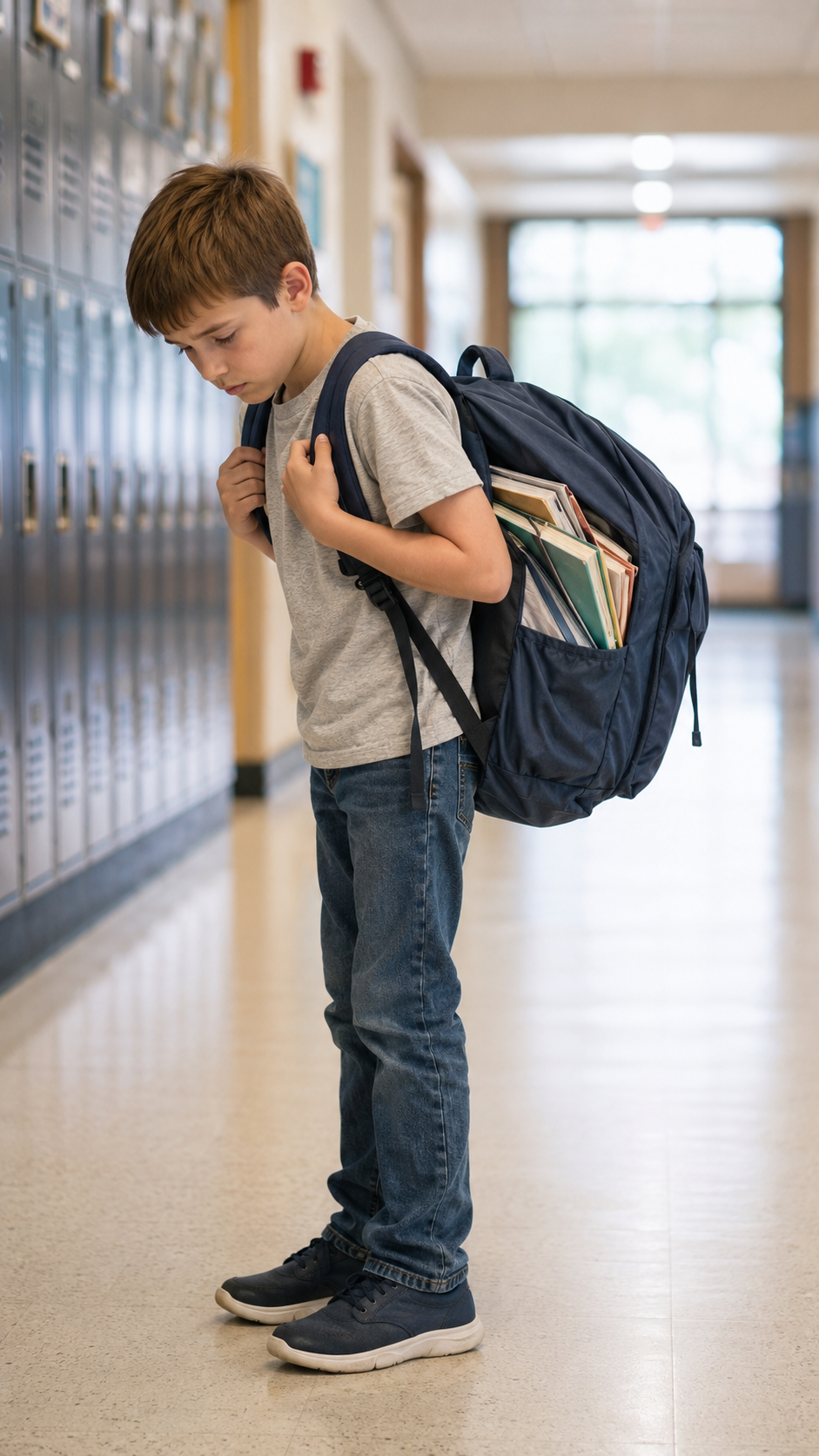

A child’s backpack may look harmless when it is sitting by the front door. Once it is filled with textbooks, notebooks, a laptop, lunch, a water bottle, sports equipment, and a few forgotten items from last week, however, it can become surprisingly heavy.
An overloaded school backpack may contribute to shoulder, neck, and back discomfort. It can also change the way a child stands and walks, make stairs more difficult, and increase the chance of losing balance in a crowded hallway.
So, how heavy should a child’s backpack be? The American Academy of Pediatrics recommends that a fully loaded backpack weigh no more than 15% of the child’s body weight. Many clinicians and safety organizations use a more conservative target of approximately 10%, especially for younger children, children who walk long distances, or anyone experiencing discomfort.
The practical answer is to aim for 10% whenever possible and treat 15% as an upper limit—not a daily goal.
The Recommended Backpack Weight Limit
The American Academy of Pediatrics states that a child’s backpack should not weigh more than 15% of their body weight. For example, a child weighing 100 pounds should not carry a backpack heavier than 15 pounds.
The Pediatric Orthopaedic Society of North America offers the same 15% upper limit while emphasizing that parents should minimize unnecessary weight whenever possible.
Because recommendations sometimes range from 10% to 15%, parents may wonder which number to follow. A useful approach is:
- Around 10%: A sensible everyday target
- 10% to 15%: A range that may be acceptable if the bag fits correctly and causes no symptoms
- More than 15%: Generally too heavy and should be reduced
The percentage is only a starting point. A child’s age, size, strength, health, walking distance, stair use, and the amount of time spent carrying the bag also matter. A load that feels manageable for two minutes may become uncomfortable during a 20-minute walk to school.
School Backpack Weight Chart
To calculate the recommended backpack weight, multiply the child’s body weight by 0.10 for a conservative target or 0.15 for the upper limit.
| Child’s weight | 10% target | 15% upper limit |
|---|---|---|
| 40 lb (18 kg) | 4 lb (1.8 kg) | 6 lb (2.7 kg) |
| 50 lb (23 kg) | 5 lb (2.3 kg) | 7.5 lb (3.4 kg) |
| 60 lb (27 kg) | 6 lb (2.7 kg) | 9 lb (4.1 kg) |
| 80 lb (36 kg) | 8 lb (3.6 kg) | 12 lb (5.4 kg) |
| 100 lb (45 kg) | 10 lb (4.5 kg) | 15 lb (6.8 kg) |
| 120 lb (54 kg) | 12 lb (5.4 kg) | 18 lb (8.2 kg) |
These figures include everything inside and attached to the bag. The backpack itself, laptop, water bottle, lunch container, pencil case, and clothing all count toward the total.
A large insulated water bottle can add several pounds when full. The empty weight of a fashionable backpack may also be higher than expected because of thick decorations, metal hardware, rigid panels, and multiple accessories.
How to Weigh a Child’s Backpack
You do not need specialized equipment. A regular bathroom scale or luggage scale is enough.
First, weigh the backpack after it has been packed for a typical school day. If using a bathroom scale, weigh the child without the backpack and then again while wearing it. Subtract the first number from the second.
Next, divide the backpack’s weight by the child’s body weight and multiply by 100.
For example:
- Child’s weight: 70 pounds
- Backpack weight: 9 pounds
- Calculation: 9 ÷ 70 × 100
- Backpack percentage: approximately 12.9%
This bag is below the AAP’s 15% upper limit but above the more conservative 10% target. If the child has no discomfort and carries it only briefly, it may be manageable. If the child walks a long distance, climbs several flights of stairs, or leans forward while carrying it, removing some weight would be wise.
Weigh the backpack on more than one day. Monday’s bag may be light, while another day may include library books, sports clothing, a musical instrument, or a large project.
Why an Overloaded Backpack Can Be a Problem
A backpack changes how weight is distributed around the body. When the load pulls backward, a child may compensate by leaning forward, rounding the shoulders, or extending the neck.
A heavy or poorly fitted backpack can strain muscles and joints, particularly when it is carried on one shoulder. Children may experience soreness around the neck, shoulders, upper back, or lower back. Narrow straps may also press into the shoulders and contribute to temporary tingling or numbness.
The American Academy of Orthopaedic Surgeons explains that backpacks worn incorrectly may contribute to muscle and joint pain. However, it is equally important not to exaggerate the risk: heavy backpacks have not been shown to cause scoliosis.
Scoliosis is a sideways curvature of the spine, not the result of carrying school supplies. Changing a backpack will not create, cure, or correct a scoliosis curve. A heavy bag can still be uncomfortable for a child who has scoliosis, but it is not considered the cause of the condition.
Signs That a Backpack Is Too Heavy
The number on the scale is helpful, but the child’s movement and symptoms provide additional information.
Look for these warning signs:
- Leaning noticeably forward
- Arching the back or twisting to one side
- Struggling to lift the backpack
- Needing help to put it on
- Walking differently while wearing it
- Frequently adjusting the straps
- Complaining of back, shoulder, or neck pain
- Numbness or tingling in the arms or hands
- Red marks where the straps press into the shoulders
- Losing balance or having difficulty on stairs
- Feeling unusually tired after carrying the bag
A backpack is probably too heavy if it changes the child’s normal posture or walking pattern. The AAP specifically advises reducing the load when a child must lean forward to support it.
Ask children directly how the backpack feels. Some children may assume discomfort is normal or avoid mentioning it because they do not want to carry a less fashionable bag.
How to Choose the Right Backpack
A good backpack does not need to be expensive, but it should fit the child rather than simply offering the most storage space.
Choose the correct size
Bigger is not necessarily better. A large backpack is easy to overfill and may hang too low on a smaller child.
The bag should be proportional to the child’s torso. According to AAP guidance, it should sit in the middle of the back, with the bottom near the curve of the lower back. It should not hang more than four inches below the waistline.
A preschooler should not be carrying a backpack designed for a teenager, even if the shoulder straps can be shortened.
Look for two wide, padded straps
Two adjustable shoulder straps distribute the weight more evenly. Thin straps may dig into the shoulders, while carrying the bag on one side concentrates the load on one area.
Extra-thick padding does not automatically make a backpack safer, but the straps should be comfortable, broad, and adjustable enough to keep the load close to the body.
Consider a chest strap or waist belt
A chest strap helps prevent the shoulder straps from slipping outward. A waist belt can keep the bag closer to the body and transfer some of the movement away from the shoulders.
These features are most useful when they are actually fastened. Teach the child how to adjust and use them correctly.
Choose a lightweight design
The backpack’s empty weight matters. A bag with a heavy frame, thick molded decorations, chains, metal accessories, or unnecessary compartments may consume part of the safe weight allowance before anything is packed.
If two bags offer similar support and durability, choose the lighter one.
Look for a padded back and compartments
A padded back can improve comfort and prevent the edges of books, rulers, and other objects from pressing into the child.
Multiple compartments help organize supplies and distribute them more evenly. They do not make an overloaded bag safe, but they can prevent everything from collecting in one unstable section.
How to Pack a School Backpack Correctly
Where the weight sits matters almost as much as the total weight.
Place the heaviest items, such as textbooks, binders, and laptops, close to the child’s back. This keeps the load nearer the body’s center of gravity and reduces the backward pulling effect.
Place lighter items toward the front of the bag. Balance the contents between the left and right sides instead of filling one side pocket with several heavy objects.
Use compartments to prevent books and devices from shifting while the child walks. A load that swings from side to side can be tiring and may affect balance.
Remove unnecessary items at least once a week. Backpacks often accumulate old worksheets, toys, extra stationery, food containers, library books, and other objects that gradually add weight.
Check whether the child truly needs to carry a full water bottle from home. If safe drinking water is available at school, a smaller bottle may reduce the load. Sports equipment can sometimes be carried separately and stored in a locker.
The Correct Way to Wear a Backpack
Even a lightweight backpack can cause discomfort if it is worn incorrectly.
Children should use both shoulder straps every time. Carrying the backpack over one shoulder may feel convenient, but it creates uneven loading and can strain the muscles on one side.
Tighten the straps so that the backpack sits close to the body. A loose bag that hangs far from the back creates more leverage and may cause the child to lean forward.
The backpack should rest around the middle of the back rather than against the buttocks. Secure the chest or waist strap if the bag includes one.
When lifting the backpack from the floor, children should bend their knees, keep the load close, and stand using their legs. Twisting while lifting a heavy bag can strain the back.
Parents can watch the child put the backpack on and walk around the room. This simple test often reveals poor fit, excessive weight, or straps that need adjustment.
How Schools and Parents Can Reduce the Load
Sometimes the problem cannot be solved by purchasing a different backpack. The child may simply be required to carry too many materials.
Parents can help by checking the timetable each evening and packing only the books needed for the following day. Encourage children to use lockers or classroom storage when available.
Other possible solutions include:
- Keeping a second set of textbooks at home
- Using approved digital textbooks
- Leaving art or sports supplies at school
- Emptying unnecessary papers every week
- Carrying a smaller water bottle
- Separating sports equipment from the school bag
- Asking teachers whether every workbook is needed daily
- Providing enough time between classes to visit a locker
If many students are struggling with excessive loads, parents can raise the issue with teachers or school administrators. The AAOS specifically encourages families to speak with schools about ways to lighten backpack loads.
A child should not have to choose between following school requirements and carrying a reasonable amount of weight.
Are Rolling Backpacks Better?
A rolling backpack may reduce strain because the child pulls the load instead of carrying it on the back. It can be useful for students who must transport heavy books or those who have temporary restrictions after an injury or surgery.
However, rolling bags have drawbacks. They can be difficult to manage on stairs, buses, uneven sidewalks, or in crowded hallways. They may also create a tripping hazard for other students. Some schools restrict them for this reason.
Check the school’s policy before buying one. If a rolling backpack is allowed, choose a model with a handle suited to the child’s height and teach the child not to pull it rapidly through crowds.
Students with medical conditions may be able to request accommodations even when rolling bags are not normally permitted.
When Should a Child See a Doctor?
Backpack discomfort should improve after the bag is removed and the load or fit is corrected. Persistent or severe symptoms should not automatically be blamed on school supplies.
Speak with a pediatrician if the child has:
- Pain that continues without the backpack
- Pain that regularly interrupts sleep or activities
- Weakness, numbness, or persistent tingling
- Pain following a fall or injury
- Difficulty walking
- Pain that spreads into an arm or leg
- Fever, unexplained weight loss, or illness
- A visible change in the back or shoulders
- Symptoms that do not improve after reducing the load
Children with recent surgery, fractures, scoliosis, muscle disorders, or other health conditions may need an individualized backpack limit. Follow their clinician’s advice rather than relying only on a general percentage.
A Simple Weekly Backpack Safety Routine
Choose one day each week to check the school bag together. Remove old papers and unnecessary objects, inspect the straps and zippers, and weigh the fully loaded bag.
Ask the child whether anything hurts while carrying it. Then watch them put it on, adjust both straps, and walk several steps. This short routine can identify a developing problem before discomfort becomes part of the school day.
The ideal backpack is not simply the one that stays below a mathematical limit. It should be light enough for the individual child, fit close to the body, remain balanced, and cause no pain or postural change. Aim for approximately 10% of body weight when possible, keep the load under 15%, and reduce it further whenever the child struggles. How heavy is your child’s school backpack on a typical day, and what strategies has your family used to lighten the load? Share your experience and practical tips in the comments below.

Hi, I’m the creator and editor behind ZestyHabit. I research everyday safety, first aid, and practical wellness topics using official guidance and reliable public sources, then turn that information into clear, realistic steps for daily life.
My goal is to help readers make safer, better-informed choices at home and beyond.


